
Ecommerce SEO Services That Grow DTC Store Revenue
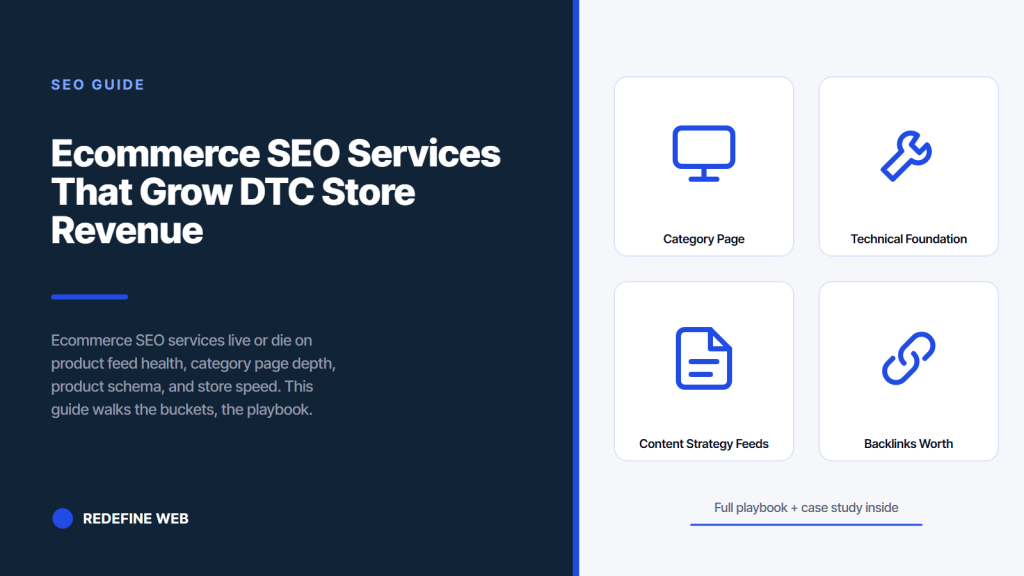
- Feed health, category depth, product schema, speed, and PR are the five buckets.
- Faceted URLs eat crawl budget on 80 percent of stores we audit.
- Product page triage focuses depth on the top 20 percent of SKUs.
- App sprawl on Shopify costs 8 to 14 mobile PageSpeed points.
- Digital PR beats guest posts for real DTC ranking gains.
- Category Page Architecture That Ranks on Head Terms
- Product Page Copy That Ranks and Converts on Store Sites
- Technical Foundation Under a DTC Storefront
- Schema Markup That Wins Rich Results for Stores
- Site Speed and Core Web Vitals for Growing Stores
- Content Strategy That Feeds Ecommerce Rankings
- Backlinks Worth Chasing for DTC Brands
- Measuring Real Revenue From Organic Search
- Comparing In-House and Agency Ecommerce SEO Services
- A 90-Day Playbook for Growing DTC Stores
- Platform-Specific Notes for Shopify and WooCommerce Stores
- Where Ecommerce SEO Services Fit the DTC Marketing Stack
A DTC store with 4,800 SKUs and a Shopify Plus plan wakes up to a Search Console drop of 38 percent, cannot trace it to a Google update, and burns the next six weeks blaming the developer, the theme, and the last agency in that order. The real problem was a feed rewrite that broke canonical tags on 1,200 collection pages, a schema migration that dropped the Product markup on 62 percent of the catalog, and a bulk description edit that stripped every unique product paragraph off the site in the same sprint. Ecommerce SEO services exist because three moving parts on a store can quietly undo two years of ranking work in a single Friday deploy. Teams reviewing this alongside our ecommerce seo audit checklist land on tighter priority stacks faster.
This guide walks the ecommerce SEO services stack Redefine Web runs for DTC brands from six-figure Shopify stores up to nine-figure Shopify Plus and headless catalogs. Five buckets. Product feed health, category architecture, product page copy, technical foundation, and off-site authority. Every bucket ties to a measurable revenue outcome. You get the playbook, the honest retainer math, the mistakes that eat rankings, and the 90-day rhythm we run inside our ecommerce marketing agency engagements.
Category Page Architecture That Ranks on Head Terms
Category pages carry most of the head-term rankings on a store site. A product page ranks for a long-tail like Ambit walnut floor lamp warm brass. A category page ranks for the head term walnut floor lamps, which drives 15 to 40 times the search volume depending on the vertical. Ecommerce SEO services that skip category page architecture leave the biggest ranking prize on the table.
A ranking category page carries four assets most default Shopify or WooCommerce templates skip. A 300 to 600 word intro paragraph above the fold that explains what the category is and what shoppers use it for. A curated sort order controlled by the merchandising team rather than raw sales velocity. A related-category linking block that passes internal link equity to sibling categories. A 500 to 900 word bottom-of-page section covering buying guides, size charts, or care instructions that supports E-E-A-T signals without pushing product below the fold.
Faceted Navigation and Canonical Discipline
Faceted navigation is the technical wound most stores never heal. Filters on color, size, price, brand, and material generate combinatorial URLs that Google indexes by default. A 200-SKU store can produce 80,000 crawlable filter URLs without discipline. The pattern that works. Canonical every faceted URL to the main category. Block deep filter combinations via robots.txt. Serve a single non-indexable version for shoppers to filter within. That combination cuts crawl waste by 60 to 85 percent and concentrates ranking signal on the pages that should carry the head term. Read the Google canonicalization documentation alongside a live crawl to catch the misses on any store audit.
Product Page Copy That Ranks and Converts on Store Sites
Product page copy sits in the middle of an ecommerce SEO retainer. A store with 4,800 SKUs cannot afford 800 words on every page. The right pattern rewrites the top 15 to 20 percent of SKUs at full depth, gives the middle 40 percent a structured 200 to 300 word template, and lets the bottom tier run on a light 60 to 90 word block plus attribute data. That triage keeps the writing cost sane while directing depth toward the products carrying real revenue.
The top-tier product page carries a 250 to 400 word main description written for the shopper rather than the algorithm, an attribute-driven bullet block covering materials and dimensions, a use-case section covering three to five real scenarios, an FAQ block answering the top five shopper questions, and structured data covering Product, Offer, AggregateRating, and Review. That stack takes a copywriter roughly 45 minutes per SKU and moves organic ranking on the long-tail queries within 6 to 10 weeks. Read our take on ecommerce category page SEO best practices for the sibling architecture pattern that pairs with product page depth.
Handling Duplicate Product Descriptions From Suppliers
Distributors and dropship suppliers publish stock descriptions that show up on hundreds of competing stores. A DTC brand running supplier copy verbatim gets classified as duplicate content and never ranks the product page. The rewrite pattern is straightforward. Take the supplier spec sheet, keep the attribute data, rewrite every prose paragraph in the brand voice, add a use-case section the supplier does not cover, and stitch in real customer language from reviews and support tickets. The result reads specifically enough that Google scores it as original content, and the store starts ranking on the long tail within two crawl cycles.
Technical Foundation Under a DTC Storefront
The technical foundation for a store site covers more moving parts than a lead-gen site. Crawl budget matters more because the URL count runs 10 to 200 times larger. Rendering matters more because most storefronts ship JavaScript-heavy templates that hide content from bots. Indexation controls matter more because faceted URLs, tag URLs, and search URLs multiply crawl waste. Every ecommerce SEO services retainer starts with an audit against these gates before content work begins.
The crawl audit runs Screaming Frog or Sitebulb against a fully-rendered version of the site to catch client-side content that raw HTML misses. It flags orphan products, deep URL depth beyond 4 clicks from the homepage, redirect chains, and 404s on internal links. A 4,800-SKU Shopify store with an average URL depth of 5.8 clicks loses roughly a third of its crawl budget to page discovery overhead. Flattening to under 4 clicks through better category linking usually shows within two weeks in Search Console’s coverage report.
Robots.txt and XML Sitemap Discipline
Robots.txt on a store blocks the cart, checkout, account, and admin URLs. It also blocks the deep faceted filter combinations discussed earlier. The XML sitemap includes only canonical product, category, blog, and static pages. Stores that leave the default sitemap in place often expose 30,000 filter URLs to Google that they never intended to index. The Search Console coverage report catches the miss, and a two-hour cleanup usually resolves 80 percent of it. That work is unglamorous, and it produces the largest single-week ranking gain we see on most audits.
40% of DTC ranking loss traces to broken canonicals on collection pages. Crawl your top 200 URLs with Screaming Frog this week. Content work is wasted until they're clean.
Schema Markup That Wins Rich Results for Stores
Schema markup on a store site drives rich results in organic search. Product markup unlocks price and availability display in the blue links. AggregateRating adds star ratings when real review data exists. Offer markup enables shopping-graph inclusion beyond the paid Shopping placement. Breadcrumb markup raises click-through rate by clarifying the site path in SERPs. Missing schema costs conversion, and misfired schema costs manual actions. Read our deeper walkthrough of ecommerce PPC management for DTC brands alongside for the paid media specifics.
The schema audit checks every markup block against Google’s Rich Results Test and against the Schema.org spec. Read Search Engine Land’s ongoing ecommerce SEO coverage for the latest on schema and rich result changes as Google updates the spec. The most common miss on Shopify stores is a Product block with a missing price or availability field on out-of-stock products, which drops rich result eligibility site-wide. The most common miss on WooCommerce is a duplicate JSON-LD block from two competing SEO plugins, which triggers a warning in Search Console and confuses Google about which markup to trust. Fixing either issue usually takes an hour of developer time and shows in the SERP inside two crawl cycles.
Review Schema Without Faking It
Review schema needs real reviews. Stores that fake AggregateRating with hardcoded 5-star markup earn manual actions and lose rich results across the whole catalog. The pattern that works pulls real review data from Yotpo, Judge.me, Okendo, or the native platform, filters for verified purchases, and only marks up SKUs with at least 3 legitimate reviews. That discipline keeps the site inside Google’s structured data guidelines and produces the star rating display on the SKUs where it actually matters for conversion.
Site Speed and Core Web Vitals for Growing Stores
Site speed on a store affects both rankings and revenue. Google uses Core Web Vitals as a ranking factor. Shoppers use load time as a purchase-abandonment signal. Storefronts running heavy Shopify apps, third-party pixels, and un-optimized hero imagery routinely score under 40 on mobile PageSpeed Insights, which loses ranking and revenue at the same time. The fix stack is well-mapped.
Largest Contentful Paint under 2.5 seconds. Interaction to Next Paint under 200 milliseconds. Cumulative Layout Shift under 0.1. On a Shopify store, the wins usually come from removing unused apps that inject JavaScript sitewide, converting hero images to WebP under 120 kilobytes, deferring third-party pixels below the fold, and cutting the theme’s liquid depth on collection pages. A DTC store scoring 32 on mobile PageSpeed can usually reach 78 to 85 within two weeks of focused fixes without a full rebuild.
App Sprawl on Shopify Stores
App sprawl is the specific pattern that eats Shopify store speed. A typical mid-size DTC brand runs 26 to 44 installed apps by the third year of operation. Each app injects JavaScript, CSS, or third-party requests on every page load, whether the app runs on that page or not. The audit lists every app, tags each as required or optional, and disables the optional ones for a 14-day measurement window. Stores routinely drop 900 kilobytes of JavaScript this way and pick up 8 to 14 mobile PageSpeed points without touching a line of code. Founders scoping the strategy layer around a services retainer should pair this piece with our take on the ecommerce seo strategies that separate blog-only agencies from real SEO shops.
Content Strategy That Feeds Ecommerce Rankings
Content strategy on a store site pairs commercial-intent category pages with informational blog content that feeds them internal links and topical authority. A DTC lighting brand ranks the walnut floor lamps category page faster when the blog covers walnut wood care, mid-century lighting history, and warm brass finish maintenance ecommerce website maintenance services, and every one of those articles links back to the category page with descriptive anchor text.
The content cadence that works on most DTC brands sits at 4 to 8 blog posts monthly plus 2 to 4 category page rewrites per quarter. Under 2 posts monthly rarely produces compounding ranking gains. Over 12 monthly usually dilutes topical depth and produces thin content Google Helpful Content penalties eat. Practices that publish at the right cadence for 12 to 18 months own the head-term category rankings and stop paying Meta and Google Ads for demand they could earn organically. Our sibling guide on the ecommerce seo checklist lays out the per-page structural requirements to run alongside cadence.
Buying Guides That Rank and Convert
Buying guides are the content type that produces the biggest revenue gain per hour of writer time on ecommerce sites. A guide titled How to Choose a Walnut Floor Lamp for a Living Room outranks the manufacturer sites, links to the store’s category page in three natural places, and converts at 4 to 7 percent versus a 1 to 2 percent conversion on generic blog content. Write buying guides for the top 10 to 20 categories on the store first. Then walk down to sub-categories. That order concentrates writing time on the pages that drive the most revenue.
Backlinks Worth Chasing for DTC Brands
Backlinks still matter on ecommerce SEO, and the pattern of good links has shifted hard toward earned editorial mentions and away from bulk directory or guest post placements. Google’s link spam classifier catches paid-guest-post patterns within weeks of publication. Editorial links from real publications, product roundups on niche blogs, and mentions in relevant industry newsletters carry the ranking weight worth chasing.
The digital PR pattern that works pairs a real angle with a real publication. A DTC skincare brand pitches a story on ingredient sourcing, not a story asking to be listed in a top-10 skincare roundup. A luxury home decor brand like Abigail Ahern pitches a design trend piece to House Beautiful or ELLE Decoration, not a link exchange with a competitor. The pitches land 4 to 10 percent of the time on cold outreach, higher with existing publication relationships. Every landed placement helps the whole domain, not just the linked page.
Product Roundups Without Paying to Play
Product roundup placements convert at high rates and raise search rankings when the placement is editorial rather than paid. The pitch angle that works. Identify writers at target publications who covered similar categories in the last 90 days, send a specific product sample with a written note tying the product to the writer’s beat, follow up once, and never ask for a link. Writers who like the product write about it. Writers who do not, do not. The conversion rate on real placements runs 12 to 25 percent with this pattern, versus under 3 percent on pay-for-placement pitches that publications increasingly disclose or reject outright.
Measuring Real Revenue From Organic Search
Measurement decides whether an ecommerce SEO retainer continues or gets defunded. Vanity metrics like keyword count and Domain Rating rarely predict revenue outcomes on a store. The metrics that matter track organic revenue, organic conversion rate by landing page type, non-branded organic sessions on category pages, and cost per acquired customer from organic versus paid. Practices that agree on those four upfront save six meetings a year and steer the retainer honestly.
The reporting stack that works pulls organic revenue from GA4 with enhanced ecommerce enabled, ranking data from Ahrefs or Semrush, Search Console data on non-branded queries, and Shopify or WooCommerce revenue splits by traffic source. The Ahrefs guide to ecommerce SEO covers the ranking and traffic side of the stack cleanly, and the GA4 side is where most DTC brands still have measurement holes worth closing before the next quarterly review.
The Five Metrics That Move Budget
- Organic revenue per month from category and product landing pages
- Non-branded organic sessions on the top 20 commercial pages
- Organic conversion rate by landing page type, tracked in GA4
- Cost per acquired customer from organic versus paid channels
- Share of voice on top 50 non-branded queries against 5 named competitors
Monthly reporting works for most DTC brands. Weekly reports invite noise. Bi-annual reports invite drift. Monthly gives the founder or marketing director enough signal to steer the retainer without burying the SEO team in reporting overhead. The report opens with the five metrics above, closes with the fix log from the month, and adds the priority backlog for the next 30 days. Any format tighter than that misses signal. Any format looser than that turns into a slideshow nobody reads.
Comparing In-House and Agency Ecommerce SEO Services
Every DTC brand weighs in-house ecommerce SEO services against agency retainers at least once a year. The comparison below maps the two paths against real cost, real capability, and the specific tasks each path covers well. Every leadership meeting on this topic starts with someone saying we could hire a marketing coordinator and ends with a spreadsheet showing that coordinator would need to be six people with a developer on speed dial. Read the table before the meeting.
| Task | In-house feasibility | Agency feasibility | Note |
|---|---|---|---|
| Merchant Center feed audit | Medium | High | Requires feed-management tooling |
| Product page copy at volume | Medium | High | Agency workflow scales past 500 SKUs |
| Category page architecture | Low | High | Needs merchandising plus SEO input |
| Schema markup builds | Low | High | Requires developer time |
| Core Web Vitals fixes | Low | High | Needs Shopify or WooCommerce specialist |
| Digital PR outreach | Low | High | Depends on publication relationships |
| Faceted navigation cleanup | Low | High | Requires crawl-audit tooling |
| Monthly reporting cadence | High | High | Either path works |
A DTC brand with a marketing coordinator and one developer on staff can carry the bottom row and part of the second row. The remaining six rows usually need a specialist partner, or the work does not happen consistently enough to move rankings. Multi-warehouse brands with international storefronts almost always benefit from an agency because the coordination overhead across markets exceeds what a single hire can carry alone.
The math on cost tells a similar story. An experienced in-house ecommerce SEO hire lands at $95,000 to $135,000 per year fully loaded, before tools, without specialist merchant feed or schema experience baked in. An agency retainer for ecommerce SEO services runs $2,500 to $9,500 per month, which stacks against the same specialist coverage without the hiring risk. Brands that only need the top three rows save money in-house. Brands that need the bottom five rows almost always save money on retainer with a partner.
A 90-Day Playbook for Growing DTC Stores
A 90-day playbook covers audit, quick wins, and content foundation. Month one runs the full audit across the five buckets, identifies the top 30 URLs by revenue potential, and produces a fix map. Month two runs the technical fixes, the schema builds, the Merchant Center feed cleanup, and the app sprawl audit. Month three drafts the ten anchor content pieces, sets up the review-response and PR outreach routine, and installs the monthly reporting template. Brands that stick to the rhythm see first ranking movement inside 60 days.
Month one delivers a written audit covering feed health, category architecture, product page copy, technical foundation, and off-site authority. A prioritized fix map ranks each issue by ranking impact and effort. A page inventory maps the top 30 URLs against revenue and traffic potential. A measurement plan for GA4 enhanced ecommerce plus Search Console non-branded query tracking gets scoped. Nothing goes live yet, but every following month has a clear direction. Brands that skip month one and jump straight to content usually rebuild after six months because the foundation was never scored properly the first time.
Month Two and Three Execution
Month two runs the fixes. Page speed corrections, schema builds, robots and sitemap cleanup, Merchant Center feed rewrites, and app sprawl reduction. Month three drafts the ten anchor pieces of content covering buying guides and category rewrites, installs a real review-request routine, opens digital PR outreach against a target publication list, and locks in the monthly reporting template. By the end of month three the site sits in a materially different technical tier than it did on day one, and the ranking curve starts bending upward on the tracked non-branded queries.
Platform-Specific Notes for Shopify and WooCommerce Stores
Shopify and WooCommerce each carry a distinct set of ecommerce SEO patterns. Shopify locks the URL structure to /products/, /collections/, and /pages/, which limits some SEO plays but simplifies canonicalization at scale. WooCommerce ships flexible URL structures at the cost of complex canonicalization decisions the store owner has to make. A retainer that works on both platforms accounts for those differences upfront rather than applying a Shopify playbook to a WooCommerce store or vice versa.
Shopify’s biggest SEO wins usually come from theme code cleanup, app sprawl reduction, and Merchant Center feed optimization through the Google and YouTube channel. WooCommerce’s biggest wins usually come from plugin consolidation to a single SEO tool, cache and CDN configuration through WP Rocket or LiteSpeed, and Yoast or Rank Math schema audit against real Product markup. Read the sibling piece on shopify vs woocommerce SEO for the full head-to-head on when to pick which platform for an SEO-first build.
Headless Storefronts and SEO
Headless commerce on Shopify Hydrogen, Next Commerce, or a custom stack introduces a different SEO surface. Server-side rendering has to serve fully-rendered HTML for Google to score the content. Client-side rendering alone loses ranking on any product or category page. Meta tags, canonicals, and schema markup have to be injected server-side or through prerendering middleware. The teams that treat headless as a purely front-end decision usually spend the next quarter fixing SEO regressions that a properly-configured monolith would have avoided.
Vertical playbooks such as fashion SEO services for apparel and accessories brands add season keyword planning and PDP variant hygiene on top of the base ecommerce SEO stack.
For pet DTC brands specifically, our guide on the pet industry SEO company covers the species-and-condition silo pattern that ecommerce SEO looks like inside a pet vertical.
Where Ecommerce SEO Services Fit the DTC Marketing Stack
Ecommerce SEO services sit underneath every other DTC customer acquisition channel. Paid search costs less when organic branded search volume is strong. Content marketing compounds when the technical foundation carries the load. Category page rankings pull in the head-term searches that paid ads cannot bid on economically past a certain scale. Reputation management doubles as a ranking signal on Google, Trustpilot, and the AI overview citation graph. Everything reinforces everything else once the five buckets are moving in the same direction across the site.
The proof case worth studying. Abigail Ahern, a luxury home decor brand, restructured SEO and paid media around intent-driven traffic and premium creative across a Shopify Plus stack. The result across the first year was a 179 percent gain in ecommerce revenue and a doubling of the conversion rate on the site. The SEO work carried the category-page depth and buying guides that drove qualified organic traffic, and the paid media stack captured the demand that organic could not economically bid on. Neither channel alone produced the result. The stack together did. For the plain ecommerce marketing definition and how the channels connect, that companion guide covers the full model.
A partner earns their retainer by carrying the specialist work that in-house teams rarely have capacity for. Feed audits with Merchant Center tooling. Schema builds that pass Google’s Rich Results Test. Faceted-navigation cleanup with crawl audit tooling. Content workflows that produce publishable buying guides every month. Digital PR outreach against a target publication list. AI overview optimization for the newest extraction layer. Redefine Web runs this stack for DTC brands across categories. See the ecommerce SEO services hub for how the retainer is scoped.
Start with the audit. Score the top 30 URLs against the five buckets on a spreadsheet. Circle the ten worst misses. Estimate the ranking impact and the effort for each. That map is the next 90 days of ecommerce SEO services work in priority order. Growing brands ready to hand this to a partner can look at our broader SEO service page for the wider program, or talk with our team about scoping the ecommerce-specific engagement that fits a Shopify, WooCommerce, or headless stack. The work compounds when the five buckets move together, and the honest math on retainer versus in-house almost always favors a specialist partner past 500 SKUs. Read the deeper walk on our ecommerce digital marketing strategy guide for how these channels stack under one plan.
Shortlist context for founders picking a partner sits in our top ecommerce marketing agencies ranking, updated with retainer floors and named client outcomes.
Frequently asked questions
What do ecommerce SEO services typically include?
Ecommerce SEO services typically include a Merchant Center feed audit, category page architecture work, product page copy at scale, technical fixes for crawl budget and faceted navigation, schema markup builds for Product and AggregateRating, Core Web Vitals fixes on Shopify or WooCommerce, buying guide content that feeds category pages internal links, digital PR outreach against target publications, and monthly reporting on organic revenue plus non-branded traffic. Retainers scoped below this stack usually cover only content and light on-page work, which rarely moves rankings on stores past 500 SKUs where the technical debt outweighs the content gap.
How much do ecommerce SEO services cost per month?
Ecommerce SEO services run $2,500 to $9,500 per month at a professional agency, depending on catalog size, platform complexity, and scope. Solo DTC brands with under 200 SKUs on standard Shopify sit at the low end. Mid-market brands with 1,000 to 5,000 SKUs across Shopify Plus or WooCommerce Storefront sit in the middle. Enterprise brands with headless architecture, international storefronts, or B2B plus DTC hybrid catalogs run at the high end. Retainers below $1,500 usually cover only blog content and light on-page fixes, which rarely produces ranking gains on a real store catalog and often distracts the founder from the technical work that actually moves revenue.
How long do ecommerce SEO services take to work?
Ecommerce SEO services typically take three to six months to produce measurable revenue gains, and twelve to eighteen months to compound into a durable channel. The fastest wins usually come from Merchant Center feed cleanup, app sprawl reduction, and schema fixes, which can move rankings within four to six weeks. Content-driven gains on category pages and buying guides take longer because Google needs multiple crawls to re-score the site after a rewrite. DTC brands that stick with the retainer past month six see the biggest gains, and the ones that pull out at month four usually miss the compounding that the earlier work set up.
Do I need an ecommerce SEO agency if I am on Shopify?
Shopify handles the URL structure, basic canonicalization, and sitemap generation out of the box, which handles roughly 20 percent of the SEO surface a DTC store needs. The other 80 percent covers Merchant Center feed optimization, category page depth, product schema, app sprawl, theme code cleanup, digital PR, and buying guide content. Most Shopify brands hit a ranking ceiling around month twelve without a specialist partner because the platform's defaults get them started but the real ranking work requires specialist tooling and workflows a solo marketing coordinator rarely has capacity to run at DTC scale.
How is ecommerce SEO different from regular SEO?
Ecommerce SEO differs from regular SEO in five specific ways. The catalog scale runs 10 to 200 times larger, which turns crawl budget from a background concern into a first-order problem. Product and category page templates carry ranking signal at volume rather than per-page. Merchant Center feeds add a parallel discovery surface that regular SEO ignores. Schema markup covers Product, Offer, and AggregateRating instead of only Article and Organization. Merchandising decisions like sort order and variant handling directly affect ranking. A regular SEO retainer applied to a store misses all five surfaces, which is why stores hire specialist ecommerce SEO services rather than generalist SEO retainers past a certain scale.
Book your free 30-minute strategy call.
No spam, no sales rep. We use your email to schedule your call with a senior strategist. That is it.
More from the blog
View all articles → SEO
SEO Organic Search Engine Optimization Services That Grow Real Traffic
Read article SEO
SEO SEO for Pet Groomers That Fills the Appointment Book Weekly
Read article SEO
SEO