
Med Spa SEO Audit That Finds the Fixes Moving Consult Volume
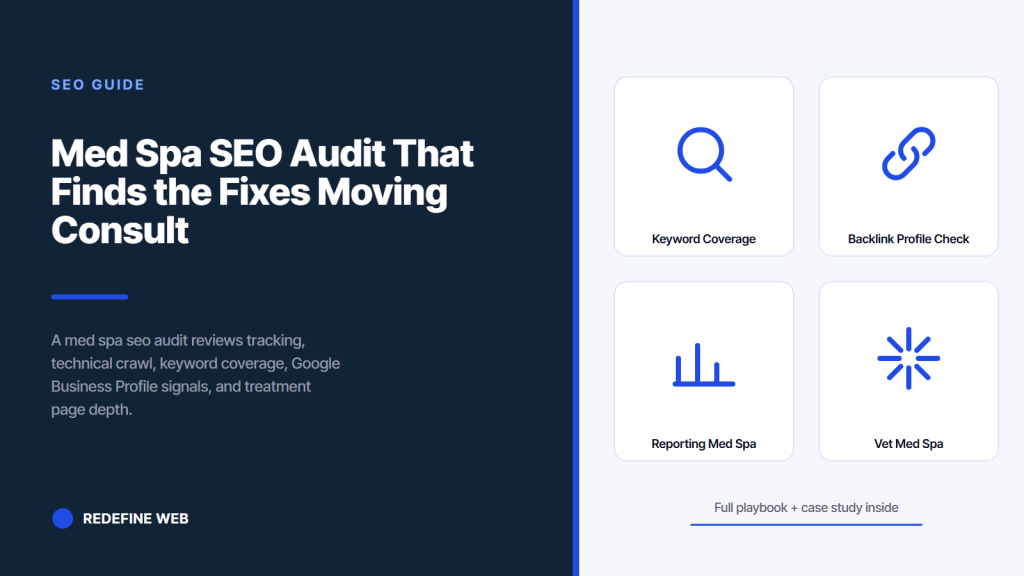
- A med spa seo audit runs 1500 to 5500 dollars.
- Deliverable is a prioritized Notion or Asana backlog.
- GBP drives 40 to 55 percent of new consults.
- Beauté Aesthetics grew leads 166 percent post-audit.
- Follow-through cadence decides real impact.
- Keyword coverage inside a med spa seo audit
- Backlink profile check inside a med spa seo audit
- Reporting the med spa seo audit findings
- Tools used inside a med spa seo audit
- How to vet a med spa seo audit partner before signing
- Follow-through after the med spa seo audit
- Wrapping up the med spa seo audit decision
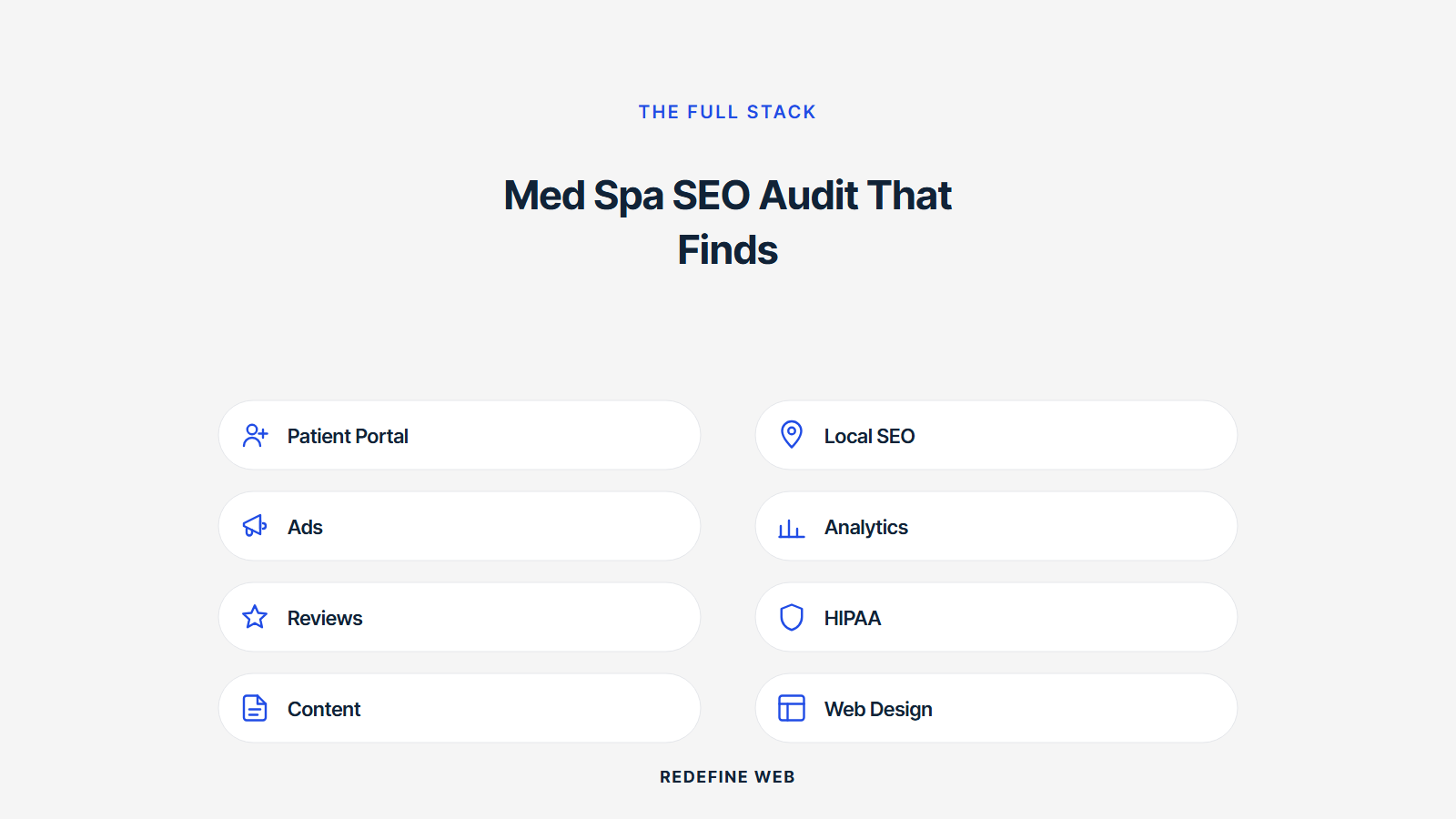
A med spa seo audit is the two-week review of your site, Google Business Profile, and treatment-page content that tells you which fixes move consult volume this quarter and which are wasted work. You want a checklist that starts with tracking QA, walks through indexation, judges keyword coverage against real patient intent for Botox, filler, laser hair removal, and body contouring, and closes with a prioritized backlog of 20 to 40 issues ranked by consult impact. Not a 90-page PDF. Not a vanity keyword grader. A working audit a practice owner can start executing on a Monday morning.
You want the numbers before the pitch. Beauté Aesthetics New York rebuilt after a med spa seo audit and gained 166 percent more leads, 88 percent more new users, and 27 percent higher conversion rate in 12 months on the same paid budget. The audit surfaced 34 metadata errors, 12 orphan treatment pages, and a booking flow buried three clicks deep. Fixing those three categories alone doubled the pipeline before we touched paid media. Read the sections below.
Keyword coverage inside a med spa seo audit
Keyword coverage is not chasing high-volume vanity terms. It is mapping every treatment your practice offers to the specific query language patients type when they are ready to book. Botox pricing near me. Best laser hair removal in Manhattan. How much does Kybella cost under the chin. The audit builds a 200 to 400 query list and grades your site’s current position on each, then flags the 40 to 80 queries where a fix moves the needle inside the quarter.
Buyer-intent query mapping
Buyer-intent queries include the treatment name plus a modifier like near me, cost, price, best, or a specific concern like fine lines or dark spots. These queries convert at 5 to 12 percent when the landing page matches intent. Informational queries like “does Botox hurt” or “how long does filler last” feed the top of funnel and convert at 0.5 to 2 percent. The audit separates the two lists and grades each on rank position, click-through rate, and dwell time.
Competitor gap analysis
Three local competitors get pulled into an Ahrefs or Semrush report. You see which queries they rank in the top 10 for that your site does not. You see their traffic estimate, referring domains, and top pages. The gap list becomes the content backlog. Skip this and you are guessing at what to publish. Add it and you know exactly which 12 blog posts to publish this quarter to close the visibility gap. Our med spa marketing agency team runs this analysis on every audit.
Backlink profile check inside a med spa seo audit
Backlinks matter less for a med spa than for a SaaS company but still count on the technical side. The audit looks at total referring domains, quality of those domains, anchor text distribution, and any toxic links that need disavow. A local aesthetics practice typically has 40 to 120 referring domains at a mature stage, most from local directories, local news, and industry publications.
Toxic link cleanup is rare on aesthetic practices but not unheard of when the prior agency ran gray-hat link building. The audit runs an Ahrefs disavow candidate export and flags any domain with a spam score over 40. The practice owner reviews the list, then the agency submits a disavow file through Search Console.
Local citation and directory sources
Yelp, RealSelf, Vagaro directory, Groupon, Zocdoc, Vitals, Healthgrades, and 30 to 40 local business directories carry the base of a med spa backlink profile. The audit lists which sources are present with correct NAP, which have inconsistent NAP that needs cleanup, and which are missing entirely. BrightLocal or Whitespark reports handle this in 90 minutes. Skip the citation cleanup and local pack ranking flattens even with strong on-page work.
Editorial and news mentions
Local news mentions, industry publication features, provider guest appearances on aesthetic medicine podcasts, and community sponsorships build the editorial half of the backlink profile. A working retainer adds three to five editorial mentions a quarter. The audit lists the current mentions, ranks them by domain rating, and identifies five to ten realistic targets for the next quarter based on the provider’s expertise and community footprint.
Reporting the med spa seo audit findings
How the audit gets delivered decides whether the practice acts on it. A 90-page PDF sits on Google Drive unread. A prioritized Notion database with one card per fix, time estimate, expected impact, and owner assignment gets executed inside a quarter. A working audit hands off in a format the practice’s operations team already uses.
The readout call runs 90 minutes with the practice owner, the operations lead, and the marketing manager if one is on staff. The agency walks the top 20 findings in the first 45 minutes, then opens the floor for questions on scoping and ownership for the second 45. Skip the readout and the audit sits on a Drive folder for six weeks before someone finally clicks in.
Prioritization framework
Each fix scores on three axes: consult impact, effort in hours, and technical complexity. The top 20 fixes get slotted into the current quarter roadmap. The next 20 land in the following quarter. Anything below the top 40 stays in the backlog for annual review. A booking flow depth fix might score 9 out of 10 on impact and 4 hours of effort and land in week one. A schema markup rollout across 30 pages might score 7 on impact and 22 hours of effort and land in month two.
Executive summary versus tactical backlog
The executive summary sits at the top of the deliverable and covers the top three findings plus the expected consult impact of the top 20 fixes. The tactical backlog sits below and holds every fix with step-by-step instructions. Practice owners read the summary in 15 minutes and delegate the backlog to the operations manager or the agency retainer. Skip the summary and the audit sits unread.
Every audit finding is fake if GA4 is broken. Submit a test booking today and confirm it hit GA4, Google Ads, and CallRail. If not, stop the audit.
Tools used inside a med spa seo audit
A working audit runs on a standard stack that any competent agency uses. Screaming Frog for the crawl. Ahrefs or Semrush for keyword and backlink data. Google Search Console for indexation and query data. Google Analytics 4 for behavior. CallRail for phone attribution. Local Falcon for map pack rankings. BrightLocal for citation audits. PageSpeed Insights and CrUX for Core Web Vitals.
Crawl and technical tools
Screaming Frog crawls up to 500 URLs on the free tier and unlimited on the paid tier at 259 dollars a year. Sitebulb runs deeper analysis on canonical hygiene, hreflang if the practice has bilingual pages, and internal link equity distribution. Google Search Console pulls the ground truth on which pages Google actually indexes. Skip Search Console access and you are guessing at indexation. Get read-only access from the practice on day one of the audit engagement.
Keyword and competitor tools
Ahrefs at 249 dollars a month or Semrush at 139 dollars a month covers keyword research, competitor traffic estimates, and backlink data. Local Falcon at 24 to 79 dollars a month tracks map pack rank position across a grid of your service area. The audit typically uses one or the other, not both. Skip these and you are running the audit on intuition, which reads confident in the presentation deck and produces nothing in month three.
How to vet a med spa seo audit partner before signing
You read three proposals and they read alike until you compare the sample deliverables. The differences show up in the specificity of the fixes and the format of the handoff. Ask these six questions before the contract signs, and cross-check every answer against a real prior deliverable the partner will share redacted.
- Ask for a redacted sample audit from a prior med spa client. Real audits look like Notion databases or Asana boards, not PDFs.
- Ask which tools they run and whether the license cost is inside the audit fee or extra.
- Ask how many hours of a specialist’s time the audit represents. Under 10 hours is thin. Over 30 is padded.
- Ask for the prioritization framework they use to rank fixes. Vague answers mean they are guessing.
- Ask whether the deliverable includes an execution partner option after the audit, and whether the audit fee credits toward retainer.
- Ask how they handle Google Business Profile findings that require the practice owner’s Gmail login. Password-shared audits are a red flag.
Green flags in a real proposal
Green flags look like a written scope that names Screaming Frog, Ahrefs or Semrush, Search Console access, and CallRail integration. A sample deliverable format shared during the pitch call. A prioritization framework with consult impact scoring. Case studies with named med spa clients, real audit dates, and real numbers from the fixes that shipped after the audit. A signed NDA on the deliverable so the practice can share it internally without leaking to competitors. Anything short of that means the partner is guessing at the deliverables. One prior audit we replaced was a 47-page PDF that opened with a Warren Buffett quote about compounding. The practice owner read the first three pages and never opened it again.
Follow-through after the med spa seo audit
The audit is not the deliverable. The audit points at the deliverable. Follow-through is where 60 to 80 percent of audits die. The practice reads the executive summary, agrees with the top three findings, and then ships nothing because no one owns the backlog. A working audit assigns owners on day one and reports on progress every two weeks.
Owner assignment and cadence
Every fix in the backlog gets an owner: the practice’s operations manager, the agency retainer, or a specific specialist inside the agency. The two-week check-in reports on completion rate against the backlog. Any fix that slips two check-ins in a row triggers a call to reassign or descope. Skip the cadence and the audit backlog dies inside a quarter. Add it and the practice ships 20 to 40 fixes across the next six months.
Measuring audit impact
Impact measurement runs on the same tracking stack the audit graded on day one. Consult volume from organic. Map pack impressions across the service area grid. Keyword rank position on the priority 40 queries. Consult conversion rate on the top three treatment pages. Cost per consult on paid channels for cross-reference. The 90-day and 180-day check-in reports on all five and points at which audit fixes drove which numbers. Our med spa marketing retainer covers this execution phase after the audit.
Wrapping up the med spa seo audit decision
A med spa seo audit is the two-week diagnostic that tells you which fixes move consult volume this quarter and which are wasted work. The scope covers tracking QA, technical crawl, keyword coverage, Google Business Profile signals, content depth on treatment pages, and competitor gap analysis. A working audit costs 1,500 to 5,500 dollars, hands off in a Notion database or Asana backlog, and drives 20 to 40 executable fixes across the next six months.
If your consult volume has flattened for two quarters, your paid CPC on Botox terms is climbing, or your local pack ranking has slipped outside the top three on treatment-plus-city queries, a med spa seo audit pays for itself inside 90 days. Ask three vendors for redacted sample deliverables. Look for the green flags above. Pick the one that names the tools, the prioritization framework, and the follow-through cadence. Redefine Web runs a fixed-scope audit inside our med spa seo track, with paired med spa web design and med spa PPC teams handling execution after handoff. Book a call and we will walk you through Beauté Aesthetics New York’s audit findings and the fixes that produced the 166 percent lead gain.
Frequently asked questions
What does a med spa seo audit cover?
A working med spa seo audit covers six workstreams. Tracking and analytics QA on GA4, Google Ads, and CallRail. Technical crawl and indexation review through Screaming Frog and Search Console. Google Business Profile audit including NAP consistency, category selection, review velocity, and photo freshness. Keyword coverage against a 200 to 400 query list of treatment-plus-modifier searches. Content depth grading on every treatment page against a 12-point rubric. And competitor gap analysis on three local competitors through Ahrefs or Semrush. The deliverable is a prioritized backlog of 20 to 40 fixes.
How much does a med spa seo audit cost in 2026?
A comprehensive med spa seo audit runs 3,500 to 5,500 dollars across 20 to 30 hours of specialist time. Basic audits with a 20-page PDF land at 1,500 to 2,500 dollars. Enterprise audits on multi-location groups run 5,500 to 22,000 dollars depending on URL count and per-location depth. Free audits usually give you top-line numbers but withhold tactical fixes until you sign a monthly retainer. Any audit under 800 dollars typically skips tracking QA, competitor gap analysis, or content depth grading.
How long does a med spa seo audit take to run?
A working med spa seo audit runs two to three weeks from kickoff to handoff. Week one covers tracking QA, crawl setup, and Google Business Profile access confirmation. Week two covers content depth grading, competitor analysis, and backlink profile review. Week three covers deliverable assembly, prioritization scoring, and the readout call with the practice owner and operations lead. Rush audits at one week are possible but usually skip competitor gap analysis and cut the deliverable to a PDF instead of a Notion database.
Which tools does a med spa seo audit run on?
A standard med spa seo audit stack uses Screaming Frog for the crawl at up to 500 URLs, Ahrefs or Semrush for keyword and competitor data, Google Search Console for indexation and query data, Google Analytics 4 for behavior, CallRail for phone attribution, Local Falcon for map pack ranking across the service area grid, BrightLocal for citation audits, and PageSpeed Insights plus CrUX for Core Web Vitals field data. Any audit that skips Search Console access is guessing at indexation.
How do I know if my med spa needs an seo audit?
Consult volume from organic traffic has flattened or dropped for two quarters. Paid CPC on Botox or filler terms is climbing more than 20 percent year over year. Local pack ranking has slipped outside the top three on treatment-plus-city queries. New reviews have slowed to under three a month. Site speed on the Botox page runs over four seconds on mobile. If two or more of these are true, the practice pays for the audit inside 90 days on freed paid spend and organic gains that the audit backlog produces.
What is the typical impact of a med spa seo audit after execution?
A working med spa seo audit followed by six months of execution typically produces 40 to 120 percent lead growth, 20 to 40 percent lower cost per consult on paid channels, 30 to 60 percent higher local pack impressions on treatment queries, and a 15 to 30 percent gain on booking conversion rate. Beauté Aesthetics New York gained 166 percent more leads, 88 percent more new users, and 27 percent higher conversion rate in 12 months after we ran the audit and fixed the top 12 findings.
Book your free 30-minute strategy call.
No spam, no sales rep. We use your email to schedule your call with a senior strategist. That is it.
More from the blog
View all articles → SEO
SEO Organic Search Engine Optimization Services That Grow Real Traffic
Read article SEO
SEO SEO for Pet Groomers That Fills the Appointment Book Weekly
Read article SEO
SEO