Optometrist print marketing is not dead, it just needs to be wired into the digital funnel. A postcard drop into three ZIP codes still books 30 to 90 new exams for a single-location practice on a $2,400 print budget when the offer is right and the QR code lands on a page that converts. The mail rate stayed flat since 2019 and digital cost per acquisition tripled in the same window. Print is not the sexy channel, but the math is honest, and the households you reach have never opened a Google search for an eye exam yet.
This piece walks the four print formats that still work for an optometry practice, QR code tracking that closes the attribution loop, EDDM versus targeted list economics, budget benchmarks by market size, and the Vision Express program that lifted bookings 62% in six months. Real print jobs from real accounts, real response rates. You will finish with the format mix, list-build steps, and drop calendar ready to run this quarter. Read straight through in twelve minutes.
Direct mail postcards for optometrist print marketing
The postcard is the highest-yield print format for a private optometry practice. Format runs 6×9 inches or 6×11 inches at 14-pt cardstock with a full-bleed color print. The 6×9 hits standard letter mail rates. The 6×11 hits the oversized rate for a small extra fee and doubles the perceived quality of the piece.
The postcard offer that works names the insurance carrier and the deadline. A generic Save on Your Next Exam offer books under 1%. A specific VSP Members $99 Annual Exam Through Dec 15 offer books 4% to 6%. A hyper-targeted New to the Neighborhood? First Exam $49 plus Free Frame Adjustment offer sent to new movers books 7% to 9%.
The design keeps it simple. Front side, one big headline, one photo of the practice exterior, one QR code to a booking page. Back side, doctor bios with real photos, three sentences on the practice differentiator, the QR code again, the practice address, phone, and website. Skip the stock-image family in eyewear. Use a real photo of your storefront.
The QR code lands on a dedicated landing page, not the home page. The landing page mirrors the postcard headline, has an above-the-fold booking form, shows the exact offer, and includes a doctor bio. Practices that send QR codes to the general home page cut their book rate in half. The visitor loses the scent of the postcard offer, and every second of friction on the page bleeds off scanners who were ready to book.
EDDM (Every Door Direct Mail) for optometry practices
EDDM (Every Door Direct Mail) drops a mail piece to every household on a selected carrier route without needing a purchased list. The USPS rate for EDDM runs $0.207 to $0.213 per piece, or under $0.30 all-in with printing. That is the cheapest way to hit a full ZIP code with a physical piece and still keep the optometrist print marketing math honest.
EDDM works for optometry when the ZIP code demographic matches the practice’s ideal patient. A high-income suburb with an average household age of 45 to 60 responds better than a college town or a low-income block. Practices in mixed-demographic markets should map median household income and age against USPS carrier routes before committing budget. USPS provides the free tool at eddm.usps.com.
The EDDM piece uses the same format as a targeted postcard, but the offer skews broader. A specific insurance carrier offer works on a targeted list. A broader offer works on EDDM. Try New Patient Exams $79 Through November or First Pair Free with Insurance for a wider audience. Response rate on EDDM runs 2% to 5%, lower than targeted mail, and yet the lower cost per piece keeps cost per booked exam competitive.
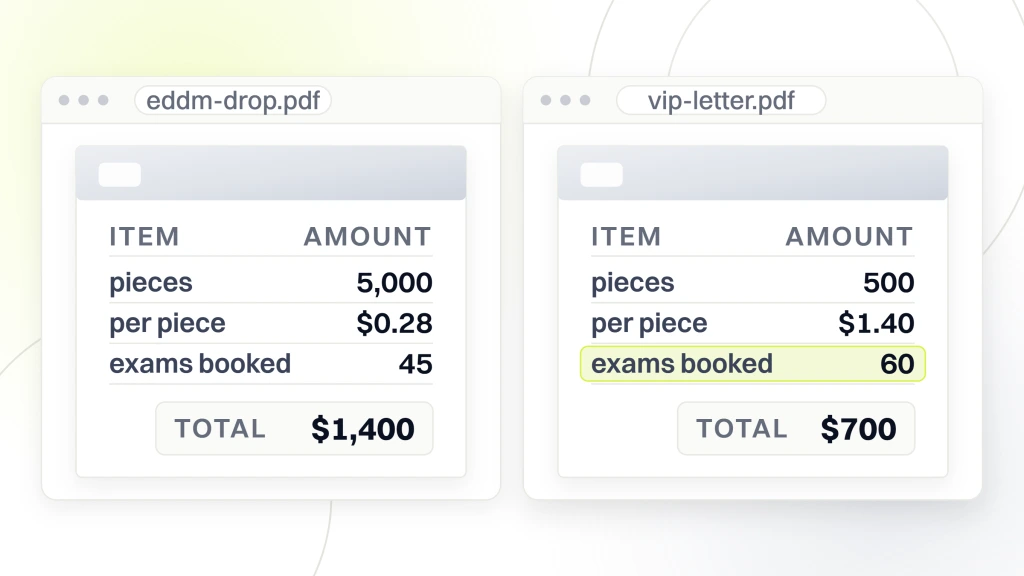
The math on EDDM. A 5,000-piece drop at $0.28 per piece equals $1,400. Response of 3% equals 150 responses. Of those, 30% book, so 45 exams. Cost per booked exam sits at $31. That is competitive with paid search at $28 to $55 per booked exam in the same market, and it reaches households that have not typed a single Google query for an eye doctor this year.
- EDDM rate, $0.207 to $0.213 per piece USPS.
- All-in cost with printing, $0.24 to $0.30 per piece.
- Response rate for optometry, 2% to 5%.
- Cost per booked exam, $25 to $48.
- Best use, broad insurance-year-end offer or new-patient welcome.
Targeted letters for VIP frame launches and re-engagement
The targeted letter is the higher-touch print format for VIP patients, insurance-carrier introductions, and doctor-signed re-engagement. A #10 window envelope with a real letterhead and a hand-signed doctor signature raises open rates from the 65% postcard baseline to 78% or higher, since the piece looks like personal correspondence, not marketing.
The letter format works for three specific jobs. First, the doctor-signed re-engagement letter to lapsed patients 24 months or older. Second, the VIP frame-launch invitation to top-spending patients ($500-plus annual spend). Third, the practice-anniversary letter that names patient tenure and includes a small offer. Each job earns a book rate 2 to 3 times the postcard baseline.
The letter costs more per piece than a postcard. Envelope, letterhead, one-page letter, and postage runs $1.10 to $1.60 per piece. That is 2 to 3 times the postcard cost. The response math still works, and the reason is simple. The audience is smaller and the book rate is higher. A 500-piece VIP letter drop at $1.40 per piece equals $700. Book rate of 12% equals 60 exams. Cost per booked exam sits at $12.
The doctor’s signature is not optional. A printed signature reads as a mass mailer. A real hand-signed pen signature on the letter reads as personal. Practices that skip this step cut their book rate in half. On a 500-piece drop, that is 20 minutes of the doctor’s time for a $1,200 revenue swing. The math is embarrassing to skip, and the fix takes an afternoon.
Layer the letter format on top of the postcard cadence. The postcard hits every household in the ZIP quarterly. The doctor-signed letter hits the top 500 lapsed patients semi-annually. The anniversary letter hits patients on the exact month of their fifth or tenth exam. Each format sits in a different lane, and the calendar keeps them from stacking on any single household inside 60 days.
QR code tracking and print-to-digital attribution
The QR code closes the biggest gap in print marketing, attribution. Before dynamic QR codes, print jobs measured response by phone calls to a tracking number or a manual campaign question at intake. Both under-counted the true response by 40% to 60%, since patients called from a different number or forgot the postcard by intake day.
Dynamic QR codes route through a tracking domain that logs the scan (timestamp, ZIP code from the IP, device type) and forwards to the landing page. That log becomes the raw attribution data. Each print job gets a unique QR code tied to that specific drop, so a February drop and a March drop are tracked separately, and you can compare offer variants head-to-head.
The tools that work for optometry. Beaconstac (free tier up to 3 codes), Bit.ly Premium ($35 monthly for the code volume most practices need), and QR Code Generator PRO ($27 monthly with A/B split). All three integrate with Google Analytics 4 through a simple UTM parameter on the destination URL, so the scans flow into GA4 as a distinct traffic source.
Pair the QR data with call tracking on the practice’s main line. CallRail or WhatConverts logs which prints the caller mentions at intake. Between the QR scans and the call log, print-to-booking attribution runs above 85% accurate. Practices that skip both close print books blind and cannot tell which drop worked. The optometrist website design services we run always include a QR-code landing page template so the practice does not pay for a custom page on every drop.
How to build the direct mail list for an optometry practice
The direct mail list decides half the campaign outcome. A well-built targeted list of 3,000 households in the practice’s 5-mile radius, filtered on age 40-plus and vision insurance carrier, books 5 to 8 times better than a random 3,000-piece EDDM drop in the same ZIP. The list builds one of three ways, purchased, appended, or accumulated in-house.
Purchased lists come from data brokers (Melissa, DataAxle, InfoUSA). Costs run $0.08 to $0.22 per record. Filter fields include age bucket, household income, home ownership, employer size (proxy for vision plan), and distance from practice. A 3,000-record filtered list for optometry costs $240 to $660 one time or on a subscription.
Appended lists start with the practice’s existing patient database and add household-level data (household income, home value, adjacent household composition). Data enrichment services (Melissa Data Enrichment, Full Contact) run $0.06 to $0.14 per record. Appended lists are used for VIP re-engagement letters and lapsed-patient postcard sends, and they punch above their weight for optometrist print marketing budgets under $3,000 a month.
Accumulated in-house lists come from the practice’s own website, intake forms, and referral events. This list grows slowly (30 to 90 emails and addresses per month for a solo practice) and converts at 3 to 5 times the response rate of a purchased list. Prioritize the in-house list for high-value campaigns (VIP frame launches, insurance renewals). Save purchased lists for acquisition.
Merge the three list sources into one master file with a source-tag column so you can see response rate by list origin over 12 months. That data becomes the input for next year’s budget split. Practices that skip the source tagging cannot tell which of the three list types produced the exam bookings and end up over-spending on purchased lists that under-perform in-house lists 3-to-1.
What optometrist print marketing costs monthly
Print marketing for optometrists runs $1,800 to $6,400 per month for a solo practice depending on drop size, format mix, and list source. Multi-location groups run $4,800 to $14,000 monthly across all locations combined. Costs sit at three layers, creative (design plus copy), print production (paper, ink, cutting), and postage (USPS or courier).
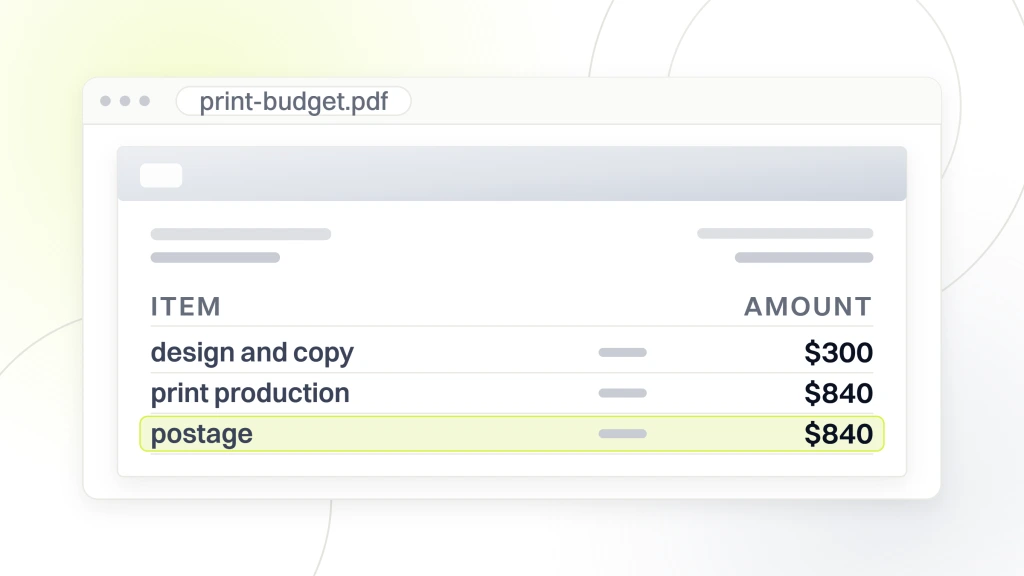
For a solo practice running a monthly 3,000-piece postcard drop plus a quarterly 500-piece VIP letter, the monthly cost breaks out as, design plus copy $300 (one time per new creative, amortized), print production $840 ($0.28 per piece), postage $840 ($0.28 per piece), list rental $220. Total monthly $2,200. Revenue attributable to print runs $9,000 to $18,000 monthly for a solo practice at these volumes.
The bigger practices scale by drop frequency and list size. A two-doctor group running a bi-weekly 4,000-piece drop plus monthly 800-piece VIP letters and quarterly EDDM saturation runs $5,200 to $6,400 monthly. Revenue attributable runs $28,000 to $58,000 for the same period.
Read our Optometrist marketing cost breakdown for the full monthly plan. Print sits inside a $6,000 to $15,000 total monthly marketing spend for the average independent practice. The retainer at our optometrist marketing retainer starts at $1,499 monthly and scales to full-stack print plus digital from $6,000 monthly.
Cash flow shape matters too. Print bills up front, creative, production, postage all hit the accounts payable line in a single week. Digital bills daily as the ads run. A solo practice with tight cash flow runs bi-monthly print drops instead of monthly to space the outflow. A practice with steady cash flow runs monthly drops to maintain the reactivation cadence.
| Format | Cost per piece | Response rate | Cost per booked exam |
|---|---|---|---|
| Postcard (targeted 3,000) | $0.55 | 4% to 6% | $18 to $28 |
| EDDM (5,000 route) | $0.28 | 2% to 5% | $25 to $48 |
| Targeted letter (VIP 500) | $1.40 | 10% to 14% | $10 to $16 |
| Anniversary letter (300) | $1.20 | 12% to 18% | $8 to $14 |
How to run an optometrist print marketing campaign in 30 days
The 30-day print rollout runs in four weeks. Week one is list build and creative. Week two is proof and QR code setup. Week three is print production. Week four is drop and tracking. This sequence protects the creative work from being rushed to hit an artificial deadline.
Week one, pull the list (purchased or in-house), lock the offer, brief the designer on the creative. Approve the offer copy in writing before the designer touches the layout. Offer specificity is what determines the response rate, so this week matters more than the design week.
Week two, proof the design at 100% scale (not on screen at 60%). Print a single test proof, read the copy out loud, check the QR code scans and lands on the right page, and confirm the address block prints correctly. Set up the QR code short link and the destination landing page with proper UTM parameters flowing to GA4.
Week three, print production. A 3,000-piece postcard print job runs 5 to 7 business days at any of the main print vendors (VistaPrint, Moo, GotPrint, PrintingForLess). Choose two-day USPS bulk delivery once the print is done. Total production plus delivery to your USPS bulk mail entry unit takes 8 to 10 business days.
Week four, drop and track. The USPS bulk mail entry unit takes 3 to 7 business days for in-home delivery on standard mail. Track scans daily starting day two of the drop window. Compare scan volume against the historical baseline of your prior drops. Adjust the next drop based on what you see in the data.
Mistakes optometrists make with print marketing
The mistakes we audit fall into five buckets. Sending a generic offer (kills response rate). Skipping the QR code (kills attribution). Sending to the wrong list (kills economics). Using stock photography (kills trust). Running one drop and quitting (kills the whole learning cycle).
The generic-offer mistake is the most common. A practice sends a Save on Your Next Exam postcard to 5,000 households and books 12 exams. Response rate 0.24%. They conclude print does not work. The truth, the offer was vague. The same 5,000 households with a VSP Members $99 Annual Exam Through Dec 15 postcard would book 150 to 250 exams, since the offer names the audience and the deadline.
The list mistake is the second most costly. A practice buys a 5,000-record list without filtering for age or insurance carrier. Half the list is under 30 and does not need an exam. The response rate is half of what it should be. Filter the list before you print, not after.
The one-and-done mistake is the most damaging over 12 months. A practice runs one drop, tracks the response for two weeks, and abandons the channel since the response was modest. The truth, print compounds. Repeat drops to the same address list every 90 days at a different offer angle raise the total household response rate to 8 to 14%. The second and third impression close the households that saw the first drop but did not scan the QR code.
The stock-image mistake is the cheapest to fix. A practice uses a stock photo of a smiling family in generic frames. The postcard reads as generic marketing and gets thrown in the trash. Swap the stock image for a real photo of the practice exterior or a doctor headshot and response rate climbs 20% to 40%. Two hours of photography time on a Tuesday afternoon covers 12 months of print creative.
- Make the offer specific to insurance carrier and deadline.
- Include a QR code on every piece with dedicated landing page.
- Filter the list by age 40-plus and vision insurance carrier.
- Replace stock photography with real practice photos.
- Run drops every 60 to 90 days to the same list, not one-off.
Layer optometrist print marketing with your channel mix
Print marketing for optometrists works best as the acquisition-and-retention layer around the digital funnel. Paid search catches active searchers. Print catches households that have not searched yet. Text and email catch the patients already on file. Each channel covers a different job, and the Vision Express program we built ran all four in coordinated flights.
The coordinated flight looks like this. Week one, postcard drop to 3,000 new movers in the target ZIP codes. Week two, Google Ads bid adjustment on the same ZIP codes goes up 25% to catch households that scanned the QR code and want to comparison-shop. Week three, Facebook retargeting on the QR code landing page traffic. Week four, text broadcast to any new patients who booked from the drop for a $20 lens upgrade offer.
The Vision Express program that ran these formats lifted appointment bookings 62% and grew organic traffic 135.9% inside a 6-month window, with overall practice growth up 71% by the end of the engagement. Print did not carry those numbers alone. Print carried the households that had not searched yet, digital caught them on the second and third touch, and the combined funnel is what moved the practice into a top independent slot in its market.
Read our Optometrist marketing strategy piece for the 12-month cadence that layers print inside a full-stack plan, and text marketing for optometrists for the reactivation program that catches households who saw the postcard but did not scan the QR code the first time.
Launch your optometrist print marketing this quarter
Optometrist print marketing books exams when the format matches the audience, the QR code lands on a working page, and the drop calendar ties into digital touchpoints in the same week. Postcards for new movers, letters for VIP frame launches, EDDM for insurance renewals, and a modest calendar for annual reactivation. Spend runs $1,800 to $6,400 monthly for a solo practice depending on drop size, and the response math holds when the offer is specific. Talk to our optometrist marketing agency when you want the audit that pairs print with the rest of your channel mix.