Do you have to pay monthly for a website? No, you are not forced into a monthly bill. Most small business owners land on one anyway, and the reason is math. The alternative is a $6,000 upfront invoice plus separate hosting, separate maintenance, and a phone call to a freelancer who stopped answering emails last November.
You are reading this because a vendor just quoted you a monthly plan, and you want to know if it is worth the recurring line item. This is the honest breakdown of the pay monthly for a website question, written by a team that runs both plan shapes every week. What the monthly fee really covers, when a one-time build is the smarter buy, the traps hiding in cheap $29 plans, and the math that lands on the right choice for your shop.
How a Fair Monthly Website Plan Is Really Priced
A fair monthly website plan is built on four inputs. The amortized build cost, the hosting and security stack, the labor pool for your monthly edits, and the vendor’s margin. Everything else on the price page is decoration. Get those four numbers straight before you sign anything.
Amortized build cost
A real site build costs the vendor between $3,000 and $6,500 in labor. Spread that across a 24-month contract, and you get $125 to $270 a month before any other line item. Any plan priced lower is either using a shared template, cutting the discovery process, or planning to recoup on upsells. Sometimes that is fine. For a five-page brochure with a contact form, you can honestly get by. Below $99 a month, the math usually breaks.
Hosting, security, and updates
Managed WordPress hosting costs a real vendor $25 to $70 a month per site. SSL is included at zero. Backups run $5 to $15 depending on retention. Security plugins add $10 to $30. Add labor for monthly plugin updates, and you land at $50 to $130 a month in infrastructure alone. Anything under that number is a red flag. Ask the vendor what host they use. If they cannot answer, they do not know.
The support pool and response time
Every good monthly website plan includes a fixed labor pool. Two hours a month is the minimum for anything above $150. Four hours is common in the $199 to $299 tier. That is enough to run 6 to 10 real edits a month. Anything less, and you are paying for hosting with a support ticket window taped on. Ask for the average first response time before you sign. Under 4 business hours is good. Over 24 hours is a support desk in a different time zone with a scripted reply.
When a One-Time Website Build Beats a Monthly Plan
The monthly website question is not always the right one. Sometimes an outright build is the better fit. Here is when you should stop reading pay-monthly comparison guides and write the one-time check, with three tests that separate a good outright candidate from an owner who should stay on monthly.
You have a technical person on staff
If a real developer, IT lead, or web-savvy operations manager sits on the payroll and has bandwidth, an outright build is cheaper across three years. That person can absorb the plugin updates, the hosting migration, and the monthly edits inside their existing 40-hour week. The site becomes a maintained asset, not a support ticket. Our WordPress Website Development Services page walks through the outright build option with a clean handoff document.
Your site will not change for three years
Rare, but real. A five-page brochure for a semi-retired accountant, a lifestyle blog with no monetization, a legacy business that has been running the same service list since 2003. No new pages, no rebrand, no growth. In that scenario, a one-time build plus $40 a month in hosting is the cheapest path. Don’t sign up for a monthly plan you will not use.
Your budget can absorb the upfront cost
If a $6,400 to $9,200 upfront quote does not affect payroll or tax planning, outright is a defensible choice. Especially for owners who know they will hate a monthly subscription line item and cancel it out of principle within 8 months. Some owners cannot tolerate recurring bills. That trait costs money one way or the other.
The Real 36-Month Cost of Paying Monthly vs. Buying Outright
Owners who ask do you have to pay monthly for a website almost never do the 36-month spreadsheet before they sign. That is the single most expensive mistake in this decision. The monthly headline number tells you what you owe in month one. The 36-month view tells you what you actually spend before your business needs a rebuild.
Monthly path across 3 years
A $199 a month plan runs $7,164 across 36 months. That covers the build, hosting, security, backups, and 24 to 48 hours of edit labor a year. Bump to $349 a month, and you spend $12,564, which usually adds priority support, a real design refresh in year two, and more edit hours. The number moves in lockstep with what the vendor delivers, which is the whole point. You pay for what you use.
Outright path across 3 years
A $6,500 outright build plus $50 a month in hosting and $40 a month in security lands at $9,740 across 36 months. Add a two-hour-a-quarter labor retainer at $150 an hour, and you clear $11,940. On paper, that is close to the mid-tier monthly plan. In practice, most owners underestimate the hidden hours their in-house team pours into managing the site. That is where outright quietly loses.
The apples-to-apples number
Owners often compare the cheapest monthly plan to a fully built outright site. That is the wrong compare. Match the tier before you run the math. A $99 a month starter plan does not compete with a $6,500 custom build. It competes with a one-time template site build. Once you match tiers, the monthly website math either wins or loses on cash flow. Not value.
A Real Client Story on Paying Monthly for a Website
Tilghman Builders came to us in 2015 with a referral-only funnel and a website that had not been touched in three years. The owner was allergic to the idea of paying an agency every month, and for good reason. A vendor in 2011 had charged him $349 a month and delivered nothing beyond a login page for a template. Every dollar going to a website subscription was a dollar not going into new tools for the crew.
What the monthly investment produced
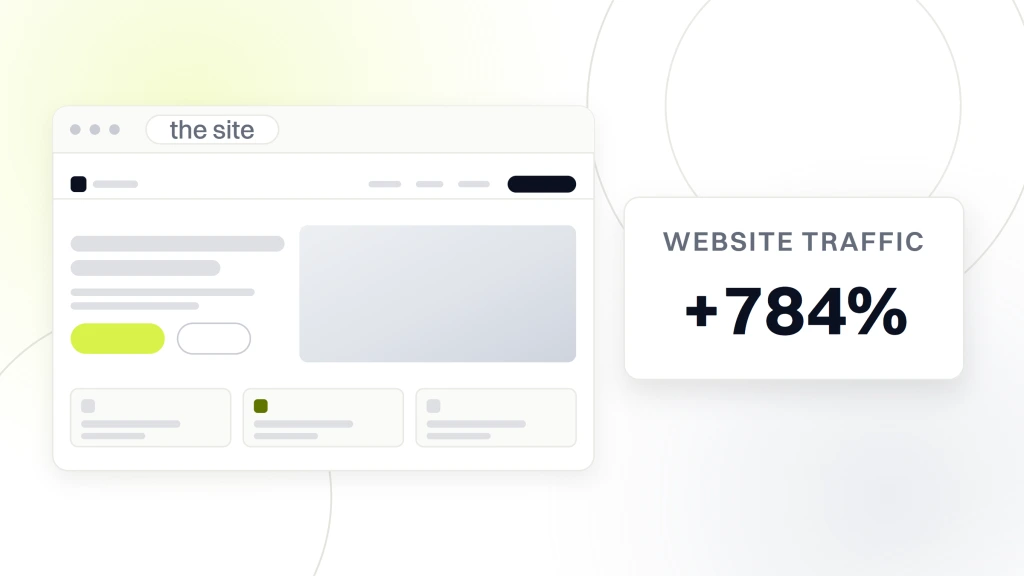
Nine years later, Tilghman Builders sits at $6.8M in annual revenue, up from $1.5M when the partnership began. That is a 353% revenue jump over the 9-year window. Website traffic grew 784% on steady content and SEO investment. Marketing-qualified leads grew 637%. The monthly retainer he almost refused to sign is why the site kept pace with a business that scaled that hard. An outright build in 2015 would have been the wrong site by 2017 and a full rebuild by 2019.
Why the outright quote would have failed
The $6,800 outright quote he almost signed in 2015 was priced against a 2015 business. Four services, one office, one truck. By 2018, the business had 11 services, three trucks, and a resource center wired to HubSpot content. A 2015 outright site would have hit the wall around month 22. The monthly plan absorbed those changes as they arrived, without a rebuild invoice ever landing on his desk.
What he tells other owners
When Tilghman refers a fellow contractor, the pitch is short. If your business is going to change in the next 24 months, pay monthly. If it is not going to change, buy the site outright. Anyone who tells you their business is not going to change in the next 24 months is either lying to you or about to retire. That framing is more honest than most agency landing pages.
The Cheap $29 Pay Monthly Website Trap
Every search for a monthly website plan returns three or four ads offering plans at $19, $29, or $39 a month. Those numbers are marketing bait. A real vendor cannot deliver a maintained business site at that price without cutting corners you will pay for later. Know what those corners look like before you click the sign-up button.
Template sites with no discovery
Sub-$50 monthly plans skip discovery entirely. You pick a template, drop in your logo, and the vendor calls it a launch. The pages read like every other template on the platform. Your Google Business Profile will outperform the site inside 90 days, which tells you the site is doing zero work. You are paying $348 a year for a login page.
Shared hosting on undersized servers
Cheap plans pack hundreds of small business sites onto a single shared server. When one site gets a traffic spike, every other site slows to a crawl. Page load times drift to 6 seconds and stay there. Your rankings quietly slide. The vendor blames Google’s algorithm, and the honest answer is you are on the wrong server. Ask the vendor how many sites share your host node before you sign.
The lock-in clause you did not read
Sub-$50 plans almost always run 24 or 36-month contracts. Cancel early, and you owe the balance in a single payment. A $29 a month plan quoted as flexible is actually a $1,044 commitment. Anyone who cannot show you the exit clause on the first call is hiding it on purpose.
Questions to Ask Any Vendor Quoting a Monthly Website
Every vendor’s landing page reads the same. Fast. Beautiful. Trusted by thousands. The truth lives in a short interrogation before you sign anything. These are the 6 questions that separate a fair monthly website plan from a bad contract, and every good vendor should answer each in under a minute.
- Ownership on cancel. Who owns the code, the design files, and the domain if you cancel? The answer is you, or the contract is broken.
- Contract length and exit fee. What is the exact term, and what does it cost to leave in month 6, 12, and 24? Get the dollar figure, not a description.
- Edit hours and rollover. How many hours of edits are included each month, and what happens to unused hours? Track this against real invoices, not the sales deck.
- Hosting stack and speed. Which host do you use, and can you see a real page speed report from a live client? Under 3 seconds mobile load is the bar.
- Support response time. What is your average first response time on a support ticket, in business hours? Under 4 hours is good. Over 24 hours is a scripted reply.
- Case study proof. Can you see three case studies of clients on this exact plan tier, with named clients and real revenue numbers?
How to read the answers
Good vendors answer all 6 questions with specifics inside a minute each. Bad vendors deflect, reframe, or ask to circle back after the call. When the response to the ownership question is a paragraph about how ownership is complicated, ownership is not complicated. You either own the code, the design files, and the domain when you cancel, or you do not. When the host question gets a vague answer about proprietary infrastructure, the host is a $6-a-month shared server somewhere, and the site is on borrowed time.
What a real case study should show
A real case study shows a named client, a starting number, an ending number, and a timeframe. When the vendor’s case studies are anonymous or use nothing but before-and-after design screenshots, something is off. The best signal is a case study section with client logos, real revenue figures, and phone numbers you could call.
The red flag pattern
The clearest red flag is a vendor who refuses to send the contract before the sales call. Real plans have real contracts, and the vendor should have zero problem emailing yours in advance. Anyone who insists on a call before you can read the contract is protecting a clause they know you would not agree to on paper.
Our Take on When Paying Monthly for a Website Is the Honest Answer
The monthly website question is one we field three times a week on discovery calls. Redefine Web runs both plan shapes for small business owners across the country. Owners on the monthly plan pay a fixed fee starting at $99 a month and stop worrying about hosting, security, or the monthly edit queue. Our tiered pay monthly plans run $99, $199, and $349 a month depending on the edit hours and support pool you need. Owners who buy outright get a clean handoff document, the full codebase, and a light retainer if they want ongoing support without the full plan. The difference between the two paths is not quality. It is fit for how your business really spends money.
Who we recommend monthly to
Solo practitioners, single-location retailers, home service crews under three trucks, and any owner who has zero interest in a WordPress admin panel. The retainer starts at $99 a month on our Pay Monthly Website Launch from $99/mo option. That includes design, launch, hosting, and a real support pool. It is not the cheapest plan on the internet. It is the honest one.
Who we recommend outright to
Multi-location operators with an internal marketing team, established brands running annual redesigns, and anyone with a technical person already on staff. For those cases, a one-time build plus a light support retainer keeps the total cost lower over 36 months. Our SMB build tiers run $2,500, $4,500, and $7,500 depending on page count and integrations, and the $2,500 tier fits the simplest brochure sites. Read Smashing Magazine on what to consider in a website redesign before deciding. The framework there maps well to the outright versus monthly decision.
The one thing every owner should do first
Before you sign anything, price the total 36-month cost on both paths using the same monthly labor and hosting assumptions. Most owners never do this and end up on whichever plan felt cheaper in the moment. The 36-month view often surprises everyone. Sometimes monthly wins by $3,400. Sometimes outright wins by $2,100. Either way, the number tells the truth better than the sales page.
What Happens After You Sign Up for a Monthly Website Plan
The first 30 days on any monthly plan look roughly the same across vendors. Discovery, design, content, staging, review, launch. When your vendor’s timeline runs longer than 60 days for a five to eight-page site, something is off. Larger sites can take 90 days, but not more.
Week one to two
Discovery calls, sitemap decisions, and a first round of copy questions. This is when the vendor learns your business well enough to write pages that convert. When the vendor skips discovery and jumps straight to design, they are giving you a template. Push back and ask what they know about your buyer.
Week three to five
Design reviews and content revisions on staging. The vendor should be showing you real page mockups with your copy, not empty wireframes with lorem ipsum. Two rounds of revision is normal. Four is a sign the discovery was too shallow. Six means someone is going to lose money on the contract, and it usually shows in the finish quality.
Week six onward
Site launches. Support pool starts. Monthly edit hours activate. The site that launched in month one is the site your business needed in month one. The site you have in month 12 is the one your business needed in month 12, edited into shape across 44 weeks of small requests. That evolution is the whole point of paying monthly.
Pay Monthly Website Add-Ons That Are Worth the Money
Most monthly website plans layer add-ons on top of the base fee. Some are worth it. Most are padding. Here is the honest read on the two add-ons owners actually get value from, and the ones you can safely decline in month one.
Site care and maintenance
A real maintenance layer covers plugin updates, security patches, uptime monitoring, and monthly backups you can restore in a click. Our maintenance tiers run $199, $299, and $499 a month depending on the site’s traffic and integrations. Anything under $99 for maintenance is either partial coverage or the vendor cutting corners.
Analytics and conversion tracking
Basic Google Analytics is free and easy to install. What most owners actually need is conversion tracking wired to their real revenue events. That is form fills, phone calls, and booked appointments tagged back to the traffic source that produced them. Pay for the wiring, not the dashboard. A dashboard without conversion tracking is a screensaver.
Do You Have to Pay Monthly for a Website. Final Answer
No, you do not have to. Yes, most owners should. The exception is a narrow profile of owner with a small site scope, a stable business, and a bank balance that can absorb $8,000 in one hit. Everyone else saves time and money on the monthly path because the alternative is running a second job managing an asset that is not the point of the first one.
What the honest math looks like
The honest 36-month cost of any site is $6,500 to $12,000 for a growing small business. Whether that lands as one invoice or 36 invoices is a cash flow question, not a value question. The value is roughly the same. The friction is dramatically different.
The one guardrail on any monthly plan
Read the contract line by line. Know who owns the code, files, and domain if you cancel. Ask for three real case studies with named clients and real revenue numbers. Look at the total 36-month cost, not the monthly headline. And walk away from any vendor who gets defensive about those questions. Read web.dev on Core Web Vitals to understand what a good site should measure, so you can evaluate any vendor’s live client work against real performance data before signing.
Where to go from here
When your budget can absorb $99 to $349 monthly, and you want the site off your plate, the monthly plan is your answer. When you have $8,000 in the bank and a technical person already on staff, buy outright. Either path works when the vendor is honest, and the contract is fair. The real risk is picking the wrong path for your specific situation because someone on a landing page told you monthly was cheaper. Sometimes it is. Sometimes it is not. The 36-month spreadsheet is the referee, and it is a 5-minute exercise.
Do you have to pay monthly for a website? No. Should you? Probably. Not because monthly is magic, but because the math almost always lands there for owners who run growing shops without a full-time developer on payroll. Compare the total spend across 36 months, read the ownership clause, and pick the plan that fits how your business really operates. Skip the sales pitch and the vendor charm. The contract is the only thing that matters after month three.