A DTC beauty brand doing $2.3M annual revenue reached out last September after their old developer disappeared for six weeks and their Shopify checkout collapsed on mobile Safari during a product launch. Discounts kept applying twice. The Klaviyo flows stopped firing. Their agency of record charged $180 an hour on a 40-hour minimum and quoted $7,200 to fix what a real ecommerce maintenance package would have caught in the weekly monitoring pass. The founder wanted to know what a monthly retainer would have cost. The answer was $299 across our Growth tier, with the mobile checkout audit as a scheduled monthly deliverable, not an emergency invoice. Our custom ecommerce platform maintenance costs vs Shopify guide covers the platform-side math in more depth.
This guide walks the question the way our team scopes it for DTC founders. Real tiers with real dollar figures. Deliverables that sit inside each tier and the ones that get treated as add-ons. Cadence for updates, backups, security patches, and platform-specific work on Shopify, WooCommerce, and BigCommerce. Where retainers pay back inside the first quarter and where they take two quarters to earn the spend.
What an ecommerce maintenance package covers at the retainer level
An ecommerce maintenance package is a monthly retainer that keeps the store safe, fast, and buyable across every browser, device, and payment path a real customer touches. Not a break-fix invoice. Not a plugin update log. A recurring scope of work with named deliverables the founder can point at on the monthly report.
The five recurring workstreams every real retainer includes
Every tier covers 5 recurring workstreams that run every month. Security patches on the platform core plus every installed app or plugin, tracked against a public vulnerability database. Automated daily backups with offsite storage and a documented restore path tested quarterly. Uptime monitoring at 5-minute intervals with escalation to a human inside 15 minutes on a failure. Performance monitoring on Core Web Vitals with monthly regression reports against the previous month. Checkout and payment path testing across the top 5 customer devices in the store’s analytics.
The 5 workstreams sit under every tier for a plain reason. A store missing any one of them eventually runs into the exact failure the missing workstream would have caught, and the founder pays the recovery cost instead of the prevention cost.
Where retainers stop being packages and start being break-fix
Retainers that skip named deliverables and quote hours instead are not real packages. Hourly retainers ask the founder to guess how many hours the store needs each month, which produces two failure modes. Under-scoping means the retainer runs out of hours by the third week and the store carries an unmaintained tail. Over-scoping means the founder pays for hours that never get used when nothing broke that month.
Real ecommerce website maintenance packages fix this by locking a recurring scope. The vendor commits to producing every named line each month, quiet week or launch week. That is the operational split between a package and a retainer of hours, and it changes the accountability pattern on both sides.
The three-tier ecommerce maintenance package model that scales
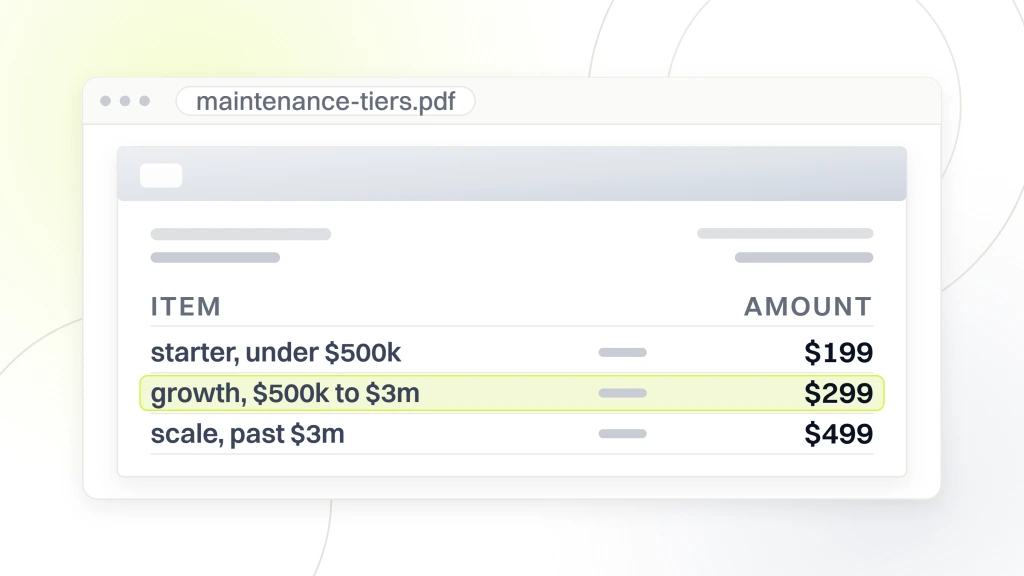
Almost every DTC store we scope fits into one of 3 tiers. Starter for brands under $500K annual revenue running Shopify or WooCommerce with under 200 SKUs. Growth for brands between $500K and $3M annual revenue with an active email program and monthly product launches. Scale for brands past $3M annual revenue with multi-warehouse fulfillment, subscription flows, or B2B wholesale sitting alongside DTC.
Why the tier structure holds at $500K and $3M revenue breakpoints
The $500K breakpoint is where a store crosses from single-owner operations into having a marketing coordinator or fractional operator who reads the monthly report. Below $500K the founder wears every hat and needs the vendor to catch problems the founder does not have bandwidth to notice.
The $3M breakpoint is where a store crosses from single-platform simplicity into multi-system integration between Shopify, Klaviyo, Recharge or Skio, ShipStation or ShipBob, and often a headless front-end. Each integration point adds a monthly monitoring line, and the Scale tier prices in the coordination overhead across those systems. Our detailed breakdown of ecommerce seo packages tiers uses the same three-tier logic for organic retainers, which most Scale-tier clients pair with.
Where founders mis-size themselves inside the three tiers
Founders under-size themselves into Starter when they hit $800K to $1.2M annual revenue and try to keep the retainer flat, which produces a store where the vendor cannot cover the growing surface area and problems start slipping past the monthly deliverables.
Founders over-size themselves into Scale when they cross $2M annual revenue and get talked into an enterprise retainer they do not need, which produces a maintenance line that eats 3% to 5% of revenue instead of the healthy 1% to 2% range. The right tier is the one whose deliverables match the store’s real complexity, not the one whose price matches the founder’s preferred sense of scale.
Starter tier scope and monthly ecommerce maintenance price
Starter tier is the entry point. Retainers start at $199 per month on our version, with six-month contracts standard. Platform updates run on quarterly cadences, and the vendor needs two quarters to prove the model against the store’s real failure patterns.
What sits inside the Starter deliverable list
- Weekly security patches on Shopify apps or WordPress plugins, with a change log the founder can read in 5 minutes.
- Daily automated backups stored offsite for 30 days, with one quarterly restore test on a staging environment.
- Uptime monitoring at 5-minute intervals with email alerts and a monthly uptime report.
- Core Web Vitals reporting against the top 20 revenue-driving product and category pages.
- Checkout smoke test monthly across 3 browsers and 2 mobile devices with a written pass or fail per path.
- 2 hours of small content edits monthly, rolling into the next month if unused, capped at 4 hours total carryover.
Starter is priced for stores under $500K annual revenue where the founder still handles product photography, copy edits, and Klaviyo flow updates directly. The retainer covers the plumbing so the founder can spend time on the marketing side of the store. Hosting is bundled in the plan, so founders do not carry a separate hosting invoice on top of the $199 monthly retainer.
Retainers at this level should not include design work, custom development, or paid marketing management. Those workstreams need their own scope and monthly budget. Bundling them at $199 monthly usually produces a package where nothing gets executed at the depth it needs, which is the failure mode most cheap plans fall into once the store crosses 5,000 monthly sessions.
Growth tier scope and monthly retainer pricing
Growth tier is the middle band, and it is where most $500K to $3M annual revenue DTC brands land after a proper kickoff scope. Pricing sits at $299 per month on our version, so the founder can plan against a fixed line item rather than a variable hourly bill.
What Growth tier adds beyond Starter
Growth keeps every Starter deliverable and adds 5 workstreams that match the higher operational tempo. Weekly Core Web Vitals reporting instead of monthly, with named regressions flagged inside 48 hours of a Google update. Checkout testing weekly across 5 devices instead of monthly across 3, matching the store’s real device mix from GA4. Klaviyo or Postscript flow monitoring for triggered send failures, deliverability drops, and revenue-attribution regressions inside the flow reports. Product feed monitoring for Google Shopping, Meta catalog, and TikTok Shop across the top 100 SKUs by revenue. 6 hours of monthly content and small-development work rolling into the next month, capped at 12 hours total carryover.
The added workstreams reflect the pattern that stores past $500K annual revenue lose revenue faster from silent flow failures and feed rejections than from big obvious platform outages. WP Rocket published a good primer on Core Web Vitals optimization that founders should read before scoping Growth tier deliverables.
Where Growth tier plans start earning back the spend
Growth retainers pay back inside the first quarter for most $1M annual revenue stores. The flow monitoring alone usually catches one silent Klaviyo failure or one product feed rejection that would have cost 2% to 6% of monthly revenue if it ran unnoticed for 3 weeks.
A single caught abandonment flow failure on an $80,000 monthly revenue store pays for 13 months of the Growth retainer at $299. That is the specific mathematical basis for why our team recommends Growth over Starter once monthly revenue crosses $50,000. The math looks different for stores under $50,000 monthly where a caught failure produces smaller absolute recovery, and Starter remains the honest recommendation there. Our writeup on what’s included in a website maintenance package covers the same deliverable-by-deliverable comparison across generic retainer scopes for founders benchmarking outside the ecommerce category. See our ecommerce website maintenance cost breakdown for line-item benchmarks by tier.
Scale tier scope and enterprise pricing
Scale tier is for DTC brands past $3M annual revenue running multi-warehouse fulfillment, subscription programs, B2B wholesale alongside DTC, or a headless Shopify or BigCommerce front-end. Pricing sits at $499 per month on our version, which is a fixed enterprise line rather than an hourly range that swings each month.
What Scale tier adds beyond Growth
Scale keeps every Growth deliverable and adds workstreams that reflect the coordination overhead of a multi-system store. Weekly integration health checks across Shopify or BigCommerce, the ESP, the subscription platform, the 3PL or WMS, and any custom middleware. Weekly performance regression testing on the headless front-end where applicable, with a written report against the previous week’s Core Web Vitals per template.
Monthly security review of any custom app code or Shopify Function code against OWASP guidance. Quarterly disaster recovery testing that walks through a full restore from the offsite backup on a staging environment, timed and documented. 12 to 20 hours of monthly development work rolling into the next month, capped at 40 hours carryover. Scale retainers also include a named account owner on the vendor side, not a shared ticket queue. The coordination overhead requires a single point of contact who understands the whole integration stack. Kinsta published a useful reference on website maintenance cadence and cost that Scale tier founders should read before signing any multi-year retainer.
Why Scale tier reads expensive until the first outage
Scale reads expensive at $499 monthly on paper until the founder sits through a full-day outage on a store doing $18,000 in average daily revenue. One outage recovers 36 months of retainer spend on that math alone, and the disaster recovery testing is the specific deliverable that keeps the outage from becoming a two-day event instead of a two-hour event.
Founders that skip Scale at $3M annual revenue and stay on Growth usually replay the exact same outage math inside their first 12 months of scale, and the tier upgrade conversation gets forced by an incident rather than chosen by strategy. Real pricing should reflect the incident recovery insurance the retainer represents, not just the monthly deliverable list.
Tier comparison table for ecommerce maintenance package pricing
The table below is the shortest honest read of the three-tier model. Every column reflects deliverables our team runs every month on real DTC retainers between our Starter, Growth, and Scale bands. The prices carry through six-month contracts. Platform release cadences and the maintenance validation window both hit two-quarter marks before either side has enough data to renew honestly.
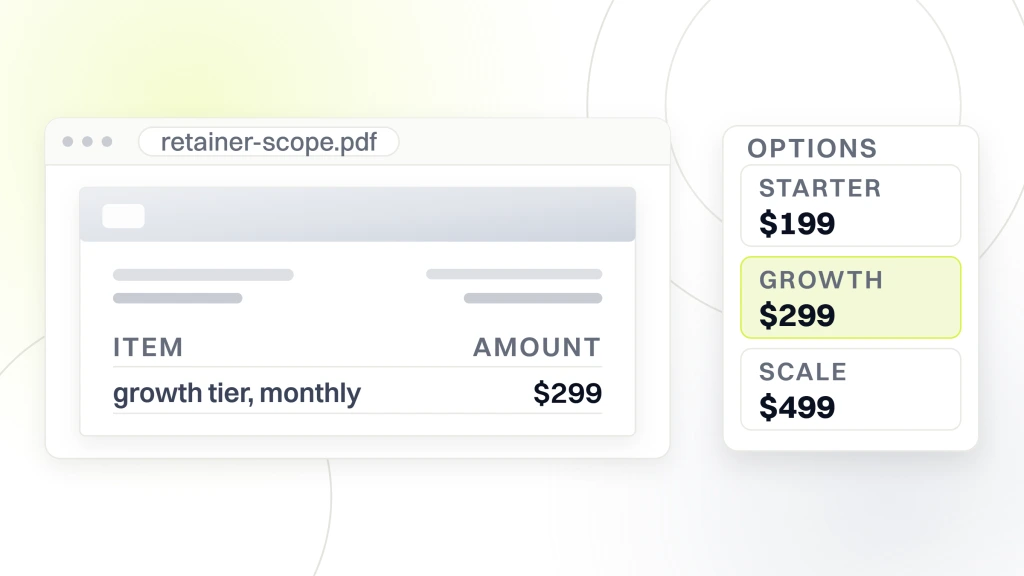
| Deliverable | Starter ($199/mo) | Growth ($299/mo) | Scale ($499/mo) |
|---|---|---|---|
| Security patch cadence | Weekly | Weekly + zero-day watch | Weekly + custom code review |
| Backup frequency | Daily, 30-day retention | Daily, 60-day retention | Daily + hourly snapshot, 90-day retention |
| Uptime monitoring | 5-minute interval | 1-minute interval | 1-minute interval + integration health checks |
| Core Web Vitals reporting | Monthly | Weekly | Weekly per template |
| Checkout testing | Monthly, 3 devices | Weekly, 5 devices | Weekly, 8 devices + payment path smoke test |
| Flow and feed monitoring | Add-on | Included (Klaviyo, Meta, Google) | Included + subscription platform + 3PL |
| Monthly work hours | 2 hours (4 carryover) | 6 hours (12 carryover) | 12 to 20 hours (40 carryover) |
| Hosting | Bundled | Bundled | Bundled |
| Disaster recovery testing | Annual | Semi-annual | Quarterly |
| Account structure | Shared queue | Named lead | Named account owner |
The table assumes six-month contracts on every tier. Platform-side release cadences from Shopify, WooCommerce, and BigCommerce run on quarterly rhythms, and a retainer needs at least two quarters to prove the recurring model against the store’s actual failure patterns. Founders that push for shorter commitments usually get quoted 20% to 35% higher monthly rates so the vendor can price in churn risk. Our writeup on ecommerce maintenance and support SLA covers the operating workflow behind the retainer.
Founders on our pay-monthly build path can also pair maintenance with a build plan at $199 or $349 per month. That structure keeps the build and the maintenance on the same invoice, and the tier upgrade path stays clean when the store crosses a revenue breakpoint.
Platform-specific differences inside a monthly retainer
Monthly work looks different on Shopify, WooCommerce, and BigCommerce. Each platform carries its own update cadence, security surface, and app ecosystem. Retainers that ignore the platform difference and quote a flat scope usually miss the specific work each platform truly needs.
Shopify retainer scope specifics
Shopify retainers focus on app stack hygiene, theme upgrade compatibility, and checkout extensibility as the platform migrates from checkout.liquid to Checkout Extensibility. Every installed app carries a monthly monitoring line, and stores past 25 installed apps usually have 3 to 5 apps duplicating functionality that could be consolidated to save monthly SaaS spend.
Theme upgrades on Dawn, Impulse, or a custom theme need testing against every product template, cart drawer, and dynamic checkout button before promoting to production. Shopify Function and custom app code needs its own review cadence. The platform’s marketplace review does not catch every edge case, and stores using Functions for discount logic have specific failure modes that only appear during high-traffic promotional windows. The WordPress.org platform documentation covers the WordPress core side for founders comparing platforms at contract time.
WooCommerce and BigCommerce retainer scope specifics
WooCommerce retainers focus on plugin update sequencing (covered deeper in our ecommerce wordpress website maintenance writeup), WordPress core compatibility, and hosting-layer optimization. WooCommerce stores run on managed hosting we bundle inside the tier, and the retainer covers server-side tuning, PHP version upgrades, and MySQL query optimization.
Retainers should include a staging environment on the same hosting stack for every update, and stores running under 30 plugins should stay that way rather than adding plugins to solve problems a paid plugin already handles. BigCommerce retainers focus on Stencil theme update compatibility, API script health, and multi-storefront coordination for brands running B2B and DTC on separate storefronts. Each platform has its own failure modes, and a good scope prices the platform-specific work into the tier rather than treating it as an add-on the founder discovers on the first invoice.
What lives outside every package as scoped add-ons
Real packages come with honest limits on scope. Some workstreams need their own scope, their own budget, and their own team. Bundling them into a maintenance retainer produces a package where nothing gets executed at the depth the store needs.
The five workstreams that should stay outside the retainer
New feature development past small edits belongs in a separate scope with its own timeline, testing plan, and budget. Migration work between platforms belongs in a project engagement. Migrations run 6 to 14 weeks and require sequenced launch planning the retainer cadence does not fit.
Design system overhauls, template rebuilds, and headless replatform projects belong outside. They change the surface area the retainer covers. Paid marketing management runs on a different weekly cadence and needs media buyers, not maintenance developers. SEO retainers run on their own quarterly cadence with content and technical work that maintenance vendors do not usually staff for. Our ecommerce marketing retainer covers the paid, organic, and creative workstreams that sit alongside a maintenance plan for brands running the full stack under one shop.
How honest scoping saves the founder from the everything package trap
The everything package trap happens when a vendor quotes a $2,500 monthly retainer that supposedly covers maintenance, SEO, paid, design, and content, and then produces mediocre work on every line. The retainer cannot fund proper depth on any single workstream.
Founders reading a proposal that claims to include 5 channels for one price should ask which specific hours per week go to which workstream, and how the vendor prevents any one channel from eating the others when a problem hits. Real scopes stay narrow and honest on limits, and the founder buys the adjacent workstreams as separate retainers with their own accountable teams. That structure produces better work on each line than the bundled quote, at a total spend usually within 10% to 20% of the everything package price.
How tier selection happens on a real kickoff call
Tier selection happens inside the first hour of the kickoff call, not a form the founder fills out before signing. The right tier depends on annual revenue, platform, app stack depth, integration count, and the founder’s own tolerance for handling small edits without vendor help on the day.
The seven questions our team asks on the tier-selection call
- What is trailing 12-month revenue and the growth rate quarter over quarter across the last 4 quarters.
- Which platform runs the store, and which version of the theme or template sits in production.
- How many apps or plugins are installed, and which 3 carry the highest revenue impact if they fail.
- Which integrations exist beyond the platform (ESP, subscription, 3PL, ERP, PIM, review platform).
- What broke in the last 90 days and how long each incident took to resolve.
- Who else touches the site (in-house dev, freelance agency, prior vendor) and how handoffs get documented.
- What monthly retainer budget feels honest against the store’s marketing line, and where the founder wants insurance versus optimization.
The 7 questions above sort most stores into the right tier inside 45 minutes. The answers reveal the actual failure surface the retainer needs to cover. Stores with 12 installed apps and no subscription platform slot into Starter or Growth depending on revenue. Stores with 40 installed apps, a Recharge subscription program, and a 3PL integration slot into Scale regardless of revenue. The integration surface area demands it. Founders that skip the selection call and pick tier by price usually replay the tier upgrade conversation inside 90 days when the store’s first real incident exceeds the wrong-tier deliverable list.
A real ecommerce maintenance package engagement in production
RAFZ Cirkulära Interiörer, a Swedish sustainable furniture DTC brand, came to our team in 2023 with a plugin-heavy WooCommerce site pushing past 15 seconds to load and a checkout that failed intermittently on mobile Safari and Chrome for Android. The store had no retainer in place. The prior vendor charged hourly and had not touched the site in 5 months. Revenue was flat and the conversion rate sat under 1.6%, driven partly by the load-time drag.
Our team ran a full site rebuild as a project engagement and then rolled the store onto a Growth tier plan at $299 monthly. The retainer covered weekly Core Web Vitals reporting against the rebuilt templates, weekly checkout testing across 5 devices, plugin update sequencing on a staging environment, daily backups with 60-day retention, and a place2place API integration with monthly monitoring for the sustainability tracking the brand runs on every SKU. The retainer included 6 hours of monthly development work rolling into the next month, which the founder used for seasonal template tweaks and small product-launch pages.
Across the following 12 months on the retainer, the site held under 2 seconds fully loaded across desktop and mobile, server request count stayed 82% below the pre-rebuild baseline, and the conversion rate held at 28% above the pre-engagement number. The plan caught two silent plugin conflicts inside quarter two that would have produced checkout errors during promotional windows, and one Klaviyo flow deliverability regression inside quarter three that would have cost about 4% of monthly revenue if it had run for 3 weeks unnoticed. The retainer paid back inside its first quarter on the caught failures alone. That is the pattern real plans should produce for growing DTC brands past the $1M annual revenue mark.
Where the retainer fits the broader DTC stack
An ecommerce maintenance package sits at the operational floor of every DTC marketing stack we run. Every acquisition dollar spent on paid, organic, email, and creative depends on a store that stays fast, buyable, and safe. Founders that budget for acquisition without funding maintenance usually run into an incident inside 12 months that undoes a quarter of paid spend, and the conversation gets forced by an outage rather than chosen at planning time.
How maintenance ties into the retainer stack alongside SEO and paid
Most DTC brands past $1M annual revenue run 3 retainers side by side. A maintenance retainer covering the store health. A paid media retainer covering Google Shopping, Meta, and TikTok Shop. An SEO retainer covering category pages, comparison content, and technical hygiene. The 3 retainers share monthly reporting so the paid manager knows what the vendor is patching, the SEO team knows what the vendor is deprioritizing, and the maintenance vendor knows what the paid team is scaling into that might change the store’s traffic mix. Our ecommerce marketing agency hub covers the combined retainer scope for founders running all three under one shop.
What honest scoping looks like at signing
Honest scoping at signing pins down a written list of monthly deliverables, a named account owner or shared queue depending on tier, a documented escalation path for incidents, and a monthly report format the founder will read on the first of the month. Retainers start at $199 per month on Starter for stores under $500K annual revenue, hold at $299 on Growth for stores between $500K and $3M, and land at $499 on Scale for stores past $3M with multi-system integrations.
Six-month contracts are standard. Platform release cadences and validation both need two quarters to run their proper cycle. Founders comparing scopes across vendors before signing should ask for the deliverable list, the escalation path, and the sample monthly report from 3 referenceable current clients. Founders scoping cross-stack cadence should read our companion writeup on ecommerce platform maintenance best practices for the per-platform update, backup, and monitoring workflows.
See our fashion website maintenance guide for the apparel-specific playbook that pairs with this framework.
Fashion brands running weekly drops need a hosting layer sized for spiky traffic rather than steady load. Our drop-day fashion website hosting playbook walks through the sizing math and the CDN pipeline that carries the peaks.
Pick the right ecommerce maintenance package tier and lock the scope
The right tier ties back to store revenue, integration count, and the founder’s tolerance for handling small edits without vendor help. Starter at $199 monthly covers stores under $500K. Growth at $299 monthly covers stores between $500K and $3M. Scale at $499 monthly covers stores past $3M with multi-system integration. Hosting is bundled in every tier, and six-month contracts hold the pricing steady across the validation window. Founders that want to talk through their store’s specific numbers can send the trailing 12-month revenue, platform, and app count, and our team will name the right tier on the first call.