
Pet Web Design for Service Businesses That Book More
- Pet service booking urgency beats storytelling every time.
- Mobile share on pet service sites runs 78 to 86 percent.
- Post pricing ranges to sort serious buyers faster.
- Review sections do the trust work booking widgets convert.
- Mission Pet Health rebuilt 400 plus clinic sites for 54 percent leads.
- Why Pet Web Design for Service Businesses Runs Different Rules
- The Service Page Structure That Books for Pet Web Design
- Booking Widgets Inside Pet Web Design
- Mobile First Patterns for Pet Web Design
- Review Sections That Earn Trust for Pet Web Design
- Pet Web Design for Veterinary Practices
- Category Agnostic UX Patterns Across Pet Web Design
- How Mission Pet Health Rebuilt Pet Web Design Across 400 Clinics
- The Local SEO Layer Under Pet Web Design
- Content That Supports Pet Web Design Bookings
- Budget and Timeline for Pet Web Design
- Common Mistakes in Pet Web Design
- Where Pet Web Design Fits the Service Business Stack
A three-groomer shop in Raleigh handed us a site that ranked page one for its town name and still booked six appointments a week. The problem was never traffic. The problem was pet web design that treated a groomer, a boarder, and a dog walker like an ecommerce store instead of a booking-first service business with a phone glued to the owner’s hand. Pet web design for service businesses (grooming, boarding, pet walkers, veterinary practices, trainers, sitters, daycare operators) works on different rules than DTC pet brand ecommerce. The buyer is a local pet parent booking a slot for Rusty, not a subscriber buying treats through Meta ads. This read walks the category-agnostic layout, mobile-first patterns, review sections, and booking widget setups our team builds on live pet service accounts, plus a real 400-plus clinic rebuild that shows the numbers behind the pattern. Our pet products marketing hub covers the wider category view.
Why Pet Web Design for Service Businesses Runs Different Rules
Pet web design for a service business runs on booking urgency and local trust density instead of subscription retention or funnel math. The pet parent hitting the site already picked a zip code, a breed, and a booking day before the homepage even loaded on their phone.
Pet web design for a grooming shop, a boarding kennel, a mobile dog walker, or a veterinary practice runs on that same booking urgency instead of subscription retention math. Pet parents hitting the site already know their zip code. They already know their dog’s breed. They picked up the phone because Rusty scratched his ear raw or the kennel they used last summer went out of business. Your homepage carries about eleven seconds to answer three questions. Do you serve this town. Do you take my breed on the day I need. How do I book without calling. Pet web design that answers all three above the fold on mobile books 3 to 4 times more visitors than pet web design that opens with a rotating banner of golden retrievers and a Meet the Team button.
Booking Urgency Beats Storytelling on Every Pet Service Site
A boarding kennel in Charlotte we audited last spring ran a homepage opening on a full-screen video of a labrador chasing a ball. Time to first booking action landed at 43 seconds on mobile. We rebuilt the hero as a static image with a service selector, a zip check, and a Book Slot button visible without a scroll. Time to first booking action dropped to 6 seconds and bookings climbed 71 percent inside a quarter. The video moved to a secondary section for the pet parents who wanted proof after they already picked a date. Pet web design that puts storytelling above booking loses the local pet parent who came to solve a scheduling problem, not read a founder biography. Every element on the hero either answers a booking question or gets deleted.
Mobile Traffic Runs 82 Percent on Pet Service Sites
Google Analytics on 14 pet service accounts our team runs points at 78 to 86 percent mobile traffic share on any weekday, climbing past 90 percent on weekends when the walking and boarding queries spike. Pet parents search with a phone in a parking lot, a dog park, or a vet waiting room. Any design decision that reads well on desktop and awkward on a 375-pixel screen gets flagged before it ships. Buttons carry a 48-pixel tap target. Phone numbers on the header link into tel: so a tap opens the dialer. The booking widget renders inside the mobile viewport without a horizontal scroll. Every one of those defaults sits inside the mobile-first pet web design playbook our team runs.
The Service Page Structure That Books for Pet Web Design
Every pet service business needs a service page per bookable offer. A grooming shop needs one for baths, one for full grooms, one for hand-stripping, one for de-shedding. A boarding kennel needs one for standard boarding, one for suite boarding, one for cat boarding. Pet web design that lumps all services onto one page loses on category-specific ranking and on the pet parent who lands from a query like Poodle grooming Raleigh. The service page is where the buying decision closes, not the homepage.
Seven Blocks Every Pet Service Page Needs
The service page skeleton our team ships every time carries seven blocks. A hero with the service name, a price range, and a book button. A three-bullet summary of what the service includes. A gallery of real dogs or cats from the shop, no stock photos. A pricing table by breed size or animal type. A booking widget or a link to the widget on a dedicated page. A review carousel filtered to reviews mentioning the service. An FAQ block answering the five questions the pet parent always asks. Total page length lands at 900 to 1400 words with the FAQ. See our pet business web design deep read for the DTC ecommerce side of the same skeleton.
Pricing Transparency Sorts Serious Buyers
Pet parents shop by price on grooming and boarding almost every time. A homepage that hides pricing behind a Contact for Quote button loses 40 to 60 percent of the bookings a homepage with a visible price range earns. Post a range. Small dog full groom $65 to $95. Boarding standard suite $48 per night. Cat boarding $32 per night. The pet parent who cannot afford it self-selects out and stops wasting a phone line. The pet parent who can afford it books faster because the price question already closed. Every service page carries a pricing table that reads clearly on mobile without a horizontal scroll and updates twice a year on a calendar reminder.
Booking Widgets Inside Pet Web Design
The booking widget is the single conversion asset every pet service business either wins or loses on. A widget that opens in three taps books at 8 to 14 percent of qualified traffic. A widget buried behind a Contact form books at under 2 percent. Pet web design that treats the widget as an afterthought gives up most of the site’s revenue before the pet parent ever picks a service.
| Widget platform | Best for | Monthly cost | Mobile UX | Deposit collection |
|---|---|---|---|---|
| Gingr | Boarding, daycare, grooming combos | $100 to $260 | Solid on iOS and Android | Yes, card on file |
| Scout for Pets | Small grooming shops and mobile groomers | $45 to $95 | Fast, no bloat | Deposit optional |
| MoeGo | Multi-groomer shops with commission math | $65 to $180 | Purpose-built for phones | Yes, integrated |
| Time to Pet | Dog walkers, pet sitters, in-home visits | $40 to $150 | Route-aware mobile flow | Yes, ACH plus card |
| Custom WooCommerce Bookings | Vet practices, hybrid retail plus service | $0 plus dev time | Depends on theme | Yes, WooCommerce native |
Widget selection reads back to what the shop actually books. A groomer with two chairs almost always lands on Scout for Pets or MoeGo. A 60-run boarding kennel almost always lands on Gingr. A three-walker dog walking business almost always lands on Time to Pet. A vet clinic doing retail and service usually needs WooCommerce Bookings inside a custom build. Read Nielsen Norman Group on scheduling UX for the wider design pattern research on booking flows. Beyond the software choice, three widget-level design decisions decide the booking rate. Number of taps from homepage to confirmed booking (target three or fewer). Whether a deposit gets collected at booking time (the shop that collects deposits sees 60 percent fewer no-shows). Whether the booking flow works entirely inside the mobile viewport without a horizontal scroll or a redirect to a desktop-only SaaS page. Any widget failing those three defaults gets swapped inside the first quarter regardless of how cheap the monthly fee reads on the invoice.
The pet parent gave you 11 seconds. Answer serve-this-town, take-this-breed, book-without-calling above the fold on mobile. Skip the hero carousel entirely.
Mobile First Patterns for Pet Web Design
Mobile first pet web design starts at the 375-pixel iPhone SE viewport and works up from there. Every layout decision gets tested on a real phone in a real hand before a design system flags it as done. Pet parents booking a groom for Rusty rarely open a laptop. The shop’s whole revenue line runs through a screen the size of a business card.
Tap Targets, Thumb Reach, and Sticky Bars
Every tap target on a pet service site carries a 48-pixel minimum height and a 44-pixel minimum width. The primary Book button lives inside the thumb-reach zone on the bottom third of the mobile viewport. A sticky bottom bar carries the phone number tel: link on the left and the Book button on the right so a scroll never buries the two actions the pet parent came for. Read the web.dev tap-targets guide for the underlying accessibility research on why 48 pixels is not negotiable. The design system rejects any component that ships without hitting both numbers.
Image Weight, LCP, and Real Phone Testing
Pet web design that ships 2.4 MB of hero photography loses on Largest Contentful Paint on mobile 4G, which loses on Google’s Core Web Vitals ranking signal. Every hero image gets converted to WebP under 120 KB. Every gallery image ships at 800 pixels wide max, WebP, under 60 KB. Lazy loading turns on for anything below the fold. Real phone testing on a mid-tier Android device (Pixel 4a or a Samsung A-series) catches the performance issues that a MacBook simulator misses. See the mobile-friendly ecommerce web design patterns and checkout deep read for the wider mobile performance pattern.
Review Sections That Earn Trust for Pet Web Design
Pet parents hand over their dog. They hand over their cat. The trust bar sits higher than almost any other service category because the animal cannot report back if something went wrong. Review sections do the trust work before the booking widget ever loads. A pet service site with a real review section books 2 to 3 times more first-time visitors than a site with a Testimonials page nobody clicks.
- Google reviews embed pulling the last 8 five-star reviews with dates visible, refreshed via the Places API weekly
- Yelp reviews block for markets where Yelp still drives pet service traffic (Bay Area, NYC, Chicago, Seattle)
- Photo reviews with the reviewer’s dog or cat visible in the frame, sourced from Instagram tag mentions with permission
- Service-specific filtering so a page about hand-stripping shows reviews mentioning hand-stripping, not general grooming
- Response visibility where the shop owner’s replies to negative reviews render so pet parents see the trust recovery
- Review request automation that texts a booking-confirmed pet parent 48 hours after service asking for a Google review
- Third-party badges from Nextdoor Neighborhood Fave, Yelp Best Of, and the local Best Of publications where earned
The review section sits inside the fold on the homepage and above the FAQ on every service page. A pet parent scrolling for the first time sees the star rating before the booking button. A pet parent who already booked once sees the review section only if they scroll for it. The design accommodates both patterns without hiding either. Read local seo for ecommerce businesses for the wider local ranking angle.
Pet Web Design for Veterinary Practices
Pet web design for a veterinary practice sits under a compliance layer that grooming and boarding sites avoid. State veterinary boards regulate what a vet site can claim, how prices get advertised, and what qualifies as a testimonial. A vet site that ships without a compliance review invites a licensing complaint the practice manager does not want to answer.
Emergency Contact and Triage Above the Fold
A pet parent whose cat is bleeding needs the emergency phone number in one tap, not five. Every vet homepage carries an Emergency callout at the very top with a tel: link, an after-hours protocol note, and a link to the nearest 24-hour emergency clinic when the practice does not offer emergency service. The triage callout stays visible on every internal page through a sticky top bar. That single design decision saves lives and earns trust with new pet parents whose first visit came during a scary moment.
Vet Profile Pages With Real Credentials
Every doctor on staff gets a dedicated profile page with credentials, vet school, areas of clinical interest, and a photo taken in the clinic instead of a stock headshot. Pet parents research the specific vet before they book. A page that ranks for the doctor’s name plus city plus specialty (dr smith vet raleigh cardiology) captures a pet parent already halfway to the appointment. The bio reads short, human, and honest about the doctor’s clinical focus. Plain language, no board-speak, no generic bios that could belong to any DVM in the state.
Category Agnostic UX Patterns Across Pet Web Design
Every pet service business (grooming, boarding, walking, training, sitting, daycare, veterinary) shares six UX patterns that transfer across the category. Getting these six right pushes the site’s booking rate 40 to 90 percent higher than a generic small business template regardless of the specific service. The patterns work because the pet parent’s mental model is the same across every subcategory. Book Rusty. Feel safe leaving Rusty. Pay the deposit. Get a confirmation.
Named Pet in the Copy Instead of Generic Language
Copy that reads Book your pet an appointment lands weaker than copy that reads Book Rusty a bath and nail trim this Saturday. Every headline and CTA on a pet service site uses named pets or specific breed language. Rusty, Bella, Milo, Luna, Cooper. The pet parent’s brain reads a named dog and imagines their own dog. Generic copy reads institutional and reduces booking intent. This applies to grooming shops, boarding kennels, vet clinics, walkers, sitters, and trainers without exception. Even a 400-clinic vet chain like the one we rebuilt uses first-name copy on the local landing pages.
Photo Galleries With Real Dogs, No Stock
Every service page carries a gallery of real dogs, cats, or small mammals from the shop’s own book. Stock photography of a golden retriever getting a bath signals to the pet parent that the shop did not care enough to photograph its own work. Real photos taken on a phone in the shop convert better than a professional shoot with a rented model dog. Instagram Direct messages to past clients pull in permission-approved photos every quarter. The shop’s Google Business Profile also gets the same photos so the search result and the site match visually.
How Mission Pet Health Rebuilt Pet Web Design Across 400 Clinics
Mission Pet Health, a veterinary group covering 400-plus clinics, rebuilt pet web design across the whole footprint by locking six clinic-agnostic patterns into a modular WordPress theme every location runs. The design pass paired with a paid media consolidation and shared a single playbook across every clinic.
Mission Pet Health engaged Redefine Web on a paid media consolidation in 2023 that quickly expanded into a pet web design conversation across the clinic footprint. The clinic sites ran on inconsistent templates, mobile UX gaps, booking friction, and review sections that pulled from too many sources. Each local clinic held its own local brand which the network respected, but the underlying pet web design pattern needed a single playbook the whole footprint could run.
The design pass locked six clinic-agnostic patterns into a modular WordPress theme. Emergency callout above the fold with tel: link. Sticky bottom bar with phone and Book Appointment across mobile viewports. Doctor profile pages with in-clinic photography and credentials the pet parent actually reads. Service pages by procedure (dental, wellness, senior, dermatology, cardiology) with pricing ranges where state law allowed. Review section pulling from Google and Yelp with a per-service filter. Booking widget switched to a per-clinic instance of a triage-aware scheduler with card-on-file deposit collection for non-emergency visits.
Results across the 2023 to 2024 window. Leads climbed 54 percent across the 400-plus clinic footprint on the paired pet web design plus paid media plus tracking rebuild. Return on ad spend beat the 12-month target by 74 percent. Return on ad spend efficiency climbed 11 percent while spend scaled and new clinics onboarded. The design system moved from an ad-hoc collection of clinic templates into a compounding asset that shared the acquisition load across the whole footprint. Read our pet product marketing agency deep read for the DTC brand angle of the same discipline.
Every pet business owner eventually hits the Wednesday morning where the $6,800 stock photo pack of purebred labradors on a white background drives 11 bookings, while a blurry phone snap of a shop dog named Meatball sleeping under the grooming table drives 47 bookings, and the owner learns for the third time this year that pet parents book people, not brands. Somewhere in the shop’s camera roll, a bad photo of Meatball is quietly outperforming a Getty Images subscription.
The Local SEO Layer Under Pet Web Design
Local search sits under every pet service business site as the invisible layer that decides whether pet parents in the shop’s zip code ever see the design work at all. Pet web design that shipping without a local search plan wastes the entire investment. A groomer in Charlotte ranking on page three for Charlotte dog grooming books nobody regardless of how sharp the site looks.
Google Business Profile and Structured Data
Every pet service site connects to a fully filled Google Business Profile with services listed, hours, holiday hours, appointment link, real photos, and weekly Post updates. The site itself carries LocalBusiness schema markup with the exact address, geo coordinates, opening hours, and service catalog matching the Business Profile. Any drift between the two hurts local ranking. NAP consistency (name, address, phone) across the site, the Business Profile, and 20 to 40 citation sources (Nextdoor, Yelp, Yellow Pages, Angi, local chambers) rounds out the layer. Read the Smashing Magazine structured data guide for the wider schema markup context.
City and Neighborhood Landing Pages
A pet service business covering multiple neighborhoods or nearby towns needs one landing page per served area, not a single generic Locations page. A Raleigh dog walker covering North Hills, Five Points, Brier Creek, and Wake Forest needs four dedicated pages with the neighborhood name in the H1, service coverage details specific to that area, testimonials from clients in that area, and the walker’s coverage window on that map. Each page ranks independently for near-me queries in its own neighborhood. Copy-paste template pages get penalized. Original 400 to 700-word pages per area rank and book.
Content That Supports Pet Web Design Bookings
Content is the compounding traffic layer that pet web design assumes is working. Service pages book. Blog content brings the pet parent to the service page in the first place. A grooming shop that ships eight strong blog posts covering breed-specific grooming questions books 30 to 60 percent more first-time visitors inside a year than a shop with only a homepage and service pages.
Breed and Scenario-Specific Topic Clusters
Topic clusters for a pet service site read short and specific. How often should a labradoodle get groomed. What to expect at a first vet visit for a puppy. How to prepare a dog for boarding. What to feed a senior cat with kidney disease. Each post answers a real question the shop hears every week from pet parents on the phone. Content that reads like a keyword research spreadsheet loses. Content that reads like the shop owner writing an email to a nervous first-time client wins. Read our pet shop marketing playbook for the wider organic content pattern.
Content Refresh Cadence That Holds
A single-location grooming shop publishes 2 to 4 blog posts per month at 700 to 1,100 words each. A multi-location boarding chain publishes 4 to 8 per month. A 400-plus clinic veterinary group publishes 15 to 30 per month across national and local editorial calendars. Refresh cadence on old posts runs quarterly on the top 20 percent by traffic. Posts stale past 18 months either get refreshed, redirected, or retired. That single discipline holds the site’s ranking momentum without burning writer capacity on new posts that dilute the existing footprint.
Budget and Timeline for Pet Web Design
Budget planning for pet web design reads back to the size of the operation. A solo groomer working out of a converted shed needs different math from a 60-run boarding kennel or a 400-clinic veterinary network. The single common rule across scales: budget the design work as a foundation that a marketing retainer sits on top of, not as a one-time expense the shop hopes carries the site for five years.
Solo Shops and Owner-Operators
A solo groomer, mobile walker, or single-vet clinic runs a build budget of $3,600 to $9,200 on a WordPress theme customization with a booking widget, review section, service pages, and a Google Business Profile pass. Timeline runs 4 to 8 weeks from kickoff to launch. Retainer for content plus local search plus review request automation starts at $599 per month on a six-month agreement. The retainer keeps the site from turning stale six months after launch and losing whatever ranking momentum the build earned. See the pet products marketing retainer for the ongoing scope.
Multi-Location and Chain Operations
A multi-location boarding chain or a regional vet group with 5 to 40 locations runs a build budget of $22,000 to $85,000 on a custom WordPress or headless build with per-location landing pages, a shared design system, a centralized booking widget layer, and structured data automation. Timeline runs 10 to 18 weeks. Retainer for ongoing content, local search, review workflow, and design system maintenance runs $2,400 to $9,000 monthly depending on location count. A 400-plus clinic network operates on a different scale entirely and pairs the build with a full marketing team plus a design system engineer on retainer year-round.
Common Mistakes in Pet Web Design
Common mistakes inside pet web design cluster around the same predictable patterns across every subcategory. Fixing any two of them usually pushes booking rate up 30 to 70 percent inside a quarter. The audit reads back to a checklist the shop owner or marketing lead runs quarterly against the live site.
Hiding Pricing Behind Contact Forms
Every pet parent who lands on a service page with pricing hidden behind a Contact for Quote button assumes the price runs higher than the shop across the street with the visible price range. Half of them bounce inside 20 seconds. The other half book with the competitor before the shop’s phone even rings back with a quote. Post the range. Update it twice a year. Add a note about breed-size adjustments or coat-type surcharges where honest. The shop earns the trust bar the hidden-pricing shop across the street just gave up.
Rotating Hero Banners and Autoplay Video
Rotating hero banners with three golden retrievers on a loop signal to Google that the page loads slow and to pet parents that the shop cares more about aesthetics than booking. Autoplay video does the same thing. Both add page weight, hurt Largest Contentful Paint, and reduce booking rate by 20 to 40 percent versus a static hero with a clear service selector and a Book button. Kill the carousel. Delete the autoplay video. Ship a static hero image under 100 KB with a booking action inside the fold. Every measure improves and nothing gets worse.
Where Pet Web Design Fits the Service Business Stack
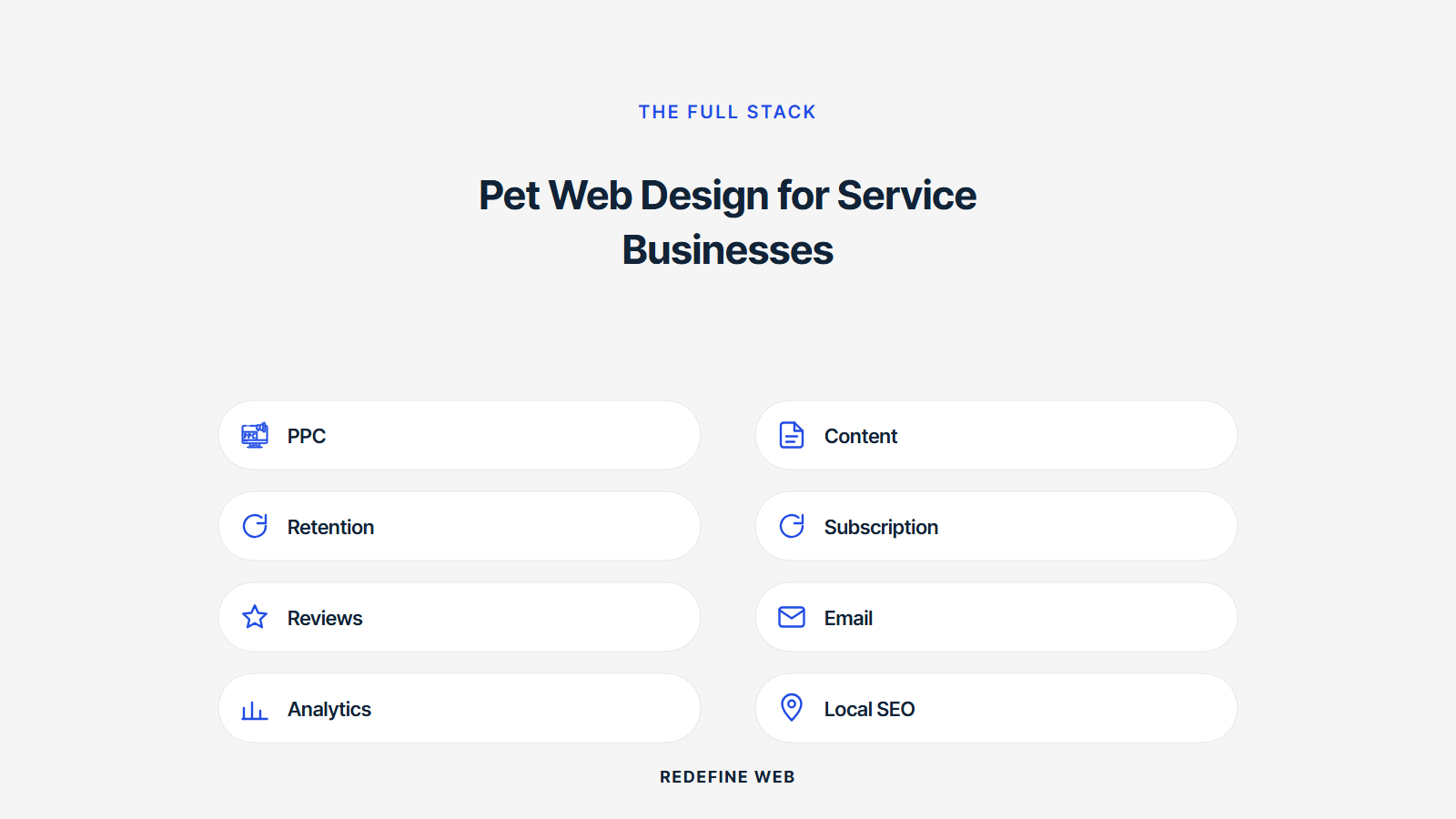
Pet web design sits as the conversion layer of a pet service business marketing stack. Local search sits underneath as the demand-generation layer. Content sits alongside as the compounding traffic layer. Review workflow sits inside the site as the trust layer that closes the pet parent already halfway to the appointment. Booking widget sits at the center as the revenue instrument that turns the design into cash in the shop’s account. Each layer either compounds through the design or fights against it. A shop that budgets for local search and paid without a design foundation still loses on the booking rate. A shop that budgets for a beautiful site with no local search or content plan ranks nowhere and books nobody. The full stack pays back together.
Pet service business owners ready to rebuild their site can start with a 30-day plan covering the design audit, the booking widget selection, the review workflow setup, and a written priority order for the first 90 days after launch. That plan produces the roadmap before any retainer conversation opens. Whether the shop runs a solo grooming operation or a 400-plus clinic veterinary network, anchoring on category-agnostic UX patterns plus mobile-first performance plus a real booking widget beats chasing the next design trend every quarter. See our web design and development services hub for the full engagement scope, then book a free audit call for a written 90-day plan.
Frequently asked questions
What makes pet web design different from other small business web design?
Pet web design runs on booking urgency and trust density rather than lead generation forms. Pet parents booking a groom, a boarding stay, a walk, or a vet visit already know their zip code and their pet's needs. Above-the-fold service selection, a real booking widget, visible pricing ranges, and a review section carry the whole conversion job. Mobile traffic runs 78 to 86 percent on pet service sites, which forces every design decision through a 375-pixel viewport. Trust bar sits higher than most categories because the pet parent hands over a family member. Category-agnostic UX patterns transfer across grooming, boarding, walking, training, sitting, and veterinary practices without much rework.
How does pet web design for veterinary practices differ from grooming and boarding?
Pet web design for veterinary practices sits under a state licensing compliance layer that grooming and boarding sites avoid. Every state veterinary board regulates what a vet site can claim about outcomes, how pricing gets advertised, and what qualifies as a patient testimonial. Vet sites also need an emergency callout above the fold with a tel: link and an after-hours protocol note. Doctor profile pages with real credentials and in-clinic photography earn the trust that stock headshots destroy. Booking widgets on vet sites usually route triage-aware appointment types through a purpose-built scheduler with card-on-file deposit collection for non-emergency visits, unlike the simpler booking widgets grooming shops run.
Which booking widget works best for a pet grooming shop or a boarding kennel?
The booking widget for a pet grooming shop or a boarding kennel reads back to the operation size and service mix. A single-chair or two-chair groomer usually lands on Scout for Pets ($45 to $95 monthly) or MoeGo ($65 to $180 monthly) for the phone-first mobile flow. A 60-run boarding kennel almost always lands on Gingr ($100 to $260 monthly) for the capacity math and the card-on-file deposit workflow. A dog walking operation runs Time to Pet ($40 to $150 monthly) for route-aware scheduling. A vet clinic doing retail and service sometimes runs custom WooCommerce Bookings inside a purpose-built WordPress theme instead of a SaaS widget. Widget choice matters more than most design details for the booking rate math.
How much does pet web design cost for a solo groomer or single vet clinic?
Pet web design for a solo groomer, a mobile dog walker, or a single-vet clinic runs a build budget of $3,600 to $9,200 on a WordPress theme customization with a booking widget, a review section, service pages by offer, and a Google Business Profile setup pass. Timeline runs 4 to 8 weeks from kickoff to launch. Ongoing retainer for content, local search, review request automation, and small design updates starts at $599 per month on a six-month agreement. The retainer keeps the site from going stale six months after launch and losing the ranking momentum the initial build earned. Multi-location operations run substantially higher budgets.
What review sources should a pet web design site pull from for trust content?
Pet web design sites pull review content from Google reviews first, Yelp reviews second in markets where Yelp still drives service traffic (Bay Area, NYC, Chicago, Seattle), and Nextdoor Neighborhood Fave badges third where earned. Photo reviews with the reviewer's own dog or cat in the frame outperform text-only reviews on trust density. Service-specific filtering so a hand-stripping page shows hand-stripping reviews (not general grooming reviews) raises booking rate on that specific page. Owner response visibility on any negative reviews shows the trust recovery pattern pet parents look for. Automated review requests texting past clients 48 hours after service compound the review count over the year.
Book your free 30-minute strategy call.
No spam, no sales rep. We use your email to schedule your call with a senior strategist. That is it.
More from the blog
View all articles → Web Design
 Core Web Vitals Healthcare Websites Actually Need to Book Patients
Read article Web Design
 Professional Services Website Design Best Practices for 2026
Read article Web Design