
Pet Products Website Maintenance for Subscription DTC Brands
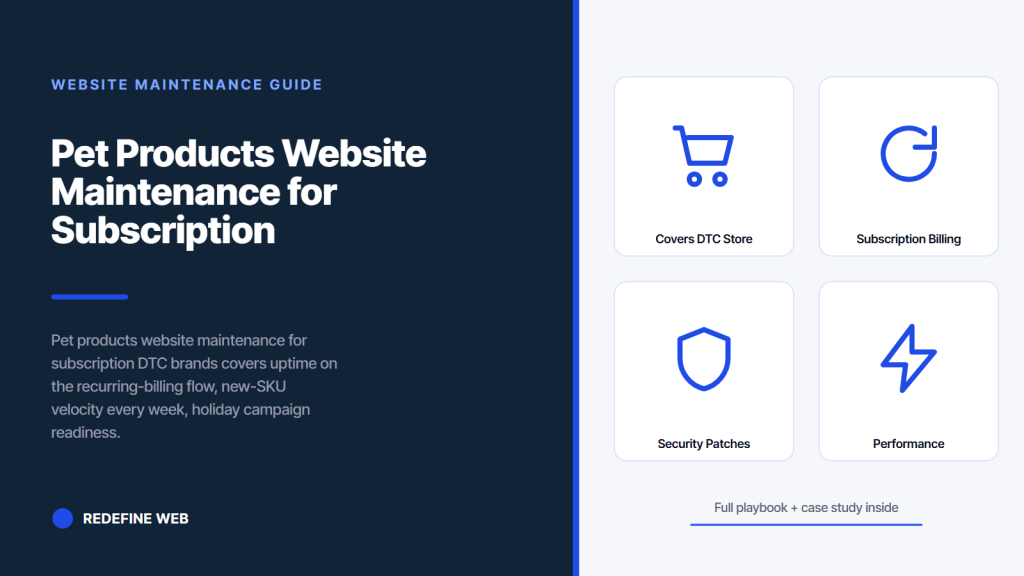
- Seven work streams cover pet DTC maintenance completely.
- Subscription billing uptime is the highest-stakes stream.
- SKU velocity needs a per-launch hygiene checklist.
- Holiday readiness is a 90-day sprint starting in August.
- Retainer at $599 covers small brands. Full tier runs $3,200.
- What pet products website maintenance covers on a DTC store
- Subscription billing uptime inside pet products website maintenance
- SKU velocity inside pet products website maintenance
- Holiday readiness inside pet products website maintenance
- Security patches inside pet products website maintenance
- Performance monitoring inside pet products website maintenance
- Backups and rollback inside pet products website maintenance
- Hosting under pet products website maintenance
- How much pet products website maintenance costs per month
- Who owns pet products website maintenance on the brand side
- A real pet products website maintenance retainer in production
- Where pet products website maintenance fits the marketing stack
Your subscription pet brand just crossed 6,400 active plans. Every Sunday night at 11:47 pm, the recurring-billing job runs, and every Sunday morning your ops lead checks the dashboard hoping it did not silently fail on 214 customers. A real pet products website maintenance retainer is what keeps that job green, keeps the checkout responsive when a Meta ad spikes traffic 12x during a treat launch, and keeps the plugin stack patched before the next PCI vuln shows up in a security bulletin. Pet DTC is a hard maintenance category because the site is doing three jobs at once: high-velocity ecommerce, subscription billing, and content marketing.
This is the maintenance retainer scope we run for pet DTC brands. What pet products website maintenance actually covers on Shopify and WooCommerce, how subscription uptime differs from one-off ecommerce, how weekly SKU launches change the patch window, what holiday readiness looks like on a pet store hitting Q4 volume, and what a retainer at $599 per month actually buys on the pet products marketing hub side of the business. Founders sizing the eco slice separately should also read our sustainable pet products market analysis alongside the wider category view.
What pet products website maintenance covers on a DTC store
Pet products website maintenance on a subscription DTC store covers seven distinct work streams that a generic web host never touches. Subscription billing uptime. Core platform patching. SKU launch support. Backup and rollback. Security scanning. Performance tuning. Monitoring plus alerting. Each stream has a distinct failure mode, and a real retainer runs all seven on a fixed weekly cadence. Read our pet web design for service businesses for the service-side view.
Seven maintenance work streams on a pet DTC store
- Subscription billing uptime: recurring-charge job health, dunning retry logic, failed-payment recovery flow.
- Platform and plugin patching: Shopify app updates, WooCommerce core, WordPress core, extension patches inside a 72-hour window.
- SKU launch support: new product entry validation, variant image checks, subscription-eligibility flag on new SKUs.
- Backup and rollback: hourly database snapshots plus daily full-site snapshots, tested restore drill once per quarter.
- Security scanning: malware sweeps, admin-login geolocation alerts, PCI scope check twice a year.
- Performance tuning: Core Web Vitals monthly report, image compression sweep, database index maintenance.
- Monitoring plus alerting: uptime checks every 60 seconds, checkout-flow synthetic tests every 15 minutes, on-call escalation.
Miss one stream and the whole retainer feels lightweight. Run all seven and the store operates like it has an internal ops team. That is the difference between generic web hosting and a maintenance retainer built for pet DTC. Every stream has a named artifact the client sees each month, which is what keeps trust intact through the year.
Subscription billing uptime inside pet products website maintenance
Subscription billing uptime is the highest-stakes stream inside pet products website maintenance. A pet subscription brand at 6,400 active plans processing $32 average order value runs $204,800 through the billing job every 30 days. A silent failure that catches 214 subscribers is $6,847 in missed revenue before anyone opens the ticket. That is why the billing job gets treated as a first-class service, not a plugin.
Recurring-charge job health checks
Every recurring-charge run gets a synthetic test that fires 90 minutes before the scheduled batch. The test creates a $1 test charge on a dedicated card, confirms the gateway responded, confirms the order webhook fired, and confirms the fulfillment flag flipped in the database. If any step fails, the on-call engineer wakes up. That gap between the test and the real batch is what gives the team time to hotfix a broken gateway integration before the 11:47 pm job runs. Brands relying on Shopify Recharge or WooCommerce Subscriptions without this pre-flight check discover breakages the same way their customers do: at 8 am Monday when 214 support tickets hit the inbox at once, which the founder then has to spend her Monday triaging instead of running the business.
Dunning and failed-payment recovery
Dunning is the automated retry sequence for failed payments. A tuned dunning flow recovers 34 to 52 percent of failed subscription charges. An untuned flow recovers 8 to 14 percent. The difference is a five-figure monthly line item at any brand past 2,000 active subscribers. Pet products website maintenance covers dunning as a quarterly review: retry timing, email copy freshness, SMS integration where the customer opted in, and card-updater service subscription so expired cards get refreshed before the retry window closes. Our ecommerce WordPress website maintenance and WooCommerce support guide covers dunning in more depth for WooCommerce stores specifically.
SKU velocity inside pet products website maintenance
Pet DTC brands run at a SKU cadence most maintenance retainers were never built for. A treat brand launches 3 to 5 new flavors every quarter. A supplement brand adds 2 breed-specific SKUs monthly. A toy brand pushes a new plush variant every two weeks. That volume means the maintenance workflow needs a launch-checklist step that runs on every new SKU, not just at quarterly retros.
New-SKU maintenance checklist
- Variant SKUs, weights, and dimensional data match the ERP master record.
- Product images uploaded at 2000 x 2000 minimum with alt text populated.
- Subscription-eligibility flag set correctly (some SKUs are subscribe-only, some are one-time-only, some are both).
- Product schema validates in Google Rich Results Test.
- Related products block includes the top 3 semantically adjacent items.
- Collection assignment covers primary and cross-sell collections.
- Analytics event mapping fires purchase, add-to-cart, and view-item on the new SKU.
Seven checks per SKU. On a brand launching 5 SKUs per month, that is 35 checks per month at 4 to 6 minutes each. Total: about 3 hours monthly of pure SKU hygiene work. Brands that skip this end up with product pages missing schema, subscription flags wrong, and analytics events not firing, which means the paid team sees garbage attribution data and makes bad budget decisions on the back of it. Full pattern is covered in our ecommerce website maintenance checklist monthly quarterly annual.
Subscription silent failures compound. Before Black Friday, force-fail a test card and watch the dunning flow. If retries don't fire in 3 days, that's your Q4 churn.
Holiday readiness inside pet products website maintenance
Pet DTC Q4 volume runs 4 to 7 times the summer baseline. National Pet Day in April, Adopt a Shelter Pet Day in October, Black Friday, Cyber Monday, and Christmas each drive spike traffic that can crash a Shopify store on a starter plan or a WooCommerce site on a shared host. Holiday readiness is a 90-day maintenance sprint that starts in August, not a stress test the week before Black Friday.
| Milestone | Window | Work stream | Fail mode if skipped |
|---|---|---|---|
| Load test the checkout | Aug 15 to Sep 5 | Performance | Cart timeouts at 8x baseline traffic |
| Hosting plan review and upgrade | Sep 1 to Sep 15 | Infrastructure | Store falls over during BFCM peak |
| Gateway rate-limit sanity check | Sep 15 to Oct 1 | Billing | Payment failures at high burst rates |
| Freeze on non-critical plugin updates | Nov 1 to Dec 26 | Change control | Plugin update breaks Q4 conversion |
| Rollback drill on the staging site | Oct 15 to Nov 1 | Backup | No safe recovery if a launch breaks live |
| On-call schedule with named engineers | Nov 15 to Dec 31 | Ops | Nobody answers when checkout goes down |
Load testing that maps to real traffic patterns
The load test that matters is not a synthetic 500-user concurrency check. The real test simulates the traffic pattern of a Meta ad spike: 400 concurrent product-page views for 20 minutes, 180 concurrent add-to-cart requests, 90 concurrent checkout initiations, and 60 concurrent payment confirmations. Tools like k6, Loader.io, and BlazeMeter run this pattern for around $180 per run. A pet products website maintenance retainer includes 2 to 4 load tests in the September window and reports back the exact bottleneck. Usually it is the theme’s product page hitting an N-plus-one query on inventory data, or a plugin firing a slow API call on add-to-cart. Both are fixable in a 2 to 4 hour window if caught in September rather than Black Friday morning.
Security patches inside pet products website maintenance
Pet DTC stores hold credit card tokens, subscription customer PII, and shipping addresses. That data attracts drive-by attacks the same as any ecommerce store, but the maintenance side rarely gets the same rigor a bank IT team applies. A real security posture for pet products website maintenance runs weekly plugin patch reviews, a monthly malware sweep, and a twice-a-year PCI scope audit.
Patch windows that hold Q4 change freeze
Every plugin patch gets triaged inside 72 hours of release. Critical CVEs get pushed to staging the same day, tested against a synthetic checkout flow, and released to production inside the maintenance window that night. Non-critical patches batch weekly. Between November 1 and December 26 the store enters a change freeze where only critical CVEs get patched and everything else waits. That protects Q4 conversion rates from a plugin update quietly breaking the subscribe-and-save flow the night before Cyber Monday. The WordPress core update documentation covers the basic pattern, though production stores need the tighter workflow the retainer runs.
Malware sweeps and login geolocation
Monthly malware sweeps catch skimmer scripts injected by compromised third-party analytics tools, drive-by cross-site scripting inserted through a compromised plugin, and payment-form Magecart-style attacks. Login geolocation alerts fire when an admin session shows up in a country nobody on the team is in. Together they catch 90 percent of pet-store compromises before customer data escapes. The remaining 10 percent get caught by twice-a-year external penetration testing, which every store past $1M annual revenue should be running. Skipping this ends up with a store that reads clean on the surface and quietly exposes card data through a supply-chain attack for six months.
Performance monitoring inside pet products website maintenance
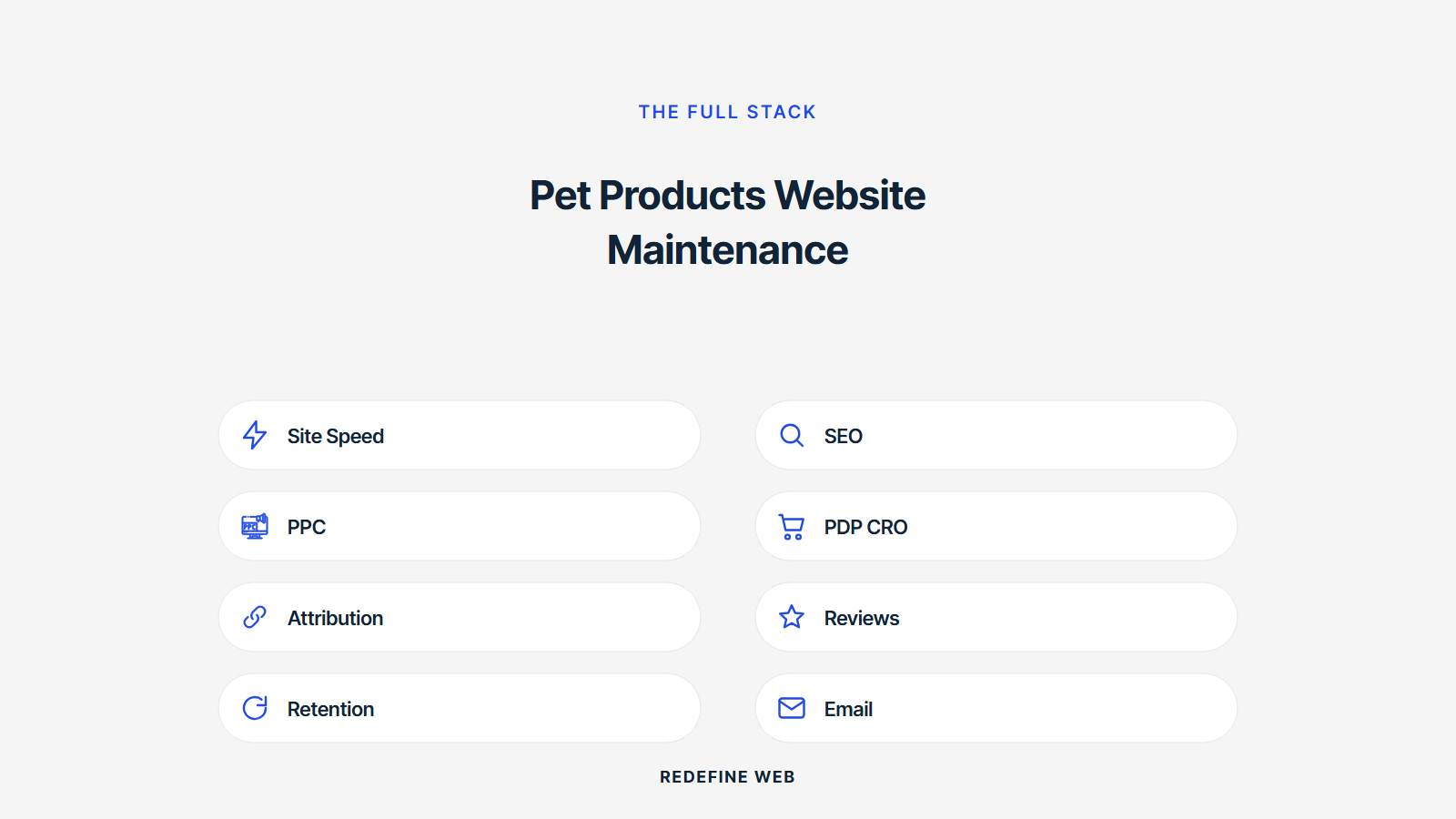
Performance monitoring covers Core Web Vitals, uptime, and checkout latency. Each has a distinct measurement stack, a distinct threshold, and a distinct remediation path when the number drifts. Pet DTC brands rarely track all three, which is why performance drift only shows up in the quarterly revenue report when it is already a two-month problem.
Core Web Vitals thresholds for pet ecommerce
Largest Contentful Paint under 2.5 seconds on 75 percent of visits. Interaction to Next Paint under 200 milliseconds on 75 percent of visits. Cumulative Layout Shift under 0.1. Pass all three and Google’s page experience signal is neutral to positive. Fail any one and organic rankings drift down 3 to 8 positions on high-competition collection keywords. The monthly report from pet products website maintenance shows the numbers per template (product page, collection page, cart, checkout) so the fix work targets the actual failing page instead of guessing.
Uptime and checkout latency alerts
Uptime checks fire every 60 seconds from three geographic regions. Any check that fails twice in a row triggers an alert. Checkout latency gets measured through a synthetic transaction that walks add-to-cart, view-cart, checkout page load, and payment method selection every 15 minutes. If the p95 latency exceeds 4 seconds on any step, the on-call engineer wakes up. Both patterns are covered in our ecommerce platform maintenance best practices across stacks guide.
Backups and rollback inside pet products website maintenance
Backup work only matters if the restore actually works. Pet DTC stores get complacent about backups because the backup dashboard shows green every day, but the restore drill never happens. When a bad plugin update takes down the store at 2 pm on a Wednesday, the team discovers the backup was corrupt three months ago and nobody noticed.
Backup frequency and retention windows
Hourly database snapshots retained for 7 days. Daily full-site snapshots retained for 30 days. Weekly full-site snapshots retained for 12 weeks. Monthly full-site snapshots retained for 12 months. Off-site copies to a different cloud region so a single-region outage does not take out both the site and the backups. That storage costs $40 to $110 per month depending on database size, which is a rounding error against the revenue exposure of a lost store.
Restore drill cadence and pass criteria
Once per quarter, the maintenance team spins up a staging environment from the most recent daily snapshot and walks through the store as an admin, as a subscriber, and as a first-time buyer. The drill passes if the staging site renders correctly, subscriptions display their next billing date, historical orders show up in the admin, and a fresh test purchase completes end to end. If any step fails, the backup pipeline gets fixed that week. Skipping the drill is how brands discover their backups have been silently broken since March when they need to restore in November. Full retention math is covered in the ecommerce website maintenance cost breakdown and benchmarks.
Hosting under pet products website maintenance
Hosting is the layer under the maintenance work. A great retainer on bad hosting still produces a slow, fragile store. The right hosting tier depends on the platform (Shopify vs WooCommerce vs custom), the traffic pattern (steady vs spiky), and the subscription volume (0 to 100k active plans).
Shopify hosting tiers by revenue
Shopify Basic works up to about $30k monthly revenue. Shopify plan handles up to $80k monthly. Shopify Advanced handles up to $500k monthly with better checkout customization. Shopify Plus starts making sense at $500k monthly plus, especially for brands running heavy subscription volume through Recharge, Bold, or a custom subscription setup. The pet products website maintenance retainer includes a quarterly hosting-tier review to catch stores that grew past their plan without upgrading, which is a common cause of Q4 checkout slowness.
WooCommerce managed hosting by traffic
WooCommerce stores below 30k monthly visitors do fine on Kinsta, WP Engine Ecommerce, or Rocket at $50 to $200 monthly. Between 30k and 200k monthly visitors, move to Cloudways autoscaling, Pressable, or a comparable managed cloud host at $300 to $900 monthly. Above 200k monthly visitors, dedicated hosting with a CDN and edge caching runs $1,200 to $4,000 monthly. The Kinsta ecommerce hosting guide is a useful reference. The wider tier framework shows up in our ecommerce maintenance package tiers and pricing guide.
How much pet products website maintenance costs per month
Retainer pricing at Redefine Web starts at $599 per month for pet products website maintenance and runs up to $3,200 per month for full-service on a subscription pet DTC store past $1M annual revenue. Six-month contracts are standard. What separates the tiers is subscription volume, plugin count, and holiday-window on-call intensity.
Entry tier at $599 per month
The $599 per month tier covers a single-platform pet DTC store on Shopify or WooCommerce with under 2,000 active subscribers, a plugin count under 20, and up to 40k monthly visitors. It includes weekly patch review, monthly performance report, hourly database backups, uptime monitoring, and a 4-hour response SLA on business days. Small brands and pre-seed founders start here. It does not cover holiday on-call, custom subscription work, or emergency incident response outside business hours. Brands that need those add either a la carte hours or move to the mid tier.
Mid and full tier pricing
The mid tier at $1,200 to $1,800 per month covers stores with 2,000 to 15,000 active subscribers, includes 24×7 on-call during November and December, quarterly load testing, and a 1-hour response SLA. The full tier at $2,400 to $3,200 per month covers stores above 15,000 active subscribers, includes year-round 24×7 on-call, monthly load testing, dedicated Slack channel with the ops team, and a 15-minute response SLA. Brands past $1M annual revenue and 25k active plans usually start at the full tier and stay there. The full tier structure is documented on our pet products hosting maintenance hub page.
Who owns pet products website maintenance on the brand side
Named ownership on the brand side is what turns a maintenance retainer from a set-and-forget expense into a real operating partnership. The pattern that fails at every scale is when nobody at the brand owns the relationship and the retainer becomes background noise until something breaks.
Ownership by store size
Under $50k monthly revenue: the founder owns the retainer relationship and reviews the monthly report herself. $50k to $250k monthly: an operations coordinator or head of ecommerce owns it. $250k to $1M monthly: a VP of operations owns it with a technical lead in the loop. Above $1M monthly: a director of engineering or head of ecommerce infrastructure owns it, often with an internal ops engineer coordinating handoffs on incidents. Whichever level the store is at, the owner reads the monthly report, joins the quarterly strategy call, and knows the on-call escalation path by heart. Without that, the retainer becomes a compliance line item that gets renewed each year without anyone knowing whether it earned its keep.
Reporting cadence and incident post-mortems
Monthly report covers uptime, patch queue status, backup health, security scan results, and Core Web Vitals per template. Quarterly strategy call covers upcoming platform migrations, holiday planning, and cost review. Every incident above P2 gets a written post-mortem inside 5 business days covering what happened, what fixed it, and what changed to prevent recurrence. That paper trail is what protects both sides during a founder change, an agency change, or a legal discovery event. Brands past $500k monthly revenue that skip incident post-mortems tend to repeat the same P2 incident three or four times per year, which the operations lead only notices when the ops team compiles the annual review and sees the same root cause five times in a row.
Every pet DTC maintenance meeting eventually reaches the moment where someone asks about the plugin called Ultra Slider Deluxe Pro that has not been updated since 2021 and is silently loading 340 kilobytes of jQuery on every page. Nobody remembers installing it. The previous agency swore it was needed for the homepage carousel. The homepage carousel was removed 18 months ago. Somewhere on the archive of every pet ecommerce site, a Slider Deluxe Pro plugin from 2021 is quietly loading more jQuery than the entire treats collection page.
A real pet products website maintenance retainer in production
Mission Pet Health, a veterinarian-owned network of 400-plus animal hospitals, came to us with a fragmented digital infrastructure across the network. Every location ran its own web presence with no shared maintenance pattern, no consistent security posture, and no shared incident response. The result was recurring outages that took two or three days to resolve because nobody at the network had a full picture of the stack.
Our team built a shared maintenance framework covering the primary network site and the 400-plus location micro-sites. Patch windows aligned across the network. Backup and monitoring standardized on a single stack. Incident response consolidated under one on-call rotation. Twelve months in, the network reported 54 percent year-over-year lead growth on the paid side and 74 percent return-on-ad-spend improvement, both underpinned by a checkout and booking flow that stopped crashing during peak paid media pushes. Uptime moved from 99.2 percent to 99.94 percent on the primary property. Incident-response mean time to recovery dropped from 4.2 hours to 41 minutes.
The pattern generalizes across every pet DTC engagement we run. A brand at $300k monthly revenue does not need a 400-site rollout, but the same seven work streams still apply. Uptime, patching, SKU support, backups, security, performance, and monitoring. Run all seven with named ownership on both sides, real cadence on both sides, and honest incident post-mortems on both sides, and the store stops feeling fragile through Q4 and into the January refresh. The SLA math and workflow guide inside the wider ecommerce category covers the same tier-sizing pattern for brands calibrating their retainer.
Where pet products website maintenance fits the marketing stack
Pet products website maintenance sits underneath every other marketing investment. Paid media, SEO, email, and content all assume the store renders correctly, the checkout works, the subscription billing runs, and the site does not go down when the ad account spends. Break any of those assumptions and the marketing spend above pours money into a broken funnel.
Brands that treat maintenance as an afterthought discover its importance the hard way, usually in November. Brands that budget for the retainer at the same rigor as the ad spend end up with a store that quietly runs while the growth work compounds on top. Google’s Core Web Vitals reference is the canonical resource for the performance measurement piece, and every founder should keep it bookmarked.
The parallel case in another DTC vertical is fashion website maintenance for apparel brands, which walks through similar subscription and seasonality patterns on the apparel side. Both verticals share the same underlying reality: heavy Q4 traffic, subscription billing on the recurring revenue base, and a plugin stack that grows faster than the ops team can keep up with. Pet brands that treat the maintenance retainer as core operating infrastructure rather than a discretionary line item see the difference within the first six months.
The broader vertical framing ties maintenance to the full growth stack including SEO, paid media, and email retention flows. Every marketing dollar spent above the maintenance layer performs better when the layer holds. That is the underlying case for treating pet products website maintenance as the foundation of the whole DTC operation rather than an afterthought tacked on when something goes wrong.
Frequently asked questions
What does pet products website maintenance cover on a DTC store?
Pet products website maintenance on a subscription DTC store covers seven work streams. Subscription billing uptime with pre-flight synthetic tests before every recurring-charge run. Platform and plugin patching on a 72-hour window for critical CVEs. New-SKU launch support with a 7-step hygiene checklist per SKU. Hourly database backups plus daily full-site snapshots with quarterly restore drills. Weekly plugin patch review plus monthly malware sweeps. Core Web Vitals reporting per template plus checkout latency monitoring. Uptime checks every 60 seconds from three regions plus 24x7 on-call during Q4. Retainers start at $599 per month and run to $3,200 at the full tier.
How is pet products website maintenance different from a normal web host?
A normal web host keeps the server running and patches the OS. Pet products website maintenance covers the application layer that pet DTC stores actually run on. Subscription billing job health checks. Dunning and failed-payment recovery tuning. SKU launch hygiene across 3 to 5 new SKUs monthly. Core Web Vitals reporting per template rather than site average. Holiday readiness including load testing that maps to real Meta ad spike patterns. Q4 change freeze that protects conversion. Incident post-mortems on every P2 event. A web host at $30 a month cannot deliver any of that. A retainer at $599 to $3,200 monthly does.
How much does pet products website maintenance cost per month?
Retainer pricing at Redefine Web runs $599 per month at the entry tier for stores with under 2,000 active subscribers, a plugin count under 20, and up to 40k monthly visitors. The mid tier at $1,200 to $1,800 monthly covers stores with 2,000 to 15,000 active subscribers, quarterly load testing, and 24x7 on-call during November and December with a 1-hour response SLA. The full tier at $2,400 to $3,200 monthly covers stores past 15,000 active subscribers with year-round 24x7 on-call, monthly load testing, dedicated Slack, and a 15-minute response SLA. All tiers run on 6-month contracts standard.
How does pet products website maintenance handle subscription billing failures?
Subscription billing failures get caught two ways. A synthetic pre-flight test fires 90 minutes before every scheduled recurring-charge batch and confirms the gateway responds, the order webhook fires, and the fulfillment flag flips. If any step fails, the on-call engineer wakes up before the real batch runs. Dunning covers the customer-side retry sequence with tuned retry timing, fresh email copy, SMS integration where opted in, and a card-updater subscription that refreshes expired cards before retries. A tuned dunning flow recovers 34 to 52 percent of failed charges. An untuned flow recovers 8 to 14 percent. That gap is a five-figure monthly revenue line.
When should holiday readiness for pet products website maintenance start?
Holiday readiness runs 90 days ahead of Black Friday. August 15 to September 5 covers checkout load testing simulating Meta ad spike traffic patterns. September 1 to September 15 covers hosting plan review and any needed upgrade. September 15 to October 1 covers payment gateway rate-limit sanity checks. October 15 to November 1 runs the rollback drill on the staging site. November 1 to December 26 enters a change freeze where only critical CVEs get patched. November 15 to December 31 activates the named-engineer on-call rotation with a 15-minute response SLA. Skipping any milestone shows up as a Q4 outage the store team spends the holiday triaging.
Book your free 30-minute strategy call.
No spam, no sales rep. We use your email to schedule your call with a senior strategist. That is it.
More from the blog
View all articles → Website Maintenance
 WordPress Website Maintenance Packages That Keep the Site Safe and Fast
Read article Website Maintenance
 Pet Website Maintenance Checklist for Ecommerce Pet Brands
Read article Website Maintenance