Custom ecommerce web development services get pitched to every founder pushing more than a few thousand orders a month, and half the time the founder does not need a custom build. The other half of the time the founder needed one 8 months ago and does not know it yet. This guide covers when custom wins over Shopify, the four price bands honest agencies quote, and a real Abigail Ahern case with a 179% revenue jump. Custom ecommerce web development services from Redefine Web start with paid scope triage and a written SOW, never a template drop with a booking widget bolted on top.
You will read what a custom made ecommerce web development service really delivers past the sales deck, why a custom ecommerce web development service quote often lands 3x a headless-Shopify quote, when the custom-made ecommerce web development service pick pays back inside 18 months, the best tools for evaluating custom web development services e-commerce buyers rely on to compare vendors, and why the Abigail Ahern rebuild proves the point that a smart merchandising layer beats a bigger ad budget every quarter of the year. For the umbrella process see our custom web design and development services page.
Stack picks that hold up past 200,000 monthly sessions
Stack picks matter because a custom ecommerce web development service gets rebuilt every 5 to 7 years when the framework choice ages out. Next.js on Vercel with a headless commerce API is the most common 2026 pick for catalogs in the 500 to 20,000 SKU range. Remix and Astro pick up market share every quarter. Nuxt fits the Vue-first teams. Every one of these runs production ecommerce at 200,000 monthly sessions without breaking a sweat. The pick depends on the engineering team’s existing skill set more than on framework marketing.
Behind the front-end, the commerce layer picks split into three camps. Commerce Layer or Medusa for full API-driven flexibility. Shopify Storefront API for teams that want the Shopify admin plus a custom head. Our Shopify web development agency services scope guide breaks down that split further. Fully custom Node or Rails or Elixir for teams that need pricing logic Shopify cannot express. Our custom web application development services guide covers the app-side scope pattern for the same technology decisions.
See web.dev commerce case studies for reference architectures the leading storefronts use to hit Core Web Vitals at scale.
Database and search picks
Postgres runs orders, customers, and inventory. Redis caches session state and cart. Algolia or Meilisearch runs product search. Elasticsearch runs facets when the catalog goes past 50,000 SKUs. Every mid-market ecommerce web development service we scope uses some version of that split. Every attempt to run product search out of Postgres past 5,000 SKUs turns into a performance rewrite inside 12 months. Every attempt to skip Redis on cart state ends in dropped carts under load.
CDN and hosting picks
Vercel, Netlify, or Cloudflare Pages handle the front-end edge with automatic image optimization and geographic distribution. Product images alone drive 40% to 60% of every mobile page weight. A CDN plus modern image formats plus responsive sizing pulls median LCP down from 3.8 to 1.6 seconds on a 4G connection. That single lever converts more revenue than most six-figure ad tests. See MDN Web Performance fundamentals for the underlying metrics that every mid-market ecommerce build gets scored against.
Integrations custom ecommerce web development services scope in every build
Integrations eat 30% of every custom ecommerce web development service scope. Payment on Stripe is 2 days. Payment on Stripe with subscription plus proration plus dunning plus tax plus refund workflow is 3 to 4 weeks. Email on Klaviyo is 3 days. Klaviyo bi-directional sync with customer segmentation, event triggers, and win-back automation is 3 weeks. Every integration the founder mentions on the first call is 3x the complexity the founder thinks.
Fulfillment integrations skew the scope harder than any other category. A single 3PL tie-in is 2 weeks including WMS handshake, inventory sync, and order push. Two 3PLs with routing logic based on SKU location adds 3 more weeks. An ERP tie-in with SKU-level cost of goods and margin calculations adds 4 to 6 weeks. Every mid-market catalog we scope hits at least one of these. Every honest agency quote itemizes integrations line-by-line so the founder sees where the 30% goes.
Tax and freight calculation
Tax calculation on Avalara or TaxJar runs $200 to $2,000 per month depending on volume and eats 1 week of engineering time to integrate cleanly. Freight calculation on ShipStation or EasyPost runs $30 to $600 per month and eats another 1 to 2 weeks. Every US mid-market ecommerce build carries both. Skipping either turns into a compliance headache or a checkout abandonment problem inside 90 days of launch. Every honest scope calls both out on day 1.
Marketing and analytics tools
Klaviyo for email. Gorgias or Zendesk for support. Segment or RudderStack for event pipeline. GA4 plus a warehouse-loaded analytics tool for the reporting layer. Every one of these ties into the checkout, the catalog, and the customer profile. Every marketing team we work with adds 2 to 4 more tools inside the first 6 months post-launch. Every honest scope reserves budget for the second wave of integrations after the launch feature set stabilizes. Skipping that reserve is a common mid-year budget surprise.
Best tools for evaluating custom web development services e-commerce buyers rely on
The best tools for evaluating custom web development services e-commerce buyers rely on when picking custom ecommerce web development services split into three categories. Portfolio review tools. Scope comparison tools. Reference validation tools. Portfolio review starts with the vendor’s live storefronts. Load them on a throttled 4G connection. Watch mobile Lighthouse. Check checkout latency. Look at variant handling. If the vendor’s own portfolio storefronts stall or fail Core Web Vitals, the vendor cannot deliver a build that hits your targets either.
Scope comparison tools mean a written scope document with feature lists, integration lists, and launch criteria. Every vendor gets the same document and returns a proposal against that document. The quote spread lands in a 30% to 60% range. The bottom is under-scoping. The top is a loaded enterprise agency. The middle is where honest scopes land. Reference validation means talking to 2 to 3 past clients about scope changes, timeline adherence, and post-launch responsiveness. Every serious buyer runs all three checks before signing.
The 12-item scope checklist
Every scope document should name catalog size, variant model, checkout customization, subscription model, tax handling, freight rules, integration list, admin roles, launch criteria, hosting target, monitoring stack, and post-launch retainer scope. That 12-item list catches 90% of the scope gaps that turn into disputes at week 12. Vendors who scope past all 12 items honestly are the vendors worth signing. Vendors who wave any of them off with a we-can-figure-that-out are quoting the wrong scope.
Reference call questions
Ask past clients four questions. Did the vendor hit the original launch date. Did the vendor scope-change more than 20% mid-project. Did the vendor stay responsive in the 90 days post-launch. Would the client sign the vendor again for the next project. Every one of those questions catches a pattern the sales deck hides. Every serious buyer runs those calls before signing an SOW past $80,000. That hour of homework prevents 8 to 12 weeks of misfit inside a bad engagement.
Custom ecommerce web development services pricing bands
Pricing lands in four honest bands. $80k to $150k for a mid-market catalog with 500 to 2,000 SKUs and 2 to 3 integrations. $150k to $280k for a growth catalog with subscription logic and 4 to 6 integrations. $280k to $480k for enterprise catalogs with multi-store, multi-currency, and B2B pricing. $480k+ for headless multi-brand platforms with dedicated squads. Every band has a scope shape and a wrong pick that looks tempting until week 10. For founders validating an offer first, our Redefine Web Development starter at $2,500 gets you to real revenue on a smaller stack before you commit to a custom $18,000+ build.
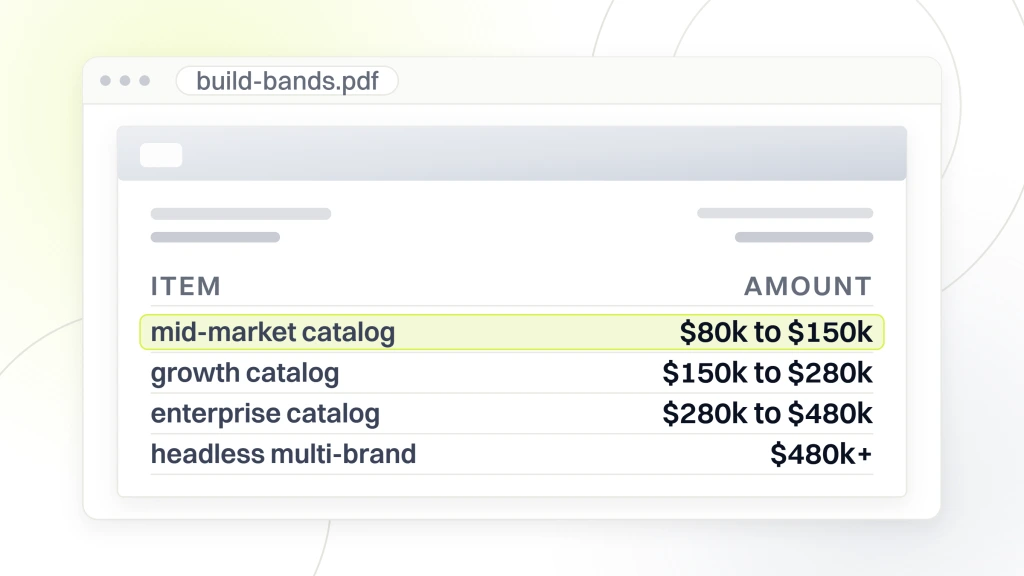
The four bands for custom ecommerce web development services do not overlap by accident. Each band matches a distinct scope shape. The $80k band assumes a Shopify Storefront API head with 2 integrations. The $150k band assumes headless commerce plus subscription plus 4 integrations. The $280k band assumes multi-store with shared cart and per-store pricing. The $480k band assumes 3 to 5 brands on shared infrastructure with per-brand theming. Every founder who tries to buy $280k scope on a $80k budget produces the same result. The build stalls at week 10 and the change orders eat the timeline.
SMB tiers for smaller catalogs
Below the custom band, Redefine Web ships SMB catalog builds at $2,500, $4,500, and $7,500 for founders under 2,000 monthly orders who need a fast, honest storefront on managed Shopify or WooCommerce. That tier covers 15 to 200 SKUs, 2 payment integrations, and a Klaviyo email setup. The move from SMB to custom happens when the merchandising logic breaks the platform admin, not when revenue crosses an arbitrary threshold.
Typical build timeline for a mid-market catalog
Typical build timeline for a mid-market custom ecommerce web development service runs 14 to 18 weeks from kickoff to launch. Two weeks discovery. Two weeks design. Six to eight weeks core build. Two weeks integration. Two weeks QA. One week soft launch to 5% of traffic. That timeline holds when scope is locked at week 3 and change orders route through a written process. It slips when scope stays open and change orders happen over Slack without a proposal update.
The soft launch step is where most first-time buyers cut corners. Rolling the new storefront to 5% of traffic for a week catches the errors that only surface at real production load. Payment edge cases. Inventory sync drift. CDN cache issues on product images. Every serious agency runs a soft launch. Every full-cutover launch we have watched has produced at least one Sev-2 incident inside 48 hours that the soft launch would have caught cheap.
Discovery phase deliverables
Discovery ends with a scoped SOW, a component inventory, a data model diagram, an integration map, and a launch criteria doc. Every one of those is written down. Every one is signed off by both sides before design begins. Discovery that skips any of these documents produces scope thrash starting in week 4 that costs the project 3 to 5 weeks over a 16-week engagement. Every honest agency lands discovery as a paid engagement so the deliverables get the attention they warrant.
Launch and hypercare
Launch runs through soft launch, staged rollout, and full production over a 10 to 14 day window. Hypercare covers the first 30 days post-launch with a dedicated engineer on-call and a daily standup between the client team and the agency team. That structure catches the small bugs before they compound into churned customers. Skipping hypercare is a common cost-cutting move that costs the project 5% to 10% of first-quarter revenue in dropped orders and support tickets.
Post-launch metrics for a custom ecommerce web development service build
Post-launch metrics for a custom ecommerce web development service build sit on four dashboards. Conversion rate per device. Revenue per session. Median time-to-interactive on product pages. Cart-to-purchase completion rate. Every one of those numbers gets a baseline in week 1 post-launch and a review every Monday for 90 days. Skipping the review cycle is how first quarters end with a soft revenue number the team could not explain until forensic analytics work three months later.
Median time-to-interactive is the leading indicator. Every 300 millisecond improvement in TTI drives roughly a 1% to 2% gain on conversion rate for mid-market catalogs. That equation holds across every vertical we have measured. Prioritizing performance work in the first 90 days pays back before the retainer bill for month 3 lands. Skipping performance work in the first 90 days costs the site 8% to 15% of first-quarter revenue to compounding drag on TTI drift.
Weekly analytics review cadence
Every Monday post-launch, the team reviews conversion by device, revenue by traffic source, checkout funnel drop-off, and any Sev-3 or higher incident from the past week. That review lands 3 to 5 tickets on the retainer queue for the week. Skipping the review turns into a monthly surprise at the invoice review when the retainer hours got spent on unranked work. Every serious build we run uses the Monday review cadence for the first 90 days.
Quarterly performance tuning
Every quarter post-launch, the team runs a full performance audit against Lighthouse, Web Vitals field data, and checkout latency traces. That audit surfaces 2 to 4 tickets worth 5% to 15% conversion rate movement per quarter. Skipping the quarterly audit costs the site steady TTI drift that compounds into a slow storefront by month 9. Every retainer we run reserves 8 to 12 hours per quarter for the performance audit. That reservation is the cheapest insurance on the whole retainer.
Custom vs Shopify Plus vs headless comparison
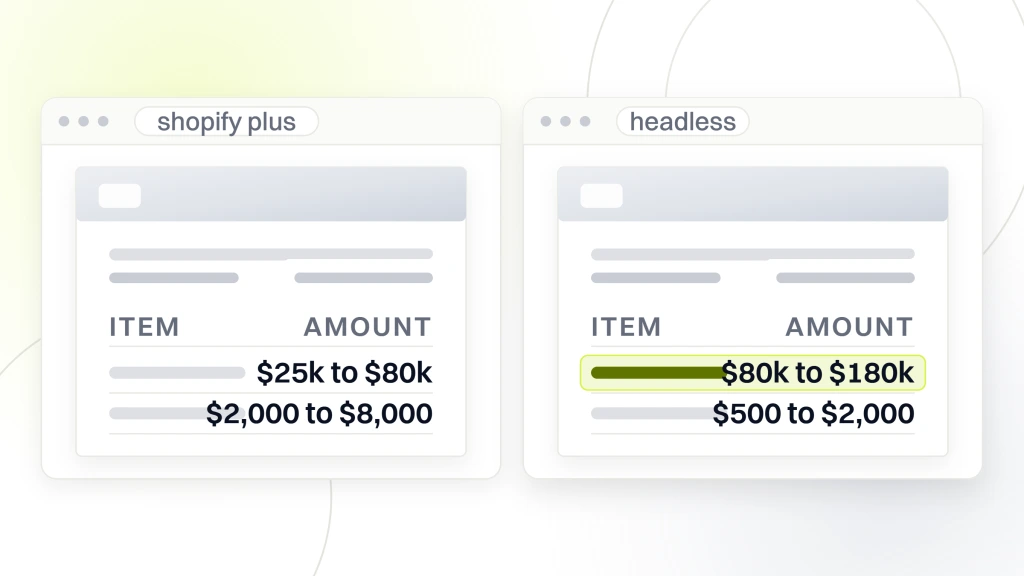
The comparison table below sorts three paths for custom ecommerce web development services by build cost, monthly platform fee, ideal catalog shape, and long-term maintenance overhead. Use the table to sanity check the shape of a proposal before comparing dollar amounts.
| Path | Build cost | Monthly fee | Ideal catalog |
|---|---|---|---|
| Shopify Plus stock | $25k to $80k | $2,000 to $8,000 | Under 5,000 monthly orders, standard merchandising |
| Headless on Shopify Storefront API | $80k to $180k | $2,000 to $8,000 plus $500 to $2,000 hosting | 5,000 to 20,000 monthly orders, custom front-end needs |
| Fully custom commerce | $150k to $480k+ | $500 to $3,000 hosting only | 20,000+ orders or merchandising Shopify cannot express |
| Redefine Web SMB build | $2,500 to $7,500 | hosting included | Under 2,000 monthly orders, 15 to 200 SKUs |
| Redefine Web custom | from $18,000 | hosting in retainer | Mid-market catalogs with real merchandising logic |
The table above shows the raw dollars. The working decision is scope shape, not price. A brand that picks Shopify Plus for a $2M revenue catalog and then bolts 8 apps plus 3 Zapier flows to approximate custom merchandising ends up paying more over 24 months than the fully custom path would have cost at kickoff. A brand that picks fully custom for a $500k catalog burns 6 months of runway on a build the SMB tier would have shipped in 6 weeks.
Custom ecommerce web development services case study
Abigail Ahern is a luxury home decor brand with strong offline recognition and a digital revenue line held back by discount-heavy campaigns and a merchandising layer that could not express premium positioning. The team came to us with a $2.4M digital run rate, conversion rate stuck at 0.9%, and a paid media budget that was training the audience to wait for the next sale. The brief was to reset merchandising, restructure paid media, and rebuild the on-site experience without diluting the aspirational brand.
We restructured SEO and paid media around intent-driven traffic, segmented product categories into separate campaigns, refined shopping query matching, and rebuilt the product detail and category pages with premium creative treatment. The custom merchandising rules picked up variant relationships, editorial groupings, and stock-based collection logic that the old stack could not express. Retargeting through display and social nurtured site visitors toward conversion instead of abandoning at the cart step.
The outcome measured over 12 months
Revenue up 179% inside 12 months. Conversion rate doubled from 0.9% to 1.8%. Cost per acquisition down 34%. Average order value up 22% as premium creative pulled buyers into higher-tier collections. Every one of those numbers came from the merchandising restructure plus the paid media rework plus the on-site rebuild running in parallel. Skipping any single leg would have cut the revenue jump by roughly a third. That is the pattern of a build where the custom layer earns its scope.
Why custom won the pick
The Abigail Ahern build could not have run on stock Shopify without the merchandising layer. The editorial groupings, the stock-based collections, and the premium creative rotation needed custom logic that Shopify’s admin cannot express. Shopify Plus with 4 apps and 2 Zapier flows could have approximated the workflow for a while. Total cost of that stack over 24 months would have exceeded the custom build’s total cost inside the first 15 months. The custom pick paid back on TCO alone before the revenue jump even landed.
Two more custom ecommerce web development services references
RAFZ Cirkulära Interiörer is a Swedish sustainable furniture brand that came to us with a plugin-heavy WordPress site loading in 15 seconds and dropping carts at the checkout step. We replaced the plugin stack with a lightweight custom WooCommerce theme, wrote efficient custom code in place of 22 plugins, added the place2place API integration for automatic cross-platform listings, and built a repaint customization feature that matched the brand’s circular-economy mission. Page load dropped from 15 seconds to 2 seconds. Server requests dropped 82%. Conversion rate climbed 28% in the first quarter after launch. Every one of those numbers came from the custom code path, not from a plugin swap.
Boogie Board is the pioneer of the reusable writing tablet, in market since 2009 and selling in 40+ countries. The engagement pre-dated the custom build discussion. It ran as a cross-channel ads plus landing page optimization program on Google Ads and LinkedIn Ads with $650,000 in managed spend. Cost per sale hit $31. Conversion rate climbed 11%. That work matters here because the same discipline that ships a custom ecommerce web development service also ships the landing page optimization and retargeting stack that turns paid traffic into revenue. The two skill sets belong on the same team, not siloed across two vendors.
Picking a custom made ecommerce web development service partner
A custom made ecommerce web development service partner should carry a portfolio of delivered mid-market catalogs at your volume band, a team of 6 to 12 people including at least 4 engineers, a sprint cadence that matches your calendar, and a communication style that matches your team. Every one of those axes matters more than the hourly rate. A partner with the wrong communication style burns 3 to 5 weeks over a 16-week build. A partner with the wrong portfolio phase burns 6 to 10 weeks.
Ask for a 3-day paid scope triage as the first engagement. That triage tests communication, delivery speed, and scope discipline at low cost. Every agency worth signing runs paid triage. Vendors who insist on free discovery are hiding scope risk into the fixed-price SOW. Every founder we advise runs paid triage before committing to a full-build SOW. That week of homework prevents 12 to 16 weeks of misfit inside a bad engagement. See our web design and development services page for the umbrella process every custom ecommerce web development services engagement runs through.
Team shape for a mid-market build
Team shape for a mid-market custom ecommerce web development services build lands at 4 engineers, 1 designer, 1 PM, and shared QA. Two engineers own the front-end. Two engineers own the back-end and integrations. The designer runs the component system and every page template. The PM owns the sprint and the client relationship. QA runs the last 3 sprints alongside the engineers. That shape delivers a 14 to 18 week build without heroic overwork. Smaller teams stretch timelines. Larger teams overheat coordination.
Post-launch retainer scope
Post-launch retainer for custom ecommerce web development services runs $8k to $18k per month and covers the first 6 months of feature work, small design refinements, and on-call incident response. That retainer is smaller than a first in-house engineer hire and covers more scope because the agency team is already familiar with the codebase. Most founders keep the retainer for 9 to 12 months, then move to a smaller retainer plus one in-house engineer. That handoff pattern is the most common shape we see for successful post-launch programs.
Where to start with your custom ecommerce build
Start with the inflection question. Does your workflow break Shopify or WooCommerce with more than 3 workarounds. See our custom ecommerce web design services for DTC brands guide for the design-side scope pattern. Does your catalog need pricing logic the platform admin cannot express. Does your team spend 20-plus hours a week on stopgaps. If the answer to any of these is yes, run a paid scope triage with 2 to 3 vendors and compare the scope shape before comparing the price.
Ready to scope a custom ecommerce web development services engagement that delivers production software. We run paid scope triage, write real SOWs, and staff builds with teams that have delivered mid-market catalogs before. See our ecommerce website design services for the design-first entry point into the same discovery process, and check web.dev Core Web Vitals for the launch quality bar every build gets measured against.