Custom ecommerce web design services get pitched to every DTC founder who asks for a redesign quote, and roughly 60% of those founders would launch sooner on a well-scoped Shopify theme instead. That’s where a specialist shopify design agency earns its retainer. The other 40% will spend two years fighting a template that can’t hold their product logic, then rebuild bespoke anyway. Both groups pay a tax the honest agencies name up front and the hype agencies bury under the words premium and enterprise. Custom is not a status choice. It’s a decision that turns on product complexity, brand system depth, and the growth roadmap the founder signs up for once the honeymoon quote lands on the desk.
This guide covers the topic the way our ecommerce website design services team scopes them. You’ll get the custom versus template decision framework. What a bespoke build really includes past the pretty homepage in the pitch deck. Realistic timelines from discovery through launch. The full 2026 cost picture across shopify web development agency theme customization, headless custom, and fully bespoke stacks. When bespoke pays back and when a template plus retainer wins. Every number below runs off real DTC store builds our team has taken live across 2024 and 2025.
Scope of a real custom ecommerce web design service
The scope of a real bespoke build covers seven phases across 18 to 36 weeks. Founders who sign a bespoke contract without a written scope walk into an eight-figure change-order treadmill. Founders who sign a written scope with named deliverables per phase get the store they paid for on the timeline they were promised. Nothing about the number 18 is arbitrary. It’s the floor a real component library, real product data, real integration testing, and a real 30-day stabilization block can honestly hit.
The seven-phase scope every bespoke contract needs
- Phase 1 discovery and brand audit (2 to 3 weeks) covering founder interview, top 12 customer interviews, ops audit, and a written requirements doc.
- Phase 2 information architecture and UX (3 to 4 weeks) with sitemap, top 12 template wireframes, and a UX prototype tested on 5 real shoppers.
- Phase 3 visual design system (4 to 6 weeks) building the component library, three to five states per component, and the design tokens the internal team will inherit.
- Phase 4 front-end code (6 to 10 weeks) writing the theme or headless front-end against the design system with real product data and real API responses.
- Phase 5 integrations and back-end (parallel to phase 4, 4 to 8 weeks) wiring Klaviyo, ShipStation, reviews, ERP, ad pixels, and any brand-specific systems.
- Phase 6 QA (3 to 4 weeks) across browser, device, payment, and integration matrices with a real test slate rather than a checklist.
- Phase 7 launch and 30-day stabilization (4 weeks) covering deploy, DNS cutover, rehearsal, and a named dev on call for the first month.
What agencies quietly leave out of the scope
Three items disappear from most bespoke contracts and become change orders after signing. Content migration (product copy, blog posts, help articles) usually gets scoped as client responsibility and becomes an agency task at the 11th hour. Third-party app costs get billed to the client as extras rather than folded into the build. Design system documentation gets promised verbally and delivered as a five-page PDF nobody can extend. A real bespoke contract names all three in writing and prices them into the build. Founders who ask for those three items in writing before signing usually catch which agencies are pitching a scope they can’t hold and which ones have run the build 20 times before.
Timeline for custom ecommerce web design services in 2026
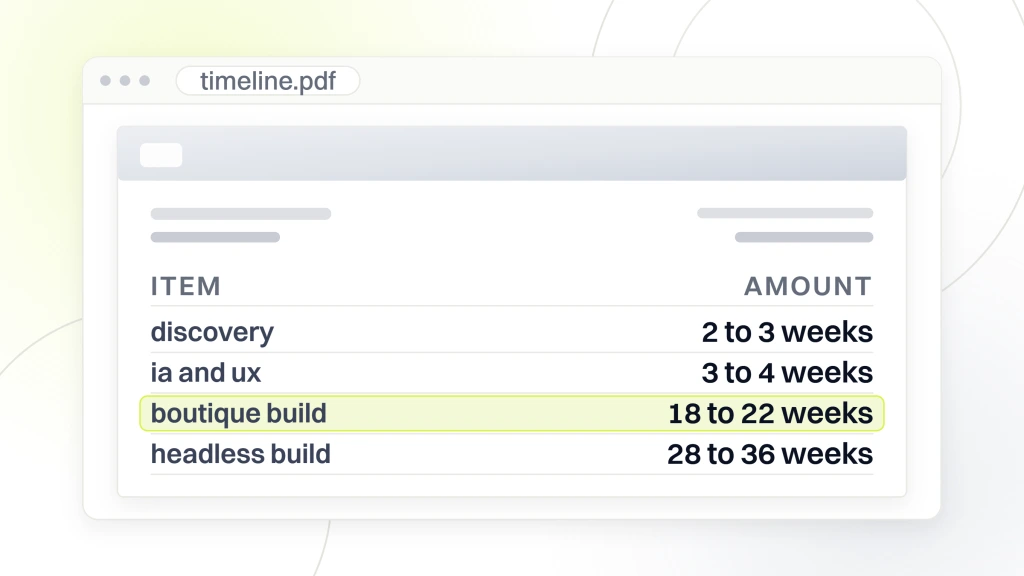
Bespoke timelines run 18 to 36 weeks depending on stack, catalog depth, and integration count. A boutique brand with 40 SKUs and a Shopify Plus custom-theme build goes live in 18 to 22 weeks. A mid-market brand with 3,000 SKUs and headless build goes live in 28 to 36 weeks. A fully custom stack (Node, Rails, Laravel) with ERP integration goes live in 36 to 52 weeks. Founders who insist on 12 weeks total usually get a reskinned theme sold as bespoke.
What quietly kills bespoke timelines
Three predictable causes slip most bespoke timelines. First, design signoff drags. The founder pulls in a spouse, a co-founder, or a friend-of-founder brand advisor at week eight, and every new opinion resets the design system by two weeks. Second, product data lands late from the merchandising team since nobody wrote the SKU import schema at kickoff (this alone costs three to five weeks on brands over 1,000 SKUs). Third, third-party integrations block on credentials from an ERP vendor, a 3PL, or a legacy PIM system that takes three weeks to arrive. The Baymard Institute has documented similar delays in real DTC checkout builds where the last four weeks of a bespoke project consume 40% of the calendar since integration debt was hidden until QA. A written kickoff doc that names the person accountable for each blocker keeps timelines honest.
Real timeline for a mid-market DTC bespoke build
Our team’s most recent bespoke build for a $22M annual DTC apparel brand ran 26 weeks from kickoff to launch. Discovery took three weeks. IA and UX took four weeks with a five-shopper prototype test in week seven. Visual design system took five weeks against a 42-component library. Front-end code and integrations ran nine weeks in parallel with the design phase, using a component-first build where the developer coded each component the day after the designer signed each one off. QA took three weeks across browser, device, payment, and integration matrices. Launch happened on a Wednesday morning behind a two-hour DNS rehearsal on the Sunday before. The 30-day stabilization block caught 14 real bugs in the first three weeks, every one of which would have cost real revenue if the store had launched without it.
Bespoke ecommerce web design cost in 2026
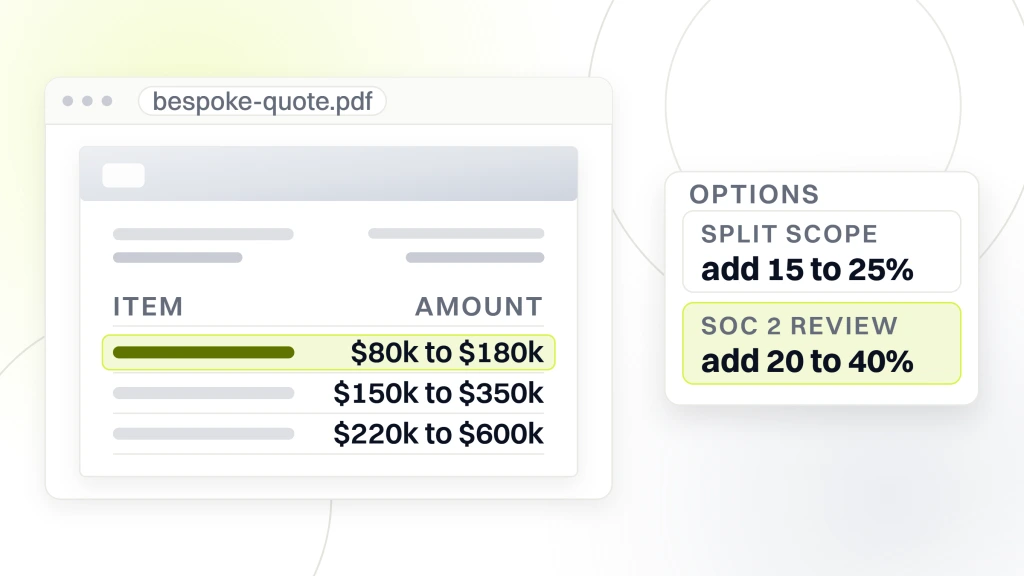
Bespoke cost breaks down cleanly by stack tier. Shopify Plus with a fully custom theme runs $80k to $180k. Headless on Next.js against Shopify or Commercetools runs $150k to $350k. Fully custom on Node, Rails, or Laravel runs $220k to $600k plus. Add 15 to 25% for split-scope proposals across two agencies. Add another 20 to 40% for enterprise brands that need SOC 2 documentation and vendor security reviews inside the build.
Where the money really goes on a $140k bespoke build
On a $140k bespoke Shopify Plus build, the money splits roughly as follows. Discovery and brand audit takes $12k. Information architecture and UX takes $18k. Visual design system takes $32k (the biggest single bucket, since component libraries are real work). Front-end theme code takes $38k. Integrations take $18k. QA takes $12k. Launch and 30-day stabilization takes $10k. Bundled scopes carry these numbers cleanly since the strategy lead, designer, developer, and QA tester sit inside one agency. Split scopes tax the founder 15 to 25% for the same output on the same timeline, and the tax scales with build complexity rather than shrinking.
Post-launch retainer scope for bespoke stores
Bespoke stores need a heavier retainer than template stores since the code is owned rather than inherited. Most brands run a $1,499 to $6,000 monthly retainer with the build agency covering component library extensions, seasonal template drops, integration updates, and CVR test cadence. Maintenance-tier plans at $199, $299, and $499 monthly cover hosting, security, and light content edits when a full build retainer isn’t the right fit. Under $1,499 buys break-fix hours only. Over $6,000 usually means the brand should hire in-house. Retainers with the original build agency stay cheaper than break-fix work with a new team every quarter since the code documentation and design system tokens live inside one shared context.
Custom web design for ecommerce and the brand system inside it
Custom web design for ecommerce lives or dies on the brand system inside it. A bespoke build without a real design system is a one-off storefront the internal team can’t extend. A bespoke build with a real design system is a brand asset the internal team runs for the next five years without hiring a designer for every seasonal drop. The gap between those two outcomes is the single biggest variable on any bespoke project, and it barely shows up in the pitch deck.
What a real design system delivers
A real ecommerce design system delivers four artifacts. First, a component library of 30 to 60 components with three to five states each, built in Figma against real product data. Second, a token library covering color, typography, spacing, radius, shadow, and motion, connected to Tailwind or Style Dictionary so the developer inherits them without copy-paste. Third, documentation covering when to use which component, what each state means, and the accessibility contract for interactive elements. Fourth, a living component gallery deployed alongside the store where the internal team can pressure-test new marketing pages before pushing them live. Brands with all four extend the store without agency time. Brands with two of the four rehire the agency every quarter.
The brand-system audit that guides scope
Our team runs a brand-system audit at the start of every bespoke engagement. The audit answers six questions in writing before design starts. What signature typographic rules define the brand voice on the page? Which motion patterns are brand-specific versus platform-standard? What color logic covers primary, secondary, accent, semantic (error, success, warning), and dark mode? What imagery style covers hero, PLP, PDP, and lifestyle contexts? What accessibility contract does the brand commit to (WCAG 2.2 AA is our default)? What is the brand’s tone-of-voice guide for microcopy, product descriptions, and system messages? A written answer to all six turns the design system from a pretty deck into a working operating manual for the storefront. The Nielsen Norman Group has published a solid overview of design systems fundamentals that pairs cleanly with a bespoke ecommerce scope.
Custom ecommerce web design solutions for weird product logic
Bespoke solutions win when product logic breaks the theme. Standard variants (size, color, material) fit almost every theme in the market. Weird product logic (configurable equipment, B2B pricing tiers, made-to-order, rental hybrids, subscription-plus-buyback) breaks themes and forces the founder into a bespoke build whether they wanted it or not. Boogie Board runs a Shopify Plus store with an 11% conversion rate and a $31 cost per sale against a $650K managed budget, and the product logic there stayed on a platform theme with careful custom code layered on top rather than a bespoke rebuild.
Product patterns that force bespoke
- Configurable industrial equipment with 30 plus variant axes (industrial pumps, custom furniture, semi-truck accessories).
- B2B pricing tiers that switch on customer group AND product family AND order volume (contract pricing for wholesale accounts).
- Made-to-order fashion with size, fabric, cut, and monogram inputs on one product.
- Rental hybrids that check inventory by date range rather than by unit count (event rental, tool rental, subscription boxes).
- Subscription plus buyback flows where the customer returns the product at end of term (kids apparel, hardware trade-in programs).
- Multi-vendor marketplaces with commission splits, per-vendor shipping, and per-vendor payout logic.
- Regional catalogs where the same SKU has different prices, images, and copy in different countries within one Shopify store.
Solving weird logic without going fully custom
Weird product logic doesn’t always force a full bespoke build. Shopify Functions, metaobjects, and Shopify Plus checkout extensibility have absorbed roughly 60% of the weird logic patterns that would have forced bespoke in 2022. Configurable products with up to five variant axes now run on Shopify metaobjects. B2B pricing tiers run on Shopify B2B or through apps like Bold and Shopify Plus discount functions. Regional catalogs run on Shopify Markets. Founders who prototype the weird logic on Shopify Plus first often find the workaround holds, saves $100k over bespoke, and goes live four months faster. Founders who assume weird logic forces custom without testing usually pay the bespoke premium for a workaround Shopify would have released anyway. Our post on ecommerce web design and development covers the platform-vs-custom decision in more depth for founders sitting on that fork.
Choosing a custom ecommerce web design service agency
Picking the right agency for a bespoke ecommerce build is a higher-stakes decision than picking a template shop. Template mistakes cost $6k and a couple months. Bespoke mistakes cost $180k and a year. The right agency shows five visible traits in the sales conversation, and agencies that miss any of them are the ones the founder regrets a year in.
Five agency traits worth signing for
Five traits separate the agencies that deliver from the agencies that pitch. First, a named project manager per build rather than a shared one across four clients. Second, a written 18-week or longer timeline with weekly milestones and defined signoff points. Third, a portfolio of five plus live DTC storefronts the founder can visit and pressure-test today (not screenshots, live URLs). Fourth, a named engineering lead who joins the first sales call, not the account manager pretending to speak for engineering. Fifth, a written 30-day stabilization block in the contract with a named dev on call. Agencies that answer these five clearly have built dozens of bespoke stores. Agencies that dodge any one are pitching a Figma file with a pretty rendered homepage as a bespoke build.
Five questions that reveal the agency early
Ask five questions on the first sales call. Who is the project manager, and what other builds are they running concurrently right now? How many hours of QA are budgeted, and what is on the browser, device, and payment matrix? Which third-party integrations are in scope, and which get billed as change orders? What is the rollback plan if the DNS cutover breaks the store? How does the 30-day stabilization block work, and who is on call for it? Agencies that answer with specifics have run this build 20 times. Agencies that answer with buzzwords will bill the founder for the learning curve. A good outside read on picking a specialized bespoke shop lives on the Smashing Magazine ecommerce UX checklist, which pairs cleanly with the questions above.
A real bespoke ecommerce web design build that went live
Abigail Ahern came to our team with a Shopify storefront that had grown organically over four years across a premium home decor catalog of roughly 900 SKUs. The brand was strong. The storefront was fighting itself. The founder wanted a bespoke build that matched the brand voice, not a theme optimized for discount messaging. Category pages listed by newest, not by curated mood. Product photography was strong. The PDP framed it in a 60/40 layout designed for supermarket brands, not for aspirational interior design. The founder wanted a bespoke build that let the brand look like itself instead of a template pretending to be premium.
Our team scoped a bespoke Shopify Plus build with a fully custom design system across 24 weeks. Discovery took three weeks including founder interview, top ten customer interviews, and a merchandising audit. The design system landed at 48 components with four states each, built against real product photography rather than stock. Front-end code ran nine weeks against the design system, with a component-first workflow where the developer coded each component the day after the designer signed each one off. Integrations covered Klaviyo, ShipStation, Yotpo reviews, Meta CAPI with server-side dedup, and a custom mood-board recommendation engine. QA ran three weeks. Launch happened on a Tuesday morning behind a Sunday rehearsal.
Over the next 18 months on the bespoke build, ecommerce revenue grew 179% year over year. Paid search return on ad spend hit 1,588%. Paid social return on ad spend hit 3,000%. Add-to-cart rate on the PDP moved from 6.2% to 13.4%. Average order value moved from $128 to $184. The bespoke build didn’t cause the numbers alone. It removed the ceiling the template had been placing on brand-aligned merchandising, which let the paid media and email programs work against a store built for the brand instead of against it. Our follow-up post on top ecommerce web design examples breaks down more storefronts running similar patterns.
Where custom ecommerce web design services fit the DTC growth stack
Custom ecommerce web design services sit at the top of the growth stack for brands that have earned the right to invest. Paid media, SEO, email, and content all rely on a store that converts the traffic they send. Founders who fix the store first make every downstream marketing dollar 20 to 40% more efficient. Founders who patch the store and run ads at the same time pay customer acquisition cost against an underperforming funnel, then blame the ad platform.
The bespoke build decision is worth it when three of five triggers hit. Product logic breaks the theme. Brand system depth demands a component library the theme can’t support. Revenue over $15M annual with template ceiling constraints. In-house dev team can maintain custom code. Growth roadmap includes headless, native mobile, or global expansion. Fewer than three triggers, and template plus retainer is the honest choice. More than three, and bespoke pays back inside 18 to 24 months of daily shopper interactions. A written trigger checklist maps the decision against real proposals before the founder signs anything. See our guide on fashion web design agency for apparel and accessories brands for the apparel-specific pattern set. Pet subscription brands often need a custom subscription rule engine that a Shopify app can’t cover past $4M in annual revenue, and our pet DTC subscription storefront patterns guide covers the WooCommerce build pattern that carries the account portal, bundle logic, and pet profile data through 24 month retention.
The rest of the growth stack sits alongside. Paid media pointed at a converting store. SEO on category and product pages that treats them as landing pages. Email flows that catch shoppers who bounced. Reviews collection that populates trust signals. Every tactic works better when the storefront is not fighting it. The bespoke scope in this piece is the one a founder can sign for a mid-market DTC brand in 2026 without a rebuild every 18 months. Our ecommerce marketing agency team runs both the build and the growth work under one roof, and the Shopify Plus custom storefronts documentation pairs cleanly with the design system and integration scope inside this guide.