Dental facebook ads work when the practice matches the platform’s behavior. Meta users aren’t searching for a dentist. They’re scrolling. So the ad has to interrupt the scroll with something specific. Invisalign before-and-after imagery, a veterans free-cleaning offer, or same-day emergency appointments. Generic ‘book your cleaning today’ creative gets skipped. This guide shows how to plan, target, write, and measure so the scroll interrupt turns into a booked patient.
This guide covers the campaign structure that works for practice sites, the targeting rules Meta rewards in 2026, the creative patterns that convert, HIPAA compliance for lead-gen forms, the tracking stack, budget math, and the mistakes that quietly burn ad spend. Use it as the checklist next time you build a paid-social account from scratch or audit an account that stopped producing patients on steady spend.
Meta reports 3 billion monthly users on the platform, and local businesses see roughly a 4x return on ad spend when campaigns are set up correctly (Wordstream, 2024). That is enough audience and enough return to fund a serious growth channel, but only if the practice runs the play right.
Targeting rules for facebook dental ads that hold up
Targeting rules on Meta tightened after the platform removed detailed health interests in 2022. Practices used to target ‘cosmetic dentistry interest’ directly. Now that option is gone, and Meta pushed accounts toward broad targeting with strong creative doing the segmentation. That isn’t a bug. Broad targeting with disciplined creative beats narrow targeting on most practice accounts.
Start with location. Use a 5 to 10 mile radius around each office. Set age 25 to 65 for general dentistry, 30 to 55 for cosmetic and implants, 25 to 45 for orthodontics. For implant-specific targeting, see our dental implant Facebook ads playbook. Skip the interest layer on cold audiences and let Meta’s algorithm find the right patients from the conversion signal you feed it. Layer on custom audiences (past patients, site visitors) for retargeting, and lookalike audiences at 1 to 3 percent of past patients for scale.
Meta’s Advantage+ campaigns automate most targeting decisions and often outperform manually structured campaigns for practices without a dedicated account manager. Advantage+ needs strong first-party conversion signal, meaning the Meta Pixel has to fire correctly and pass conversion events accurately. A broken pixel kills Advantage+. Fix the pixel first, then test Advantage+ against your manual campaigns. See targeting dental patients with meta ads for the deeper play.
Audience exclusions that stop wasted spend
Exclude past patients from cold-audience campaigns so you don’t pay Meta to reach patients who already booked. Exclude dental industry professionals (dentists, hygienists, dental students) unless the campaign is B2B. Exclude anyone who submitted a lead in the last 30 days across all campaigns, so Meta doesn’t show the same ad to the same lead five times and burn budget.
Creative patterns for dental marketing facebook ads
Creative patterns for practice campaigns decide whether the scroll stops. Three formats convert best on practice accounts. Before-and-after imagery with proper photo consent, practitioner testimonial videos under 60 seconds, and clear-offer static images with a specific dollar amount plus a specific service plus a specific expiration. Generic ‘book your appointment’ copy produces the worst click rate of any pattern.
Video outperforms static creative 2 to 4 times on Meta, but video quality matters in an unusual way. A phone-shot 30-second clip from the practitioner explaining a common procedure (‘what to expect at your first Invisalign visit’) outperforms a slick 60-second brand video every time. Meta favors authentic human video over agency-polished production. Use a phone. Talk to the camera. Post the raw version, not the over-edited cut.
Copy hooks the scroll. First 3 words of the ad copy do 80 percent of the work. Effective hooks for practice campaigns sound like this. Steal from our dental Facebook ads examples pack for more hooks like these. ‘Straighter teeth in 6 months.’ ‘Emergency dental care same day.’ ‘Free Invisalign consultation this week.’ ‘Veterans get free cleaning.’ Bland hooks like ‘our practice offers’ or ‘we provide full-service care’ fail on Meta since scrollers care what they get, not who you are.
Rotate creative every 2 to 3 weeks. Meta flags stale creative fast, and click-through rate decays after week 3. Every ad set should have 3 to 5 creative variants running in parallel, with 2 new variants dropped in weekly. Kill anything under a 1 percent click rate after 500 impressions. Our converting dental ppc ads guide covers the creative rotation cadence.
Tracking Meta conversions with HIPAA safety
Tracking paid-social conversions with HIPAA safety is where most practice accounts break. Meta Pixel installed on the site sends event data (page views, form submits, phone clicks) back to Meta for ad optimization. If the pixel picks up protected health information (patient names, phone numbers, appointment reason) and sends it to Meta, that’s a HIPAA violation with real HHS penalties.
The HIPAA-safe stack looks like this. Install the Meta Pixel through Google Tag Manager with a data-layer filter that strips protected health information before the event fires. Set up Meta Conversions API server-side so conversion signals bypass the browser (more accurate, and easier to keep HIPAA-safe). Configure custom conversion events on form submit and phone click, without any patient identifiers in the payload. If you’re unsure whether the pixel is HIPAA-safe, assume it isn’t and audit before running paid.
Conversion events feed Meta’s algorithm. Without accurate conversions, the algorithm optimizes toward whatever fake signal is loudest, usually raw page views or bot form submits. Broken tracking is why practice owners say ‘Facebook Ads doesn’t work for dentists’ when the setup is wrong. Fix tracking day one, before any campaign launches. See our hipaa marketing compliance for dentists for the full compliance framework.
Attribution windows on Meta shortened after iOS 14. Default is 7-day click, 1-day view. Every practice should stay with the default and layer CallRail phone tracking on top to catch offline conversions Meta cannot see. Assign every campaign its own CallRail number so offline calls attribute to the right ad set.
Budget structure for dental facebook ads campaigns
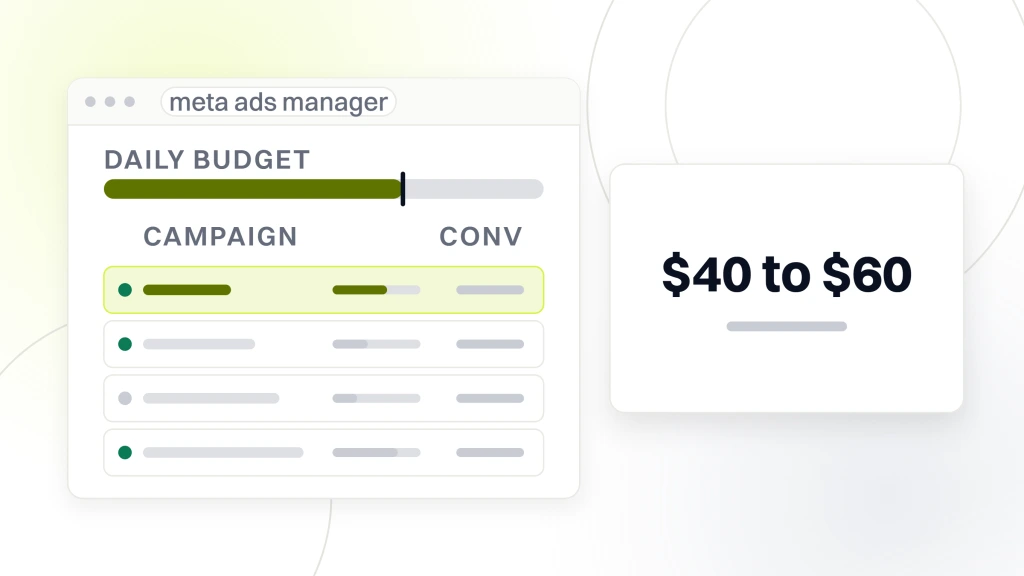
Budget structure decides scale. Start with a floor of $40 to $60 per day per campaign for cold audiences. Below that floor, Meta’s algorithm can’t gather enough signal to optimize, and cost per lead stays high. Scale winning ad sets up 15 to 20 percent every 3 days. Faster scaling resets the learning phase and blows out cost per lead for 5 to 7 days.
Allocate 60 percent of budget to cold-audience campaigns (lead-gen or traffic). 25 percent to retargeting, meaning site visitors, video viewers, and past lead-form abandoners. 15 percent to lookalike audiences of past patients. Adjust monthly based on cost per lead and booking rate by audience, not gut feel. Retargeting almost always has the lowest cost per lead but produces limited scale, so it isn’t a substitute for cold-audience volume.
| Audience | Budget share | Typical CPL | Best objective |
|---|---|---|---|
| Cold (broad) | 60% | $20-$50 | Lead-gen or traffic |
| Retargeting site visitors | 25% | $8-$25 | Traffic or conversion |
| Lookalike past patients | 15% | $20-$40 | Lead-gen or conversion |
| Video-view retargeting | Rotates in | $5-$18 | Booking offer |
Practice budgets under $1,500 per month on Meta produce inconsistent results since the algorithm needs volume. Practices willing to commit $2,500 to $5,000 per month for 90 days see reliable booked-patient volume. Below that threshold, spend on Google Ads or Local Services Ads instead. Both produce booked patients at lower monthly floors.
One budget mechanic most accounts miss is campaign budget optimization (CBO) versus ad-set budget. CBO lets Meta allocate spend across ad sets inside a campaign based on which one produces conversions cheapest. CBO is the right default for most practice accounts. Ad-set-level budgets give a manager tighter control but need more weekly work. If you don’t have a dedicated manager, default to CBO and let Meta route spend between ad sets.
Case study, Smile Design Dentistry’s paid social funnel
Smile Design Dentistry is a 50+ location DSO in Central Florida and Tampa Bay. Before the engagement, paid social was barely used as a growth channel. Engagement was low, and Meta was not built into the funnel. Pay-per-click on Google alone was carrying acquisition, and cost per booked patient sat higher than the group wanted.
We launched Smile Design’s first paid-social campaigns with a full-funnel structure. Awareness campaigns used video ads to build a warm audience. Consideration campaigns retargeted viewers with service-specific offers. Conversion campaigns pushed warm audiences to booking-focused creative. Ad-variation testing ran continuously with 4 to 6 creative variants per ad set, refreshed weekly. Demographic-focused targeting layered on location and age with lookalike audiences of past patients per office.
Results across the DSO. Pay-per-click conversion rate up 20 percent, since paid social built the warm-audience gain that Google campaigns converted. Cost per call down 30 percent. Full campaign coverage across 50+ locations. The full-funnel structure let the DSO scale spend without cost per acquisition drift. Warm audiences held costs down as cold audiences expanded.
The lesson is simple. Paid social works best inside a funnel, not as one-off boosted posts. Warm audiences created by video engagement drop retargeting cost per lead 60 to 70 percent. Rolling that discount across a 50-office group compounds fast. See meta ads lead generation for dental practices for the funnel breakdown.
Compliance rules for dental facebook ads
Compliance rules on Meta come from three directions. Meta’s ad policies, state dental board rules, and HIPAA. Break any one and ads get disapproved, the account gets flagged, or the practice gets regulatory heat. Every ad should pass all three checks before launch.
Meta’s ad policies prohibit before-and-after imagery without compliant framing, since Meta treats before-and-after images as personal-attribute content that can imply body-image issues. Use side-by-side images with the phrase ‘actual patient results’ and photo consent from the patient. Health claims like ‘pain-free’ or ‘guaranteed results’ get flagged. Insurance mentions must be accurate. Financial claims (‘save 50 percent’) need substantiation.
State dental board regulations vary. California, Texas, and New York each have specific rules about what a dentist ad can promise. Most boards require the practice license number in fine print. Some prohibit testimonials for specific procedures. Check your state board’s advertising rules before launching creative. Our dental ads compliance guide covers the state-by-state variations.
HIPAA on lead-gen forms means no appointment reason, no symptom description, no insurance details collected on the Meta lead form. Collect name, phone, email only. Move the qualifying questions to a HIPAA-safe follow-up SMS or email that reaches the patient after they submit. Meta lead forms sending PHI is one of the fastest HIPAA violations to trigger.
Get a legal reviewer to sign off on ad creative before it goes live if the practice runs high volume paid social. A quick 15-minute pre-launch review catches most compliance issues that would cost the account a suspension or the practice a state-board complaint.
Funnel structure for dental social media ads that scale
Funnel structure on Meta decides whether the account scales beyond a single audience. A well-built funnel runs three tiers. Top-of-funnel awareness with video content, middle-of-funnel consideration retargeting the video viewers, and bottom-of-funnel conversion offering a specific booking incentive. Every tier feeds the next.
Top-of-funnel creative introduces the practice through a short practitioner video. ‘Meet Dr. Sanchez, cosmetic dentist for 14 years.’ Watch time goals matter more than clicks at this stage since Meta uses video watch percentage to build the warm-audience list. Middle-of-funnel retargets viewers who watched 50 percent or more with a service-specific offer. ‘New patients get a free Invisalign consultation this month.’ These leads book at 2 to 3 times the rate of cold leads.
Bottom-of-funnel closes with high-intent offers and short-form lead-gen creative. ‘Book your free consultation, this week only.’ At this stage the audience is warm and familiar with the practice, so conversion rates climb sharply. Practices skipping the funnel structure spend 100 percent of budget on cold-audience conversion campaigns and burn budget on patients who need multiple exposures to trust the practice enough to book.
Budget allocation by tier looks like this. 40 percent top-of-funnel awareness, 35 percent middle-of-funnel retargeting, 25 percent bottom-of-funnel conversion. Shift these percentages monthly based on booking rate per tier. Practices with strong warm-audience volume can shift up to 50 percent to middle-of-funnel and get lower blended cost per booked patient across the account.
Common Meta ad mistakes practices should skip
The biggest mistake is running one ad, one audience, one creative, forever. Our dental marketing Facebook ads breakdown shows the rotation cadence that keeps CPL flat. Meta rewards fresh creative and audience testing. Static accounts decay fast. Every practice should refresh at least 30 percent of creative every 2 weeks, and test at least one new audience per month, or the account will stall inside 90 days.
Second mistake is boosting posts from the Page instead of running structured campaigns from Ads Manager. Boosted posts give up half of Meta’s targeting and optimization options. They are fine for occasional awareness plays but never as the primary paid-acquisition strategy. Third mistake is no retargeting at all. Site visitors who did not book are the cheapest booked patients in the whole funnel. Skip retargeting and you leave booked patients on the table every month.
Fourth mistake made a practice owner cover his face during a review call. He’d run a ‘book now’ ad with a stock photo of teeth so bright they looked painted on. The scroll reflex on that ad was to look away. His cost per lead was $340, which isn’t a cost per lead. That’s a small fire in the marketing budget. Meta rewards real, authentic imagery. Stock photography that reads as fake drops click rate fast.
Fifth mistake is targeting too narrowly. Practices build audiences of 5,000 people and wonder why the ad set never optimizes. Meta needs a minimum audience size to run algorithm learning. Aim for cold audiences of 200,000 to 2 million and let creative qualify the audience, not interest layers.
- Running one ad, one audience, one creative forever
- Boosting posts from the Page instead of using Ads Manager
- Skipping retargeting for warm site visitors
- Stock photography that reads as ‘not real’
- Narrow audience targeting that starves the algorithm
Turn dental facebook ads into steady booked patients
Paid social rewards practices that treat Meta like a system, not a set-and-forget line item. Fix tracking first, hold a $2,500 to $5,000 monthly floor for 90 days, rotate creative every 2 weeks, and build the funnel from awareness through conversion. Skip any one of those pieces and cost per patient drifts up fast. Follow all four and the platform rewards you with a scalable second acquisition channel next to Google Ads.
If your practice wants a paid-social funnel that produces booked patients on steady spend, not one-off boosted posts, we can help. Redefine Web has cut cost per call 30 percent for a 50+ location dental DSO and lifted pay-per-click conversion rates 20 percent by running the play in this guide.