Meta ads lead generation for dentists works when three operational pieces line up. A short form. A tight audience. A front desk that calls back inside 15 minutes. Miss any one of those and leads sit in Meta’s lead center without a single booked exam. This guide covers the campaign structure, targeting rules, form settings, and follow-up workflow that pull a $37 cost per booked exam. Read straight through in about 11 minutes.
You’ll get the three-campaign structure that turns form submissions into booked exams at 40 to 60%. The targeting rules for adults on Meta that produce lead quality worth calling. The form field sequence that beats landing page forms on cost per lead. The 15-minute front desk SLA that decides whether the lead books. The retargeting and lookalike layers that scale a working campaign. And the numbers from a 50-plus location dental group that cut cost per call 30% with paid social.
Why meta ads lead generation for dental practices beats landing pages
Lead ads on Meta cut the click-to-form friction. The form opens inside Facebook or Instagram, so the patient never leaves the app. Name, email, and phone pre-fill from the profile. Completion rate jumps from 3 to 5% on landing pages to 12 to 18% on lead forms. That’s a 3x to 5x lift on the same ad spend.
The catch. Lead-ad quality is lower than landing-page quality on average. The pre-filled convenience pulls curiosity clicks alongside real intent. So fast follow-up is the whole game. The 15-minute SLA converts the lower-intent leads. Slow follow-up loses them. Every practice we run has an SMS auto-responder firing inside 60 seconds and a live front desk callback inside 15 minutes.
Friction as the completion-rate lever
Every extra field on a form drops completion rate 8 to 15%. Landing page forms average 5 to 8 fields because the practice wants insurance, referral source, and preferred provider up front. Lead ads default to 3 to 4 pre-filled fields. That field gap drives lead ad completion to 12 to 18% versus 3 to 5% on landing pages. Move the extra questions into the follow-up call.
The lead-quality tradeoff
Lead ads generate 40 to 60% more leads at the same spend versus landing pages. Average lead quality runs 20 to 30% lower. The math still favors lead ads if the follow-up ops are strong. If the front desk cannot handle 40 to 60% more calls, run landing page campaigns instead. Match the format to the operational capacity.
Three-campaign structure for dental meta ads for dentists
The dental meta ads for dentists strategy runs three parallel campaigns. New patient exam. One high-value treatment (Invisalign, implants, or veneers). And reactivation of dormant patients. Each one gets its own audience, creative, and lead form. Splitting them lets you track cost per lead by service and shift budget by real ROI, not by aggregate account performance.
- New patient exam campaign. Broad audience, financing-plus-offer hook, $99 exam CTA. 50% of budget.
- High-value treatment campaign. Interest-targeted audience, financing hook, free consult CTA. 35% of budget.
- Reactivation campaign. Custom audience from CRM upload, welcome-back hook, book-recall CTA. 15% of budget.
Every campaign runs its own lead form with treatment-specific questions. The new patient form asks preferred day and insurance carrier. The high-value form asks financing interest and treatment type. The reactivation form asks preferred date and whether the patient still lives locally. See our dental facebook ads guide for the campaign structure basics.
New patient exam campaign structure
New patient exam campaigns hit the broadest audience. The offer appeals to anyone without a current dentist. Audience: adults 25 to 65 within a 10-mile radius, no interest targeting. Creative: warm doctor photo with a $99 exam offer. Lead form: name, phone, email, preferred day, insurance carrier as a checkbox. Cost per lead runs $18 to $32 in most markets.
Reactivation campaign structure
Reactivation campaigns run to custom audiences uploaded from the practice’s PMS. Any patient not seen in 18 months. Audience size runs 800 to 3,000 depending on practice history. Creative: friendly “we miss you” hook plus a $79 recall exam offer. Cost per lead runs $8 to $16 because the audience already knows the practice.
Cap the lead form at 5 fields. Every field past that drops completion 8 to 15%, and the missing data belongs on the callback call.
Targeting dental patients on Meta
Targeting dental patients on Meta breaks into four audience types. Cold local. Interest-based. Lookalike. Custom from CRM. Each one serves a different funnel role. Cold local powers awareness. Interest-based powers high-value treatments. Lookalike scales what’s working. Custom from CRM powers reactivation. Every one is a specific audience configuration, not a general recommendation.
| Audience type | Best campaign | Size range | Typical CPL |
|---|---|---|---|
| Cold local | New patient exam | 150k-400k | $18-$32 |
| Interest-based | Invisalign / cosmetic | 40k-120k | $28-$62 |
| Lookalike 1-3% | All campaigns | 200k-500k | $16-$28 |
| Custom CRM upload | Reactivation | 800-3,000 | $8-$16 |
| Retargeting | All campaigns | 2k-15k | $12-$22 |
Custom CRM upload is the highest-ROI audience type for reactivation. The audience already has a relationship with the practice. Lookalike 1 to 3% built from booked patients is the highest-scaling audience for growth. Every account we run uses both in parallel with cold local. See Meta Business Help on custom audiences.
Lookalike source data
Lookalike quality depends on the source data. Upload the practice’s booked-exam patient list from the last 12 months. Meta finds the demographic and behavioral pattern. Set the lookalike at 1 to 3% for the tightest match. Larger percentages (5 to 10%) dilute the match quality. Lookalike CPL runs 20 to 30% below cold local because the audience mirrors booked-patient patterns.
Custom CRM audience upload
Custom CRM audience uploads match hashed email or phone in Meta’s audience system. The practice exports the patient list from PMS as a CSV. Every column with patient identifiers gets hashed before upload. Meta matches against its user data and returns the addressable audience. Match rate typically runs 45 to 65% depending on how up-to-date the practice’s email list is.
Lead form field sequence for facebook lead generation dental
Field sequence drives completion rate as much as creative does. Meta pre-fills name, phone, and email from the user profile. The practice adds 2 to 3 qualifying questions after the pre-filled fields. Every extra question drops completion rate 8 to 15%. Cap the total at 5 fields. That balances lead quality against completion rate on facebook lead generation dental forms.
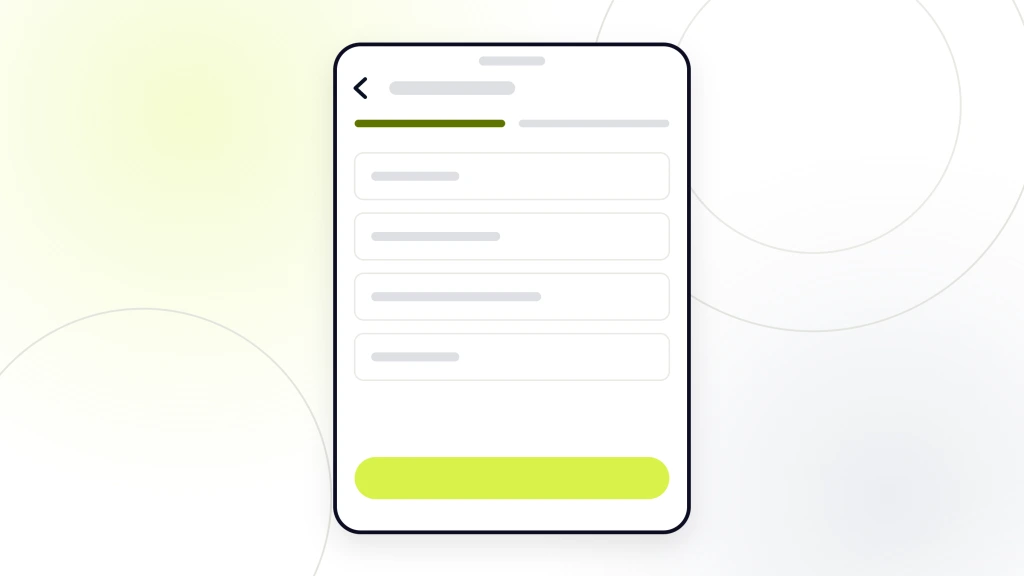
The optimal sequence. Pre-filled name. Pre-filled phone. Pre-filled email. Preferred day as multiple choice. Insurance carrier as multiple choice. That five-field form runs at 14 to 18% completion. Add a sixth field (reason for visit, referral source) and completion drops to 8 to 12%. Add a seventh and it drops to 5 to 8%. The right cap is 5.
Leads called inside 15 minutes book at 40 to 60%. Wait an hour and that drops to 8 to 15%. The SLA is the whole conversion mechanism.
Pre-filled field mechanics
Pre-filled fields use Meta’s cached profile data. Name, email, and phone appear filled when the form opens. The user reviews, edits if needed, and taps submit. That drops form-fill time from 60 to 90 seconds on a landing page to 8 to 15 seconds on a lead form. That time saving is why lead form completion beats landing page forms by 3 to 5x.
Custom question sequence
Custom questions belong after pre-filled fields. Use multiple choice, not short answer, for every question. Multiple choice runs at 90-plus percent completion once the user starts the form. Short answer drops to 60-70%. Preferred day: three options plus “other.” Insurance carrier: your top 5 plus “other/not sure.” Match the question format to the desired response speed.
15-minute follow-up SLA on dental Meta leads
The 15-minute follow-up SLA is the operational rule that turns lead ads into booked exams. Leads called within 15 minutes book at 40 to 60%. Leads called after 60 minutes book at 8 to 15%. Leads called after 4 hours book at 2 to 5%. That callback window is the whole conversion mechanism for meta ads lead generation.
The workflow runs in three parts. Meta lead form submits to a Zapier webhook. Zapier sends SMS to the front desk pool with lead details. Front desk calls back inside 15 minutes and enters the appointment in the PMS. Total elapsed time from form submit to booked appointment averages 22 minutes. Every practice we run has this workflow live before the first ad launches.
SLA workflow setup
SLA workflow setup. Meta lead form connects to Zapier via the native integration. Zapier fires SMS to the front desk pool via Twilio. SMS includes lead name, phone, preferred day, and insurance carrier. Front desk sees the SMS on the office phone or a tablet. Callback happens inside 15 minutes during business hours. Setup takes 45 minutes end to end.
After-hours lead handling
After-hours leads get an SMS auto-responder inside 60 seconds. It acknowledges the submission and offers a callback the next business morning. The auto-responder includes a link to book online for the after-hours audience willing to self-book. That combined workflow captures the 40% of leads that hit after office hours. Miss the auto-responder and after-hours leads book at 4 to 8% instead of 20 to 30%.
Meta creative that produces dental meta ads results
Meta creative for dental lead ads follows the same rules as landing page ads. Specific promise. Specific audience. Specific proof point. The one difference is the CTA. Lead ads use “Learn More” or “Get Offer” rather than “Book Now” because the form opens inside the app rather than routing to a booking page. That copy difference matters more than most practices realize when they run dental meta ads.
Every winning creative on lead ads uses a real doctor photo, a specific offer number, and one line of trust proof. Years in practice. Review count. Insurance carriers accepted. Skip stock imagery. Skip generic “welcome to our practice” copy. Skip long-form copy that gets truncated on mobile feed. See our dental facebook ads examples for real breakdowns.
Refresh Meta creatives every 14 days. Wait longer and CPMs climb 20 to 60% as the audience fatigues on the same three hooks.
Real doctor photo mechanics
Real doctor photos beat stock photos by 30 to 60% on cost per lead. Meta’s algorithm reads image metadata and recognizes stock inventory. Real photos get a lower CPM because the algorithm reads them as fresh creative. Every practice we run has 3 to 5 doctor photos on file for ad rotation. Rotate every 4 to 6 weeks to prevent ad fatigue.
Single-image versus carousel
Single-image creative wins for general new-patient exam campaigns. The offer is simple. Carousel wins for pediatric and cosmetic campaigns because the audience wants multi-angle reassurance before submitting a form. Match format to campaign complexity. Every campaign we run tests single-image and carousel side by side for two weeks before committing to the winning format.
Dental meta lead ads dental practice benchmarks
Dental Meta lead ad benchmarks sit in a predictable range once operations are dialed in. Cost per lead runs $8 to $32 depending on audience type and campaign. Lead-to-booked-exam rate runs 30 to 60% with 15-minute follow-up. Cost per booked exam runs $37 to $85 on a healthy meta lead ads dental practice account. Return on ad spend runs 8x to 15x on general exam campaigns.
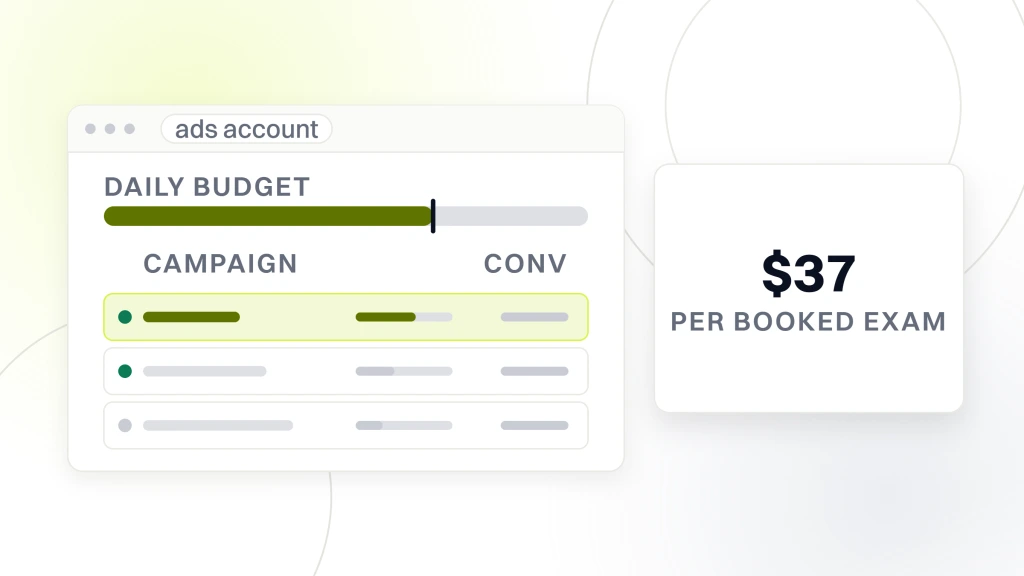
Benchmarks vary by city and treatment mix. High-competition metros run 30 to 50% above the median. Low-density smaller cities run 20 to 30% below the median. Match your account numbers to the table and adjust expectations by market density. See our dental marketing roi guide for the full framework.
Cost per lead benchmark
Cost per lead runs $8 to $16 on reactivation campaigns. $18 to $32 on new patient exam campaigns. $28 to $62 on high-value treatment campaigns. Match your account numbers to campaign type before drawing conclusions. Blended CPL across all three campaigns typically lands at $22 to $28 on a healthy account.
Booked exam benchmark
Cost per booked exam runs $37 to $85 on healthy Meta lead accounts. The 15-minute follow-up SLA drives the low end of the range. Slow follow-up (60-plus minutes) pushes cost per booked exam to $85 to $180 because 60 to 80% of leads drop off. The biggest cost lever is the SLA workflow, not the ad creative.
Case study. Smile Design Dentistry cut cost per call 30% across 50-plus offices
Smile Design Dentistry, a 50-plus location DSO founded in 2004 in Dade City, Florida, came to us with inflated ad spend, poor-quality leads, and limited tracking across the network. We restructured PPC by funnel and geography, launched their first full-funnel paid social program on Meta, and built brand-consistent landing pages tied to CallRail analytics. PPC conversion rate went up 20%. Cost per call went down 30%. All 50-plus dental offices went live with the new structure.
The paid social piece is what maps directly to what you’ll build here. Awareness, consideration, and conversion campaigns built around video and demographic precision. Continuous A/B creative testing with capacity-aware budget allocation between high- and lower-volume offices. Geo-modified bidding at the neighborhood level, not just per office, so patients searching from drivable distance actually landed at an office with capacity. Same operational discipline that runs a single-location Meta lead ads program, scaled across a DSO.
Route Meta leads through a signed BAA partner before they hit the PMS. Zapier alone isn’t HIPAA-compliant, and OCR fines run up to $50,000 per violation.
Smile Design Dentistry numbers
PPC conversion rate: +20% across all locations. Cost per call: -30% blended across search and paid social. Locations live on the new structure: 50-plus. Reporting cadence: weekly, per location. Every one of those numbers ties back to the same operational spine, per-location, per-stage campaigns so high-intent leads went to offices with capacity, not the next available phone.
SLA impact on the numbers
The follow-up SLA is the single operational lever that moves cost per booked exam by 3x. Leads called inside 15 minutes book at roughly 3x the rate of leads called after 60 minutes. Same leads. Same creative. Same offers. The only difference is the callback time. That’s why the workflow ships before the first ad goes live.
Scaling with lookalikes and retargeting
Scaling a working Meta lead account starts with lookalike audiences built from the booked-exam patient list. Upload the last 12 months of booked exam patients as a custom audience. Build a 1 to 3% lookalike. Run it as a new ad set inside the winning campaign. Cost per lead typically runs 20 to 30% below cold local audiences.
The retargeting layer runs to page visitors and video viewers who did not submit a lead form. Sequence: 3 days of testimonial creative, 7 days of financing FAQ, 14 days of urgency (spots for this month). Every retargeting ad matches the objection most likely blocking the visitor at that day-count. See our dental remarketing ads guide.
Lookalike audience build
Lookalike build starts with the highest-value custom audience. Booked-exam patient list beats email subscriber list. Booked-exam list of patients with 3-plus visits beats general booked list. Higher-value source data produces higher-quality lookalikes. Every account we scale uses the highest-tier custom audience the practice can produce, not the largest.
Retargeting sequence structure
Retargeting sequence runs three ads across 21 days. Day 1 to 3: testimonial video from a happy new patient. Day 4 to 10: financing or insurance FAQ creative. Day 11 to 21: monthly-slots-remaining urgency creative. Each ad matches a specific objection or motivator. The sequence pulls 22 to 34% of retargeted visitors back into the funnel.
Compliance and privacy for dental meta ads
Compliance on dental Meta lead ads runs across HIPAA, Meta ad policy, and state dental board rules. HIPAA governs how lead data flows from Meta to the practice’s systems. Meta ad policy governs which claims are allowed in creative. State boards govern advertising claims and disclosure requirements. Every dental Meta account we run passes a compliance checklist before delivery.
HIPAA requires that patient-identifiable data leaving Meta’s lead center goes to a HIPAA-compliant destination. Zapier is not HIPAA-compliant by default. Configure the lead flow with a HIPAA-compliant intermediary or direct integration to a compliant PMS. See our HIPAA marketing compliance for dentists guide. See also HHS HIPAA guidance.
HIPAA-compliant lead flow
HIPAA-compliant lead flow routes Meta lead data through a signed Business Associate Agreement (BAA) partner before it reaches the PMS. Options include HIPAA-compliant CRMs like DentalIntel or LocalMed, or direct integration via a HIPAA-compliant middleware provider. Zapier without a BAA is not compliant for identified patient data. Every account we run confirms the BAA is in place before any lead form goes live.
The consequences of skipping the BAA are real. HHS Office for Civil Rights has fined dental practices for HIPAA violations tied to marketing data flows. Fines run $100 to $50,000 per violation, capped at $1.5 million per year per identical violation type. Every dental practice running meta ads lead generation should confirm every step in the data flow has a signed BAA on file.
Required disclosure lines
Required disclosure lines vary by state. Most states require the treating dentist’s license number in the ad or on the linked landing page. Some states require “Individual results may vary” on before-and-after claims. California requires added disclosures on financing offers. Check your state board rules before you write creative. See our dental ads compliance guide and the ADA marketing resources.
Where to start with meta ads lead generation
Start with the SLA workflow. Set up the Meta lead form to Zapier to SMS routing before you launch the first ad. Test with a live submission from your own phone. Watch the SMS land in the front desk pool. Confirm the callback happens inside 15 minutes. Only after the workflow is proven do you launch the first ad. Practices that skip this step waste month one on leads that never get called.
When you’re ready to run this across the whole practice, our dental marketing for dentists covers the full stack. For related reading, see our targeting dental patients with meta ads, our dental facebook ads that work, and our dental social media ads guide.
These are the questions dental practices ask us most often about running meta ads lead generation on Facebook and Instagram.