Ecommerce platform maintenance falls apart the moment a founder assumes one stack’s playbook carries to another. A DTC skincare brand doing $2.4M annual revenue across a Shopify Plus storefront, a separate WooCommerce wholesale portal, and a legacy Magento 2 site called us last February after their Woo portal went dark during a Sunday flash sale. The Woo portal had missed 14 plugin updates in 4 months, one a critical WooCommerce Payments patch. The Magento site had gone 11 months without a security patch cycle. Each platform runs on its own maintenance clock, and the discipline that keeps Shopify Plus quiet doesn’t translate one-to-one to Woo or Magento inside the same brand.
This guide covers the cross-stack routine we scope when a founder runs more than one storefront. Update cadence per platform. Two-layer backup strategy. Staging workflow discipline. A 5-tool monitoring stack. Server maintenance on self-hosted stacks. Managed maintenance scoping. Every number traces back to real DTC brands audited across 2023 to 2025.
Update cadence for ecommerce platform maintenance per stack
Update cadence is the first line item that separates a quiet store from a Sunday-night fire drill. Shopify Plus, BigCommerce, WooCommerce, and Magento 2 each run on different release rhythms. Map the release feed of every platform in the brand’s stack to a weekly calendar, then assign a documented owner per feed.
Shopify Plus and BigCommerce cadence rules
Shopify Plus handles core patching for you, so the retainer scope shifts to app-level review. Audit installed apps monthly, drop any app the store hasn’t used in 90 days, and re-test checkout after every Editions release in June and January. BigCommerce follows a similar model. Core is managed, integrations are yours. Track API version deprecation announcements in March and September and stage every migration inside the 6-month sunset window. Skip the sunset window and the founder finds out from a customer, not a monitor.
WooCommerce and Magento cadence rules
WooCommerce and Magento put the release calendar back on the operator. WordPress core lands major releases twice a year and minor security patches roughly every 6 weeks. WooCommerce ships minor releases monthly, with plugin patches on their own clocks. A healthy Woo retainer stages core plus plugin patches every 2 weeks and pairs with WooCommerce SEO best practices and runs a full checkout smoke test before promotion. Magento 2 ships quarterly security patches in January, April, July, and October. Miss two in a row and you’re 6 months behind, the window most breach reports quote as the median gap between disclosure and exploit at scale.
Backup strategy across snapshot and application layers
Backups are the line every founder claims to have and few actually test. A hosting snapshot is not a backup. A snapshot proves the disk existed at a point in time. It doesn’t prove that a fresh install can restore a working store from it. The gap between a snapshot policy and a real recovery time objective is where the 47-hour post-incident restoration horror stories come from.
The two-layer backup rule every stack should follow
Every stack in the brand should carry two backup layers. Layer 1 is the platform-side snapshot, taken by the host or the platform on a documented schedule. Layer 2 is the application-side export, taken by the retainer team and stored in a second cloud region on a separate credential. Shopify Plus operators use Rewind or BackupMaster for the app layer. WooCommerce operators use BlogVault, Jetpack VaultPress, or UpdraftPlus with an S3 or Backblaze target. Magento 2 operators run mysqldump plus a media rsync into a versioned bucket. The two-layer rule holds because a single-layer failure, whether that’s a compromised admin credential or a corrupted snapshot, still leaves a clean restore path from the other layer.
Monthly restore tests separate real backups from wishful thinking
Once a month, restore the newest backup into staging and log the recovery time in minutes. Not theoretical. Actual. Stores that do this discover the corrupted archive, the missing WooCommerce order table, or the misconfigured S3 permission on a Tuesday morning with the founder awake, not on Black Friday at 11pm with the checkout down. Our team runs the restore test as a monthly line inside every managed retainer, and roughly 1 in 6 tests surfaces something the store didn’t know was broken. That 17% surprise rate is the case for testing every month, not every quarter.
Staging workflow inside ecommerce store maintenance
Staging workflow is the ecommerce store maintenance line that prevents roughly 80% of live-store regression incidents. Every platform supports a staging environment in some form, and every platform hides a different set of gaps behind the word “staging.” Operators who stage every update, run smoke tests, and promote only on a green pass sidestep the regression incidents that operators skipping staging tend to meet on Friday afternoons in November.
Staging environments per platform
Shopify Plus provides dev stores for theme and app testing but no true staging clone of production data. Operators simulate staging with Shopify Plus Sandbox environments and theme preview URLs, which cover 70% of the staging use cases and miss integration testing against real order flows. BigCommerce provides sandbox stores at every plan tier for theme and API testing. WooCommerce staging depends entirely on the hosting layer, where Kinsta, WP Engine, and Cloudways all provide one-click staging clones with database refresh options. Magento 2 self-hosted staging is a full second environment maintained by the operator or hosting vendor, usually with weekly database refreshes from production to keep the staging catalog current. Cross-stack brands running two or more platforms usually maintain two staging environments, which doubles the maintenance overhead and keeps regression risk isolated per platform.
Staging pipeline discipline that catches regressions
A real staging pipeline covers 4 checkpoints before any change reaches production. First, the change gets applied to staging with the same production data snapshot. Second, automated smoke tests run against checkout, cart, product detail, and search paths. Third, a manual QA pass validates any UI change against 3 device widths. Fourth, a rollback plan gets documented before promotion, naming the exact steps to reverse the change inside 15 minutes. Operators that follow the 4-checkpoint pipeline discover roughly 1 blocking regression per 3 deploys, which they fix on staging instead of on production. Operators that skip the pipeline discover the regression when a customer emails the founder from a broken checkout on Sunday night. The pipeline discipline is what turns staging from a checkbox into an actual safety net inside the store maintenance workflow. Our team runs this pipeline on every retainer engagement and documents the checklist inside the shared runbook so the founder can review the pass before promotion.
Monitoring stack inside ecommerce platform maintenance best practices
Monitoring stack is the maintenance practice that catches silent failures. A checkout that stops accepting a specific card network without throwing a customer-facing error can burn revenue for hours before anyone notices. A shipping API that times out and falls back to a slower vendor can quietly cost margin for weeks. The monitoring stack sits underneath every platform and reports the failures that dashboards and manual checks miss.
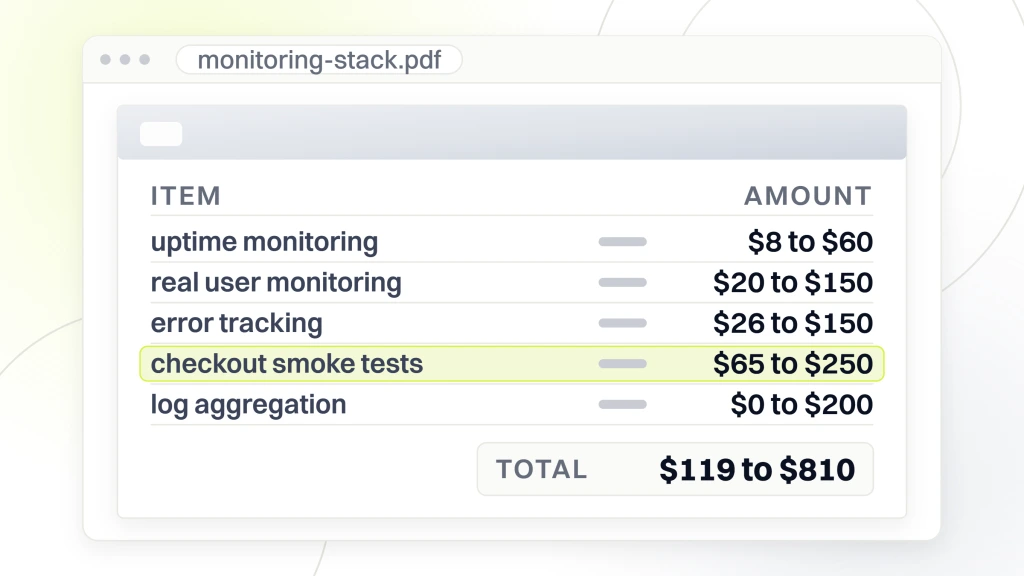
The 5-tool monitoring stack every real store carries
- Uptime monitoring at 1 to 5 minute intervals across storefront and checkout URLs. Better Stack, UptimeRobot, or Pingdom at $8 to $60 monthly.
- Real user monitoring on Core Web Vitals plus custom timings for cart and checkout. SpeedCurve, DebugBear, or Cloudflare RUM at $20 to $150 monthly.
- Error tracking on storefront JavaScript, server-side PHP or Ruby, and third-party integration webhooks. Sentry, LogRocket, or Rollbar at $26 to $150 monthly.
- Checkout path smoke testing running a synthetic transaction every 30 minutes against a real test card. Checkly, Rainforest, or DataDog Synthetics at $65 to $250 monthly.
- Log aggregation across the platform, apps, integrations, and hosting layer. Papertrail, Loggly, or DataDog Logs at $0 to $200 monthly depending on volume.
The 5-tool stack costs $119 to $810 monthly across the ecommerce band. Stores running the full stack catch silent failures inside 6 minutes on average. Stores running only uptime and error tracking catch the same failures inside 47 minutes on average across a Q3 2024 audit our team ran on 22 DTC brands. The 41-minute difference maps to $600 to $8,000 in prevented revenue loss per incident depending on traffic volume, which pays back the annual monitoring spend inside 2 prevented incidents. The monitoring stack is the highest per-dollar payback line in every ecommerce maintenance envelope, and our team refuses to sign a retainer that doesn’t include a monitoring configuration pass in the first 30 days. WP Rocket published a useful reference on real user monitoring configuration that WooCommerce operators should read before scoping the RUM line.
Server maintenance for ecommerce on self-hosted stacks
Server maintenance becomes a first-class concern the moment the store runs on WooCommerce or Magento 2 self-hosted. Shopify and BigCommerce operators skip this section since the platform handles the layer. WooCommerce and Magento operators own the server layer, and that means OS patches, PHP updates, database version upgrades, and memory tuning all live inside the maintenance retainer scope. Founders that skip server maintenance discover the omission when a security disclosure forces an emergency PHP upgrade and the site breaks against a plugin or extension that only worked on the old version.
The server maintenance lines that hit every self-hosted stack
Server maintenance for ecommerce on self-hosted stacks covers 8 recurring lines. First, OS security patches applied inside the vendor’s stated window, usually monthly. Second, PHP version tracking, with an upgrade cycle every 18 to 24 months when the running version reaches end-of-life. Third, database version tracking, with a major-version upgrade every 3 to 5 years. Next, web server configuration review (nginx, Apache, or Litespeed) for connection limits and buffer sizing tuned to traffic band. Then Redis or Memcached cache health and eviction rate monitoring. Plus SSL certificate renewal automation with a manual verification pass every quarter. Cron job health monitoring for the platform’s scheduled tasks like order status sync and abandoned cart triggers. And filesystem cleanup for log rotation, temporary file expiration, and media asset garbage collection. The 8 lines usually consume 4 to 12 hours of retainer time monthly on a mid-band WooCommerce store, and 10 to 24 hours on a mid-band Magento store where the stack has more moving parts to keep in sync.
Where server maintenance quietly compounds into cost
Server maintenance compounds cost when a store skips the cadence for two or more cycles. A skipped OS patch cycle usually adds 2 to 6 hours of unplanned work when the store finally applies the backlog, since dependency conflicts stack up. A skipped PHP upgrade past end-of-life can force a $2,400 to $8,000 emergency compatibility project when the hosting vendor drops support for the old version. A skipped database upgrade past end-of-life usually forces an emergency migration during a window the founder didn’t choose. The cost math on deferred server maintenance runs roughly 3.2x the cost of the regular cadence work, and that’s why our team scopes server maintenance as recurring monthly hours rather than as-needed billing. Kinsta’s reference on managed WordPress hosting covers the same math from the hosting provider’s side of the equation.
Managed maintenance for ecommerce service scoping across vendors
Managed maintenance for ecommerce service means the retainer owns the recurring workstreams end-to-end, so the founder is not naming individual tasks each month. The scoping of a real managed service reads very differently from a break-fix or as-needed engagement. Managed maintenance costs more per month than break-fix billing. It costs less per year than break-fix on any store past the complexity threshold, which usually lands around 12 installed apps or 25,000 monthly orders.
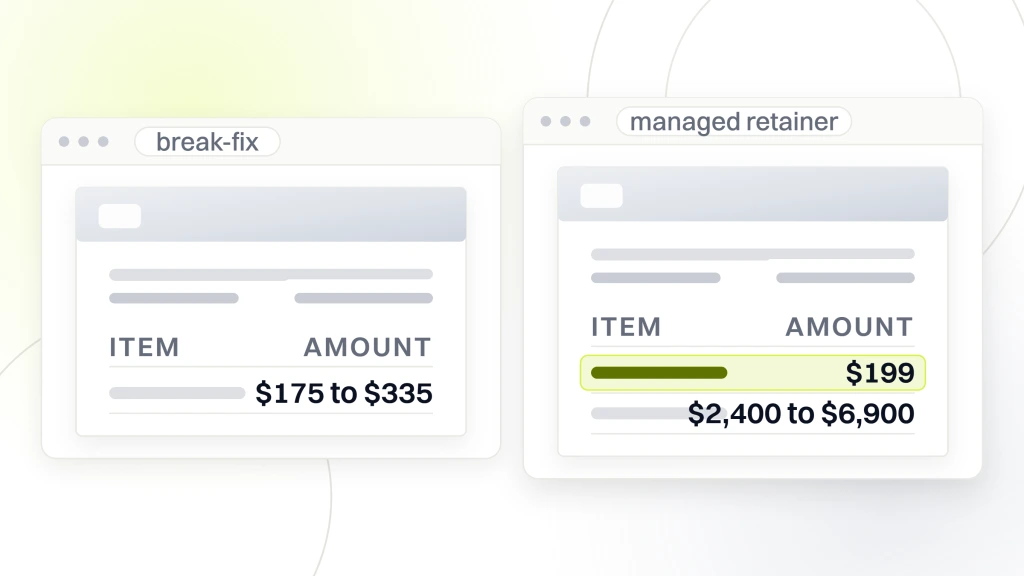
What managed maintenance for ecommerce service includes
Managed maintenance for ecommerce service scoped honestly includes 6 workstreams inside the recurring retainer. Update cadence execution per platform, following the release notes and staging discipline documented above. Backup verification with monthly restore tests read back to staging. Staging pipeline discipline on every change reaching production. Monitoring stack configuration, alert triage, and incident response. Server maintenance on self-hosted stacks where the operator owns the layer. Quarterly cross-stack review to catch drift between the maintenance runbook and the platform’s current best practices. Retainer scoping that stops at only 2 or 3 of the 6 workstreams leaves the store exposed on the remaining ones, and the founder usually discovers the gap during an incident that touches an uncovered layer. Our team scopes managed maintenance retainers starting at $199 monthly on Starter for stores under $500K annual revenue, scaling into the mid four figures on Growth for stores between $500K and $3M, and reaching $2,400 to $6,900 monthly on Scale for cross-stack DTC brands running Shopify Plus alongside WooCommerce or Magento.
The vendor comparison table for managed maintenance scoping
| Workstream | Break-fix billing | Managed maintenance retainer | In-house team |
|---|---|---|---|
| Update cadence | As-needed hourly at $175 to $335 | Documented monthly cadence in retainer scope | Weekly sprint planning |
| Backup verification | Rarely scoped, usually skipped | Monthly restore test inside retainer scope | Weekly or continuous |
| Staging pipeline | Skipped on quick fixes | Mandatory on every promotion | CI/CD pipeline enforcement |
| Monitoring stack | Configured once, forgotten | Alert triage in scope, quarterly review | Ongoing SRE ownership |
| Server maintenance | Billed hourly per incident | Recurring hours in retainer | In-house DevOps time |
| Response time | Days to weeks | Under 2 to 4 hours business hours | Under 30 minutes 24/7 |
| Monthly cost band | $400 to $9,000 depending on incidents | $599 to $6,900 predictable | $12,000 to $32,000 salary plus tools |
| Total annual cost | $4,800 to $108,000 highly variable | $7,188 to $82,800 predictable | $144,000 to $384,000 |
The table above is the honest comparison across the 3 managed maintenance service models. Break-fix works only for stores under $500K annual revenue where the founder can absorb some downtime tolerance and handle most edits directly. Managed retainer wins for the $500K to $8M band since the recurring cadence prevents the incidents that break-fix billing charges to fix. In-house teams win for stores past $8M annual revenue where coordination overhead across platforms, integrations, warehouses, and marketing operations justifies a dedicated staff. The right model is the one whose response time matches the revenue per hour at risk during peak windows, not the model whose monthly line reads cheapest at signing. Founders comparing quotes across managed vendors should ask for the response time commitment in writing, since vendors that hedge the number usually deliver the response window that suits their capacity rather than the founder’s revenue urgency.
Maintenance for ecommerce website across quarters and seasons
Maintenance for ecommerce website is not a flat monthly workload. Each quarter carries a different maintenance shape depending on the platform’s release schedule, the store’s promotional calendar, and the vendor ecosystem’s compliance windows. Operators that plan the annual maintenance envelope quarter by quarter avoid the surprise workload spikes that catch flat-monthly retainers off guard.
The four-quarter maintenance calendar every stack follows
Q1 maintenance usually covers post-Q4 cleanup, backup restoration verification against the Q4 traffic volume, plus prep work for spring launches. Q2 usually covers annual PCI DSS attestation for stores that self-scope compliance, plus platform release absorption from Shopify Editions Summer or WooCommerce quarterly releases. Q3 usually covers pre-BFCM load testing, checkout smoke test hardening, and monitoring alert threshold review against the expected Q4 traffic band. Q4 usually covers peak-season incident response with a code freeze from mid-November through New Year on most stacks, plus dev retainer hours running 1.5x to 2.5x baseline for the pre-launch and post-incident triage work. Operators that flatten the calendar to a single monthly line either under-scope Q3 and Q4 or over-scope Q1 and Q2, and the annual envelope suffers on both ends. Real ecommerce website maintenance planning documents the quarterly shape at annual budget time so the founder is not surprised by the November staffing conversation.
Seasonal patterns per platform that shift maintenance load
Seasonal patterns shift maintenance load per platform. Shopify Plus stores usually see Shopify Editions Summer land in mid-June and Editions Winter land in late January, which drives app-audit cadence up in the 2 weeks after each release. WooCommerce stores usually see WordPress core major releases in December and June, which drives staging cycles up in those months. BigCommerce stores usually see API version deprecation announcements in March and September with a 6-month sunset window, which drives integration review cadence up in the same months. Magento 2 stores usually see security patch releases in January, April, July, and October, which drives the security-patch staging window quarterly on a predictable rhythm. Cross-stack brands running two or more platforms need a coordinated maintenance calendar that overlays the platform-specific patterns onto the store’s promotional calendar. Our ecommerce marketing retainer integrates the maintenance calendar with the paid, organic, and creative workstreams so the founder sees one aligned quarterly plan instead of four separate ones.
A real cross-stack ecommerce platform maintenance engagement
Abigail Ahern, the luxury home décor DTC brand running a Shopify custom theme storefront, brought a cross-stack maintenance problem to our orbit that maps onto the pattern most growing brands face. The operation ran Shopify Plus alongside heavy paid-media and category SEO investment, and the maintenance workload had drifted across multiple release cycles without a documented cadence. The team wanted to know where the gaps sat and how to close them without disrupting the paid-media and SEO calendar that had already generated 179% revenue growth and 3,000% paid-social ROAS across the partnership window.
Our audit against the 6-workstream managed maintenance framework above surfaced 3 gaps. Backup verification ran against the platform-side snapshot only, with no application-level restore test on a monthly cadence. Staging pipeline discipline held on the theme layer and didn’t extend to the inventory feed integration, which was one of the highest-risk change surfaces during peak season. Monitoring stack covered uptime and error tracking and didn’t include checkout path synthetic transactions, which meant a silent checkout regression could burn revenue for 40-plus minutes before the team noticed. The 3 gaps didn’t need a headcount increase to close. They needed the maintenance runbook to name the gaps in writing, assign a documented owner per gap, and bake the remediation into the recurring quarterly review cycle instead of leaving it as a wishlist item.
The intent-driven test-and-learn discipline the Abigail Ahern team had already built into their paid-media program mapped cleanly onto the maintenance workstream once the runbook named the 6-workstream framework. The maintenance calendar overlaid onto the promotional calendar, and the pre-BFCM window included a documented monitoring hardening pass, a backup restore test, and a checkout smoke test cycle rather than an implicit “make sure the site works” wishlist. The result inside two quarters was zero unplanned checkout downtime through peak season, a 4-hour recovery time objective the team could commit to publicly, and a monitoring stack that caught one silent shipping API regression inside 8 minutes rather than the 40-plus minute window the prior stack produced. Cross-stack maintenance discipline is exactly this kind of unglamorous framework work.
Where ecommerce platform maintenance fits the annual DTC plan
Ecommerce platform maintenance sits underneath every marketing dollar the DTC brand spends. Paid, organic, and creative all depend on a store that stays fast, buyable, and safe across every platform in the operation. Founders that budget acquisition without pricing cross-stack maintenance usually replay the incident math inside 12 months, when one silent regression on the under-maintained platform undoes a quarter of paid spend and the maintenance conversation gets forced by an outage.
How maintenance discipline maps to the annual budget shape
DTC brands past $1M annual revenue running a single platform usually spend 1 to 3% of revenue on maintenance discipline. Brands running two platforms usually spend 1.4 to 3.8% since coordination overhead adds a real line rather than sharing across the stacks. Brands running three or more platforms usually spend 1.8 to 4.6% unless a consolidation plan is on the horizon, in which case the envelope temporarily inflates for 2 to 3 quarters as the second and third platforms are wound down. The maintenance line should be planned as a percentage of revenue at annual budget time, then split across the platforms per each platform’s responsibility model. Founders that budget only for the biggest platform and treat the others as afterthoughts usually discover the underinvestment when the smallest platform produces the biggest incident. Our writeup on the ecommerce website maintenance checklist covers the per-quarter task list every stack needs to run against.
What honest cross-stack scoping looks like at signing
Honest cross-stack scoping at signing names a per-platform hours estimate, a written responsibility split against each platform’s own maintenance model, a recovery time objective baked into the retainer, a documented monitoring configuration, and a quarterly runbook review sitting on the calendar as a real event. Retainers start at $199 monthly on Starter for single-platform stores under $500K annual revenue, scale into the mid four figures on Growth for stores between $500K and $3M, and reach $2,400 to $6,900 monthly on Scale for cross-stack brands running Shopify Plus alongside WooCommerce or Magento. Six-month contracts are standard since the discipline proves itself across two quarters, not one. Founders comparing vendors should read the total annual envelope including reserve hours, not the headline monthly number, since reserve is where honest scoping separates from the everything-included quote that quietly under-prices the real work. Custom PHP alongside platform-native maintenance sits in our sister writeup on laravel ecommerce maintenance services for the Composer, migration, and CI/CD side of the retainer.
Put ecommerce platform maintenance on your annual plan
The work here isn’t glamorous, and that’s the point. Ecommerce platform maintenance keeps every paid, organic, and creative dollar working. Map the release feed of every platform in the stack, layer two backups with a monthly restore test, run the 4-checkpoint staging pipeline, deploy the 5-tool monitoring stack, and scope managed maintenance against the 6-workstream framework. Founders that follow the cadence run resilient stores. Founders that skip it pay the cost math at 3.2x, usually during peak season, always at the worst moment for revenue.