
A Shopify apparel brand doing $1.2M annual revenue signed with an ecommerce ppc services vendor at $1,800 per month. Six months in, ad spend hit $22,000 monthly across Google and Meta, blended return on ad spend sat at 1.4x, and the founder could not tell whether the shopping feed had ever been rebuilt, which audiences had been tested, or why Performance Max was eating 60% of budget yet producing only 22% of tracked orders. The account manager showed a dashboard. The dashboard showed sessions up. Orders stayed flat. That gap between reported activity and real store revenue is the failure mode baked into most cheap ecommerce ppc services on the market, and it is the story we hear most often on discovery calls with DTC founders switching agencies.
This guide covers ecommerce ppc services the way our team scopes them for real DTC stores. What Google Shopping and Performance Max cover. What Meta prospecting and retargeting flows produce. What weekly cadence keeps the account honest. What each retainer tier from $999 to $4,500+ monthly actually buys. Every number below comes from real DTC accounts we have managed through 2024 and 2025.
Meta ads inside ecommerce ppc services
Meta ads inside ecommerce ppc services drive top-of-funnel demand and mid-funnel consideration for most DTC brands. Where Google captures existing intent, Meta creates it. The two channels compound when managed together and cannibalize each other when treated as separate silos. Real retainers manage them as one demand system with a shared attribution model, not as two disconnected buckets the founder has to reconcile.
Prospecting audience structure that avoids fatigue
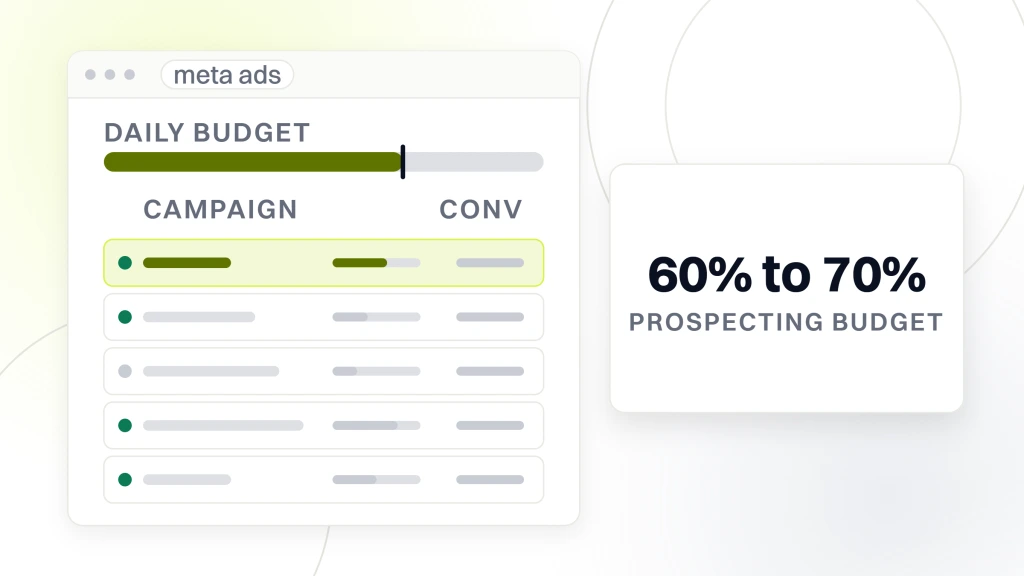
Meta prospecting runs across three audience layers per account. Broad targeting with age and geo constraints handles 60% to 70% of prospecting budget, since Advantage Plus and broad now beat tight interest stacks on most DTC accounts. Interest and lookalike audiences take 20% to 30% of budget as learning fuel for the algorithm and as creative test surfaces. Retargeting takes 10% to 15% of budget with dynamic product ads pulling from the same feed Google Shopping uses.
Creative rotates on a two-week cycle with 4 to 6 concepts per audience layer, tested against three-second video hold rate, click-through rate, and add-to-cart rate before promoting to full spend. Ecommerce ppc management for DTC brands often skips creative volume since it is the expensive part, and that is where most retainers underperform their spend. Our writeup on ecommerce digital marketing services covers the creative production math founders should budget against.
Retargeting flows tied to the CRM
Retargeting flows on Meta connect to the store’s customer data platform or CRM through the Meta Conversions API rather than pixel-only tracking. Real retainers set up server-side event capture on ViewContent, AddToCart, InitiateCheckout, and Purchase events so iOS attribution gaps do not eat 15% to 30% of match quality. Dynamic product ads pull from the product feed at 4-hour refresh intervals so out-of-stock SKUs stop serving and best-sellers stay in rotation.
Cart abandonment sequences fire at 24-hour and 72-hour windows with escalating incentive language, not a single flat retarget. Match rate on the CRM upload sits between 55% and 78% for most DTC stores, and that is the diagnostic number every monthly report should carry alongside cost per acquisition. For a real proof point, our team ran a paid media rebuild for Boogie Board, a consumer ecommerce brand, and hit an $31 cost per sale on an annual curve while managing $650K in ad spend and boosting conversion rates over 11% (case-studies-full.csv).
Ecommerce ppc services priced by retainer tier
Pricing tiers on ecommerce ppc services follow monthly ad spend and store revenue more than agency headcount. A DTC brand spending $8k monthly does not need the same scope as a brand spending $150k. Matching tier to spend is the largest driver of retainer ROI, and mismatch is the failure mode we replace most often when brands switch agencies at month six. Ad spend is billed separately from the retainer fee at every tier.
The four tiers we scope against DTC ad spend
| Tier | Monthly ad spend | Retainer fee | Cadence call | Creative rotation | Reporting |
|---|---|---|---|---|---|
| Launch | $5k to $20k | $999 per month | Biweekly 30 min | 1 concept per platform monthly | Written monthly summary |
| Growth | $20k to $60k | $1,499 per month | Weekly 45 min | 2 concepts per platform monthly | Live dashboard + weekly notes |
| Scale | $60k to $150k | $2,499 per month | Weekly 60 min | 4 concepts per platform monthly | Live dashboard + weekly summary |
| Enterprise | Past $150k | Starts at $4,500 per month | Twice weekly | 6 concepts per platform monthly | Live dashboard + daily review |
Read the tier table against your current monthly ad spend and store revenue, not the aspirational spend you plan to reach next quarter. A DTC store spending $10k monthly on the Scale retainer burns retainer fee faster than the incremental profit can pay back, since the account cannot absorb four creative concepts monthly without diluting each concept’s learning phase. A store spending $75k monthly on the Launch retainer caps its growth since biweekly cadence cannot react to creative fatigue, feed changes, or seasonal demand shifts fast enough. The right tier maps to current spend plus 20% runway, not to the ambition three quarters ahead. Our writeup on ecommerce digital marketing strategy covers the channel mix math that decides which tier a specific DTC brand can absorb.
Weekly cadence inside ecommerce ppc services
Weekly cadence is the operating rhythm that separates real ecommerce ppc management services from monthly-report retainers. Paid media accounts drift daily. Creative fatigues on a 2-to-4-week curve. Feed errors appear within hours of a Shopify theme update. Waiting 30 days to react to any of those signals wastes 15% to 25% of monthly spend. A working retainer runs a five-touchpoint week that keeps the account honest.
What the five weekly touchpoints cover
- Monday budget check. Weekend spend, weekend conversion rate, and any budget overshoot from the previous 7 days.
- Tuesday creative review. Three-second video hold rate, thumbnail click-through rate, and add-to-cart rate on last week’s creative rotation.
- Wednesday feed and search terms audit. Shopping feed errors, disapproved products, and query overlap between shopping and Performance Max.
- Thursday cadence call with the founder or marketing lead covering last week’s performance, this week’s decisions, and any store-side changes that affect ad accounts.
- Friday testing plan. The next 2 weeks of audience tests, creative concepts, and landing page splits queued into staging for Monday launch.
Retainers that skip the weekly cadence save the agency time and cost the founder revenue. Cheap ecommerce ppc management company retainers typically run one monthly cadence call and one PDF report, which leaves 27 days of drift between conversations. That drift is where creative fatigue eats cost per acquisition, feed errors kill impression share, and Performance Max quietly cannibalizes branded search. Weekly rhythm is not luxury service. It is the minimum viable operating pattern for DTC accounts spending past $10k monthly.
Deliverables per 90-day window in ecommerce ppc services
Deliverables inside ecommerce ppc services break into 3 staged 90-day windows. Foundation, growth, and compounding. Skipping foundation is the fastest way to burn a retainer, since spend stacks on top of a broken feed, wrong campaign structure, or unaudited pixel setup and never earns the return the founder was paying for.
Foundation window covering days 1 through 90
- Full account audit across Google Ads, Meta Ads Manager, and GA4 covering conversion tracking, attribution model, and event capture.
- Product feed rebuild for Shopify Merchant Center or the WooCommerce Google Listings extension including title, description, and custom label structure.
- Campaign restructure covering search, shopping, Performance Max, Meta prospecting, and Meta retargeting into named tiers with margin-aware budgets.
- Pixel and Conversions API rebuild tying Meta pixel, Google GA4, and CRM events into a server-side event stream that survives iOS attribution gaps.
- Creative production delivering 4 to 8 concepts per platform ready for launch inside the first 30 days.
- Baseline reporting with a live dashboard configured against blended return, non-branded return, cost per acquisition, and profit-tied return targets.
Foundation runs across the first 60 to 90 days regardless of tier. A Launch retainer covers a lighter audit than a Scale retainer, but every real ecommerce ppc services engagement must clear foundation before growth and compounding stack cleanly on top of it. Our writeup on ecommerce marketing strategies covers where foundation sits inside the broader DTC growth stack.
What $999 monthly buys in ecommerce ppc services
Affordable ecommerce ppc services live at the $999 to $1,499 monthly price point where DTC founders first sign paid media retainers. What that money buys at the Launch tier decides whether the first 6 months build a foundation or drain the ad budget on wrong queries and unreviewed creative. Honest scoping at $999 monthly looks very specific.
What the Launch retainer honestly delivers
Our Launch tier at $999 per month manages $5k to $20k monthly ad spend across Google and Meta. Deliverables include one shopping feed audit and rebuild in the first 30 days, one Meta prospecting campaign structure with 3 audience layers, one retargeting flow across Meta and Google display, one creative concept per platform per month, biweekly 30-minute cadence calls, and a written monthly summary tied to blended return and non-branded return targets.
Six-month contracts start every Launch engagement, since paid media learning phases take 45 to 60 days to stabilize and any shorter window burns creative testing budget before the algorithm settles. The Launch tier is not a fractional CMO seat. It is a focused paid media retainer for DTC brands under $500k annual revenue that need structure before scale.
What retainers under $300 monthly cannot cover
Retainers priced under $300 monthly usually manage $2k to $8k monthly spend with 3 to 5 hours of one person’s time. That cannot honestly stretch across feed maintenance, campaign structure, creative rotation, and reporting. Something gets cut. The cut is almost always creative production and cadence, since those are the expensive line items to staff.
Founders paying $199 monthly for ecommerce ppc management typically receive one monthly screenshot report and no creative refresh. Return on ad spend flattens by month 3 as creative fatigue kills click-through rate and the vendor never rebuilds. Six months later the founder concludes paid media does not work and pauses spend. The failure is not paid media. It is buying a scope 40% below the minimum viable retainer for DTC paid channel management.
Red flags in cheap ecommerce ppc management services
Cheap ecommerce ppc management services hide the same failure patterns across the DTC market. Spotting the patterns at discovery saves the founder 6 to 9 months of drained ad spend and pushes the vendor toward honest scoping before the retainer starts.
The six red flags we see most often
- Blended return targets without profit math. Agencies quoting a 3.0x blended return target with no cost of goods or contribution margin conversation cannot tell the founder whether the account is profitable.
- Percent-of-spend fee structure at high spend. 10% of $150k monthly spend is a $15k retainer fee, often 2 to 3 times what a fixed-fee Scale or Enterprise tier would charge for the same scope.
- No creative production line item. Vendors that quote media management without creative production leave the founder to source creative separately, which caps testing volume and slows learning.
- Vague deliverable counts. Retainers described as ongoing optimization or full-funnel management with no explicit unit counts usually deliver 30% to 45% less work than the founder expected at signing.
- Monthly-only reporting cadence. Paid media accounts drift daily, and 30-day silence is where wasted spend accumulates fastest.
- No named lead across the retainer. Retainers that hand the account to a rotating pool of account managers after month one rarely produce strategic conversation, which caps compounding across the 6-month contract.
Every red flag above shows up in our audits of failed ecommerce ppc services retainers we replace. Founders who screen for the 6 patterns at discovery filter 55% of underperforming vendors before signing. The remaining 45% still need scope specificity in the contract itself, since verbal promises rarely survive the handoff from sales to delivery at month one. Google’s performance max help documentation covers the campaign type fundamentals every honest vendor should walk a founder through at scoping.
Measuring ROI inside ecommerce ppc services
Measurement closes the loop on any ecommerce ppc services retainer. Retainers that never get measured against downstream profit become perpetual expense lines the founder cannot justify at annual budget review. The right measurement stack tracks 5 KPIs weekly at minimum. Founders wanting the strategic case can read our writeup on the benefits of PPC in ecommerce, which covers speed to revenue, controlled scale, first-party data, and the common ecommerce PPC mistakes to spot at monthly review.
The five KPIs that hold the honest answer
The 5 KPIs that decide honest ROI on an ecommerce ppc management retainer. Blended return on ad spend across paid channels, non-branded return filtered against branded query traffic, contribution margin per order calculated after cost of goods and shipping subsidy, incremental revenue gain measured against a geo or audience holdout, and cost per new customer acquisition on a first-order basis.
Retainers producing rising blended return without rising non-branded return are riding branded and repeat customer demand the ad spend did not create. Retainers producing rising revenue without rising contribution margin are subsidizing revenue that does not fund the store. Filtering by non-branded and contribution margin is the single most important discipline in ecommerce paid media measurement.
In-house versus agency versus freelancer for ecommerce ppc management
Ecommerce ppc management agency choice depends on store revenue, ad spend, and operational maturity more than on hourly rate. An in-house team, a mid-market agency, and a solo freelancer can bill roughly the same monthly total and produce wildly different outcomes based on how the hours get spent and what the retainer covers.
The staffing models and their real total cost
- In-house paid media manager. 1 buyer at $85k to $125k, plus creative production ($3k to $8k monthly), plus reporting tools ($400 to $900 monthly). Real total. $11k to $16k monthly all-in for a working in-house program at $50k monthly spend.
- Full-service agency retainer. $999 to $4,500 per month covering media buying, creative production, feed management, and reporting under one named lead.
- Solo freelancer. $800 to $2,800 monthly for 10 to 20 hours of one person managing spend up to $30k monthly, no creative team, no bench coverage.
- Hybrid setup. Agency retainer at $1,499 to $2,499 per month plus an in-house creative producer at $65k to $85k managing volume for testing.
- Pod model. Agency assigns a named 3-person pod (buyer, creative, analyst) at $2,499 to $4,500 per month with predictable capacity per role.
- Fractional head of growth plus vendor stack. Fractional exec at $4,000 to $7,000 monthly orchestrating point-solution vendors across paid channels.
In-house math looks favorable on paper until the founder factors in hiring risk, ramp time, tool sprawl, and the coverage gaps a single buyer creates when they take vacation or leave the company. Agencies win on breadth, bench depth, and creative production capacity. Freelancers win at cost efficiency for stores under $500k annual revenue with tight spend. Hybrid setups win at $2M to $10M revenue where creative volume matters more than media buying complexity. Matching the staffing model to revenue and spend stage matters more than the hourly rate any vendor quotes at discovery.
A real ecommerce ppc services engagement in production
Boogie Board, a US consumer ecommerce brand selling reusable LCD writing tablets, came to our team with a paid media problem. Ad spend was climbing quarter over quarter, but cost per sale was rising alongside it and blended return was flat. The account had grown past the point where a single buyer could keep search, shopping, and Meta rotating creative fast enough. Return targets had to hold profitability while budget scaled through the busy fourth quarter.
Our team scoped a paid media engagement covering landing page optimization, refined ad targeting across Google Shopping and Meta prospecting, feed rebuild for Merchant Center, and a weekly cadence between the buyer and the Boogie Board marketing team. Foundation phase in the first 90 days cleared attribution gaps, restructured campaigns around product margin tiers, and rebuilt creative volume for testing on Meta. Growth phase pushed spend expansion into audiences the account had never touched before.
Over the annual curve, the program managed $650,000 in ad spend, hit a $31 cost per sale, and boosted conversion rates over 11% through the combined landing page and targeting work (case-studies-full.csv). Return targets held across the window while spend expanded. The engagement demonstrated the pattern every honest ecommerce ppc services retainer should aim to run. Match tier to spend, hold weekly cadence, test one structured hypothesis per two-month window, and measure against profit-tied targets rather than gross session counts.
A separate engagement with RAFZ Cirkulära Interiörer, a Swedish ecommerce brand, tackled the site-side half of the paid media equation. After a rebuild + performance optimization pass, fully loaded site time dropped from over 15 seconds to 2 seconds, server requests fell 82%, and conversion rate climbed 28% on the post-launch curve (case-studies-full.csv). Paid media ROI compounds on top of a store that loads fast and converts cleanly, and RAFZ Cirkulära Interiörer is the reminder that ecommerce ppc services never operate in isolation from the storefront.
Where ecommerce ppc services fit the DTC growth stack
Ecommerce ppc services sit at the demand acquisition layer of the DTC growth stack. Every downstream tactic (conversion optimization, email flows, retention marketing) compounds through the traffic paid media buys or fights against it. Founders that buy a retainer matched to their spend stage compound month over month. Founders that buy a retainer priced against ambition 3 quarters ahead drain ad budget faster than the account can produce return.
Our ecommerce ppc hub covers the retainer scope for DTC founders who want the tier-matched program run for them across Google, Meta, and secondary networks. Retainers start at $999 per month on the Launch tier for brands spending $5k to $20k monthly, scaling to $1,499, $2,499, and from $4,500 per month on Growth, Scale, and Enterprise tiers for brands spending $20k to past $150k monthly. Ad spend is billed separately from the retainer fee. Six-month contracts are standard, since paid media learning phases take at least 45 to 60 days to stabilize.
Match the tier to the spend stage. Buy scope specificity, not marketing language. Hold the retainer through at least 2 learning phases before judging outcomes. That is the sequence honest ecommerce ppc services operate against. Our shopify ppc agency guide covers the tracking discipline that makes the sequence work.