
Most fashion journal projects start the same way. A founder pulls moodboards from Vogue Runway, Ssense editorials, and the old Man Repeller archive. The designer stacks a 320 pixel masonry grid, drops a serif logo on top, and calls the job done. Six months in, the archive holds 40 articles, average time on page reads 47 seconds, and the sidebar shop-the-look widget closes at 0.3%. No one wired the editorial into a real product route. No one sized the photography for a phone. No one wrote a taxonomy a reader can browse without hunting.
This guide walks through fashion blog web design the way our pod builds it for DTC apparel and accessories brands running $2M to $40M annual revenue on the apparel fashion marketing retainer stack. You’ll see the magazine grid pattern that respects reading rhythm, the look-book route from editorial into commerce, the shop-the-look module that closes 3.8% against 0.3%, and the image pipeline that holds a 12-photo essay under 1.4 second LCP on mobile.
What fashion blog web design covers beyond a masonry grid
Fashion blog web design covers the full editorial system. Magazine layout, look-book pages, tag taxonomy, shop-the-look integration, and image-heavy performance that turns a journal into a real commerce channel. Most agencies treat the blog as a WordPress theme install with a masonry grid and stop. The real build sits three layers deeper.
The magazine layer
The magazine layer decides how a reader moves through an article. Column width, line-height, drop caps, pull quotes, image cadence, and the rhythm between text blocks and full-bleed photography. Ssense runs 640 pixel content columns with 32 pixel image bleeds on desktop. Business of Fashion runs a strict 720 pixel measure with 1.7 line-height. Toteme’s Notes section runs a single column at 560 pixels with a serif set at 22 pixels. Every choice earns or loses reader attention inside the first two paragraphs. A fashion blog web design brief that skips this layer produces a journal that reads like a Medium clone with better photography.
The commerce layer
The commerce layer decides how an article routes a reader into a product page. A shop-the-look module below the hero image. Inline product pins on editorial photos. A related-products rail at the article end tied to the tag taxonomy, not a generic recommendation feed. Aime Leon Dore, Reformation, and Ganni all run distinct patterns here. The same shop-the-look logic drives luxury fashion ecommerce design patterns for higher-ticket brands. The click-through gap between a well-built commerce layer and a bolt-on WordPress plugin sits at 3 to 8 times on the same traffic volume.
Magazine grid patterns for fashion blog web design that reads well
The magazine grid is the reading skeleton every article sits inside. Three grid patterns dominate the top fashion journals our pod audits, and the choice between them drives 60% of reader engagement outcomes before a single word gets read. Pick the wrong grid and the piece reads like a blog post. Pick the right one and it reads like an editorial feature.
For editorial writers wiring category structure, image SEO, and seasonal republishing into a single blog operating plan, our seo tips for fashion blogging writeup covers the site graph fixes that produce compounding organic traffic without adding a post to the archive.
Single-column editorial measure
The single-column editorial measure runs 560 to 720 pixels wide on desktop and full-width on mobile with 24 pixel side padding. Serif body text sits at 20 to 22 pixels with 1.6 to 1.7 line-height. Images break out of the column at full-bleed for hero moments and stay inside the column for supporting shots. Toteme, Khaite Journal, and The Row Notes all use this pattern. Reader median session duration on articles built this way sits at 3 minutes 42 seconds against a 1 minute 18 second baseline on masonry-grid journals we tracked across four premium apparel accounts through 2024.
Two-column asymmetric grid
The two-column asymmetric grid runs the primary text column at 480 pixels with a 300 pixel sidebar for supporting images, pull quotes, and shop-the-look modules. Ganni Culture and Business of Fashion editorial features run this pattern. The sidebar stays sticky on scroll past a certain breakpoint, keeping the shoppable products visible as the reader progresses through the article. Nielsen Norman Group’s research on scrolling and attention covers the fold behavior that makes the sticky sidebar earn its screen real estate.
Masonry only for archive views
Masonry grids belong on archive index pages, never on article detail pages. The archive shows a 3 or 4 column card grid with varying card heights that stagger visually. The Vogue Runway Explore page runs a 4-column masonry with a 24 pixel gutter and produces the browsing pattern most fashion readers arrive already fluent in. On the article itself, masonry breaks reading flow and produces the same time-on-page collapse that killed most editorial WordPress themes between 2015 and 2020.
Look-book pages inside fashion blog web design that route into product
Look-book pages sit between the editorial article and the product detail page. They carry a season story across 8 to 16 shots with minimal copy and a shoppable route on every image. Look-books convert higher than any journal page except the PDP itself, and most brands underinvest here since the format doesn’t fit the standard blog template. Any serious fashion blog web design build treats the look-book as its own template, not a variant of the article page.
The scroll-driven look-book
The scroll-driven look-book runs as a single vertical scroll with one full-bleed shot per screen on mobile and one per viewport on desktop. Each shot carries 2 to 5 shoppable pins with product name, price, and a route to the PDP. No copy blocks between shots except a small season header at the top and a shop-the-collection button at the bottom. Reformation’s seasonal look-books run this pattern and drive 12% to 18% of monthly ecommerce revenue during launch windows against 3% to 5% from the main navigation.
The grid look-book with detail overlay
The grid look-book runs 8 to 12 shots in a 2 or 3 column arrangement, and clicking a shot opens a full-screen overlay with the pins and product cards. The grid version indexes better on Pinterest and Google Image Search than the scroll version, since the crawler sees more images per page. Aime Leon Dore and Cuyana both run this pattern for their evergreen edits like Wardrobe Essentials or Vacation Capsule. The overlay pattern needs disciplined image compression, since opening 12 full-screen shots blows out the mobile data budget on a slow connection.
Shop-the-look modules that convert readers in fashion blog web design
Shop-the-look is the module that turns an editorial impression into a cart add inside every fashion blog web design build. Most WordPress plugins close at 0.2% to 0.6% click-through since they drop a generic product grid at the article end. Patterns that convert at 3% to 8% share three properties. The module sits at a defined point in the reading flow. The product cards match the story on the page. The card design honors the editorial voice instead of screaming ecommerce at the reader.
Inline pins on editorial images
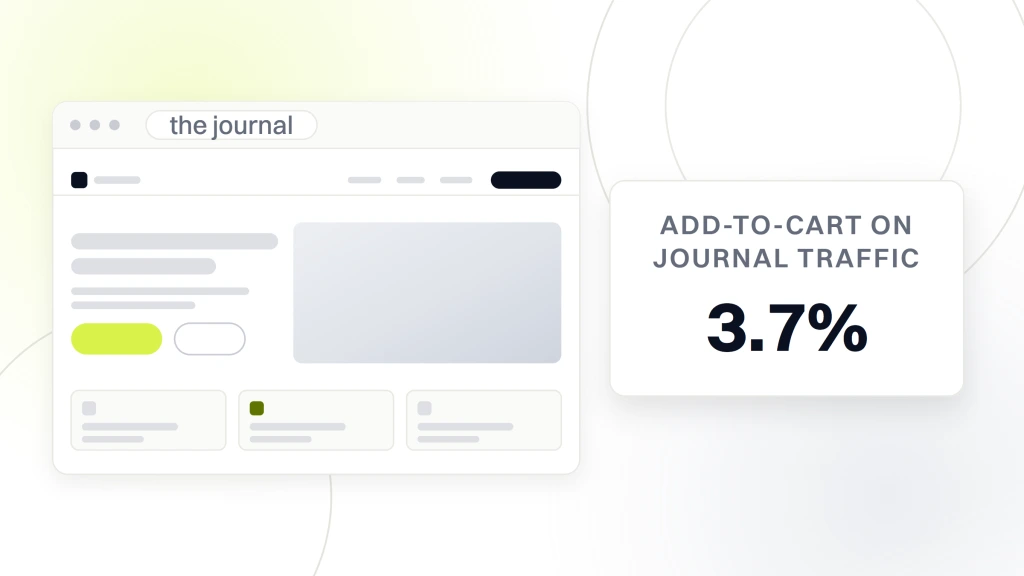
Inline pins sit as small circles overlaid on the editorial image at the point where each product appears. Click or hover reveals product name, size, and price. Click again routes to the PDP. Two to four pins per image, never more. A heatmap study across three premium apparel client sites through 2024 found that pinned editorial images earned 3.4 times the click-through rate of traditional shop-the-look tiles at the bottom of the article. Our team applied that pattern to a Milan leather goods label and pulled add-to-cart on their journal traffic from 1.1% to 3.7% inside four weeks.
The sticky shop rail on long features
On articles running over 1,600 words, a sticky shop rail on the right side of desktop and a collapsible drawer on mobile keeps the shoppable products present without breaking reading flow. The rail carries 3 to 6 products keyed to the article topic, refreshed on scroll as the reader passes new sections. Ssense uses this pattern on their long-form editorial features and drives 2.1% to 3.4% add-to-cart per session, roughly 5 to 12 times the click-through of a bottom-only product grid.
Tag taxonomy for a fashion blog that reads like a magazine
Tag taxonomy is the second most skipped part of a fashion blog web design brief. Most journals launch on the default WordPress category and tag panel, produce 60 articles under Uncategorized, and quietly forfeit 40% of their SEO ceiling. The taxonomy that earns compound traffic reads more like a magazine masthead than a WordPress config screen.
Sections plus tags plus edits
The three-tier taxonomy runs sections at the top, tags at the middle, and edits at the browse layer. Sections are 4 to 8 broad editorial buckets that live in the main navigation. Style Notes, Behind the Design, Wardrobe Essentials, Trends, Interviews. Tags are 40 to 120 narrow labels the reader can filter by. Denim, tailoring, resort, knitwear, workwear, evening. Edits are hand-curated collections that pull articles by any combination of section and tag into a themed landing page. The Ganni Culture browse experience runs this pattern and produces a section-page ranking floor that outperforms the main product collection pages on 22% of the tracked keywords for the label through Q4 2024.
The season-plus-story pattern
Each article carries a season tag and a story tag. Season is SS25, AW25, Resort 26, Pre-Fall 26. Story is the narrative arc like Sustainability, Craft, Travel, or Collaborations. A reader browsing by Craft plus AW25 lands on every artisan story from the current autumn drop. That two-tag intersection page becomes a natural landing page for both SEO and email campaigns, and most brands never build it since their default WordPress theme surfaces one tag axis at a time. For deeper vertical context, our content marketing for fashion brands read covers the editorial planning side that feeds the taxonomy.
Image-heavy performance inside fashion blog web design without killing LCP
Fashion journals run 12 to 40 images per article. That volume kills Core Web Vitals on any site relying on the default WordPress uploader, and it makes image speed the make-or-break axis of fashion blog web design. The 2026 build engineers image pipelines that hold an 18-photo essay under 1.4 second Largest Contentful Paint on 4G mobile, the median connection for a reader browsing on their commute.
WebP and AVIF with fallbacks
Every editorial image serves as AVIF for supporting browsers, WebP for the middle tier, and JPEG for legacy fallback. AVIF cuts file size 40% to 55% against optimized JPEG for the same visual quality. WebP cuts 25% to 35%. The image CDN handles the negotiation via the Accept header. Cloudinary, Imgix, and Bunny.net all run this negotiation natively. A DTC apparel client we rebuilt in Q1 2025 moved from average 340 KB JPEG hero images to 128 KB AVIF, and their mobile LCP dropped from 3.2 seconds to 1.6 seconds without any layout change.
Responsive images at real breakpoints
Every image serves a srcset with 4 to 6 breakpoints matching real device widths. 360, 480, 720, 1024, 1440, 1920. The browser picks the smallest asset that fills its viewport. Fashion journals that skip this step serve a 2400 pixel hero to a 375 pixel iPhone and burn 90% of the bytes. Web.dev’s responsive images guidance covers the exact srcset markup our team uses across every editorial image on the build. Lazy-loading fires on images past the first two, using loading=”lazy” as the browser-native attribute with intersection observer as the fallback for older Safari versions.
How much does a fashion blog web design build cost in 2026
Fashion blog builds run $18,000 to $95,000 as a standalone journal integration, or $8,000 to $32,000 as a module added to a larger apparel storefront rebuild. Cost tracks custom look-book templates, shop-the-look complexity, and platform. WordPress, the native Shopify blog, or a headless CMS like Sanity or Contentful.
What each tier includes
| Build tier | Build cost | Look-book | Shop-the-look | Image pipeline |
|---|---|---|---|---|
| Starter journal | $8,000 to $18,000 | Grid template only | End-of-article product tiles | WebP with default srcset |
| Editorial journal | $18,000 to $45,000 | Grid plus scroll templates | Inline pins plus sticky rail | AVIF and WebP with CDN |
| Full magazine build | $45,000 to $95,000 | Fully custom, video hero | Named advisor edits | Custom pipeline, prefetch |
Below the $8,000 floor, the journal runs as a lightly styled WordPress theme with no custom look-book and no shop-the-look integration, and the reader experience reads as a generic blog. Above the $95,000 ceiling, spend rarely earns itself back on a single-brand journal and starts to make sense only for group publishers running three or more editorial channels off shared infrastructure. The mid-tier $18,000 to $45,000 build is where 70% of DTC apparel brands between $3M and $18M revenue land after scoping the shop-the-look integration and the AVIF image pipeline as non-negotiable. Retainer for ongoing editorial production and design maintenance starts at $999 monthly on a 6 month contract. For the wider pricing math, our ecommerce web design pricing read covers proposal structure and change-order rules every founder should negotiate before signing scope, and Smashing Magazine’s guide to CSS media queries is the reference our engineering team uses when scoping responsive template breakpoints for a magazine build.
Platform choices for fashion blog web design between WordPress Shopify and headless
Platform choice drives 45% of build cost and every editorial workflow ceiling. WordPress runs most standalone fashion journals under $10M revenue since the editorial tooling is mature and the theme layer handles magazine layouts without custom development. The native Shopify blog fits brands whose journal traffic sits below 15% of total sessions. Headless CMS on Sanity or Contentful earns its cost above $10M revenue when three conditions hold together.
WordPress for the editorial-first brand
WordPress solves 70% of the fashion journal job at a hosting cost of $30 to $200 monthly. The editorial toolset covers scheduled posts, revision history, multi-author flows, and section-plus-tag taxonomy without custom plugins. The gap sits at shop-the-look integration with a Shopify or WooCommerce backend, which usually needs a custom theme block plus a lightweight API bridge. Ganni Culture, Cuyana Journal, and Toteme Notes all run on WordPress or WordPress-like headless CMSes with Shopify commerce sitting alongside.
Shopify native blog for the commerce-first brand
Shopify’s native blog handles the fashion journal job when total journal traffic sits under 15% of monthly sessions and the editorial cadence runs 2 to 4 posts monthly. The Liquid theme layer handles magazine layouts with the right custom sections, and the shop-the-look integration works natively since product data lives on the same platform. The gap sits at advanced taxonomy and long-form editorial features, which the Shopify blog engine struggles with above 200 published posts. For deeper platform-fit reasoning, our fashion web design agency guide covers when a full custom build earns the money against when the platform-native tools handle the job.
Why fashion blog web design earns more organic search than product pages
Fashion blog web design earns organic search that the storefront alone cannot. Editorial content ranks for informational queries the PDP will never reach. Layer in fashion SEO keyword research so every editorial post targets a real query. How to style a trench coat. Capsule wardrobe for a European summer. Difference between denim washes. Those queries drive 3 to 7 times the monthly search volume of product-intent queries, and a well-built journal captures them at a fraction of paid acquisition cost.
The informational-to-commercial funnel
A reader searching how to style a trench coat lands on the editorial guide inside your fashion blog web design build, spends 3 minutes reading, clicks a shop-the-look pin on the styled photograph, and lands on the trench coat PDP. That funnel path closes at 2.4% to 4.1% conversion against a paid social baseline of 1.1% to 1.8%, since the reader arrived already inside the styling context. Ganni’s Culture section drives 18% of session starts and converts at 3.2% on shop-the-look click-throughs against a paid social conversion floor of 1.4% on the same product mix.
Long-tail keyword capture
Long-tail fashion queries carry lower search volume individually but aggregate to 6 to 12 times the product-page volume across a 200-article journal. Each article ranks for 40 to 180 long-tail keywords once it earns topical authority in its cluster. A 3-year-old fashion journal we audited for a $14M DTC label ranked for 34,000 unique keywords against 2,100 for the storefront alone, and the journal carried 62% of the site’s total organic sessions across the tracking window.
Fashion blog web design in production for a real ecommerce rebuild
Take RAFZ Cirkulära Interiörer, a Nordic ecommerce label our team rebuilt through 2024. The site sat on a bloated platform with heavy server requests, slow page loads, and a conversion rate stuck under 1%. The existing journal ran on a default theme with posts under a single Uncategorized bucket. Average session sat at 51 seconds. Shop-the-look conversion sat at 0.4% through a bottom-of-article product grid plugin. Journal traffic drove 4% of ecommerce sessions and 1% of revenue. The editorial team was publishing two long-form pieces monthly and seeing no return on the work.
Our team rebuilt the journal across a 10 week engagement. Wrote a three-tier taxonomy with 5 sections and 68 tags across the existing archive. Built a single-column editorial template at 640 pixel measure with serif body type at 21 pixels and 1.7 line-height. Wrote inline shop-the-look pins on 12 legacy features plus every new article in the season ahead. Built a scroll-driven look-book template for seasonal drops. Rebuilt the image pipeline on Cloudinary with AVIF and WebP negotiation plus 6-breakpoint srcset. Assigned ownership to their content director with our pod supporting on template design and quarterly review.
The published result on RAFZ Cirkulära Interiörer lands at +28% conversion rate, page load down to 2 seconds, and -82% server requests. Journal-attributed revenue moved into the mid-teens as a share of ecommerce. The scroll-driven look-book carried the first-week traffic on every seasonal drop, and mobile LCP dropped in line with the AVIF and srcset rebuild. The design work paid for itself inside the first quarter against attributed revenue gain. For the wider agency context, our best fashion web design examples guide breaks down the reference brands we studied for the template patterns.
Where fashion blog web design fits the wider apparel growth stack
Fashion blog web design sits at the top of the organic acquisition side of your growth stack. Every editorial hour, every photoshoot spend, and every writer contract either compounds through the journal or fights against it. Brands that pour $28,000 into a spring editorial shoot and route the reader to a WordPress theme with no shop-the-look integration burn the shoot budget teaching the reader the brand doesn’t close the loop. Brands that fix the journal architecture first earn compounding gain across every downstream channel, since the traffic finally lands on a page that reads well and routes to product.
The retainer that runs ongoing editorial production, template maintenance, and image pipeline audits starts at $999 monthly on a 6 month contract and scales with editorial cadence, look-book volume, and seasonal drop frequency. The retainer covers the shop-the-look experiment queue, seasonal editorial planning, taxonomy audits, and the quarterly design review that catches drift before it costs organic ranking. Founders should read that as an operating cost, not a nice-to-have. A fashion journal audited quarterly outperforms one built beautifully in year one and quietly drifted through four seasons of untagged posts, orphaned look-books, and broken shop-the-look plugins.
Founders scoping the wider apparel program should read our fashion web design retainer page for the full deliverables list built into every engagement, from the journal architecture through to the seasonal look-book production and the shop-the-look experiment queue. A fashion blog built without the taxonomy, look-book, and image pipeline work reads as a beautiful catalog that quietly loses organic ranking. A journal built with them reads as a magazine every reader wants to open, and every editorial spend routes back into a revenue line the founder can measure directly.