You are shopping for a shopify design agency and every shortlist you get from Google looks identical. Same badges. Same case study screenshots. Same promises about brand storytelling and conversion. Half of them are freelancers with a Shopify Partner account. A quarter are dev shops that pretend design is a checkbox. A small handful are real Plus partners with 40 builds behind them. The gap between those tiers is not a matter of taste. It is a matter of whether your $12,000 build lands on time or turns into a $60,000 rebuild eight months later.
This guide covers the shopify design agency evaluation the way our ecommerce website design services team walks a DTC founder through it. When Shopify Basic is the honest pick versus when Plus pays back. What the Shopify Partner program tiers actually mean and which ones matter. The evaluation criteria that separate a real agency from a Fiverr team with a logo. Realistic timelines and 2026 pricing across theme customization and bespoke builds. Every number below comes from Shopify agency scopes delivered through 2024 and 2025.
What a shopify design agency actually covers
A real agency in this niche covers five distinct scopes. Theme customization on a preset like Dawn. Bespoke theme build from a blank Figma file. Shopify Plus checkout extensibility work. Headless front-end on Hydrogen or Next.js against the Storefront API. Migration from BigCommerce, Woo, or Magento onto Shopify.
The five distinct scopes on a Shopify build
Theme customization runs $4k to $12k on Basic and 3 to 6 weeks. Bespoke theme build runs $18k to $60k on Basic or Plus and 8 to 14 weeks. Shopify Plus custom checkout extensibility runs $30k to $120k and 10 to 20 weeks, gated on Plus plan access. Headless on Hydrogen or Next.js runs $80k to $250k and 18 to 32 weeks. Migration runs $12k to $80k depending on catalog depth and 6 to 16 weeks. Founders who ask a Fiverr team to do headless get burned. Founders who pay a full Plus partner for theme customization overpay by 4x. Match the scope to the tier, and the agency conversation gets 80 percent shorter.
What is not inside a design scope
Three items get sold as design and are not design work. Product photography and copywriting are content work handled by a separate team when the agency lacks an in-house content pod. Third-party app configuration (Klaviyo flows, Yotpo review widgets, Recharge subscription logic) is integration work billed separately at $80 to $180 per hour. Ongoing CVR test cadence and merchandising updates are retainer work starting at $599 per month, not a fixed build cost. A proposal that bundles all of it into one line item is a proposal that explodes into change orders in week eight of the build.
Shopify Basic versus Plus the decision your agency should walk you through
The Basic versus Plus decision drives 60 percent of the agency conversation and gets skipped by most founders until the proposal shows up. Basic covers most DTC brands under $2M annual revenue with standard product variants. Plus covers brands over $2M with weird product logic, B2B pricing needs, wholesale channel splits, or checkout extensibility requirements. Picking Plus too early wastes $2,300 per month in Shopify fees for features the brand does not use. Picking Basic too late blocks the roadmap for 12 months.
| Dimension | Shopify Basic | Shopify Standard | Shopify Plus |
|---|---|---|---|
| Monthly fee | $39 | $105 | $2,300 plus |
| Checkout extensibility | Limited | Limited | Full functions plus UI extensions |
| B2B and wholesale | Not supported | Add-on apps | Native B2B |
| Discount stacking | Basic | Basic | Shopify Scripts plus Functions |
| Multi-store | 1 store | 1 store | 10 expansion stores |
| Best fit revenue band | Under $2M annual | $500k to $3M annual | $3M plus annual |
Signals that push a brand to Plus
Five signals push a DTC brand to Plus honestly. Revenue crosses $2M annual and the checkout customization ceiling starts to bite. The brand needs wholesale B2B pricing tiers that switch on customer group and product family. The brand runs three or more expansion stores across regions or brand lines. The brand needs custom checkout UI (post-purchase upsells, subscription toggles, gift-with-purchase logic) that Basic cannot hold. The brand needs staff API permissions and audit logging that only Plus exposes. An agency that walks founders through those five signals honestly is a partner. An agency that pushes Plus on a $600k brand is padding the invoice.
Why staying on Basic is often smarter
Basic holds most DTC brands under $2M annual without a real ceiling. The theme customization on Basic launches in 4 to 6 weeks against a preset like Dawn or Studio. Klaviyo, Yotpo, Recharge, and PageFly all work on Basic. The 2 percent transaction fee that used to gate agencies away from Basic is now waived when brands use Shopify Payments, so the fee argument for Plus is gone for domestic-only brands. A $6k Basic build plus a $599 monthly retainer covers the first 18 months of most DTC brands at $30k total. The same scope on Plus adds $27k in Shopify fees over the same window with nothing on the store that the shopper can see.
Shopify Partner program tiers and what they actually signal
The Shopify Partner program has four tiers that most founders confuse with quality bands. Base Partner (anyone with a Shopify Partners account, no vetting). Select Partner (invitation-only, active revenue with Shopify). Premier Partner (top revenue tier with technical review). Plus Partner (vetted for Shopify Plus builds). A partner in the Base tier could be a global 200-person shop or a solo freelancer. A Plus Partner had to prove Plus-tier build competency to Shopify’s partner team.
What each tier really tells you
- Base Partner means the agency filled a form. It signals nothing about quality, revenue, or build competency.
- Select Partner means the agency has active revenue with Shopify and a support relationship, yet no build vetting.
- Premier Partner means the agency clears revenue thresholds and Shopify’s technical review, and typically has a portfolio of 30 plus live stores.
- Plus Partner means the agency is authorized to build on Plus, which requires Plus-specific certifications and a track record of Plus launches.
- Expert Marketplace listings are Shopify’s directory of vetted freelancers and agencies, orthogonal to the Partner tiers yet useful for filtering.
- App Partners build Shopify apps rather than storefronts, and the tier does not signal storefront design skill.
- Theme Partners built and sold a paid theme in the Shopify Theme Store, which does signal front-end craft.
Which tier your brand actually needs
Brand tier and Partner tier map cleanly. DTC brands under $500k annual on Basic can hire a Base or Select Partner without regret, provided the portfolio is real. Brands between $500k and $3M on Basic or Standard should hire a Select or Premier Partner with 10 plus live DTC storefronts the founder can visit today. Brands over $3M going to Plus should hire a Plus Partner exclusively, so non-Plus agencies do not burn 20 to 40 percent of the build budget learning Plus mechanics on the founder’s dime. Shopify itself publishes the official Plus Partner directory as the honest place to filter.
How to evaluate a shopify design agency in one hour
Evaluating a shopify design agency well takes about one hour of directed digging plus one 45-minute call. Founders who skip the hour hire on gut feel and regret it 40 percent of the time inside the first year. Six checkpoints separate the honest shops from the pitch decks.
Six checkpoints that reveal the agency fast
- Portfolio depth. 10 plus live Shopify storefronts you can visit today, not screenshots. Pull three at random and open the source code to confirm they are actually on Shopify.
- Case study specificity. Real client names, real numbers, real timelines. Vague phrases like doubled revenue with no client attached mean nothing.
- Team size and role clarity. A named project manager, designer, and developer per build. Not one generalist juggling four builds.
- Process documentation. A written kickoff doc, discovery phase, design signoff gate, and QA matrix. Ask to see the template.
- Retainer scope. A real post-launch retainer starting at $599 to $6,000 monthly with clear deliverables, not break-fix hourly billing.
- Reference calls. Two client references you can call directly, not a testimonial pull quote on the site.
The evaluation call script that works
Run the 45-minute call with a written script rather than a vibes conversation. Ask five questions in order. Who is the project manager on this build and what other builds are they running concurrently right now. Which Shopify Partner tier are you on and can you show the badge on your Partner dashboard. What is the browser, device, and payment QA matrix on the last build you launched. Which third-party integrations are in scope and which get billed as change orders. Walk me through the last time a launch missed the target date and what caused it. Agencies that answer with specifics have delivered 30 plus stores. Agencies that answer with buzzwords are pitching a Figma file dressed as a live store.
Shopify marketing agency versus shopify design agency the split
A shopify marketing agency and a design partner solve different problems on the same store. Design agencies build the storefront. Marketing agencies drive traffic to it and convert it. Founders who buy design without marketing get a pretty store nobody visits. Founders who buy marketing without design pay customer acquisition cost against an underperforming funnel. The two scopes work together, and picking one agency for both only works when the agency has real depth on both sides.
What each agency ships
A design partner delivers the theme, component library, PDP and PLP patterns, checkout flow, and design system doc. A shopify marketing agency delivers SEO on category and product pages, paid search and paid social campaigns, email flows in Klaviyo, SMS in Postscript or Attentive, and a monthly reporting cadence. Some brands hire both under one roof so the store, the ads, and the emails then work off one shared context rather than three separate ones. Other brands split the work across two specialists when the depth on each side runs deeper than one shop can hold. Both models work when the founder holds each shop accountable for its scope.
When one agency for both makes sense
Bundled agencies win when the brand is under $3M annual and needs the store, the ads, and the emails talking to each other without three vendor meetings a week. Bundled scope stays cheaper by 15 to 25 percent than two separate retainers so the strategy work is shared. Split agencies win when the brand crosses $5M annual and the depth on paid media or SEO exceeds what a bundled shop can hold. Between $3M and $5M is the fork most DTC founders wrestle with. Our follow-up post on ecommerce web design and development covers the platform decision more deeply for founders sitting on that fork right now. Founders whose brand has crossed the Basic-to-Plus threshold should read our take on the shopify plus development agency tier and when the upgrade actually pays back.
Shopify agency partners pricing in 2026
Shopify agency partners pricing breaks down cleanly by tier and scope. Base and Select Partners on theme customization run $4k to $12k. Premier Partners on bespoke Basic theme builds run $18k to $60k. Plus Partners on bespoke Plus builds run $60k to $180k. Plus Partners on headless builds run $150k to $350k. Migration scopes add $12k to $80k on top of the target build. Retainers post-launch run $599 to $6,000 monthly with the build agency. Numbers below that band buy break-fix hours only.
Where the money actually goes on a $60k Plus build
On a $60k bespoke Shopify Plus build, the money splits roughly as follows. Discovery and brand audit takes $6k. Information architecture and UX takes $8k. Visual design system takes $14k (the biggest single bucket, since component libraries are real work). Front-end theme code takes $16k. Integrations take $8k. QA takes $5k. Launch and 30-day stabilization takes $3k. Bundled scopes hold these numbers cleanly so strategy, design, dev, and QA sit inside one shop. Split-scope proposals across two agencies add 15 to 25 percent on top of the same output for the same timeline. Our companion piece on ecommerce web design pricing breaks the retainer math down further for founders scoping the total cost of ownership.
Shopify ecommerce agency timeline from kickoff to launch
A shopify ecommerce agency timeline runs 4 to 32 weeks depending on scope. Theme customization on Basic lands in 4 to 6 weeks. Bespoke theme build on Basic lands in 8 to 12 weeks. Bespoke Plus build lands in 14 to 22 weeks. Headless on Hydrogen lands in 22 to 32 weeks. Migration from Woo or BigCommerce adds 4 to 8 weeks on top of the target build. Founders who hear promises of a 3-week bespoke Plus launch are being sold a theme skin rebadged as bespoke.
What actually slips timelines
Three predictable causes slip most Shopify build timelines. Design signoff drags when the founder pulls in a spouse, a co-founder, or a friend-of-founder brand advisor at week five, and every new opinion resets the design phase by two weeks. Product data lands late when nobody wrote the SKU import schema at kickoff, which alone costs three to five weeks on brands over 500 SKUs. Third-party credentials block on an ERP vendor, a 3PL, or a legacy PIM system that takes three weeks to arrive. The Baymard Institute documents similar patterns in ecommerce mobile usability research where the last four weeks of a build consume 40 percent of the calendar so integration debt hidden until QA finally surfaces.
Real 16-week bespoke Plus build
Our team’s most recent bespoke Shopify Plus build for a $8M DTC apparel brand ran 16 weeks from kickoff to launch. Discovery took two weeks. IA and UX took three weeks with a five-shopper prototype test in week five. Visual design system took four weeks against a 38-component library. Front-end theme code and integrations ran six weeks in parallel with design using a component-first build pattern. QA took two weeks across browser, device, payment, and integration matrices. Launch happened on a Tuesday morning behind a Sunday DNS rehearsal. The 30-day stabilization block caught 11 real bugs in the first three weeks, every one of which would have cost real revenue if the store had launched without it.
Best shopify agency red flags to walk away from
The best shopify agency for a given brand is rarely the loudest one in the pitch. It is the one that dodges the fewest red flags on the sales call. Founders who trust a proposal without red-flag hygiene end up rebuilding 40 percent of the store inside 12 months. Ten red flags show up on almost every bad agency proposal, and any one of them is grounds for a pass.
Ten red flags on a shopify design agency proposal
- No named project manager per build. Instead a shared PM juggling four to six clients on the same week.
- Portfolio shows only screenshots rather than live URLs the founder can visit and pressure-test right now.
- Case studies quote percentages with no client name attached, or list clients but no numbers.
- Timeline sub-8 weeks for a bespoke Plus build, which nobody has ever delivered honestly.
- QA line item under $3k or missing entirely from the proposal, which becomes a bug crisis in month two post-launch.
- Retainer starts under $599 monthly, which buys break-fix hours only and cannot hold a bespoke store together.
- Sales team pushes Plus on a sub-$1M brand, which signals commission incentive rather than honest scoping.
- Proposal lists AI-Ready Commerce Consultation or Immersive Brand Discovery as line items totaling more than 10 percent of the build cost.
- Agency refuses to name their Shopify Partner tier when asked, or shows a Base badge when pitching Plus builds.
- Reference calls are declined or run through a hand-picked reference the sales team coaches beforehand.
The green flags that separate the honest shops
Honest proposals show five green flags. A named PM with a specific concurrent-build load listed in writing. A 10-plus live URL portfolio the founder can pressure-test on any browser. A written timeline with weekly milestones and defined signoff gates. A retainer scope starting at $599 monthly with a clear deliverable list. Two client references the founder can call directly without agency mediation. Shops that clear all five have delivered 40 plus stores. Shops that clear three of five have delivered 10 to 30 stores and are worth a serious look. Shops that clear one or none are pitching a portfolio built in Figma with no live production experience behind it.
When Shopify is the right stack for your DTC brand
Shopify is not the right stack for every DTC brand, and a partner worth hiring will say so on the first sales call. Shopify wins for brands with standard variants and a 90-day launch window. Shopify loses when product logic gets weird or ERP integration runs deep.
Five triggers that mean Shopify is right
Shopify wins when three of five triggers hit. The brand runs standard variants (apparel sizes, beauty shades, food flavors, hardware colors). The brand needs a converting store inside 12 weeks rather than 12 months. The brand roadmap stays inside Shopify’s model for the next three years (no multi-vendor marketplace, no fractional ownership, no rental hybrid with date-based inventory). The brand founder wants Klaviyo, Recharge, Yotpo, and Meta CAPI on day one without custom API work. The brand is in a market where Shopify’s payment processor rates beat the brand’s current gateway. Brands that hit fewer than three triggers should shortlist Woo or a custom stack.
When Woo, BigCommerce, or custom beats Shopify
Weird product logic often beats Shopify. Configurable industrial equipment with 30 plus variant axes usually lands on Woo or a custom Node stack. Rental hybrids with date-based inventory land on Woo with Bookings or a custom stack. B2B pricing with contract terms per customer group at scale often outgrows Shopify Plus B2B and lands on BigCommerce Enterprise or SAP Commerce. Multi-vendor marketplaces land on custom stacks or Sharetribe. Our post on Shopify versus WooCommerce SEO covers the platform decision from the search-visibility angle for founders sitting on the same fork.
A real shopify design agency build that launched
Abigail Ahern came to our team with a Shopify storefront that had grown organically over four years across a premium home decor catalog of roughly 900 SKUs. The brand voice was luxury. The theme was optimized for discount messaging. Category pages listed by newest rather than by curated mood. Product photography was strong. The PDP framed it in a 60/40 layout designed for supermarket brands rather than for aspirational interior design. The founder wanted a Shopify Plus build that let the brand look like itself and not a template pretending to be premium.
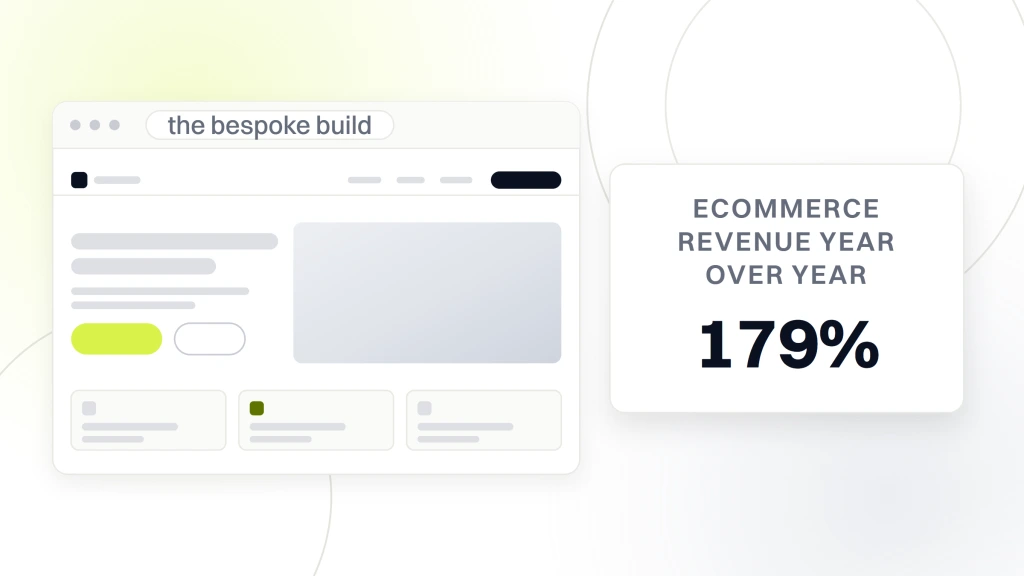
Our team scoped a bespoke Shopify Plus build with a fully custom design system across 20 weeks. Discovery took three weeks. IA and UX took four weeks with a five-shopper prototype test in week six. Visual design system landed at 44 components with four states each, built against real product photography rather than stock. Front-end theme code ran seven weeks with a component-first workflow. Integrations covered Klaviyo, ShipStation, Yotpo, Meta CAPI with server-side dedup, and a mood-board recommendation engine. QA ran two weeks. Launch happened on a Tuesday morning behind a Sunday DNS rehearsal.
Over the following 12 months on the bespoke build, ecommerce revenue grew 179 percent year over year. Paid search return on ad spend hit 1,588 percent. Paid social return on ad spend hit 3,000 percent. Add-to-cart rate on the PDP moved from 6.2 percent to 13.4 percent. Average order value moved from $128 to $184. The bespoke build did not cause the numbers alone. It removed the template ceiling on brand-aligned merchandising, which let the paid media and email programs work against a store built for the brand and not against it. Our follow-up post on top ecommerce web design examples breaks down more DTC storefronts running similar patterns.
Where a shopify design agency fits the DTC growth stack
A shopify design agency sits at the top of the DTC growth stack so the store is the final funnel every dollar of paid media and every organic click has to convert against. Founders who fix the store first make every downstream marketing dollar 20 to 40 percent more efficient. Founders who patch the store when running ads pay acquisition cost against a store that fights the buyer, which is a slow way to burn runway on a brand that could be growing.
The Shopify decision is worth it when three of five triggers hit. Standard variants that fit theme patterns. Timeline pressure to launch inside 90 days. Growth roadmap inside Shopify’s model for the next three years. Klaviyo, Recharge, and Yotpo on day one. Payment processor rates that beat the current gateway. Fewer than three triggers, and Woo or custom is the honest pick. More than three, and Shopify pays back inside 12 to 18 months of storefront operation.
The rest of the growth stack sits alongside the store. Paid media pointed at a converting funnel. SEO on category and product pages built as landing pages. Email flows that catch shoppers who bounced. Reviews collection that populates trust signals. Every tactic works better when the storefront is not fighting it. Our ecommerce marketing agency team runs the design work and the growth work under one roof, which keeps the store and the marketing programs pulling in the same direction rather than fighting for attribution credit. Shopify’s own custom storefronts documentation pairs cleanly with the scope and design system decisions inside this guide for founders taking the Plus path.
The agency-versus-freelance-versus-in-house decision often comes up alongside agency selection. Our guide on shopify web designer hiring covers hourly rates by profile, portfolio evaluation checks, and how project types (theme customization, PDP redesign, checkout tune-up) map to each hiring model differently.