You want to classify dental practices independent vs DSO because it changes what you’re walking into. A patient wants to know if the person on the treatment plan owns the chair or reads from a corporate script. A vendor wants to know if the buyer is the owner-dentist or a regional director in Nashville. An investor wants to know if the practice on the spreadsheet is a rollup target or already a rollup line item. The sign on the door won’t tell you. Half of DSO practices still trade under the founder’s name because retention scores go up when patients think their dentist owns the place.
This guide walks the physical signals, staffing signals, tech stack signals, and billing patterns that let you classify dental practices independent vs DSO inside a 30-minute visit or a 10-minute records pull. You’ll see what the signage looks like, what the front desk says when you call, which practice management systems point which direction, and how EOB codes give the game away. Skip to the section you need. The comparison table near the top is the quick-look.
Why you’d want to classify dental practices independent vs DSO in the first place
You want the classification because ownership changes the negotiation, the continuity of care, the pricing authority, and the acquisition target math. Patients want to know who sets the fee. Vendors want to know who signs the purchase order. Investors want to know if the practice is available or already inside somebody else’s platform.
The reason depends on the hat you’re wearing that day. A patient booking a crown wants to know if the dentist has room to negotiate on price or if the fee schedule is locked at the regional office. A supply rep working on a $40,000 sterilization deal wants to know if the decision maker sits in the operatory or in a group purchasing agreement three states away. A private-equity analyst underwriting a rollup wants to know how many of the 87 practices on the target list are already inside a DSO structure and don’t count as fresh acquisition inventory. Same question. Three very different reasons.
The trick is that DSO ownership is rarely disclosed on the practice website. Most DSOs run on a captive PC model where the dentist of record legally owns the professional corporation and the DSO owns the management company that runs everything else. On paper, the practice is dentist-owned. In reality, marketing, hiring, purchasing, scheduling, and billing all run through the parent. That corporate practice of medicine loophole is why the front-of-house looks independent even when the back-of-house is anything but. According to the ADA Health Policy Institute, roughly 13% of US dentists were affiliated with a DSO as of 2022, up from 8.8% in 2017, and the curve keeps climbing.
You need a repeatable method because the surface signals lie. The rest of this guide is that method. 15 minutes of observation and 3 phone calls will tell you the answer with 90% confidence. A records pull and an EOB review get you to 98%. You rarely need the last 2% unless you’re closing a deal.
The full classification framework to classify dental practices independent vs DSO
Before signals, get the taxonomy right. “Independent” and “DSO” are the endpoints, not the whole spectrum. Real ownership sits on a ladder with 7 rungs, and each rung answers the price, staffing, and marketing questions differently. Naming the rung correctly is 60% of the classification job.
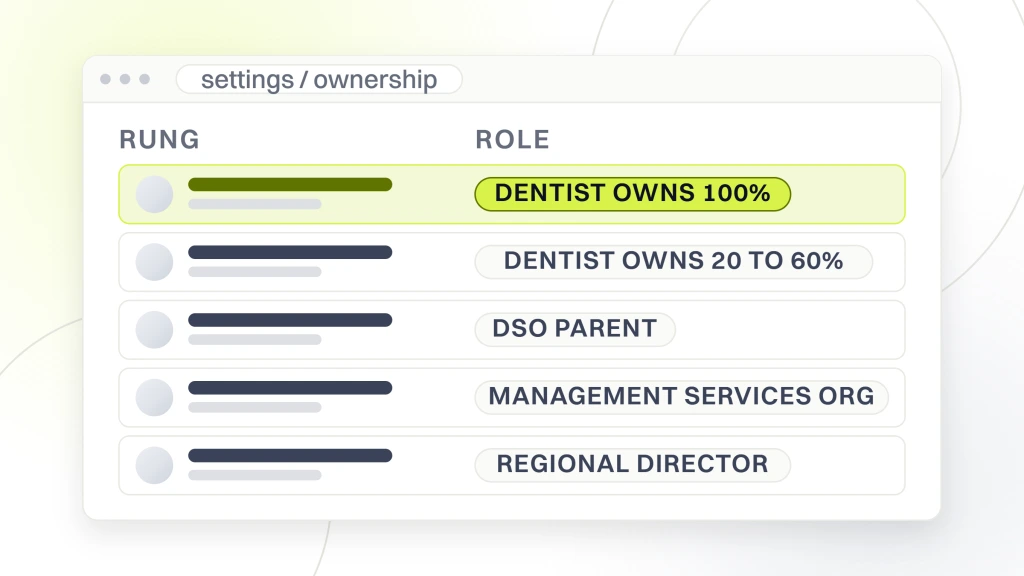
Rung 1. Solo independent practice. One owner-dentist. One location. No management company, no equity partner, no franchise fee. Owner sets fees, hires the team, negotiates supply contracts, and pays taxes on the S-corp or PLLC. Roughly 50% of US practices still fit here in 2026. Marketing runs through the owner or a local agency. The buyer, the operator, and the provider are the same person.
Rung 2. Group-owned independent (small partnership). 2 to 5 dentist-owners sharing 1 to 4 locations. Owners split equity, split management duties, and split call. No outside investor. The practice looks and behaves independent, but decisions are consensus-driven. Common in mature markets where a founder brought in a junior partner over 5 years. Fee schedules are set by the group, not by an outside operator.
Rung 3. Group-owned solo (multi-location). One or a few dentist-owners running 5 to 20 offices without a management company. Sometimes called “dentist-led group.” The clinical brand is often unified, and there’s a central back office for billing and HR, but ownership sits with practicing dentists. This rung looks DSO on the outside and independent on the inside. Signals to check: who owns the real estate, who signs the equipment leases, and whether there’s a management services agreement.
Rung 4. Joint-venture DSO (JV-DSO). The dentist owns 20% to 60% of the local entity, and a DSO owns the rest. Both sides sit on the operating agreement. The dentist keeps clinical autonomy and a real profit share. The DSO handles marketing, RCM, and shared services. Rollover equity in the parent is common at year 3 to 5. This is the fastest-growing DSO structure in 2026, especially in the sub-100-location tier.
Rung 5. MSO / management services model. The dentist owns 100% of the professional corporation. A management services organization owns the non-clinical assets and takes a management fee, usually 6% to 12% of collections. On paper, the dentist is fully independent. In practice, the MSO controls the vendor list, the marketing spend, and often the fee schedule through the management agreement. Common in states with strict corporate practice of medicine rules.
Rung 6. Full-acquisition DSO (small-mid platform). The DSO owns 100% of the practice through a captive PC structure. The former owner-dentist typically stays on for 2 to 4 years under an employment contract, then rolls off. This is the classic “sold my practice to a DSO” story. Platforms in this tier run 30 to 200 offices, often built by a single family office or a lower-middle-market PE fund. Smile Design Dentistry sits in this band at 50+ Central Florida and Tampa Bay locations.
Rung 7. Private-equity DSO platform (large or mega). A PE-backed DSO with 200+ locations, often across multiple states. Ownership passes between PE funds every 4 to 7 years in a recap or platform sale. Marketing, HR, RCM, IT, and supply are fully centralized. Clinical protocols are standardized to some degree. Fee schedules, hiring authority, and equipment budgets live at the regional or national office. Heartland, Aspen, Pacific Dental, Smile Brands, and MB2 are the reference names in this tier.
Adjacent-but-different structures worth naming so you don’t miscategorize. Strategic acquirers (insurance-owned or hospital-owned dental groups) look like DSOs but answer to a payer or health-system board. Franchise dental brands (rare in the US, common in Australia and Brazil) are dentist-owned locally with a brand license and royalty. Community health centers and FQHCs aren’t DSOs at all, they’re 501(c)(3) or governmental entities with different fee schedules and grant funding. The framework above is built for rungs 1-7; if you hit an FQHC or a hospital-based clinic, the signals shift.
Quick comparison table to classify dental practices independent vs DSO
Before the full walkthrough, the quick reference. Every signal below carries weight but none is a single-point diagnosis. You want 3 or 4 consistent signals pointing the same direction before you classify dental practices independent vs DSO with confidence. A solo dentist who bought a Weave phone system and outsourced billing to a national vendor can look DSO-adjacent on 2 signals and still be genuinely independent. Read the pattern, not the pixel.
| Signal category | Independent practice | DSO-affiliated practice |
|---|---|---|
| Signage | Dentist name on the door, hand-painted or local sign shop | Uniform corporate signage, glowing box logo, national vendor |
| Website footer | Owner-dentist headshot, local address, single location | “Part of the X family of practices,” location switcher, national HQ |
| Front-desk script | “Dr. Smith’s office, how can I help?” | “Bright Smiles at Riverside, this is Angela speaking” |
| Practice management | Dentrix, Eaglesoft, Open Dental, single-office license | Dentrix Enterprise, Curve DEX, or a custom fork on multi-site license |
| Insurance participation | 10-15 PPO plans, owner-selected | 25-40 PPO plans, negotiated at the network level |
| Fee schedule | Owner sets, changes yearly | Regional office sets, changes quarterly |
| Hiring notices | Local Indeed or Craigslist post, owner’s name in the ad | Corporate careers page, ATS-driven, “benefits package” |
| EOB assignee | Individual NPI billed under group NPI matching the DBA | Multiple practice locations rolling to a single tax ID or MSO tax ID |
Signage and front-of-house signals
Signage is the loudest signal a practice sends without meaning to. A solo owner picks the sign vendor, argues about lettering with a spouse, and drives past the finished job on the way to open the office. A DSO picks a national sign vendor, orders a standard face plate for the illuminated cabinet, and installs the same box across every acquisition. You can read the difference from the parking lot in 20 seconds.
Independent signage cues. The dentist’s name in the signage, often with a credential (DDS, DMD) after it. Hand-painted or vinyl lettering. A logo the sign shop clearly built for this one office. Awnings or window graphics that match the year the practice opened, not the current year. A wall clock, framed diplomas, and family photos visible from the reception window. Waiting-room magazines that lean regional (Highlights for kids, the local Chamber magazine, a Reader’s Digest from 2019). Coffee in a real mug, not a paper cup with a national logo.
DSO signage cues. A corporate logotype where the practice name reads as “Bright Smiles at Riverside” or “Perfect Teeth Denver” with a shared visual identity across every location. Backlit LED cabinet signs. Vinyl decals on the door listing insurance networks in a corporate typeface. A patient portal QR code on a printed tent card that matches the same tent card at other locations. Digital signage in the waiting room playing brand-produced videos with the parent brand’s logo bug in the corner. Bottled water branded to the DSO, or coffee cups printed with the parent brand.
Signage-adjacent tells. The way appointment reminders arrive. An independent office sends texts through Weave or Solutionreach with the dentist’s name in the message. A DSO sends them through NextHealth or a custom platform, and the sender ID often reads as the DSO parent name, not the local practice name. Check the sender field on an old text or email; that one detail flips the coin more often than not.
Staffing signals to classify dental practices independent vs DSO
The staffing pattern tells you as much as the signage. Independent practices hire slowly, retain longer, and pay in the local labor market rate. DSOs hire on a corporate calendar, use recruiters, and pay against a national grid. Both models have their strengths. Both leave fingerprints.
Independent staffing cues. Long-tenured office manager and dental assistants (5 to 20 years is common). A single hygienist who works Tuesday, Wednesday, Friday because “that’s her schedule.” Small team, 4 to 8 total. Everyone answers the phone if the front desk is busy. Bonuses handed out at Christmas as cash or gift cards. Health insurance often not offered, or handled through a professional employer organization the owner set up personally.
DSO staffing cues. Multiple hygienists rotating across locations. Regional office manager who covers 3 to 5 offices and isn’t in the building most days. A “lead dentist” role that’s a corporate promotion, not an ownership stake. HR handled at the parent level, with a benefits portal and 401(k) match. Uniforms with the corporate logo, ordered in bulk. Locum tenens dentists filling gaps during hygiene rescheduling. A recruiter reaches out to dental hygienists on LinkedIn using the DSO’s parent brand, not the local practice name.
The clearest staffing tell is the credentialing timeline. When a new dentist joins an independent practice, insurance credentialing typically takes 90 to 120 days because the office manager files the paperwork one PPO at a time. When a new dentist joins a DSO, credentialing takes 30 to 60 days because the DSO’s centralized credentialing team files everything in parallel and has relationships at each insurer’s provider network team. Ask any front desk when they last credentialed a provider. The answer tells you which model runs the back office.
Tech stack and practice management signals
The tech stack is the hardest signal for a DSO to hide because it lives inside the operatory and shows up on the login screen. Practice management software choice, imaging platform, phone system, and payment processor all cluster along the ownership line. If you can see a login screen, or a receipt, or a monthly patient statement, you can classify the practice with high confidence.
Independent tech stack cues. Dentrix G7 or Eaglesoft on a single-office license. Open Dental if the owner leans clinical and wants control of the database. Weave or Solutionreach for patient communication. A local IT vendor’s remote-support icon in the system tray of the front-desk computer. Merchant services through a local bank or Heartland. Payroll through Gusto, QuickBooks, or Paychex. Wi-Fi named after the practice or the owner’s favorite sports team.
DSO tech stack cues. Dentrix Enterprise (the multi-office SKU), Curve DEX, or a custom-built platform the DSO acquired or built in-house. Aspen uses a proprietary system called ASPEN. Heartland runs Dentrix Enterprise. Pacific Dental uses a proprietary system. Phone system through RingCentral or Fuze with a corporate SIP trunk. Merchant services through Elavon, Global Payments, or Bank of America Merchant, negotiated at the parent level for a lower processing rate. Payroll through Workday, ADP Enterprise, or UKG. Wi-Fi named with a corporate prefix or “guest” and “staff” segments visible on the network scan.
The single most reliable tech signal is the imaging platform. Independent practices run whatever the local dental supply rep sold them: Dexis, Carestream CS, Planmeca Romexis, or Vatech. DSOs standardize on 1 or 2 platforms across the network. If every operatory has an identical Planmeca setup and every X-ray software login carries a corporate SSO redirect, the practice is inside a DSO 95% of the time. If the imaging looks like it was picked from 3 different vendors over 15 years, the practice is independent.
Billing and insurance signals
Billing signals are the highest-confidence classification tool, and the hardest to access without a records pull or an inside contact. If you can see an EOB, a claim, or a monthly bank statement, you can classify the practice with 95%+ confidence. If you can see the tax return, you’re at 100%.
Independent billing cues. The provider NPI matches the group NPI matches the DBA on the sign. A single tax ID for the practice, filed as an S-corp or PLLC in the state the practice operates in. PPO fee schedules negotiated locally, often 30% to 40% below UCR. Insurance participation limited to 10-15 payers, with Delta Dental, MetLife, and the state Blue Cross plan headlining. Billing done in-house by the office manager or a virtual billing assistant hired directly.
DSO billing cues. Multiple locations rolling under a single tax ID, or a captive-PC structure where each dentist-of-record owns a shell PC and the DSO’s MSO owns the receivables. PPO fee schedules negotiated at the network level, often 15% to 25% below UCR (better than independent because of scale). Insurance participation running 25 to 40 payers. Billing done through a centralized RCM team, often offshore. Statements arrive in envelopes with a national PO box return address, not a local one.
The tax-ID trick is the fastest billing check for vendors and investors. Pull the state dental board licensure record, cross-reference the tax ID on the DEA registration, and check whether the same tax ID appears on 3+ other practices in the state. If it does, the practice is inside a group. If the group has a management services agreement filed with the state, it’s a DSO. If not, it’s a dentist-led group. Public records get you 80% of the way in under an hour.
The 3-phone-call test that classifies most practices in 15 minutes
You can classify most practices with 90% confidence using 3 phone calls. This is the test we use when we vet dental PPC management clients at Redefine Web before starting a marketing engagement. It costs nothing, it takes 15 minutes, and it exposes the ownership structure faster than any records pull.
Call 1. New patient inquiry. Call the practice as a new patient, ask about pricing for a specific service like a crown or Invisalign. An independent office quotes a range, mentions the dentist by name (“Dr. Smith usually quotes…”), and offers to book a consult. A DSO office reads from a script, quotes a range from a printed menu, and pushes a $99 new-patient exam special. Note the sender ID on the confirmation text.
Call 2. Vendor pitch. Call the practice pretending to be a supply rep for a new sterilization cassette, ask to speak to the person who makes purchasing decisions. An independent office puts you through to the owner-dentist or the office manager who has purchasing authority. A DSO office says “We buy through corporate, please email our regional office at accounts@brightsmiles.com.” That single response is a 99% DSO tell.
Call 3. Insurance verification. Call the practice, ask which PPOs they participate in and whether they negotiate fee schedules. An independent office rattles off 8 to 12 payers from memory. A DSO office reads from a list of 20+ payers and says “Fees are set by our network agreements.” The word “network” in that answer is a DSO fingerprint.
Combined, the 3 calls give you a directional read within 15 minutes. If you get 2 out of 3 DSO indicators, the practice is inside a DSO structure. If you get 3 out of 3, you can bank it. If you get 0 or 1, the practice is independent or an early-stage group. The false-positive rate is under 8% in our vendor screening for dental marketing engagements.
The records pull that closes the classification to 98%
When you need certainty (a vendor closing a $200,000 supply contract, a PE analyst underwriting an acquisition, a marketing agency deciding whether to take a JV-DSO client at $1,499/mo per office), the records pull is the tool. It costs $200 to $800 in public-records fees and takes 3 to 5 business days. It gives you the ownership structure with 98% confidence.
What you pull. State corporate filings for the DBA on the sign (secretary of state’s business search). State dental board licensure records for every dentist listed on the practice website. DEA registrations for the practice location. Any Management Services Agreement filed with the state (some states require this). County property records for the office real estate. UCC filings for equipment liens. If the practice has ever been sold, the state’s transfer-of-ownership filings.
What the records tell you. If the S-corp or PLLC on the corporate filing has 1 dentist as sole owner and the DEA registration matches, it’s independent. If the corporate filing shows a management company registered in Delaware as the parent of the local PC, it’s a DSO. If the UCC filings show equipment liens held by a national dental equipment finance company under a group name, it’s a DSO. If the property records show the real estate owned by a real-estate LLC with the same address as a DSO’s HQ, it’s a DSO.
North County Dental Care is a useful benchmark for the independent end of the spectrum. It is a Vista, CA family practice that has served its community for more than 20 years. The marketing engagement (secure HTTPS site, local SEO, Google Business Profile ads) drove +1,000% patient growth and 12 to 16 new patients monthly. The tactics that work on independents don’t work on DSOs, and vice versa. The records pull tells you which playbook to run.
Edge cases that trip up the classification
A few structures look independent or DSO on the surface but classify differently once you dig in. Know these before you close a deal on a wrong assumption.
The full playbook for these structures lives in our dental marketing for dentists guide.
The dentist-led group. 3 to 10 offices, owned by 1 to 3 practicing dentists, no outside investor, no MSO. Looks DSO from the parking lot (uniform signage, shared brand, central back office). Classifies as independent because ownership sits with practicing dentists. Vendors negotiate at the group level, but purchasing authority stays with the owners. Common in mature suburban markets where a founder scaled up over 20 years.
The IDSO (invisible DSO). The dentist sold 60% to 80% of the practice to a DSO but kept the signage, the staff, the brand, and clinical autonomy. On the surface, indistinguishable from an independent. Records pull shows a management services agreement filed with the state and a captive PC structure. The dentist runs the office day-to-day and shares in the upside of a future platform sale. This is the fastest-growing structure in 2026, especially for practices doing $2M+ in annual production.
The dentist who “went with a group” but retained ownership. Sometimes an independent dentist signs a management services agreement without selling equity, paying 8% to 12% of collections in exchange for marketing, RCM, and vendor discounts. Legally, the practice is 100% dentist-owned. Practically, it operates like a DSO satellite. Classify based on how much control the MSO has over pricing and hiring, not on the equity structure.
The corporate dental chain that isn’t a DSO. A handful of dental chains (usually retail or insurance-owned) look like DSOs but are legally structured as employee-owned or insurance-affiliate networks. Kaiser Permanente’s dental clinics, some hospital-based dental practices, and a handful of state-funded community health centers all fall here. Classify these as their own category, not as DSOs, because the fee schedules and marketing playbooks are entirely different.
The former-DSO independent. A dentist who bought out of a DSO after the sale window closed and now runs the practice as an independent again. These are rare (usually 1 in 20 DSO acquisitions) but real. Records show the ownership transfer, and the tech stack often still carries DSO fingerprints (Dentrix Enterprise, corporate email addresses in the staff directory) for 12 to 24 months after the buyout. Read the current state, not the history.
Why the classification matters for marketing, vendors, and investors
The classification isn’t academic. It changes what tactic works, who signs the check, and how fast the deal closes. Getting it wrong wastes months.
For dental marketing agencies, the tactics diverge sharply. Independents respond to local SEO, GBP optimization, patient reviews, and a well-built website. iSmile Dental Spa in Carmichael, CA is the reference case: a premium independent that ranked 75 keywords on page 1 in 6 months and grew patient volume 900% with an HTTPS rebuild, specialized service pages, GBP optimization, and paid ads. That playbook doesn’t work on a Heartland office because Heartland’s SEO runs at the parent domain and local pages roll up to a regional strategy. Sell local SEO to a Heartland office and you’ll be talking to the wrong buyer within 2 weeks.
For vendors, the buyer changes entirely. An independent buys through a local rep with a handshake and a purchase order. A DSO buys through group purchasing organizations (GPOs) like Vizient or through direct contracts with regional VPs of Supply Chain. Selling a $40,000 sterilization system to an independent takes 3 to 5 visits. Selling the same system to a DSO takes 6 to 18 months and a formal RFP. Different sales motion, different pipeline math.
For investors and acquirers, the classification decides whether the practice is a target or a wrapper. An independent doing $1.5M in production with 12 PPO participations and a solo owner is a rollup target for a lower-middle-market PE fund or a JV-DSO platform. A practice already inside a DSO isn’t available for a new deal; it’s a line item on someone else’s platform. Getting the classification right on the first 20 practices in a rollup pipeline saves 6 weeks of wasted outreach. See our dental DSO website rollout approach for the tactical breakdown.
VP Dental in Long Beach, CA is the reference case for a mature independent that unified its digital strategy and doubled new patient bookings, added $8,100/mo in recurring revenue, and grew search impressions 776%. That result set is achievable for a dentist-owned practice with pricing authority. It’s not achievable for a DSO satellite because pricing authority and website ownership sit at the parent level.
Applying the framework to a real classification job
Take the 8 signals from the table, run the 3 phone calls, and (if the stakes justify it) do the records pull. Score each signal as independent, DSO, or ambiguous. The distribution tells you the answer. 6+ signals pointing DSO is a bank-it DSO. 6+ signals pointing independent is a bank-it independent. Split votes usually mean a dentist-led group, a JV-DSO, or an IDSO, all of which classify as their own category.
Build the classification into your process. If you’re a marketing agency, add it to the intake form. If you’re a vendor, add it to the CRM as a required field before the rep books a demo. If you’re a PE analyst, add it to the target-list screening template. The upfront cost is 15 minutes of phone work per practice. The downstream cost of wasting a quarter on the wrong tactic runs into the tens of thousands of dollars per bad classification.
The final read on any borderline practice comes from the money trail. Who signs the check? Who sets the fees? Who negotiates the vendor contracts? Whoever answers yes to 2 of those 3 questions is the real owner, regardless of whose name is on the door. That’s the north-star principle behind every signal in this guide.
How are DSOs different from private practices?
At a high level, private practice offers ownership and upside, while DSOs offer stability and structure. A private-practice dentist owns the business, sets fees, hires the team, and takes home the profit after operating costs. A DSO-affiliated dentist works inside a corporate structure where marketing, HR, RCM, purchasing, and often fee schedules live at the parent level, in exchange for a salary plus production bonus or a smaller equity stake in the platform. The operational trade-off shows up in day-to-day authority. A private-practice owner picks the practice management software, negotiates PPO contracts, and decides whether to add a Saturday shift. A DSO dentist runs the clinical schedule but doesn’t touch those decisions. The financial trade-off shows up at exit. A private practice sells for 4x to 7x EBITDA to another dentist or a DSO. A dentist inside a DSO already sold and now earns wages or a smaller rollover equity stake.
What are the different types of dental practices?
The main types include solo practices, group practices, specialty offices, and community or corporate clinics. Solo practice runs 1 dentist leading care, usually supported by a smaller team of 4 to 8, owning 100% of the business. Group practice runs 2 to 20 dentists sharing offices and back-office, with ownership split among practicing dentists (dentist-led group) or between dentists and outside investors (JV-DSO). Specialty office runs a solo or group practice limited to one specialty (orthodontics, oral surgery, endodontics, periodontics, pediatric dentistry). Corporate or DSO clinic runs 1 to 200+ offices operated under a management company owned by private equity, a family office, or a strategic acquirer. Community health center runs a nonprofit or federally qualified health center offering dental care on a sliding-fee scale with grant funding. Each type has a different fee schedule, marketing model, and hiring pattern.
How can I tell if my dentist is part of a DSO?
Look at 5 fast signals. First, the website footer. If it says “part of the X family of practices” or has a location switcher pointing to multiple offices under one brand, it’s a DSO. Second, the appointment reminder sender ID. If it reads as a national brand name, not the dentist’s name, it’s a DSO. Third, the practice management software login screen. Dentrix Enterprise or a custom SSO screen means DSO. Fourth, the front-desk script. “Bright Smiles at Riverside” is DSO; “Dr. Smith’s office” is independent. Fifth, the insurance participation list. 25+ PPOs usually means DSO-negotiated networks. 3 or more of those 5 pointing DSO gets you to 90% confidence without a records pull.
Why does it matter whether a dental practice is independent or DSO?
It matters because the classification decides who owns the pricing authority, the marketing budget, and the vendor relationships. For patients, independents have room to negotiate on high-ticket treatment and often build a personal relationship with the owner-dentist over years. DSOs offer standardized pricing, extended hours, and multi-location convenience. For vendors, independents buy directly and close in weeks. DSOs buy through GPOs or corporate RFPs and close in months. For marketing agencies, independents respond to local SEO and GBP work. DSOs run centralized marketing at the parent level. For investors and acquirers, independents are acquisition targets. DSO-affiliated practices are already inside someone else’s platform and don’t count as fresh inventory.
What is a joint-venture DSO and how is it different from a full DSO acquisition?
A joint-venture DSO (JV-DSO) is a partnership structure where the dentist keeps 20% to 60% ownership of the local entity and a DSO owns the rest. The dentist retains clinical autonomy, sits on the operating agreement, and shares in the upside of a future platform sale through rollover equity in the parent. A full DSO acquisition, by contrast, transfers 100% of the practice to the DSO through a captive PC structure. The former owner-dentist typically stays on for 2 to 4 years under an employment contract at 70% to 90% of previous take-home, then rolls off. JV-DSOs are the fastest-growing DSO structure in 2026 because they align the dentist’s incentives with the platform’s growth. Full acquisitions still dominate the sub-$1.5M production tier where the dentist wants a clean exit.
What is an MSO in dentistry?
An MSO (management services organization) is a corporate entity that owns and operates the non-clinical assets of a dental practice. The building, equipment, staff (non-dentist), marketing, RCM, vendor contracts, and IT all live inside the MSO. The dentist owns 100% of the professional corporation (PC) that holds the clinical license and employs the dentists. The PC pays the MSO a management fee, typically 6% to 12% of collections, in exchange for those services. The MSO structure is a workaround for state corporate practice of medicine (CPOM) rules that ban non-dentists from owning dental practices. Legally, the practice is 100% dentist-owned. Practically, the MSO controls most operational decisions through the management agreement. Every large DSO uses some version of the MSO structure to operate across CPOM states.
How do private equity and strategic acquirers differ in the dental DSO space?
Private-equity DSOs are financial buyers backed by PE funds. Their model runs buy, integrate, grow, and sell in 4 to 7 years for a multiple expansion. They aggregate practices, standardize back-office, and exit through a recap or platform sale to a larger PE firm. Heartland, Aspen, Smile Brands, and Pacific Dental are all PE-backed at various points in their history. Strategic acquirers are operating buyers who plan to hold long-term. Insurance-owned dental groups (Delta Dental’s clinic arms), hospital-owned dental practices, and payer-affiliated networks all classify here. Strategics pay lower multiples but offer longer-term stability. PE-backed DSOs pay higher multiples but always face a resale timeline. The dentist choosing between them is choosing between a bigger check now and a more stable partner long-term.
Does Redefine Web work with both independent dental practices and DSOs?
Yes. We split the work by ownership model because the tactics diverge. For independent practices, the retainer runs $1,499/mo per office and covers local SEO, GBP optimization, patient reviews, PPC on high-intent local queries, and a conversion-tuned website. That’s the playbook that drove North County Dental Care to +1,000% patient growth and iSmile Dental Spa to 75 page-1 keywords in 6 months. For DSO-affiliated practices, we run at the parent level on centralized SEO, multi-location schema, PPC restructuring, and per-office landing pages. Smile Design Dentistry’s 50+ Central Florida and Tampa Bay offices run on that model, and the result was a 30% drop in cost per call and 20% higher PPC conversion rate. Getting the classification right on intake decides which retainer structure and which tactic set applies.
Where to go next with the dental practices independent vs DSO classification
Use the framework once and it becomes second nature. Run it on the next 5 dental practices you encounter and you’ll spot the pattern from the parking lot. Vendors close faster because they’re pitching the right buyer. Investors underwrite faster because they’re screening the right list. Marketing agencies save quarters of wasted work by matching the tactic to the ownership structure on day 1.
If you’re a dental practice deciding how to position your marketing (independent solo, JV-DSO satellite, or DSO-owned), the answer to the classification also decides which agency structure and retainer level makes sense. Redefine Web works with both models at $1,499/mo per office for independents and custom parent-level pricing for DSO platforms. Structure and inclusions live on our dental marketing retainer page. Book a 30-minute call and we’ll walk your specific classification and the tactic set that matches it. Bring the 8-signal table if you’ve already scored yourself. If not, we can run the 3-call test live during the meeting.