You want to know how to tell if a dental practice is a DSO quickly, without asking the front desk or waiting on the state dental board. This guide gives you the 5 visible signals, the legal structure test, and the front-desk cues that separate solo offices from dental support organizations at a glance. In 2024 more than 1 in 4 dentists up to 10 years out of dental school were affiliated with a DSO, according to ADA News, and the tells that give one away stay identical across every region, every specialty, and every brand you have never heard of.
Read straight through in about 8 minutes. You get the corporate website tells, the phone system tells, the treatment plan signals, the staffing cues, and the review pattern that shows whether a location is truly independent, part of a small group, or affiliated with a national DSO parent. We built this classification framework by running marketing programs for both solo and DSO clients, so you get honest tells, not marketing copy.
How to tell if a dental practice is a DSO in 90 seconds
The 90-second version comes down to 3 checks. Website footer for a parent company name. Phone system routing on the first call. Treatment plan language on the second visit. 2 of 3 matching a corporate pattern confirms a DSO.
Those 3 tells work for a structural reason. DSOs standardize on 3 operational layers. Shared web infrastructure. Centralized call intake. Unified treatment planning software. Every DSO runs those layers to earn the economies of scale that justify the management fee. Solo practices skip them, so paying for centralization at one office makes no financial sense. That structural gap bleeds through into every patient touchpoint.
The 3-tell test in practice
Open the practice website and scroll to the footer. Look for phrases like managed by, powered by, part of the, or a shared parent brand name. Any of those mean the office belongs to a DSO. Call the main phone number during business hours. If the greeting names a parent brand, and the person answering can transfer you to 5 other offices in the network, the practice sits inside a DSO. Sit through a treatment plan review. If the coordinator reads from a scripted framework instead of having a real conversation with the dentist, corporate templates are running the visit.
Why some DSOs hide the parent brand
Plenty of DSOs deliberately keep the original office name after acquisition. The legacy brand carries patient trust, insurance credentialing, and local search rankings. Erasing that equity costs the DSO patient volume for the first 18 months. So the corporate parent hides in the footer, in the invoice line items, in the HR paperwork, and in the phone system routing, and the practice name on the door stays exactly the same. Patients rarely learn about the affiliation without reading the fine print.
Website signals that give away a DSO office
The practice website is the fastest DSO tell you can run in one browser tab. Independent practices run WordPress or Squarespace with a local vendor fingerprint in the footer. DSO practices run a shared platform with the parent brand fingerprint, matching page architecture across every location, and a location switcher in the navigation. Once you recognize the pattern, one glance settles it.
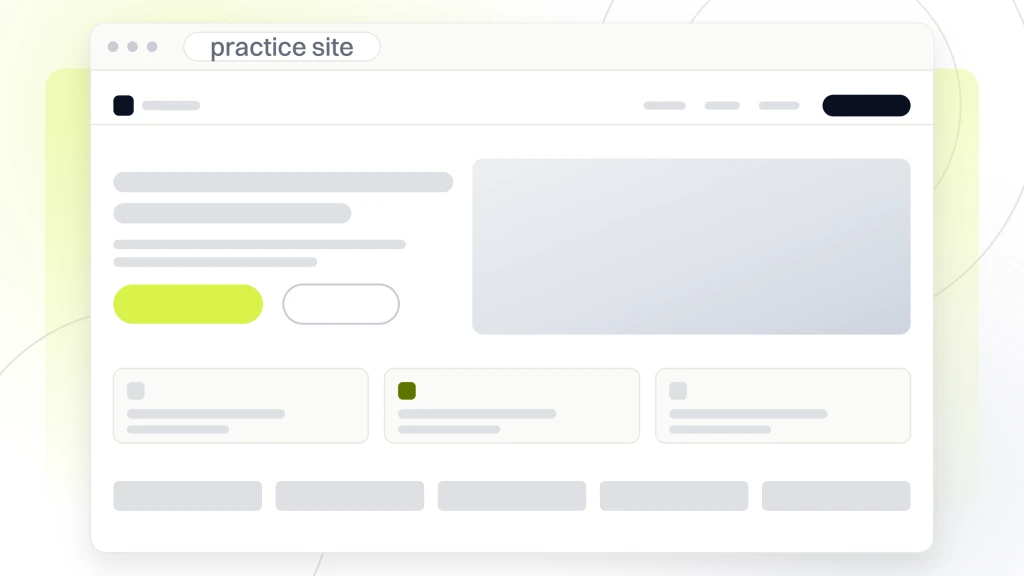
| Website signal | Independent practice | DSO practice |
|---|---|---|
| Location switcher | Absent | Top nav or footer |
| Meet the team page | All at one office | Filterable by location |
| Footer copyright | Practice name | Parent brand or LLC |
| Contact page | Single location | Multi-location list |
| Blog post cadence | Sporadic or none | Weekly, brand voice |
Footer check is the first move
Scroll to the practice website footer and read the copyright line. Independent practices show the practice name and the year. DSO practices show either the parent brand name, an unfamiliar LLC, or a phrase like part of the such-and-such family of practices. The parent LLC name is often searchable and reveals the DSO the moment you paste it into Google. Some DSOs even drop a small parent logo next to the copyright text, which reads as branding to patients but reads as a classification giveaway to anyone looking for one.
Page architecture across locations tells the same story
DSO websites reuse a template across every affiliated office. The service pages, staff bio layout, contact form structure, and even the color accents match across 40 locations. Solo practices run whatever the local vendor built for them one time. When 2 practice websites share the same layout down to the button styles, they either share the same web vendor or they share the same corporate parent. Follow the shared vendor to the parent, and the classification lands.
Technology fingerprint on the classify dental practices independent vs DSO chain question
Run the practice URL through a tech stack checker. DSO offices tend to run enterprise call-tracking, a centralized chat widget from a partner vendor, and a shared analytics container across every location URL. Solo offices run one Google Analytics tag, one basic chat plugin, and no call-tracking layer at all. That fingerprint is one of the fastest ways to classify dental practices independent vs DSO chain assignments without ever picking up the phone.
Phone system tells for what type of dental setting is a DSO
What type of dental setting is a DSO becomes obvious the moment you call the main number. DSO phones route through a shared call center or a shared voicemail script. Independent phones ring straight to the front desk of the office you dialed. That single test resolves the question faster than any website check.
Call during business hours and pay attention to 5 cues. Whether the greeting names the specific office or a parent brand. Whether the person answering can transfer you to other offices in the network. Whether the hold music sounds like a small business or a corporate loop with a jingle. Whether the person can book you into any office in the network or only the one you called. Every one of those cues points to central call handling, which points to a DSO.
- Central greeting with a parent brand name
- Voicemail script that mentions multiple locations
- Front desk can transfer you to other offices in the network
- Hold music with a corporate jingle or looped script
- After-hours line routes to a central answering service
- Callback commitment inside 24 hours as a written policy
After-hours routing tells you a lot
Call the office after hours. Independent practices route to a personal voicemail or a simple message asking you to call back tomorrow. DSO offices route to a corporate answering service that captures the message on a shared platform, assigns a callback ticket, and reads a scripted policy. That level of infrastructure only exists inside an operation running multiple locations, which lines up with the operational definition of a DSO.
Caller ID when they call back
Leave a callback request. When the front desk returns your call, check the caller ID. Independent practices call back from the office’s own local number. DSO offices sometimes call back from a central corporate line, from a different area code, or from a VOIP number that does not match the office’s public phone. That mismatch reveals central call handling infrastructure and confirms a DSO classification with almost no false positives.
Treatment plan signals a dental practice is part of a DSO
Sit through a treatment plan review. Independent dentists talk the plan through, often at the chair, sometimes at a small consult room. DSO practices assign a treatment coordinator who works off a scripted framework, a printed treatment plan document with a corporate template, and financing pitches that carry a partner logo. The presentation feels professional. It feels standardized too in a way a solo office rarely does.
Watch for specific patterns. The coordinator opens with a scripted rapport-building line. The treatment plan document is a branded PDF with the parent’s design system. The financing options include the corporate parent’s preferred partner, often a specific dental credit provider. The optional add-ons are grouped and priced in a way that mirrors other practices in the network. Every one of those patterns is a hallmark of central treatment planning software rolled out across every office.
Financing partner is a strong signal
DSOs negotiate volume deals with dental financing providers. The office you visit will offer a specific financing partner as the default, sometimes with a branded application flow on a tablet at the check-out desk. Independent practices offer whatever financing the office manager set up years ago, usually a small stack of 3 or 4 options with no branded application flow. When the financing pitch feels like a national program, you are inside a national DSO office.
Upsell cadence during the visit
Watch for the same optional add-ons pitched at the same points in the visit. Fluoride during hygiene. Whitening at check-out. Night guard at the follow-up. When the pattern feels rehearsed and appears identical to what you experienced at another practice in the same brand, you are seeing central treatment plan templates in play. Solo practices vary those pitches by the personality of the front desk manager and the mood of the day. DSOs standardize them, in short, so the volume difference on those add-ons pays for the corporate marketing team.
Staffing cues reveal signs a dental practice is part of a DSO
Signs a dental practice is part of a DSO show up in staffing conversations. The staffing test comes down to 3 questions asked casually at check-out. How long have you been with the practice. What does the benefits package look like. What did the hiring process feel like. DSO answers cluster around 18 months, a national benefits provider, and a corporate recruiting portal. Independent answers cluster around 5 to 10 years, a locally shopped health plan, and a hiring conversation with the dentist.
The staffing signal works for a simple reason. DSOs run higher turnover than solo practices in the first 24 months after affiliation. Corporate benefits are consistent. Local benefits are not. Corporate hiring routes through a central recruiter. Local hiring routes through the office. Every one of those signals shows up in casual conversation with the front desk during check-out, if you know what to listen for.
Tenure pattern of the team
Ask the hygienist how long she has worked at the office. DSO hygienists average 2 to 4 years in role. Solo practice hygienists often hit 10 or 12 years with the same dentist. That gap is not proof that DSOs are worse employers. It reflects that DSOs run standardized comp bands that do not adjust for local labor markets as fast as a solo dentist would. Turnover reflects that gap. A team where every member joined in the last 3 years is almost always a DSO office.
Benefits conversation with the front desk
Ask a friendly staff member which health plan they use. DSO answers name a national carrier that shows up across every affiliated office. Independent answers name a plan the office manager shopped locally, usually a regional Blue Cross Blue Shield plan or a local co-op. The consistency of the answer across affiliated offices is what gives away the corporate benefits program, and by extension the DSO structure.
The legal structure test that ends any classification argument
When visible signals point one way and someone still argues the other, the legal test settles the DSO classification once and for all. Every dental practice files documents with the state dental board and the state secretary of state. Those filings name the corporate parent, the operating LLC, and the licensed dentist. A quick search of the state records ends the argument in 5 minutes.
Look up the practice on the state secretary of state business entity search. Note the LLC name and the registered agent. If the LLC name matches the practice name, the office is probably solo. If the LLC name is a corporate parent you have never heard of, and the registered agent is a Delaware or Nevada corporate services firm, the office is inside a DSO. The pattern repeats across every state and every DSO parent.
Registered agent gives it away
The registered agent listed on the practice LLC filing is the strongest single classification signal. Solo practices name the dentist personally, a local attorney, or the office address. DSOs name a national corporate services firm like CT Corporation, Corporation Service Company, or Registered Agents Inc. That name shows up for a simple reason. The DSO runs LLCs in multiple states and standardizes the registered agent to simplify compliance. Once you see a national corporate services firm as the registered agent, the office is inside a DSO 95% of the time.
Management services agreement clues
State dental boards sometimes require disclosure of management services agreements. Some states publish those disclosures. Check the state dental board website for the practice by name. If a management services agreement disclosure comes up naming a corporate parent, the classification is settled. That agreement is the exact legal instrument that defines a DSO relationship, so its presence in the public record is definitive.
Professional corporation vs DSO management fee
Most states require the clinical practice to be owned by a licensed dentist through a professional corporation. The DSO does not own the clinical practice on paper. Instead, the professional corporation signs a management services agreement with the DSO, and the DSO collects a management fee for handling everything outside clinical care. That legal structure is the industry-standard DSO framework. Find the management fee, and you find the DSO.
Review patterns and DSO dental practice signals
DSO dental practice signals show up in the review pattern more than almost anywhere else. DSO offices run coordinated review flow. Solo offices run whatever review pattern the front desk manager happens to remember to ask about. Read 40 recent reviews for the practice on Google Business Profile. The patterns give away the operational infrastructure fast.
DSO reviews often cluster around specific dates and specific staff names for a simple reason. The review request goes out on a scripted cadence after each appointment. The replies from the practice follow a corporate template that mentions the parent brand voice. Solo reviews trickle in without a clear pattern and get replies that read like the front desk manager writing them personally. That difference in reply voice is the most reliable single signal on the review side.
Reply voice consistency
Read 10 review replies from the practice. Independent replies feel personal. The reply mentions something specific from the review, apologizes for a specific issue, or thanks the reviewer for a specific compliment. DSO replies feel scripted. They repeat the same phrase across 40 replies, mention the parent brand name, and use marketing language a solo front desk manager would never write. Once you see the pattern in 5 replies, you can classify the office in another 30 seconds.
Review posting cadence
Plot the review dates. DSO offices post reviews on a steady cadence, often 10 to 15 per month, since the review request automation runs after every appointment. Solo offices post reviews in fits and starts, sometimes 20 in a month during a review push, sometimes zero for 3 months when the front desk got busy. That posting rhythm gives away the marketing infrastructure and by extension the corporate structure. Check Google Business Profile review guidelines for the technical side of what triggers reviews.
Edge cases that break the classification framework
The framework above settles the DSO classification in about 90% of cases on the first pass. The remaining 10% are edge cases where a solo practice adopted DSO-style infrastructure or where a DSO deliberately hides its parent brand behind the founder’s original name. Knowing the edge cases prevents false positives and false negatives in your classification.
Solo practices in high-growth suburbs sometimes hire a fractional CMO who brings DSO-style marketing infrastructure, complete with review automation, a corporate-feeling website, and treatment plan templates. Those practices look like DSOs on paper but stay solo owned. DSOs that quietly acquire a practice sometimes keep the original brand fully intact for years, right down to the founder’s name in the reviews. Those offices look independent on the front end and only reveal the affiliation in the state entity filing.
Solo practices that look like DSOs
A well-marketed solo practice with a modern website, review automation, and a treatment coordinator can look like a DSO office at first pass. The tell is the LLC filing and the phone routing. Solo practices always have one LLC, one office phone that rings to a real receptionist, and one location in every legal filing. A DSO office always has multiple locations somewhere in the entity structure. When in doubt, run the legal test and settle it fast.
DSOs that look independent
Some DSOs deliberately keep the acquired practice looking independent for years. The website stays the same. The founder’s name stays on the door. The staff remembers the pre-acquisition culture. Only the corporate parent’s fingerprint in the entity filing, the benefits paperwork, and the RCM invoicing reveals the affiliation. That soft-branded DSO model is intentionally hard to detect from the patient side. Use the legal test as the tiebreaker whenever the visible signals stay ambiguous.
Why classify dental practices independent vs DSO chain decisions matter
Classifying a dental practice correctly matters for anyone selling into the dental market or partnering on a service contract. Marketing agencies pitch a solo practice differently than a DSO. Vendors negotiate differently. Dental supply reps offer different volume discounts. And any agency needs to know whether it is coordinating with a solo owner or a corporate marketing team.
Solo practices decide fast, spend cautiously, and value the personal relationship with the vendor. DSO practices decide slowly through a corporate procurement process, spend at scale once approved, and expect enterprise-grade reporting. Misreading which one you are dealing with wastes the first 3 meetings and often loses the deal. If you already run DSO dental marketing, you already know this. If you are running a marketing pitch and just met the practice yesterday, this classification framework decides the first email.
Vendor approach changes by structure
A dental supply rep visits a solo office, brings donuts, and negotiates a supply contract over a chair-side conversation with the dentist during a lunch break. The same rep visits a DSO office and works with a central procurement team, sending pricing spreadsheets and negotiating master service agreements. The DSO deal takes 6 months to close and lands at a lower per-unit price, in short, since the volume is 30 times higher. Every vendor in the dental space runs both playbooks and picks the right one based on the classification.
Marketing service implications
Solo practices buy marketing services from a local agency or a specialist that focuses on solo practices. DSO practices buy marketing services through a corporate marketing team that either builds the program in-house or contracts an agency at the parent level. Selling into a DSO office as an outside agency means talking to the parent, not the office. If you run dental PPC services for a solo owner, you own every decision with the dentist. Selling the same service into a DSO office means routing every decision through a regional director and a central marketing lead. Read HubSpot on multi-location marketing for the coordination side.
Put the classification framework together
Combine the 5 signals with the legal test and you can classify any dental practice as independent or DSO in about 5 minutes. Website check for the parent brand and location switcher. Phone call for central routing. Treatment plan review for a scripted framework. Front desk conversation for tenure and benefits. State entity filing for the LLC name and registered agent. When we onboarded Smile Design Dentistry, a 50-location DSO across Central Florida and Tampa Bay, this exact framework let us confirm every office belonged to the same corporate parent inside a single afternoon of research. The follow-up work then cut cost per call 30% and drove PPC conversion rate up 20% across all 50 offices. 2 out of 6 matching the DSO pattern means the office is a DSO. 5 or 6 matching means the office is definitely a DSO no matter what the brand still puts on the door.
If you plan to run a marketing program for a practice you just classified, our dental marketing agency writeup covers what a real solo program looks like, and our dental marketing retainer shows how the numbers change once a DSO pulls in 5 or more offices under one program. The classification decides the pitch. The pitch decides the deal.