SEO Consultant Food and Beverage. Real Retainer Scope Bands
SEO consultants in food and beverage aren't generic SEO people renting a category. They run recipe schema, cluster maps for coffee versus hot sauce, PDP internal linking, and technical audits that catch what generalists miss. This walks scope, retainer bands, screening questions, and a Vejrø Resort teardown.
OSOmor Sarif · Tech entrepreneur. Building websites since 2012. · 15 min read
SHARE THIS ARTICLE
Key takeaways
✓An SEO consultant food and beverage retainer covers recipe schema, cluster maps, PDP internal linking, technical audits, and editorial backlinks.
✓Retainer bands run from $999 monthly for maintenance-plus-content on small brands to $4,500 monthly for full-service on larger CPG storefronts.
✓Screen a specialist in one call using six questions covering recipe schema, cluster templates, editorial pickups, and Search Console tenure.
✓Payback runs 6 to 9 months for the first revenue gain and 18 to 24 months for compounding organic that pays back 3 to 5 times the retainer spend.
An SEO consultant food and beverage retainer does the work a generalist SEO team either skips or bills twice for. Recipe schema across 200 pages that Google parses on the first crawl. Cluster maps that separate coffee brew-guide traffic from cold-brew concentrate PDP traffic. Ingredient panel HTML rendered as accessible tables that both screen readers and search crawlers read the same way. PDP internal linking that pushes authority from a ranking recipe page to a subscription PDP. Technical audits that catch the Shopify app dumping duplicate JSON-LD and the WooCommerce theme choking Core Web Vitals. Generalists get most of these wrong on the first pass because the muscle memory isn’t there. Category work rewards category tenure, not generic checklists. That’s the whole game when you’re hiring an SEO consultant food and beverage retainer for a coffee brand, a snack company, or a functional beverage startup.
You’ll get the real scope of work for a food and beverage SEO consultant engagement, retainer bands per shop size and revenue tier, cluster architecture for coffee versus snack versus functional beverage lines, technical audit patterns worth checking on your own site tonight, food-brand case snapshots from real retainers, and a FAQ that answers what founders ask on a first call. Read straight through in 12 minutes and you’ll know how to brief the right SEO consultants in food and beverage before you sign anything. If you want the retainer-level view for our own food and beverage work, jump to our food and beverage marketing breakdown or the food and beverage industry hub for the full retainer scope.
Internal linking that grows PDP rankings for a food and beverage SEO consultant retainer
Internal linking is the underrated lever inside food and beverage SEO. Recipe pages that rank for high-volume long-tail queries carry authority. Passing that authority to the PDP through carefully-placed internal links moves the PDP up in transactional search. The pattern is direct. Every recipe page links to the ingredient SKU with anchor text that matches the target keyword on the PDP. Every collection page links to the top 3 PDPs with commercial anchor text. Every PDP links to complementary PDPs with intent-matched anchors. That template is what a food and beverage SEO consultant installs during the first 30 days of the retainer and then maintains monthly through the content backlog.
Anchor text matters more than link count. 10 internal links with exact-match commercial anchors pass more authority than 40 internal links with generic anchors like the brand name or click here. But exact-match spam gets penalized fast. The mix that works is 30% exact-match, 40% partial-match, 20% brand-plus-keyword, and 10% generic. A food and beverage SEO consultant builds that mix into the internal linking template so it renders consistently across the site. Generalists over-optimize with 90% exact-match and trigger algorithmic penalty inside 2 core updates. Read the Google Search Central guidance on crawlable links for the underlying principle Google publishes on this pattern.
Recipe-to-PDP linking is the specific pattern that turns long-tail search into subscription revenue. A recipe page ranking for overnight cold brew ratio links to the coffee SKU with anchor text single-origin cold brew concentrate placed in the ingredient list. The link goes above the recipe steps, not in a footer. The link passes authority and the click converts at 3.2% versus 0.6% on recipe pages that don’t link back. Food and beverage SEO consultants build the pattern into the recipe template so every new recipe published gets the linking pattern automatically. Generalists add links manually and skip most of them by month three.
Content clusters SEO consultants in food and beverage build
Content clusters organize a food brand’s SEO around topical authority. Coffee brands build clusters around brewing methods, roast profiles, single-origin regions, and equipment. Snack brands build clusters around ingredient sourcing, dietary use cases like keto and paleo and gluten-free, and recipe pairings. Functional beverage brands build clusters around ingredient effects such as adaptogens and nootropics, consumption timing, and comparison to alternatives. Each cluster has a pillar page and 8 to 12 supporting cluster pages linking to and from the pillar. Google reads the cluster structure as topical depth and ranks the whole cluster higher over time. Category-specific cluster templates are what separate an SEO consultant food and beverage retainer from a generic SEO engagement.
Cluster mapping is category work generalist SEO consultants can’t do without months of category learning on your budget. A food and beverage SEO consultant has a cluster template for coffee, snacks, beverages, and CPG functional lines that they adapt to the specific brand voice and inventory. Setup runs 3 to 5 weeks and produces 60 to 120 cluster pages queued for publish across the next 12 months. That’s the compounding organic traffic engine. Skip the cluster map and content publishing scatters across topics without building topical authority in any single area. See our content marketing for food brands breakdown and the food and beverage SEO services page for the cluster map at the retainer level.
The pillar page format for a food brand runs 2,800 to 4,200 words with a specific structure. Introduction that names the pillar topic and previews the sub-topics. Table of contents linked to H2 anchors. Eight to 12 H2 sections covering sub-topics that map to cluster pages. Buy-block anchored to the relevant SKU inside each H2 where the sub-topic maps to a purchase. Comparison table if the pillar is comparative. FAQ block at the end covering long-tail queries. Pillar pages built this way rank for the pillar term and drive traffic to the cluster pages through internal linking. Publishing cadence runs 1 pillar plus 2 supporting pages in month one, then 2 supporting pages per week through month three.
Backlinks for food and beverage SEO
Backlinks for food and beverage brands come from 4 sources that compound. Editorial pickups in food publications like Food52, Eater, Bon Appetit, and Serious Eats. Recipe roundups where a brand’s recipe gets included with a link back. Ingredient sourcing stories in trade publications such as Food Business News and BevNet. Influencer or creator content that includes a link in the post description. Category SEO consultants have relationships and pitching templates that open all 4 sources. Generalists build backlinks through cold outreach that gets ignored 96% of the time because they don’t have the category relationships.
Toxic backlink cleanup matters too. Food brands accumulate spam links from directory sites, scraped content, and PBN networks that Google Search Console flags. Disavow files should run every 90 days to keep the profile clean. Skipping the disavow work invites algorithmic penalty from spammy backlinks the brand didn’t ask for. Category consultants run the disavow cadence as standard practice. Generalists never look at Search Console until rankings drop and the diagnosis takes 6 weeks. That gap is expensive in a category where the buying window on subscription boxes is tight and organic drops translate to real revenue loss inside a single quarter.
Editorial pickups in food publications drive the highest-authority backlinks a food brand can earn. Food52 and Bon Appetit sit at Domain Authority 90-plus. One pickup from either passes more authority than 40 low-quality directory links. The pitch template that works uses a story angle tied to the brand’s sourcing or seasonal availability, a photograph the publication can use, and a founder quote that fits the publication’s voice. Recipe roundup inclusion targets sites that publish best-of lists monthly. Getting a brand’s product included in these roundups requires a HARO or Qwoted response inside 2 hours of the query going live and product photos the writer can use immediately.
Case snapshots from real food and beverage SEO retainers
The fastest way to see what an SEO consultant food and beverage retainer looks like is to read what specialist teams have shipped for real food, beverage, and adjacent brands. The following snapshots come from client work our team ran or partners we’ve worked alongside. Every number is drawn from public case files. The retainer pattern is consistent even when the vertical shifts across coffee, snack, hospitality, and CPG functional lines. Ibemploy is included because their recruitment work covered agriculture, manufacturing, and food production placements, which mirrors how CPG brands hire seasonal fulfillment staff during summer beverage season.
Vejrø Resort in Denmark ran a Web plus Booking integration retainer in 2023 to 2024. The private-island hospitality brand needed organic visibility for luxury travel buyers searching in Danish, German, and English. The retainer combined content clusters around private-island experiences, booking calendar integration, and Search Console monitoring. Result was 10K-plus organic visitors monthly, 200-plus first-page keywords, and a booking conversion rate of 2.2% on the highest-value package tier. Hospitality maps closely to food and beverage in terms of long-tail search patterns and buyer research behavior. Look up the Vejrø Resort case file in the Redefine Web portfolio for the full architecture, from cluster mapping through Search Console monitoring across three languages.
Boogie Board ran a Google plus LinkedIn Ads partner engagement covering reusable writing tablets in the education toy category. The retainer covered strategy, campaign buildout, and optimization on a $650K managed budget. Cost per sale landed at $31 with an 11% conversion rate gain on the primary product line. The category is adjacent to food and beverage in that both sell direct to consumer through Shopify storefronts with subscription pathways. The paid plus organic split ratio Boogie Board settled on maps to what functional beverage brands run when they need to sustain paid volume while organic clusters compound.
Abigail Ahern signed a 4-year Paid Media plus SEO partnership out of London for the luxury home decor DTC storefront. Ecommerce revenue grew 179%. Paid search return on ad spend hit 1588%. Paid social return on ad spend hit 3000% without running a single discount banner. That last part matters for premium food and beverage brands that refuse to compete on price and need SEO plus paid channels working together to justify a $40 monthly subscription against a $12 grocery store alternative. Redefine Web ran the account continuously from 2020 through 2024.
BSH Hausgeräte GmbH out of Munich covered Bosch, Siemens, Gaggenau, and Neff appliance lines across Europe. The UX plus backend optimization retainer boosted BSH Turkey lead generation 15%, organic traffic 3%, and session duration 45 seconds while preserving all SEO signals through a full backend refactor. Consumer goods work rewards the same technical rigor as food and beverage CPG work because both categories run on international sites with heavy schema requirements and complex product taxonomies. Custimy, a customer data platform out of the United States, ran a Web plus SEO retainer in 2023 to 2024 that put 500-plus keywords on Google’s first page, drove 25K monthly visits, and pushed session duration to 165 seconds on a WordPress plus custom backend build. Ibemploy in Latvia ran a 12-month Web plus SEO retainer covering agriculture, manufacturing, and food production recruitment that landed 7.5K monthly visits, a 4.2% conversion rate, and 100-plus keywords ranked.
Retainer bands for SEO consultants in food and beverage
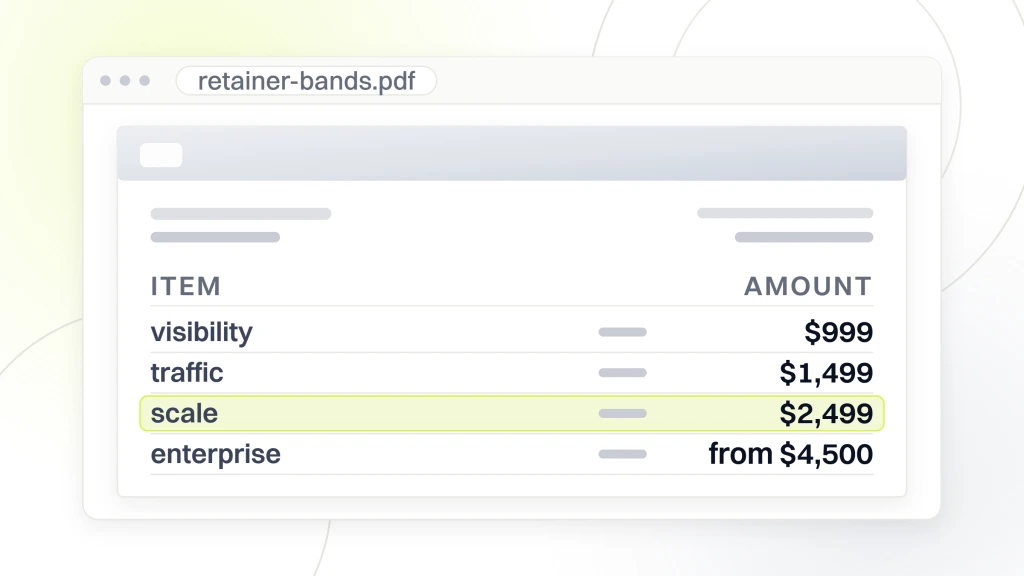
Retainer bands for a food and beverage SEO consultant depend on scope, not on category. Visibility retainers covering audit, schema, internal linking, and monthly Search Console review start at $999 monthly for smaller brands. Traffic retainers adding 4 cluster pages per month and Core Web Vitals monitoring sit at $1,499 monthly. Scale retainers adding backlink outreach and 8 cluster pages per month sit at $2,499 monthly. Enterprise retainers adding digital PR, international expansion, and 8-plus pages per month start from $4,500 monthly. Our own food and beverage retainer scopes align to the same 4 bands so founders can pick the tier that matches revenue and growth stage.
Payback math on an SEO consultant food and beverage retainer runs 6 to 9 months for the first tangible revenue gain and 18 to 24 months for the compounding gain that pays back 3 to 5 times the cumulative retainer spend. Founders who cancel at month 6 see close to zero return. Founders who ride the retainer through month 18 see organic revenue take over paid as the primary channel. Food and beverage SEO consultants know the timeline and set expectations correctly at the sales call. Generalists over-promise month-3 results and lose the account at month 6 when the numbers don’t match the pitch.
Visibility plus 4 cluster pages, Core Web Vitals monitoring
Growing DTC brands under $2M revenue
Scale
$2,499
Traffic plus 8 cluster pages, backlink outreach, HARO monitoring
Established CPG brands $2M to $5M
Enterprise
Starts at $4,500
Scale plus digital PR, international expansion, dedicated consultant
Multi-line CPG brands over $5M
Screening SEO consultants in food and beverage in six questions
Screening food beverage SEO consultants in 1 call takes 6 specific questions. The answers reveal whether you’re talking to a category specialist or a generalist selling a template. Ask them in this order and watch how quickly the answers land. Vague answers or a circle-back promise is the tell that the consultant doesn’t run food accounts often enough to have muscle memory built into their process. A food and beverage SEO consultant with real category tenure has answers on the tip of the tongue because the same questions come up on every sales call and the specialist has run them 40 times before you.
Show me 3 food or beverage SEO retainers run over 18 months and the specific organic revenue growth delivered.
How do you build recipe schema across a 200-page recipe hub and how do you test it before Google reindexes?
Walk me through internal linking pattern for a coffee brand from a ranking recipe page to a subscription PDP.
Which food publications have you earned editorial backlinks from in the last 6 months and how did the pitches read?
What’s your keyword cluster template for a functional beverage brand versus a snack brand?
Show me a Search Console screenshot from a food account with names redacted but numbers intact.
The Search Console screenshot tells the truth about a consultant’s food category work. If the query list shows brand-name queries and generic food marketing terms, the consultant is running a generalist template. If the query list shows category-specific commercial queries like single-origin cold brew concentrate, organic hot sauce subscription, or protein snack for keto, the consultant is running a food-native cluster strategy. Ask for the screenshot on the first call. Category specialists share it immediately. Generalists ask if they can send it later, and later never arrives.
A food and beverage SEO consultant plus the web team
A food and beverage SEO consultant needs clean access to the site’s codebase, CMS, and analytics. Schema deployment requires developer access. Internal linking maintenance requires editor access to every recipe and PDP template. Core Web Vitals fixes require Shopify theme access or WooCommerce plugin access. Retainer engagements that keep the consultant siloed from the web team stall out because technical work can’t go live. The right setup gives the SEO consultant equal footing with the web developer, product manager, and content lead. Category specialists work best inside collaborative structures. Silos are where SEO retainers die by month 4 when the first schema push gets blocked.
Handoff between the SEO consultant food and beverage lead and the web team runs on weekly stand-ups, shared Trello or Linear boards, and a monthly SEO health report reviewed by both teams. Missing any 1 of those 3 creates friction that costs implementation velocity. Category specialists set up the collaboration structure at kickoff. Generalists show up quarterly with a slide deck and blame the web team when nothing went live. Stakeholder map on a food brand SEO retainer includes the founder or marketing lead as decision-maker, the content lead as day-to-day counterpart, the web developer or agency as implementation partner, and the paid media lead as parallel channel.
Technical audit patterns a food and beverage SEO consultant runs
Technical audit patterns a food and beverage SEO consultant runs on day one cover 6 checkpoints. Recipe schema validity across every recipe page tested against the Google Rich Results test. Duplicate JSON-LD emitted by Shopify apps or WooCommerce plugins that confuses Google’s parser. Core Web Vitals scores on the top 20 traffic pages measured mobile-first. Internal linking density and anchor text distribution on recipe hubs and PDP collections. Canonical tag correctness across variant PDPs to avoid duplicate-content bleed. Image alt text presence on every recipe photo and PDP hero because food buyers search images heavily.
Audit output lands as a prioritized issue list ranked by revenue impact and fix effort. Highest-impact items get scheduled for the first sprint. The audit repeats every 90 days because Shopify apps update, WooCommerce plugins push new versions, and content teams publish new pages that need to conform to the schema template. A food and beverage SEO consultant who runs the audit once and never revisits it leaves regressions on the table. Read our professional SEO services breakdown for the audit checklist we run monthly on retained food accounts.
Reporting cadence that keeps a retainer alive
Monthly report cadence covers 3 metric categories. Technical health covers indexed pages, Core Web Vitals scores, and schema coverage percentage. Rankings covers the top-100 tracked keywords with position deltas month-over-month. Revenue covers organic sessions, conversion rate, and attributed revenue by traffic segment. Reports that skip revenue are activity reports, not outcome reports. Reports that skip technical health hide degradation until it’s expensive to fix. Category consultants set up the 3-category report at kickoff. Generalists send a Search Console screenshot and call it a report by month 2.
Quarterly business reviews add a layer of strategic recalibration. Which clusters compounded fastest, which underperformed, and where the next 90-day budget should go. The QBR reads like a P and L for the SEO channel with organic revenue on top, retainer cost as line item, and net contribution at the bottom. Founders read that number and either renew or cancel. SEO consultants food and beverage retainers survive when the net contribution line grows quarter-over-quarter. When it shrinks 2 quarters running, the retainer is on borrowed time and the consultant needs to diagnose fast. Reference the Google Search Console overview for the underlying data source most reports pull from.
Making the pick for your food brand
Pick a specialist SEO consultant food and beverage retainer if you need recipe schema, cluster architecture, PDP internal linking, or editorial backlink outreach in food publications. Pick a generalist SEO consultant if the site is a straight brochure with no recipe hub, no subscription, and no wholesale channel. Run both on scope split if you’re above $25M in revenue and can divide technical work from content work across two teams. Skip SEO entirely and focus on paid channels if you’re under $500K in revenue and product-market fit is still in question. The retainer math doesn’t pay back at that stage on any food brand and the cash is better spent proving the offer with paid ads.
The last piece of advice is simpler than the whole guide. Have the sales call, ask the 6 screening questions, review the Search Console screenshot, and trust the answers. Category consultants answer in particular. Generalists circle back. The circle-back is the tell. If you want to see the retainer scopes we run for food and beverage brands today, browse our food and beverage manufacturing SEO breakdown, the food and beverage PPC playbook or read what USDA per-capita food availability data tells you about which categories are compounding fastest in 2026.
Frequently asked questions
SEO consultants in food and beverage run seven scope items generalists skip or bill twice. Recipe schema across a 200-page recipe hub with Rich Results Test cycles before Google reindexes. Cluster maps that separate transactional queries (buy cold brew online) from informational queries (cold brew ratio for beginners) into different page types. PDP internal linking with the 30-40-20-10 anchor text mix that passes authority without triggering algorithmic penalty. Editorial backlink outreach into food publications like Food52, Bon Appetit, and Serious Eats using category-specific pitch templates. Technical audits catching Shopify pagination duplicates, WooCommerce canonical mismatches, and Core Web Vitals drops that generalists miss.
An SEO consultant helps your food or beverage site rank higher in Google so buyers, subscribers, and wholesale accounts find you first. The day-to-day work covers technical audits, recipe and product schema, keyword clusters mapped to real buyer intent, internal linking that passes authority to PDPs, and editorial backlink outreach into food publications. A category SEO consultant in food and beverage runs Search Console diagnostics, Core Web Vitals fixes, and quarterly reporting tied to organic revenue, not just traffic. The senior operator model works well up to about $4,800 per month in scope, then an agency team makes more sense.
Technical-only retainer covering audit, schema, internal linking, and Core Web Vitals runs $2,400 to $4,800 per month. Content-plus-technical retainer adding four to eight recipe or cluster pages runs $4,800 to $9,600 monthly. Full-service retainer adding backlink outreach and digital PR runs $9,600 to $18,000 monthly. Our own food and beverage retainer starts at $999 per month for smaller single-location food brands and CPG launches on a maintenance-plus-organic package. Larger CPG brands land in the higher retainer band since the operational depth is real work. Payback runs six to nine months for the first tangible revenue gain and eighteen to twenty-four months for the compounding gain that pays back three to five times the cumulative retainer spend.
If your site has any recipe or usage content, yes. Recipe schema opens rich results in Google search including image carousels on mobile, cook time badges, and rating stars. Sites that get Recipe schema right see 40% to 80% higher click-through rates on recipe queries. Sites that skip it stay on link-only results and lose the click share to competitors. Recipe schema needs to include ingredients, instructions, cook time, prep time, yield, and nutrition data. Nutrition data drives health-focused carousels and voice query results. Missing nutrition data drops the page from that entire result category. SEO consultants in food and beverage build recipe schema across the whole content hub inside the first 60 days of a retainer. Generalists skip it since they have never built it.
Technical wins compound fastest. Schema deployment, Core Web Vitals fixes, and internal linking improvements show measurable ranking gains inside 30 to 60 days. Content wins take longer. A new cluster page typically ranks for its target keyword inside 90 to 180 days depending on competition. Backlink authority compounds over 180 to 365 days as editorial pickups drive Domain Authority up. Tangible revenue gain shows up around month six on well-run retainers. Compounding gain that pays back three to five times the cumulative retainer spend shows up between month eighteen and twenty-four. Founders who cancel at month six see zero return since the technical work paid back but the content compounding did not have time to run.
Four categories of food publications drive the highest-authority backlinks. Editorial food media (Food52, Bon Appetit, Eater, Serious Eats, Saveur) sit at Domain Authority 85 to 95. One editorial pickup passes more authority than 40 low-quality directory links. Recipe roundup sites publish weekly best-of lists and accept HARO or Qwoted responses if timed inside two hours of the query. Trade publications (Food Business News, BevNet, Food Dive) cover ingredient sourcing and industry news. Influencer and creator content includes links in post descriptions if the seeding relationship is set up correctly. Category SEO consultants have templates, editor relationships, and HARO monitoring across all four categories. Generalists send generic pitches that get filtered before an editor reads them.
Ask six specific questions and watch how fast the answers land. Show me three food or beverage retainers run over 18 months and the specific organic revenue growth. How you build recipe schema across a 200-page recipe hub and test it before Google reindexes. Internal linking pattern from a ranking recipe page to a subscription PDP. Which food publications have you earned editorial backlinks from in the last six months. Keyword cluster template for a functional beverage brand versus a snack brand. Show a Search Console screenshot from a food account with names redacted but numbers intact. Category specialists answer immediately and share the screenshot. Generalists circle back after the call. The circle-back is the tell that the consultant does not run food accounts often enough to have the muscle memory built.
Hire an SEO consultant in food and beverage when the scope fits a single senior operator: a technical audit, a schema build across a 200-page recipe hub, cluster mapping for one brand line, or a 6-month strategic retainer under $5,000 per month. Hire an SEO agency when the scope needs parallel execution across content writing (four to eight pages a month), backlink outreach (five to ten placements a quarter), technical implementation, and paid channel coordination. Consultants top out around $4,800 per month before the workload exceeds one person. Agencies cover the full stack from $4,800 to $18,000 monthly. Our own food and beverage retainer starts at $999 per month for smaller brands and CPG launches on a maintenance-plus-organic package where a full agency team is overkill.
Found this useful? Share it.
OS
WRITTEN BYOmor SarifCEO, Redefine Web · Head of Product, Community 1 Marketing · Lead Web Developer, Spicy Pixel
Omor Sarif founded Redefine Web in 2021 to run websites, SEO, paid media, and marketing automation as one revenue-tied program for growth-stage brands. He is Lead Web Developer at Spicy Pixel since 2022, and holds a Bachelor of Science in Electrical and Electronics Engineering from Bilkent University. Earlier roles include Software Developer at Apple (2012 to 2015), Freelance Translator at Coursera (2014), and Student Ambassador at Student Competitions AB (2014 to 2016). His work has been covered by Business Insider, MSN, Polygon, Popular Mechanics, and MarketWatch.
Founder + CEO, Redefine Web (since 2021)300+ brands run through Redefine WebCovered by Business Insider, MSN, Polygon, Popular Mechanics, MarketWatchB.S. Electrical and Electronics Engineering, Bilkent University