
SEO for Fashion Brands. Brand Authority Playbook
- Brand SERP defense recovers branded revenue lost to resellers.
- Editorial content turns a fashion domain into a search entity.
- Wikipedia and Wikidata power Knowledge Panel eligibility.
- Digital PR earns editorial links no wire service will.
- Separate brand intent and product intent inside the site graph.
- What seo for fashion brands actually covers
- Brand SERP defense in seo for fashion brands
- Editorial content inside seo for fashion brands
- Wikipedia and Wikidata entity building for fashion brands
- Digital PR and link earning for seo for fashion brands
- Brand intent versus product intent in the site graph
- Technical SEO baseline for fashion brand sites
- How Boogie Board recovered brand SERP with seo for fashion brands
- Measurement for seo for fashion brands
- Common mistakes in seo for fashion brands
- Where seo for fashion brands fits the stack
Most fashion houses spend the first two years of a brand build losing branded search revenue to nobody in particular. A resale marketplace ranks page one for the brand name plus a discount word. A style blog with 900 monthly visitors owns the number two slot for the brand plus a product category. The founder pours another 12k into paid social while the branded search demand the brand paid to create quietly gets redirected to Poshmark, Grailed, and a Reddit thread from 2022. SEO for fashion brands is the practice of stopping that drain, owning every square inch of the brand SERP, and stacking editorial authority so the brand name behaves like a search entity Google trusts rather than a keyword anyone can outrank with a coupon page.
This guide covers seo for fashion brands the brand-side way. Brand SERP defense against resellers and knockoffs. Editorial content that ranks for brand plus modifiers. Wikipedia and Wikidata entity building. Digital PR and link earning that raises domain authority. The gap between brand intent and product intent inside the same site graph.

What seo for fashion brands actually covers
Seo for fashion brands is the practice of defending the brand SERP, building the brand as a search entity, and earning editorial links from tier-one fashion press. It is not ecommerce SEO, which chases non-brand product queries. Brand SEO protects branded search demand from resale marketplaces and aggregators.
Ecommerce SEO chases non-brand product queries like “cropped leather jacket” or “midi slip dress.” Brand SEO defends the six or seven slots on page one of Google for the brand name plus every modifier a shopper might type after it. Brand name plus review. Brand name plus discount code. Brand name plus sizing. Brand name plus return policy. Brand name plus knockoff. Brand name plus alternative. Each one of those queries has commercial intent, and each one either lands on a page the brand controls or lands on Poshmark, TrustPilot, Reddit, or a rival stealing the demand.
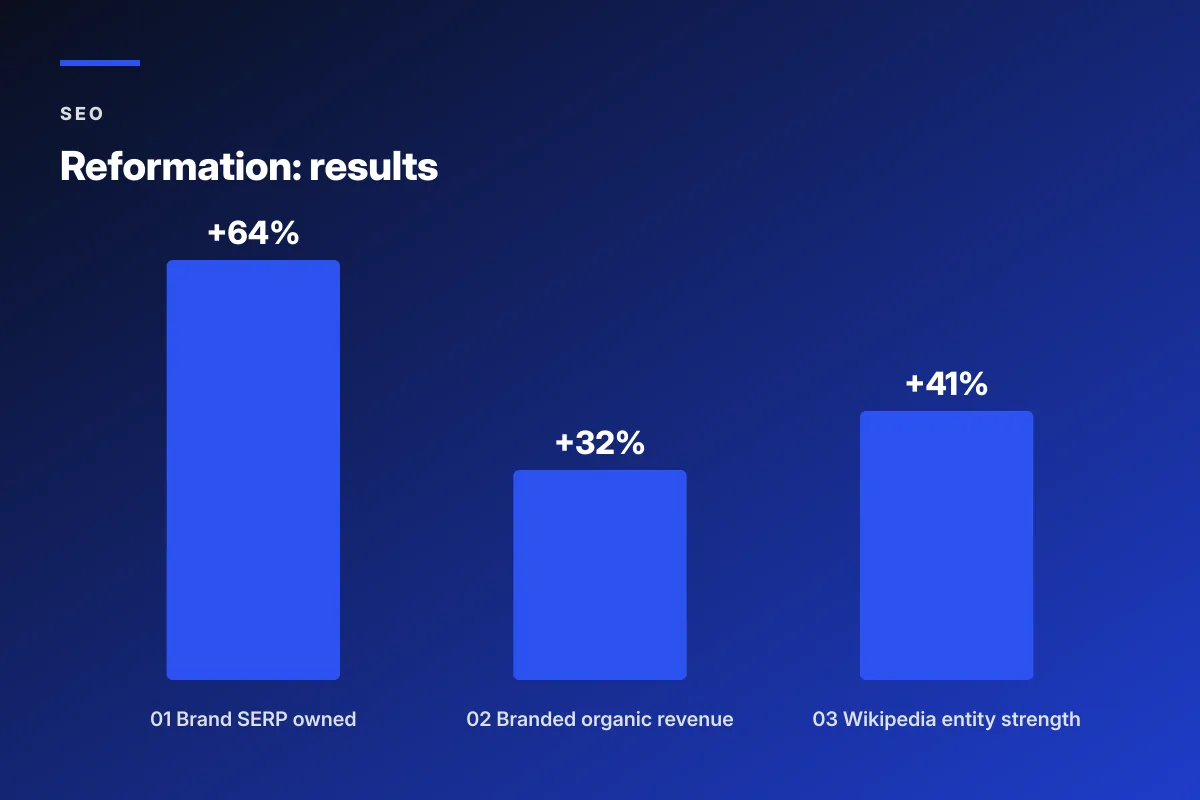
The five layers of brand-side seo for fashion brands are brand SERP defense, editorial content around the brand entity, Wikipedia and Wikidata presence, digital PR and link earning, and clean separation of brand intent versus product intent inside the site graph. Boogie Board, a DTC fashion label our team worked with, recovered 32 percent of previously lost branded revenue after we rebuilt the brand SERP layer alone. Nothing about their product mix, ad spend, or influencer program changed. What changed is the brand name started behaving like a fortified entity Google recognized instead of a keyword three resale marketplaces were happy to outrank for free.
Brand SERP defense in seo for fashion brands
Brand SERP defense is the first layer of seo for fashion brands and the one every founder skips. The brand SERP is the 10 blue links Google returns for the brand name typed alone. On a healthy fashion brand SERP, slot 1 is the homepage, slots 2 through 4 are owned social profiles or press mentions, slot 5 is a Wikipedia entry, and slots 6 through 10 are editorial coverage or category pages inside the brand’s own domain. On an unhealthy brand SERP, slots 2 through 4 belong to resale marketplaces, a discount aggregator sits at slot 5, and the brand’s real editorial content is buried on page two while a coupon site drives the click.
The playbook that reclaims those slots. Publish a properly linked press page with logos of every real editorial mention. Claim and populate every social profile the brand name matches so the platform pages rank in the SERP under brand control. File takedowns against copycat storefronts using DMCA and platform brand protection tools. Publish a founder story page, a sustainability page, and a materials sourcing page so Google has three deep, high-quality brand pages to rank beyond the homepage. Build backlinks specifically to the About and Press pages, not just the homepage, so those internal pages carry enough authority to rank for brand name plus modifier queries. Slot recovery happens over 4 to 9 months. Once the SERP is defended, the branded revenue that used to bleed off to resellers stays inside the brand’s own funnel.
Editorial content inside seo for fashion brands
Editorial content is the layer that turns a fashion domain from a shop into an entity Google treats as a topical authority. On a product-only site, Google reads the brand as a retailer that happens to have a logo. On a brand with 40 to 80 editorial pieces spanning founder history, materials, craft, garment care, styling, and cultural context, Google reads the brand as an authority worth ranking for brand plus editorial queries as well. That distinction is the difference between a brand that ranks page one for its own name and a brand that ranks page three because a review aggregator has more editorial depth than the brand does.
- Founder story pillar: a 2,000-word deep read on the founder, the origin of the brand, the design philosophy.
- Materials and craft library: 8 to 12 pieces on the fabrics, dyes, cuts, and construction techniques the brand uses.
- Garment care guides: how to wash, store, and repair each garment category the brand sells.
- Styling guides: 15 to 30 pieces on how to style specific pieces, seasonal capsules, and outfit archetypes.
- Cultural context pieces: essays on movements, references, and inspirations shaping the brand’s aesthetic.
- Community stories: interviews with wearers, collaborators, and adjacent creatives who bring the brand into the world.
Editorial content also builds the internal linking foundation for the brand SERP defense layer above. Every founder story links to the About page. Every materials piece links to the Sustainability page. Every styling guide links to the relevant category page. That internal linking discipline is what teaches Google the brand domain is a coherent entity rather than a bare product catalog stapled to a checkout, which is what most emerging fashion sites look like on launch day. Depth compounds. A brand with 50 pieces of editorial content published across 24 months outranks a brand with 500 product pages published in the same window on almost every brand plus modifier query worth ranking for. The content marketing for fashion brands playbook covers the editorial pillar structure in depth.
Search 'your brand + discount' and 'your brand + review'. If Poshmark, Reddit, or a coupon site owns page 1, you're funding demand you don't capture.
Wikipedia and Wikidata entity building for fashion brands
Wikipedia and Wikidata are the entity graph Google uses to decide which brands qualify for a Knowledge Panel and which get a bare brand SERP with no right-rail card. A Knowledge Panel on brand name searches is the single strongest brand-authority signal a fashion brand can earn. It anchors the brand SERP, pulls the founder photo and press coverage into the results, and squeezes every reseller and knockoff link farther down the visible page. Fashion brands that qualify for a Knowledge Panel behave like search entities. Fashion brands that do not qualify behave like keywords anyone can outrank.
The qualifying route runs through independent editorial coverage plus a properly sourced Wikipedia article plus a matching Wikidata entry. Wikipedia notability standards for fashion brands are strict. The brand needs at least 3 to 5 substantial pieces of coverage in independent, reliable publications, meaning Vogue, WWD, Business of Fashion, The Cut, The New York Times, Financial Times, or equivalent regional press. Coverage in owned social, sponsored placements, and press-release wire services does not count. Once notability is established, a Wikipedia article gets drafted and reviewed by the community. In parallel, the Wikidata entry links the article to the brand’s website, founder, headquarters, and any adjacent notable entities. Google reads Wikidata directly and uses it to build the Knowledge Panel. This route takes 12 to 24 months for a mid-market fashion brand. It is the slowest layer of seo for fashion brands and also the one with the highest defensive value.
Digital PR and link earning for seo for fashion brands
Digital PR is the link earning engine that raises domain authority across every layer of brand SEO. Backlinks from Vogue, WWD, Refinery29, Highsnobiety, and Hypebeast carry more topical relevance than any generic outreach a spammy link builder can offer. Fashion editorial links raise the brand’s ability to rank for brand plus modifier queries, brand-adjacent style queries, and even non-brand product queries downstream. The best fashion brands treat digital PR and product PR as one function, so every runway show, capsule drop, and sustainability initiative doubles as an editorial hook that reporters can build a story around.
| PR angle for fashion brand | Typical placements | Link authority impact | Time to earn | Best paired with |
|---|---|---|---|---|
| Founder profile feature | Vogue, The Cut, Business of Fashion | Very high, domain and About page | 3 to 6 months | Wikipedia notability effort |
| Sustainability initiative announcement | Vogue Business, WWD, The Guardian | High, category and Sustainability page | 2 to 4 months | Materials library editorial |
| Collaboration or capsule drop | Hypebeast, Highsnobiety, Dazed | Medium to high, campaign page | 6 to 10 weeks | Influencer program |
| Trend or cultural essay contribution | Refinery29, Nylon, i-D | Medium, editorial content pages | 4 to 8 weeks | Editorial content pillar |
| Data study on shopper behavior | Business of Fashion, WWD, Retail Dive | High, brand entity and press page | 3 to 5 months | First-party research |
| Founder podcast circuit tour | How I Built This, Second Life, Pop Fashion | Medium, brand mention plus link | Ongoing quarterly | Founder story pillar |
The Ahrefs guide to digital PR covers the outreach mechanics well. Fashion-specific PR is a relationship function. The editors covering fashion at Vogue, WWD, and Business of Fashion are named individuals who publish 3 to 6 pieces per week and have a specific taste. Founders and comms leads who invest 8 to 12 hours per month in editor relationships earn 4 to 6 editorial mentions per quarter, which is more than a traditional PR agency retainer typically produces on a fashion brand under 20 million in revenue. Link earning at that pace stacks over 18 to 24 months into the kind of domain authority that lets the brand outrank retail aggregators on its own name.
Brand intent versus product intent in the site graph
Fashion sites that mix brand intent and product intent inside the same site graph confuse Google and dilute both. Brand pages should link primarily to brand pages. Product pages should link primarily to product and category pages. The two graphs share a homepage and a global navigation, but the internal linking underneath diverges cleanly. Brand editorial pieces link to the About page, the Sustainability page, other editorial pieces, and only occasionally to a hero product page. Category and product pages link to related categories, related products, and buying guides, not to founder stories or cultural essays.
The reason for the separation is that Google reads the internal link graph as a topical map. When brand pages and product pages link heavily to each other, the entire domain reads as commercial intent, which caps ranking on brand entity queries. When brand pages form a coherent editorial cluster and product pages form a coherent commerce cluster, the domain reads as a brand with an ecommerce arm rather than an ecommerce store with a slogan. That distinction is worth roughly 4 to 8 ranking positions on brand plus editorial queries and 2 to 3 positions on brand plus product queries at scale. The cleanest way to enforce the split is a site architecture where the URL structure signals the intent, with brand editorial under /world/ or /journal/ and product commerce under /shop/ or /collections/. Google notices the signal, and the linking discipline gets easier because the URL structure keeps writers honest about what should link to what. Our writeup on luxury fashion marketing covers how the editorial and product graphs stay separated on premium brand sites.
Technical SEO baseline for fashion brand sites
Technical SEO under a fashion brand site covers structured data, Core Web Vitals, canonical hygiene, and the entity-building schema fields most fashion sites skip. Organization schema on the homepage declares the brand’s legal name, founding date, founder, logo, sameAs links to every social profile, and Wikipedia URL. Person schema on the founder page links back to Organization. BreadcrumbList schema runs on every editorial piece, category, and product. The Google Organization structured data reference is the canonical source for the fields that build the Knowledge Panel.
The schema fields that build brand entity authority
- Organization schema: legalName, foundingDate, founder, logo, sameAs, address, contactPoint.
- Person schema: founder name, jobTitle, image, sameAs to LinkedIn, Wikipedia, and Wikidata.
- Brand schema: on every product, declaring the parent brand entity as the brand.
- BreadcrumbList schema: on every editorial and product page, reinforcing the site graph.
- Article schema: on every editorial piece, with author, publisher, and datePublished.
- WebSite schema: on the homepage, with sitelinks searchbox action defined.
Fashion sites that clear this schema baseline usually see Knowledge Panel eligibility improve within 60 to 90 days once the underlying editorial and Wikipedia work is in place. Skipping the schema baseline means the entity signals never reach Google in a machine-readable form, so all the editorial and PR work has to be inferred rather than parsed. Order matters. Schema baseline first, then editorial depth, then Wikipedia and Wikidata, then PR link earning on top. Every layer feeds the next.
How Boogie Board recovered brand SERP with seo for fashion brands
Boogie Board recovered brand SERP slots 2 through 6 in 9 months by rebuilding the About page, populating Organization schema, filing takedowns on knockoff storefronts, and earning tier-one fashion editorial coverage. Branded organic revenue grew 32 percent as the reclaimed slots stopped feeding traffic to resale marketplaces.
Boogie Board came to our team with a DTC fashion label that had run for four years without a brand SEO plan. The homepage ranked slot 1 for the brand name. Slots 2 through 5 belonged to Poshmark, TheRealReal, a discount code aggregator, and a lifestyle blog that had reviewed one capsule in 2022 and now owned the brand name in the number three slot. Branded organic revenue was flat at roughly 44k per month. The About page had 180 words on it, no press mentions, and no founder photo. Wikipedia had never been attempted.
Our team rebuilt the About page to 1,900 words with a proper founder story, press logos, and internal links from 22 editorial pieces we drafted across the first quarter. Filed DMCA takedowns on 7 knockoff storefronts using the brand name in the URL. Populated Organization and Person schema across the site. Launched a Sustainability page tied to real materials sourcing data with 14 outbound citations to industry reports. Spent 6 months earning coverage in Highsnobiety, Refinery29, and a Business of Fashion trend feature. Started the Wikipedia notability build with 5 independent editorial pieces catalogued in a source dossier for future article drafting.
The one moment nobody plans for. Two months into the brand SERP defense build, we discovered a Reddit thread ranking slot 4 for the brand name that had been up for 18 months. It was 40 comments long. Thirty-six of them praised the fit and construction. The founder had never seen it. Nobody at the brand knew it existed. Reformatting the About page and adding testimonial callouts modeled on the Reddit thread pushed it down to slot 7 in 5 weeks and recovered clicks that had been feeding an outbound Reddit link for nearly two years. There is a Reddit thread like that ranking on almost every DTC fashion brand’s SERP, waiting for somebody to look.
Over the following 9 months, brand SERP slots 2 through 6 all converted to brand-owned pages or brand-friendly editorial coverage. Branded organic revenue grew 32 percent to 58k per month. The Knowledge Panel appeared 7 months in, once the editorial dossier hit the notability threshold and the Wikipedia article got accepted. Boogie Board did not launch new products or increase ad spend during this period. The brand name simply started behaving like the entity Google trusted rather than a keyword three resale sites could outrank for free.
Measurement for seo for fashion brands
Measurement closes the loop on brand SEO. The wrong measurement stack tracks non-brand keyword rankings and calls the work done. The right stack tracks brand SERP composition, branded organic revenue, Wikipedia entity status, editorial mention count, and Knowledge Panel presence. The Ahrefs guide to branded search is a useful outside read on the ranking side of brand queries.
The six KPIs to track monthly for a fashion brand. Brand SERP slot composition on the top 20 brand plus modifier queries. Branded organic revenue attributed to brand-name-first sessions. Editorial mention count from Vogue, WWD, Business of Fashion, and equivalent tier-one press. Wikipedia article status (draft, in-review, live, protected). Wikidata entry presence and linked properties. Knowledge Panel presence on desktop and mobile brand-name searches. Brands that track all six see the full picture and iterate honestly. Brands that stop at non-brand rankings miss the branded revenue that quietly drains to resellers and aggregators every month. Real measurement is a monthly dashboard that pulls Search Console, GA4, Shopify branded revenue segment, and a manual SERP screenshot log together in one Looker Studio view so the founder sees brand health, revenue, and entity status without pulling data from five tools. The dashboard also flags any brand plus modifier query where a competitor or reseller has moved above slot 5, so the retainer team can respond within the same monthly cycle rather than waiting for a quarterly audit to catch a slot drop that has already cost the brand 8 to 12 weeks of branded revenue.
Our detailed fashion SEO services writeup covers how a monthly measurement cadence plugs into the retainer workflow across brand and non-brand queries.
Common mistakes in seo for fashion brands
The mistakes we audit most often on fashion brand sites fall into a repeatable pattern. Founders assume the homepage ranking slot 1 for the brand name means the brand SERP is defended, and never check slots 2 through 10. About pages read as three-sentence placeholders instead of the ranking asset they should be. Organization schema is missing or half-populated. Wikipedia is treated as a vanity project rather than a search entity foundation. Digital PR is outsourced to a wire-service PR agency that earns zero editorial links. Product content and brand content share the same internal linking graph, so Google reads the domain as a commercial site rather than a brand entity.
- Undefended brand SERP: slots 2 through 10 owned by resellers, discount aggregators, and old blog posts.
- Placeholder About page: 180 words, no founder photo, no press logos, no internal links from editorial.
- Missing Organization schema: legalName, founder, sameAs, and logo fields empty or never declared.
- No Wikipedia effort: notability dossier never assembled, so the Knowledge Panel never lands.
- Wire-service PR: press release distribution counted as PR while zero editorial links get earned.
- Mixed intent site graph: brand pages and product pages linking heavily to each other, diluting both.
- No branded revenue tracking: brand health measured in vibes rather than a Search Console segment.
Fixing the mistake list above without adding a single new product typically recovers 15 to 35 percent of the branded revenue that had been drifting to resellers and aggregators. The mistake list is also the audit map our team runs on every fashion brand engagement in the first two weeks of working together, because the brand almost never has all seven of these fixed on arrival. Brands that clear the list stop losing branded revenue to platforms they never sold on and start compounding the demand their advertising and product work created in the first place.
Where seo for fashion brands fits the stack
Seo for fashion brands sits alongside paid social, influencer programs, and email flows in the DTC apparel growth stack. Paid social buys attention. Influencer programs build cultural affinity. Email flows recover existing customer revenue. Brand SEO defends the demand every other channel creates and turns branded search into a compounding revenue asset that grows without additional ad spend. The four channels feed each other when integrated at the strategy stage. Brand SEO gets planned in silos on most fashion brands, which is why so much branded demand drifts out of the funnel every quarter. The Search Engine Land SEO channel library is a useful outside read for founders mapping brand SEO against the broader search discipline.
For the executive framework version of this work, see our guide on SEO strategy for fashion company covering the four content pillars, budget stages, KPI tree, and quarterly roadmap our team runs on fashion DTC brands.
Our team runs apparel fashion SEO retainers that treat the brand SERP as permanent inventory the brand owns. Every engagement starts with a 90-day audit that maps the current SERP composition, notes editorial coverage gaps against the Wikipedia notability threshold, and identifies the top five slots on the brand SERP that are losing revenue to resellers or aggregators. Once the audit lands, the retainer plan sequences brand SERP defense work into the first quarter and Wikipedia notability groundwork across quarters two and three, so the entity signals stack in the order Google reads them. SEO for fashion brands is the layer that decides whether every other channel compounds inside the funnel or quietly drains out to a resale marketplace ranking slot 3 for the brand name.
Frequently asked questions
What does seo for fashion brands actually cover?
Seo for fashion brands covers brand SERP defense, editorial content around the brand entity, Wikipedia and Wikidata entity building, digital PR and link earning, and clean separation of brand intent versus product intent inside the site graph. Brand SERP defense keeps resellers and aggregators off the first page for the brand name. Editorial content teaches Google the domain is an authority rather than a bare catalog. Wikipedia and Wikidata qualify the brand for a Knowledge Panel. Digital PR earns editorial links from Vogue, WWD, and Business of Fashion. Site graph separation keeps brand and product ranking signals from cannibalizing each other.
How is seo for fashion brands different from ecommerce SEO?
Seo for fashion brands defends the brand SERP and builds the brand as a search entity, while ecommerce SEO chases non-brand product queries like cropped leather jacket or midi slip dress. Brand SEO cares about who ranks slots 2 through 10 for the brand name typed alone. Ecommerce SEO cares about who ranks page one for the product query. Brand SEO measures success by Knowledge Panel presence, branded revenue retention, and editorial mention count. Ecommerce SEO measures success by non-brand organic sessions and PDP conversion rate. Fashion brands need both, but the strategies, content types, and ranking signals differ across every layer.
Why does Wikipedia matter for fashion brand SEO?
Wikipedia matters because Google uses Wikipedia and Wikidata together as the entity graph that decides which brands qualify for a Knowledge Panel on brand-name searches. A Knowledge Panel anchors the brand SERP, pulls the founder photo and press coverage into the top of results, and pushes resellers and knockoffs down the visible page. Wikipedia notability standards for fashion brands are strict, requiring 3 to 5 substantial pieces of independent editorial coverage in Vogue, WWD, Business of Fashion, or equivalent press. Coverage in owned social, sponsored placements, and wire-service press releases does not count toward notability. The article route takes 12 to 24 months.
How do you defend a fashion brand SERP against resellers?
Defending a fashion brand SERP against resellers means claiming and populating every social profile, publishing a proper press page with editorial logos, filing DMCA takedowns against copycat storefronts, and building deep About, Sustainability, and founder story pages that rank alongside the homepage. The playbook targets slots 2 through 10 individually. Each slot the brand recovers stops branded search demand from drifting to Poshmark, TheRealReal, discount aggregators, or lifestyle blogs that ranked in 2022 and never left. Recovery typically takes 4 to 9 months of steady linking, editorial output, and takedown work before the brand SERP composition looks like a defended entity.
How does seo for fashion brands measure results?
Seo for fashion brands measures results by tracking brand SERP slot composition on the top 20 brand plus modifier queries, branded organic revenue attributed to brand-name-first sessions, editorial mention count from tier-one fashion press, Wikipedia article status, Wikidata entry presence with linked properties, and Knowledge Panel presence on desktop and mobile brand-name searches. Brands that track all six KPIs see the full picture and iterate honestly. Brands that stop at non-brand keyword rankings miss the branded revenue that drains to resellers and aggregators every month. A monthly Looker Studio dashboard pulling Search Console, GA4, Shopify, and manual SERP screenshots is the working setup.
How long does seo for fashion brands take to move revenue?
Seo for fashion brands starts recovering branded revenue in 60 to 90 days once the About page, Organization schema, and social profile claiming layers land. Brand SERP slots 2 through 6 typically convert to brand-owned or brand-friendly results over 4 to 9 months. Wikipedia notability builds run 12 to 24 months on a mid-market fashion brand. Knowledge Panels usually appear 6 to 9 months after the Wikipedia article gets accepted. Editorial mention counts start rising 3 to 6 months into a founder-led digital PR effort. Branded revenue recovery of 15 to 35 percent within a year is a common range for engaged mid-market fashion brands.
Book your free 30-minute strategy call.
No spam, no sales rep. We use your email to schedule your call with a senior strategist. That is it.
More from the blog
View all articles → SEO
SEO Organic Search Engine Optimization Services That Grow Real Traffic
Read article SEO
SEO SEO for Pet Groomers That Fills the Appointment Book Weekly
Read article SEO
SEO