
SEO Strategy for Fashion Company Growth Framework 2026
- Four layers run the strategy: pillars, budget, KPIs, roadmap.
- Four content pillars build the topical authority a fashion site needs.
- Budget stages tie SEO spend to the brand's revenue phase.
- A KPI tree walks from revenue down to technical health.
- Quarterly roadmap turns the strategy into shipped pages.
- What an SEO strategy for fashion company actually covers
- The four content pillars inside an SEO strategy for fashion company
- How budget stages map inside an SEO strategy for fashion company
- The KPI tree behind an SEO strategy for fashion company teams
- The quarterly roadmap inside an SEO strategy for fashion company operations
- How content clusters inside an SEO strategy for fashion company connect
- How technical SEO supports an SEO strategy for fashion company site
- Where content velocity fits an SEO strategy for fashion company plan
- How ownership runs inside an SEO strategy for fashion company teams
- How Custimy scaled an SEO strategy for fashion company accounts
- Why common mistakes derail an SEO strategy for fashion company operators
- Where an SEO strategy for fashion company fits the growth stack
Most fashion apparel founders think about SEO the way they think about paid social. A monthly budget, a channel manager, a scoreboard that reports last month’s sessions. The problem is that a channel-manager view of SEO produces a scattered site graph and a ranking curve that flattens out around month nine. A real SEO strategy for fashion company teams is not a channel, it is a system. Pillars decide what the site is authoritative on. Budget stages decide what gets built in what order. A KPI tree decides what to measure at every layer. A quarterly roadmap decides who does what by when.
This guide covers a full SEO strategy for fashion company operators, the way our team runs it on DTC apparel brands scaling past the first million in annual revenue. Four content pillars that hold the topical authority. Three budget stages that map spend to expected non-brand traffic gains. A KPI tree with six measurable branches. A four-quarter roadmap that turns the strategy into shipped pages. Every layer connects to the others, and the roadmap keeps the strategy operating instead of sitting in a Google Doc that ages out.

What an SEO strategy for fashion company actually covers
An SEO strategy for fashion company teams covers four layers running in parallel. Content pillars decide topical authority. Budget stages decide phased investment. A KPI tree decides measurement. A quarterly roadmap decides shipping cadence. Skipping any single layer produces a fashion site that publishes scattered content without ranking compounding over time.
Founders that treat SEO as a channel budget without the framework layers end up with a store where the writer picks whichever term looks interesting this month, the paid team fights the organic team for the same brand queries, and the founder cannot tell whether last quarter’s spend produced any lasting ranking gain. Custimy, a Danish DTC platform serving fashion brands our team worked with in 2024, spent 18 months publishing 2 blogs a month against a flat 240-term keyword doc that had no tier column and no owner. Non-brand organic sessions had been flat at 3,400 for 11 months running when we came in. Reframing the work into the four-layer strategy grew non-brand sessions 78 percent inside 7 months without adding new writers or a bigger budget. The gain came from finally treating the work as a system rather than a channel line item on a marketing budget.
The delivery cadence for this framework sits inside fashion SEO services, which covers what our team ships month by month against the roadmap when a founder wants the framework operated for them rather than the theory explained.
The four content pillars inside an SEO strategy for fashion company
Content pillars are the topical territories the fashion site claims authority on over 12 to 24 months. Four pillars work for almost every apparel brand. Product category depth. Style and aesthetic editorial. Occasion and moment-driven content. Sizing, fit, and care education. Each pillar hosts 15 to 40 pages, links internally through a cluster structure, and compounds as the pages age past 12 weeks.
Founders that pick two of the four pillars cap their addressable non-brand traffic at roughly half of the store’s potential. Founders that run all four in parallel see the site graph accumulate the authority signals Google uses to expand rankings across a cluster instead of one page at a time. A pure product-catalog store with only the category pillar built out ranks well for head buying-intent terms and rarely much else. A store running all four pillars ranks on the buying-intent terms plus the style, occasion, and educational queries that feed the top of the funnel. That top-of-funnel demand is what the paid team is spending against every month, and organic can cover 40 to 65 percent of it once all four pillars are 12 months old.
| Pillar | Page types | Pages target | Primary keyword tier | Non-brand traffic share once mature |
|---|---|---|---|---|
| Product category depth | Category, sub-category, filter URLs, PDPs | 40 to 120 pages | Head + mid-tail buying intent | 35 to 45 percent |
| Style and aesthetic editorial | Store slash style landing pages, capsule guides, shoppable editorials | 15 to 30 pages | Style queries + image search | 15 to 25 percent |
| Occasion and moment-driven | Occasion collection pages, event edits, seasonal roundups | 10 to 20 pages | Occasion queries | 15 to 20 percent |
| Sizing, fit, and care education | Size guides, fit finders, fabric care, buying guides | 15 to 30 pages | Long-tail informational + buying | 15 to 25 percent |
The four pillars connect through internal linking. Category pages link to relevant style editorials in the buying guide section. Style editorials link back to the underlying product categories through shoppable cards. Occasion pages cross-cut category and style. Education pages link into product where the fit or care matters. The cross-pillar linking is what turns four separate content clusters into a single authority graph the search engine reads as one site with deep coverage on apparel decisions rather than four unrelated content silos sharing a domain.
How budget stages map inside an SEO strategy for fashion company
Budget stages tie SEO investment to the brand’s revenue phase. Three stages work across almost every fashion DTC company. Foundation runs under 500K annual revenue. Growth runs 500K to 3M. Scale runs past 3M. Each stage funds a different pillar mix and produces a different 12-month traffic curve.
Founders that skip the foundation stage and jump into a growth-stage budget spend twice as much for the same rankings because the site is not ready to absorb the content. Founders that stay in a foundation-stage budget past 3M in revenue leave 60 to 75 percent of the addressable organic traffic uncaptured. Matching the budget to the stage is a real strategic decision, not a productivity metric. The stage-by-stage table below shows the shape our team runs on the fashion DTC brands we operate the roadmap for.
| Stage | Annual revenue band | Monthly SEO investment | Pillars in scope | Expected 12-month non-brand traffic gain |
|---|---|---|---|---|
| Foundation | Under 500K | $599 to $1,500 per month | Category depth + basic education | 25 to 60 percent |
| Growth | 500K to 3M | $1,500 to $5,000 per month | All four pillars, category and occasion prioritized | 60 to 120 percent |
| Scale | 3M to 10M | $5,000 to $12,000 per month | All four pillars, style and education scaled | 80 to 160 percent |
| Enterprise | 10M plus | $12,000 plus per month | All four pillars, international layer added | 50 to 120 percent |
Every stage funds a specific pillar mix. Foundation stage funds category depth first because head and mid-tail buying queries produce the highest immediate revenue. Growth stage adds occasion pages because occasion queries convert on 14-day windows and produce the fastest revenue payback of any pillar. Scale stage adds style editorial and expanded education because those pillars carry the top-of-funnel demand that the brand’s paid social will otherwise pay for at rising cost per thousand impressions. Enterprise stage adds international layers because that is where the addressable market doubles or triples.
Fashion SEO fails at year 2 when there's no pillar structure. Pick 4 topics your brand owns. Every future post ladders to one. Rest goes on the shelf.
The KPI tree behind an SEO strategy for fashion company teams
A KPI tree connects the top-line SEO outcome to the operational metrics that drive it. Six branches cover the fashion apparel case. Non-brand organic revenue at the top. Non-brand organic sessions below it. Ranking positions on the priority term set. Content velocity against the roadmap. Internal linking hygiene. Technical health metrics under the content. Each branch has one or two measurable numbers, and the founder can walk from the top-line number down through the tree to find where the strategy is on track and where the strategy is stalling.
Brands that track only the top-line number cherry-pick numbers that support the strategy they already wanted to run. Brands that track the full tree can point at a specific branch and say the content velocity is fine but the internal linking hygiene is broken, or the ranking positions on the priority terms are climbing but the pages are not converting. That specificity is what turns SEO from a black box into a set of levers the founder can actually pull. The Google Search Console reporting documentation covers the query-level reporting foundation every fashion DTC team should have wired before building the KPI tree.
- Non-brand organic revenue: attributed revenue in GA4 with brand terms excluded, tracked monthly and quarterly.
- Non-brand organic sessions: filter Search Console queries by brand exclusion, sum sessions from those queries in GA4.
- Ranking position on priority terms: track top 30 head, top 60 mid-tail, and top 40 occasion queries weekly in Ahrefs or Semrush.
- Content velocity: pages published or updated against the roadmap plan per month, expressed as a percentage of plan.
- Internal linking hygiene: orphan pages count, average internal links per page, anchor text distribution.
- Technical health: Core Web Vitals, crawlable pages count, schema errors, mobile usability errors from Search Console.
The tree gets aggregated into a monthly Looker Studio dashboard pulling Search Console, GA4, Shopify, and Ahrefs together. The founder sees the full state on one screen, and the strategy owner has a single artifact to walk through in the monthly review with the CEO or CMO. That single-view discipline is one of the highest-return operational changes our team makes on the fashion DTC brands we take over from a previous agency.
The quarterly roadmap inside an SEO strategy for fashion company operations
A roadmap turns the strategy from a document into a shipping cadence. The right shape for a fashion DTC brand is a four-quarter roadmap with a named theme per quarter, page counts by pillar, and a named owner per initiative. Founders that operate without a quarterly roadmap end up publishing whatever the writer felt inspired to write this month. Founders with a quarterly roadmap ship 3 to 5 times more page volume against the same team headcount because the plan removes decision friction from every week.
Quarter one runs foundation work. Category page rewrites, technical SEO audit, sitemap resubmission, brand plus product audit, KPI tree setup, roadmap finalization. Quarter two runs the buying-intent expansion. Filter URLs across the top 8 categories, sub-category pages against mid-tail queries, buying guides against long-tail comparative queries. Quarter three runs the top-of-funnel expansion. Style editorials, occasion pages, image-sitemap submission. Quarter four runs the compounding and international layer if scope allows. Refresh of the highest-traffic pages, international market research, backlink outreach against the flagship pillar pages. Each quarter has a page-count target, a named owner per initiative, and a review meeting where the KPI tree gets walked branch by branch.
The quarterly theme discipline is what keeps the team focused. Without a theme, every quarter reads like the previous one, and the roadmap becomes a rolling to-do list nobody feels ownership over. The Ahrefs guide on SEO strategy is a useful outside read on the theme-per-quarter pattern for teams building their first roadmap in-house. Fashion DTC brands running a themed quarterly rhythm ship 3 to 5 times the page volume against the same team headcount because every week’s work is clearly tied to that quarter’s expected ranking movement rather than scattered against whatever felt important on Monday morning.
How content clusters inside an SEO strategy for fashion company connect
Content clusters are the mechanism the four pillars use to compound. Each cluster is a pillar page plus 5 to 12 supporting pages that answer sub-questions within that pillar. The pillar ranks the broad head query. Supporting pages rank mid-tail and long-tail variants. Reciprocal internal linking makes the cluster compound as one.
The mechanics work because the pillar page hoards the strongest topical authority signals, then passes ranking equity down to the supporting pages through descriptive anchor text. The supporting pages hand equity back through breadcrumb links and Related Reading blocks. Search engines read the reciprocal graph as a single authoritative source on the pillar topic, and rankings across the cluster move together rather than one page at a time.
The cluster mechanics are what our team walks through inside SEO for fashion ecommerce, which covers the tactical pattern applied at the individual page level rather than the executive strategy layer. Founders operating without a cluster structure end up with orphan pages that never accumulate ranking signal, and the site graph shows up in Screaming Frog audits with 30 to 60 percent of pages having 0 or 1 internal inbound links. That orphan rate is what most fashion DTC audits catch first, and reclustering the site graph often produces 20 to 40 percent traffic gains inside 90 days with no new content published at all. The Search Engine Land reference on SEO fundamentals is the outside read every fashion team should keep on hand for cluster architecture.
How technical SEO supports an SEO strategy for fashion company site
Technical SEO covers page speed, schema markup, crawlability, and site architecture. It sits under the content strategy like a foundation under a house. Content strategy assumes the technical layer is healthy, and when the layer breaks, the content strategy stops compounding regardless of writing quality.
The four checks that matter most for fashion DTC brands are Core Web Vitals, Product and CollectionPage schema, JavaScript-rendered category-page indexability, and the presence of a clean image sitemap for the visual-search side. Core Web Vitals need to be in the green on 90 percent of URLs by month 4 of the strategy. Product schema declared on every PDP with brand, model, price, availability, and image URLs. CollectionPage schema on category and occasion pages. Category pages must render server-side or the search engine ignores 40 to 60 percent of the product listings on a headless Shopify build. Image sitemaps submitted through Search Console for every visual asset on style editorial pages. The tooling side of the workflow lives in our AI-powered SEO for fashion retailers playbook, which covers PDP generation, AI Overviews visibility, and personalization guardrails.
Fashion brands running an SEO strategy on top of a broken technical layer waste 30 to 50 percent of the content investment on pages the crawler never sees. Our ecommerce SEO strategies guide covers the technical checklist in more operational depth for the team running the audits monthly. A quarterly technical audit belongs on the roadmap regardless of the stage, because search engines quietly change their crawling behavior every 6 to 8 weeks and a technical layer that was healthy in January often shows regressions by April.
Where content velocity fits an SEO strategy for fashion company plan
Content velocity is the number of pages published or updated per month against the roadmap. Too slow lets competitors outpublish the store on cluster keywords. Too fast burns writer capacity and produces thin pages that dilute topical authority rather than build it. The right velocity depends on the stage, the pillar mix, and the writing capacity available to the brand.
Foundation-stage brands publish 3 to 5 pages monthly across category rewrites and basic education. Growth-stage brands publish 6 to 10 pages monthly with occasion pages layered in. Scale-stage brands publish 10 to 18 pages monthly with style editorial and expanded education. Enterprise brands publish 18 to 30 pages monthly across all pillars plus international variants. Founders that push velocity past these bands without also expanding the editorial process end up with thin pages that Google’s helpful content system quietly demotes across the site over the following two ranking updates. Velocity is a real strategic decision, not a KPI to maximize.
The editorial process behind the velocity is what founders forget when they push volume up. A page that ranks needs a brief with target term, target ranking position, page-type assignment, internal linking plan, and named owner. A page that ranks needs a first draft, an SEO edit, a copy edit, a design review, and a published version validated against the technical layer. Each of those steps costs writer, editor, or reviewer time. Doubling the page count without doubling the process capacity produces pages that skip the edit step and dilute the whole site’s topical authority. Founders that respect the process capacity get compounding gains. Founders that push volume without respecting the process capacity plateau by month 9 and cannot break through.
How ownership runs inside an SEO strategy for fashion company teams
Ownership decides whether the strategy gets executed or gets deprioritized. Every fashion DTC brand needs a named strategy owner who runs the roadmap week over week and reviews the KPI tree monthly. Without ownership, the strategy defaults back to whichever team member has capacity this week, and the roadmap stalls the moment somebody has a busier week.
- Foundation stage: founder owns strategy, hires a freelance SEO writer for execution, meets weekly.
- Growth stage: marketing lead owns strategy, works with an SEO agency or in-house writer team of two, monthly review with founder.
- Scale stage: SEO director or head of organic owns strategy, in-house team of 2 to 4, plus agency support on technical audits and outreach.
- Enterprise stage: VP of SEO or head of search owns strategy, in-house team of 4 to 8, plus specialist agency support on international and technical.
- All stages: quarterly review with the executive team, monthly KPI tree review, weekly roadmap standup.
- Cross-functional partners: paid team on brand plus product audit, product team on PDP copy standards, design team on style editorial cadence.
- External support: technical SEO audit twice per year at minimum, backlink outreach quarterly.
Practices without a named owner produce inconsistent output and blame the writer or the agency. Practices with a named owner iterate the strategy honestly and hold the KPI tree accountable branch by branch. The ownership layer is what turns a strategy document into an operating rhythm the whole brand can run against. Assigning the right owner at each stage is one of the highest-return decisions the founder makes for the SEO layer.
How Custimy scaled an SEO strategy for fashion company accounts
Custimy came to our team with a Danish DTC customer data platform serving fashion brands across Scandinavia. The team had 620 SKU records, 14 collection URLs, and a 240-term keyword doc assembled over a weekend two years earlier. Non-brand organic sessions had been flat at 3,400 monthly for 11 months.
The doc had no tier column, no target page, and no named owner. Blog posts had been published against maybe 40 of the 240 terms, none linking back to the categories. Twelve of those blog posts ranked on page 2 for head buying-intent queries that belonged on category pages, not editorial URLs, and nobody at the brand had ever checked. The whole SEO layer read as scattered activity rather than a system.
Two weeks into the engagement, we found that a 2021 blog post titled 7 Ways to Wear a Denim Jacket had been quietly ranking on page 2 for a two-word head term worth 8,900 monthly searches. The post had 12 views over the previous six months because the writer had linked it to nothing and the head-term rank sat at position 14. Nobody at Custimy had ever noticed the post existed. Reassigning that head term to the category page and adding one internal link from the old blog post to the category moved the category to position 4 inside 42 days. Somewhere on almost every fashion DTC site, a page like that is quietly holding a valuable ranking on a query the founder assumed was locked in by paid search, waiting for someone to open Search Console for 10 minutes.
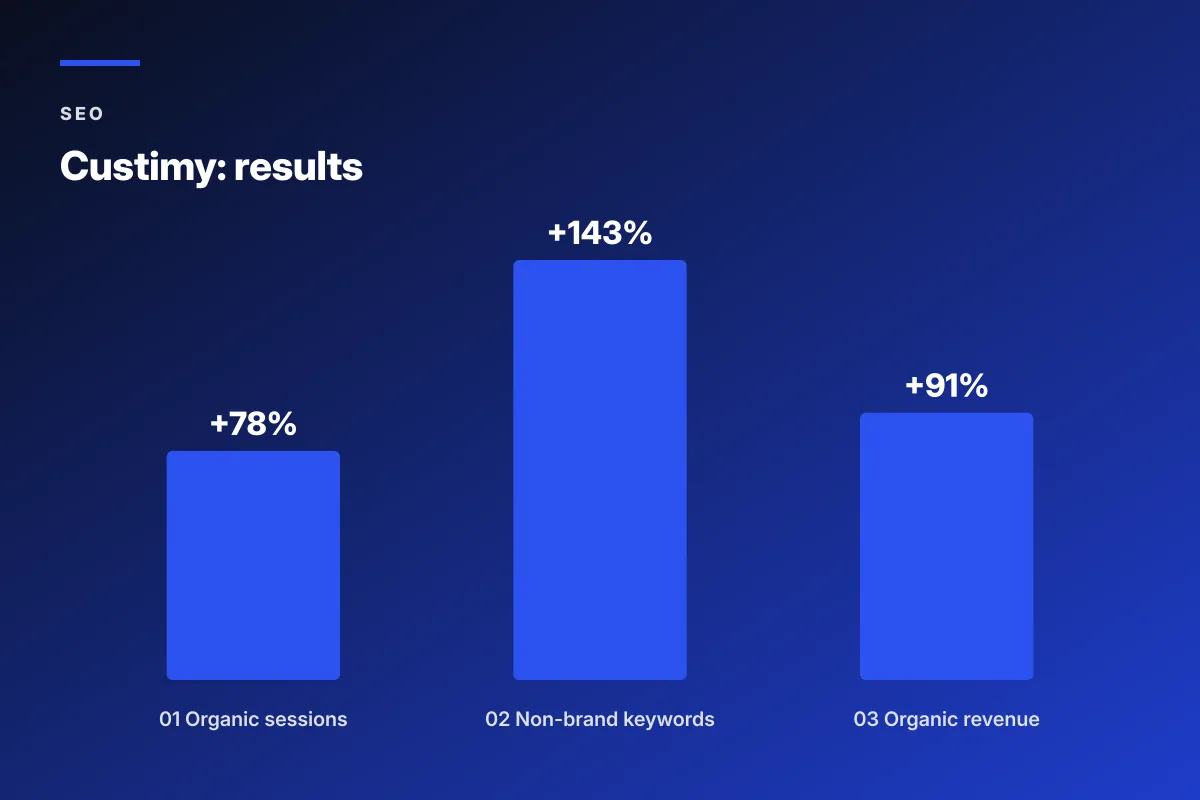
Our team rebuilt the keyword file into a 620-term map across the seven tiers. Reassigned head terms to 11 evergreen categories. Built 42 filter URLs targeting mid-tail queries. Wrote 18 buying guides under the categories for long-tail comparative queries. Folded 60 seasonal terms into the evergreen categories. Created 9 style pages under a store slash style URL structure with shoppable cards. Ran a brand plus product audit that recovered 3 out of 4 branded searches from paid to organic. Built 8 occasion pages targeting Scandinavian occasion queries. Over the following 7 months, non-brand organic sessions grew 78 percent to 6,050 per month, non-brand keyword rankings grew 143 percent, and non-brand organic revenue grew 91 percent. Custimy did not add new SKUs, hire a photographer, or increase ad spend. Every gain came from finally treating the SEO layer as a four-part strategy rather than a monthly channel budget.
Why common mistakes derail an SEO strategy for fashion company operators
The mistake pattern our team audits most often on fashion DTC brands has a repeatable shape. Treating SEO as a channel budget instead of a four-layer strategy. Publishing scattered content without a pillar structure. Running a growth-stage budget on a foundation-stage site. Skipping ownership entirely.
- Channel-budget framing: SEO gets treated like paid social with a monthly line item, no roadmap behind the spend.
- No pillar structure: content gets published against whichever term looks interesting this month, orphan rate climbs to 40 to 60 percent.
- Wrong-stage budget: growth-stage spend on a foundation-stage site produces the same rankings at double the cost.
- No named owner: strategy defaults back to the busiest team member, roadmap stops shipping within two months.
- Vanity KPIs: total sessions or total keyword rank count get reported instead of non-brand revenue and pillar-specific ranking movement.
- Ignored technical layer: content strategy publishes into a site with broken Core Web Vitals or missing schema, 30 to 50 percent of investment wasted.
- Paid-organic conflict: paid team runs brand queries in perpetuity, organic never recovers the demand as free traffic.
Fixing the mistake list above without new hires or new tooling typically produces a 25 to 45 percent non-brand traffic gain inside 90 days on a fashion DTC store with any pillar coverage at all. The mistakes are the audit map our team runs on every fashion engagement in the first two weeks of working together, because the store almost never has all seven fixed on arrival. That first-two-weeks audit is what tells the founder which pillar gets the investment in quarter one of the roadmap.
Where an SEO strategy for fashion company fits the growth stack
An SEO strategy for fashion company operations sits at the compounding-revenue layer of the DTC growth stack. Paid social buys attention and pays back inside 30 to 90 days. Email flows recover revenue from customers already in the file. Creator programs build affinity across a 60 to 120-day window. Organic search compounds every quarter and becomes the cheapest revenue channel at scale, but only if the four-layer framework runs behind it. Founders that budget for tactics without the framework end up with a fashion site publishing scattered content forever and blaming the writer for flat rankings.
The organic layer pays back over 18 to 30 months while paid and creator channels pay back inside 30 to 90 days. Founders that fund only the fast-payback channels build a store that stops growing the day the ad spend stops. Founders that fund the SEO strategy alongside the fast channels build a fashion brand whose organic revenue base compounds every quarter regardless of what happens to CPMs on Meta or TikTok. That structural resilience is the reason SEO belongs at the top of the growth stack for any fashion DTC brand past the first million in annual revenue.
Our team runs the framework on apparel fashion marketing retainer engagements starting at $599 per month on 6-month contracts, covering all four layers of the strategy from pillar research through content-map operation and monthly KPI tree review. An SEO strategy for fashion company teams is the framework that decides whether every other channel compounds or resets each quarter, and the retainer is the delivery model that keeps the strategy running against the store’s real ranking movement over time.
Read the paired fashion SEO case study of a DTC apparel turnaround for the ranking and revenue numbers alongside the framework.
Frequently asked questions
What does an SEO strategy for fashion company teams cover?
An SEO strategy for fashion company teams covers four layers running in parallel. Content pillars decide what the site is authoritative on. Budget stages decide how much gets invested at each phase of the brand's growth. A KPI tree decides what gets measured across revenue, sessions, rankings, velocity, linking hygiene, and technical health. A quarterly roadmap decides which pages get built by when. Skipping any single layer produces a fashion DTC store where content gets published against whichever term looks interesting that month, the site graph never accumulates topical authority, and the founder cannot tell whether last quarter's spend produced any lasting ranking gain.
How many content pillars belong in an SEO strategy for fashion company sites?
Four content pillars work for almost every fashion apparel brand. Product category depth holds head and mid-tail buying queries on category, sub-category, filter URLs, and PDPs. Style and aesthetic editorial captures style queries and image search on store slash style landing pages. Occasion and moment-driven content targets occasion queries through cross-category collection pages. Sizing, fit, and care education handles long-tail informational and buying queries through size guides, fit finders, and fabric care pages. Founders that run all four pillars in parallel see the site graph accumulate the authority signals search engines use to expand rankings across a cluster instead of one page at a time.
What monthly SEO budget fits a foundation-stage fashion DTC brand?
Foundation-stage fashion DTC brands under 500K in annual revenue fit a monthly SEO investment between $599 and $1,500 per month, covering category page rewrites, basic technical SEO work, brand plus product auditing, and simple educational content. Growth-stage brands between 500K and 3M in revenue move into the $1,500 to $5,000 monthly band, adding occasion pages and expanded pillar coverage. Scale-stage brands past 3M move into $5,000 to $12,000 monthly, adding style editorial and expanded education. Matching the budget to the stage is a real strategic decision, not a productivity metric. Wrong-stage budgets produce the same rankings at double the cost every time.
Which KPIs belong in an SEO strategy for fashion company measurement?
Six KPIs belong in the tree. Non-brand organic revenue attributed in GA4 with brand terms excluded sits at the top. Non-brand organic sessions below it. Ranking position on the priority term set across head, mid-tail, and occasion queries. Content velocity against the roadmap plan. Internal linking hygiene including orphan pages and anchor text distribution. Technical health metrics including Core Web Vitals, schema errors, and mobile usability. Brands that track only the top-line number cherry-pick data that supports the strategy they already wanted to run. Tracking the full tree lets the founder pinpoint where the strategy is stalling and which lever to pull next.
How does the quarterly roadmap inside an SEO strategy for fashion company work?
Quarter one runs foundation work including category page rewrites, technical SEO audit, brand plus product audit, and KPI tree setup. Quarter two runs buying-intent expansion through filter URLs across top categories, sub-category pages against mid-tail queries, and buying guides against long-tail comparative queries. Quarter three runs top-of-funnel expansion through style editorials, occasion pages, and image sitemap submission. Quarter four runs compounding work through refresh of highest-traffic pages, international market research when scope allows, and backlink outreach against flagship pillar pages. Each quarter carries a page-count target, a named owner per initiative, and a review meeting walking the KPI tree branch by branch.
Who should own an SEO strategy for fashion company operations?
Ownership depends on the brand's stage. Foundation-stage brands have the founder own strategy and hire a freelance SEO writer for execution with weekly check-ins. Growth-stage brands have a marketing lead own strategy working with an agency or in-house writer team, monthly review with the founder. Scale-stage brands have an SEO director or head of organic own strategy with an in-house team of 2 to 4 plus agency support. Enterprise brands need a VP of SEO with a team of 4 to 8. All stages need a quarterly review with the executive team, monthly KPI tree review, and a weekly roadmap standup that keeps the plan shipping.
Book your free 30-minute strategy call.
No spam, no sales rep. We use your email to schedule your call with a senior strategist. That is it.
More from the blog
View all articles → SEO
SEO Organic Search Engine Optimization Services That Grow Real Traffic
Read article SEO
SEO SEO for Pet Groomers That Fills the Appointment Book Weekly
Read article SEO
SEO