
Which Top Food Marketing Agencies Fit CPG Brands Best
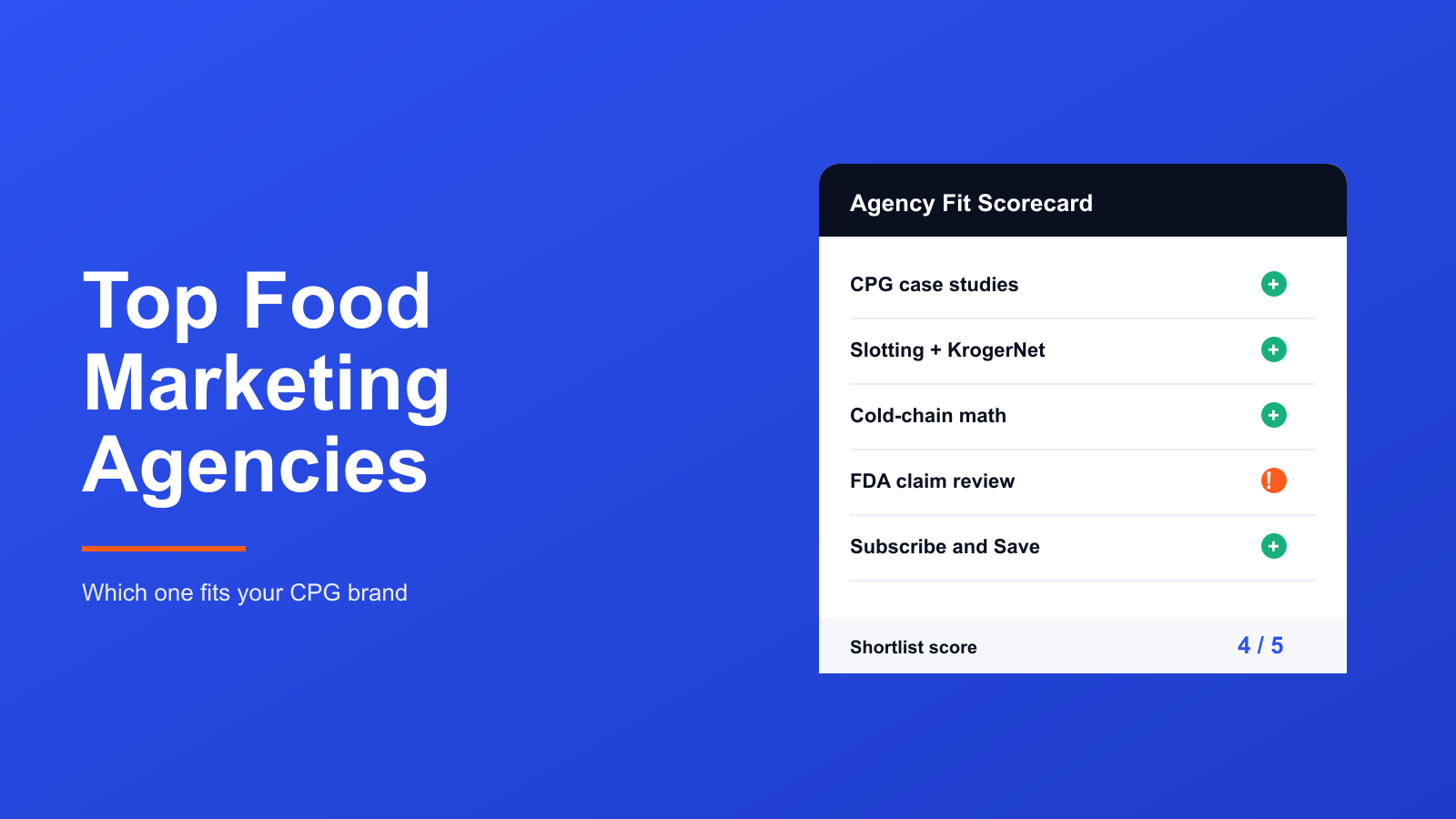
- The top food marketing agencies split into six honest tiers: full-service, specialist, paid plus Amazon, SEO-led, ecommerce-heavy, and boutique, and each tier fits a specific brand stage.
- Score any shortlist entry against six columns: CPG case-study depth, slotting fluency, cold-chain shipping math, FDA and USDA claim review, Subscribe and Save modeling, and retail-support media line item.
- Honest monthly retainer bands run from $599 for boutique DTC-only up through $40K for scale-stage full retail support, before media spend.
- Retainer payback under one quarter is realistic for growth-stage brands, mostly through redirected ad spend and avoided FDA claim rejections.
- Any two missing scorecard columns means the shortlist entry is a generalist wearing a food label, and the first-call questions in the post surface that fast.
A top food marketing agency for your brand is the one whose case studies, retainer band, and channel mix line up with what your line actually needs next. Not the flashiest deck. Not the loudest awards shelf. The one that has run the exact combination you are hiring for on brands whose growth you can verify. A shelf-stable snack chasing Whole Foods regional slots needs a different partner than a frozen meal kit fighting cold-chain math, and both need a different partner from a functional beverage line about to go up against FDA claim scrutiny on Meta.
Below is a working scorecard for the top food marketing agencies worth putting on a shortlist, the tier each agency profile fits, the honest retainer band you should expect, and the questions to ask on the first call. If you want the frame underneath the shortlist, our food marketing agency team maintains the live intake we run on every new engagement, and we walk through it below.

Full-service top food marketing agencies for CPG brands past first shelf
This is the tier most top food marketing agencies claim to sit in, and where about a third of them actually do. A full-service food agency runs brand strategy, paid media, SEO, ecommerce web, email, retail-support ads, and creative under one roof, staffs a named strategy lead who has worked on five or more CPG brands, and can point you to real dollar figures on the case-study page. If the food case studies are anonymized (a Midwest snack brand grew sales 220%) or every number rounds to a friendly ten, keep looking. Ask for the client name, the year range, and the specific channels used before the second meeting.
A full-service agency at this tier will also know how to hold the wholesale conversation alongside the DTC one. When Abigail Ahern partnered with us on the ecommerce side, they were leaning too hard on discount-led paid media that pulled traffic but eroded the brand. We restructured SEO around non-branded intent and rebuilt the paid-media plan into segmented shopping campaigns with prospecting and retargeting layers. Inside 12 months, ecommerce revenue grew 179%, paid-search ROAS grew to 1,588%, and paid-social ROAS reached 3,000% without a single discount banner. The pattern is transferable straight into food and beverage: premium positioning, non-branded organic capture, and margin-aware paid segmentation are the same three levers whether the SKU is a chair or a shelf-stable soup.
Specialist top food marketing agencies for brands with real retail exposure
A specialist food marketing agency is the right shortlist entry once your P&L has meaningful retail exposure. Meaningful means real slotting fees on the ledger, a UNFI or KeHE distributor relationship, and at least one buyer meeting per quarter with Whole Foods, Sprouts, or a Kroger banner. Specialists at this tier price a new SKU into three Sprouts regions in the first call. They quote KrogerNet display CPMs alongside Meta CPMs. They know why a 15% Subscribe and Save discount on a $9 unit is structurally different from a 5% enrollment on a $28 unit, and they design the enrollment ladder around that math.
The specialist tier costs more per month but earns the difference back through avoided claim rejections and better-modeled Subscribe and Save enrollment. On our engagements, the first quarter of a specialist retainer typically pays for itself through the ad-spend savings alone: the 15 to 25% of Q1 budget that was going to be spent against structurally unprofitable units gets redirected. Full retainer scope on the specialist side is covered on our food and beverage marketing retainer page.
Top food marketing agencies focused on paid media and Amazon
Some of the strongest top food marketing agencies specialize narrowly in paid media plus Amazon and let the brand hold the strategy layer in-house. This works for brands where the founder or an in-house head of growth already owns positioning, and where the remaining need is disciplined execution across Meta, Google, and Amazon Sponsored Products at a level generalist media buyers cannot hit. The best of these run three-account setups (Amazon Ads console + DSP + brand DTC) with a shared naming convention and weekly incrementality tests, not a single-account push-and-hope motion.
If Amazon is the primary channel, the agency also has to model Subscribe and Save enrollment against Sponsored Products bid economics. Discount depth on Subscribe and Save affects Sponsored Products cost-per-conversion, since the effective margin on repeat units changes. A paid-media-only agency that skips that interaction produces a good month-one report and a broken year-two P&L. Our food and beverage PPC page covers the retail-support paid layer we run alongside DTC.
SEO-led top food marketing agencies for recipe, ingredient, and comparison intent
Food and beverage SEO is a category most generalist agencies underprice. The organic opportunity around recipe intent, ingredient sourcing, comparison queries (protein powder vs whey isolate, oat milk vs almond milk, cold brew vs iced coffee), and functional benefit searches is enormous, and the SERP is winnable by brands willing to publish depth. SEO-led agencies that specialize in food and beverage rank category pages, comparison hubs, and recipe libraries the way general SEO shops rank service pages. Ask any SEO-led agency for a live example of a food brand they moved from page three to page one on a non-branded comparison query with search volume over 1,000 per month.
The SEO-led tier is often the best fit for brands that already have paid media handled in-house and need organic to catch up. It is also the tier that scales cheapest per acquired customer once the content library compounds. Full scope is on the food and beverage SEO page.
Ecommerce-heavy top food marketing agencies for Shopify and WooCommerce food brands
Ecommerce-heavy top food marketing agencies own the technical stack in a way full-service shops do not. If your food brand runs Shopify with a custom theme, WooCommerce with subscription plugins, or a headless setup with a separate PIM, an ecommerce-heavy agency is often the right shortlist entry. This tier runs site speed audits (Core Web Vitals in the green on mobile, LCP under 2.5 seconds, INP under 200 milliseconds), subscription-flow reviews, and cold-chain shipping-rate configuration alongside the standard marketing scope. A food DTC checkout that miscalculates zone-based shipping loses more revenue in a month than a bad Meta account loses in a quarter.
Every food and beverage ecommerce audit we run at Redefine Web opens with a shipping-rate map by zip code, a subscription-flow reconciliation between the site and the payment processor, and a Core Web Vitals scan on the top ten product pages. Our food and beverage web design engagements build against that exact stack. Ecommerce-heavy agencies that skip the shipping-rate map are not equipped for perishable or refrigerated shipping economics.
Boutique top food marketing agencies for emerging brands under one million in revenue
A boutique food marketing agency is the honest shortlist entry for an emerging brand under $1M in trailing 12-month revenue. This tier does not carry the retail-support layer or the distributor conversation. The brand is not at that scale yet. What it carries is DTC discipline, Amazon Sponsored Products fluency, a competent email and SMS retention build, and a first-90-day plan that treats brand positioning as an active input, not a leftover asset. Retainer bands at this tier realistically run $599 to $3,000 per month, media spend on top.
Boutique agencies should be judged on the same three questions as any other tier: named case studies, honest retainer math, and channel mix that matches the brand stage. Boutique does not mean cheap-and-vague. Founders taking capital from boutique agencies without those three answers usually spend the first two quarters undoing the setup. The scorecard we walk through on the food marketing agency page is the same one we apply internally to every intake, whether the brand is at $200K or $20M.
How to score any top food marketing agency shortlist against your brand
A working scorecard turns “top food marketing agency” from a marketing phrase into a hiring decision. Every intake we run against a new food and beverage engagement checks the same six columns: CPG case-study depth, slotting and KrogerNet fluency, cold-chain shipping math, FDA and USDA claim review discipline, Amazon Subscribe and Save modeling, and retail-support ad line-item in the media plan. Any two of those columns missing means the agency is a generalist wearing a food label. All six present means the shortlist entry is real.
| Scorecard column | Full-service | Specialist | Paid + Amazon | SEO-led | Ecommerce-heavy | Boutique |
|---|---|---|---|---|---|---|
| CPG case-study depth | + | + | + | partial | partial | partial |
| Slotting + KrogerNet | + | + | – | – | – | – |
| Cold-chain shipping math | + | + | partial | – | + | – |
| FDA + USDA claim review | + | + | partial | + | – | partial |
| Subscribe and Save modeling | + | + | + | – | partial | partial |
| Retail-support media line item | + | + | partial | – | – | – |
Score each shortlist entry against the six columns, add the pluses, and rank. Our companion piece on how to vet a marketing agency for food brands walks through the same six-column card in more depth, with the first-call questions we bring to every intake. Full-service and specialist agencies usually clear five or six pluses. Paid-plus-Amazon shops clear three to four. SEO-led and ecommerce-heavy agencies clear two to three, which is fine when they are hired inside their lane. Boutique agencies clear one to two, which is honest for the brand stage they serve. The scorecard is not a ranking of quality. It is a ranking of fit against the specific brand stage and P&L shape you are hiring for.
Questions to ask on the first call with any top food marketing agency
First-call questions decide whether a shortlist entry stays on the list. The six questions below are the ones we would ask if we were hiring a food agency ourselves. Any hesitation on any of them is a signal, and any confident wrong answer is worse. Bring these to every intake call, and score the answers against the scorecard above. Our food and beverage website hosting and maintenance team runs the same interview protocol on infrastructure vendors, and it works the same way.
One, walk me through how you would price a new SKU into three Sprouts regions this quarter. Two, what does your Subscribe and Save enrollment ladder look like for a $12 unit versus a $28 unit. Three, which three FDA structure-function claim traps do you screen for at the copy stage. Four, show me a food case study where your paid-media plan included a retail-support line item. Five, how do you handle cold-chain zone-based shipping rates in the ecommerce configuration. Six, what does your first-90-day plan look like for a food brand at the exact stage we are at. Any agency that answers those in the first call earns the second meeting.
Frequently asked questions about hiring a top food marketing agency
How do the top food marketing agencies differ from a general marketing agency at the shortlist stage?
The top food marketing agencies differ from a general agency in what they audit before touching the ad account. Specialists start with the cold-chain shipping table, the DTC versus wholesale revenue split, and the FDA and USDA claim review on every SKU. Generalists start with a site-speed audit and a Google Ads account teardown. Both audits are useful. The specialist path avoids the trap of spending the first quarter of media against unit economics that cannot support the CAC target, and it reshapes the creative brief around what the brand can honestly say about its ingredients. Shortlist any agency whose intake matches the specialist pattern.
What retainer range should a food brand expect from top food marketing agencies
Top food marketing agencies price against brand stage. A boutique agency running DTC-only for an emerging brand under $1M realistically runs $599 to $3,000 per month, media spend on top. A specialist agency running DTC plus Amazon plus wholesale support for a $1M to $10M growth-stage brand runs $5,000 to $12,000. A full-service agency running the same scope for a scale-stage brand past $10M runs $15,000 to $40,000. Any food marketing agency quoting a flat retainer without asking about brand stage, retail exposure, or SKU count is quoting a template. Ask them to break the retainer into scope columns.
Which top food marketing agencies handle Amazon Subscribe and Save the best
The top food marketing agencies for Amazon Subscribe and Save are the ones that model the enrollment tier as a P&L structure, not a marketing tactic. Enrolling into Subscribe and Save at 5% costs the brand 5% margin per repeat unit. At 10% it costs 10%. At 15% it costs 15% forever, or until the brand runs the extraction sequence to convert subscribers to one-time buyers. Ask any Amazon-heavy agency to walk you through their enrollment ladder for a $9 unit, a $16 unit, and a $28 unit. Confident answers with different tiers by price band mean the agency has done the math. One-size answers mean they have not.
Do the top food marketing agencies handle FDA and USDA claim review at the copy stage
The top food marketing agencies handle FDA and USDA claim review at the copy stage, before a designer touches the mockup. Structure-function claims (immune, mood, energy), USDA organic labeling rules, zero-sugar disclosure requirements, and FTC-enforced language (detox is the classic trap) get screened on every headline, subhead, and body line. Ask the agency which three claim traps they screen for by default and which platform policy documents they reference. If the answer is generic, expect a 40 to 60% Q4 creative rebuild cycle once Meta starts rejecting ads at scale. Specialist agencies build the claim review into the creative brief and avoid that cycle.
How long does a food marketing agency retainer take to pay for itself
A specialist food marketing agency retainer typically pays for itself inside one quarter, most often through the 15 to 25% of Q1 media budget that gets redirected away from structurally unprofitable units. The second common payback lane is avoided claim rejections that would have forced a three-week rebuild cycle during the peak Q4 or Q1 window. The third is better-modeled Subscribe and Save enrollment that protects margin over multi-year horizons. Payback under one quarter is realistic for growth-stage brands with real retail exposure. Emerging brands at boutique tier usually see payback inside two quarters as the retention and DTC funnel work compounds.
What red flags mean a top food marketing agency shortlist entry is actually a generalist
Red flags include a case-study section with only DTC ecommerce and no CPG examples, a proposal that skips slotting math or cold-chain freight modeling, a creative brief with no claim review step, no Subscribe and Save enrollment strategy in the media plan, no retail-support ad line item, and reporting templates that show channel ROAS without contribution margin per acquired customer. Any two of those together mean the shortlist entry is a generalist. Any four together mean the agency should be removed from the shortlist entirely. Fit against your brand stage matters more than agency size or award count.
See how our specialist retainer runs against DTC, wholesale, and Amazon for growing food brands at food marketing agency, or read the paid-media side of the work at food and beverage PPC.
Book your free 30-minute strategy call.
No spam, no sales rep. We use your email to schedule your call with a senior strategist. That is it.
More from the blog
View all articles → Marketing Strategy
 How Dental DSOs Grow Through Marketing. Tactics That Scale
Read article Marketing Strategy
 Dental DSO Marketing Services. What to Expect From an Agency Partner
Read article Marketing Strategy