
What Are Search Engine Optimization Services and How They Work
- SEO services cover technical, content, links, and reporting work.
- Real engagements run continuously, not as one-time projects.
- Local map pack results land in 8 to 16 weeks.
- National ranking timelines run 3 to 12 months.
- Payback windows sit at 6 to 24 months depending on scope.
- What are search engine optimization services in one clear answer
- What is search engine optimization services scope in month one
- Search engine optimization services description over months 1 through 12
- What are search engine optimization services really worth per dollar
- How to vet a real search engine optimization services vendor
- A real search engine optimization services engagement
- Common misunderstandings about what SEO services do
- Search engine optimization services scope by industry
- In-house team versus SEO services agency
- Wrapping the definition
What are search engine optimization services in plain English. They are the set of activities an agency runs on your website and around it to raise your rankings on Google and other search engines. That covers technical work on the site, content written to match what people actually search for, links earned from other sites, and monthly reporting on what moved. Every real SEO retainer sits on those four legs. Anything missing one of them is not real SEO.
You will get the plain-language scope of a real SEO engagement, the deliverables you should expect month by month, the honest timeline before results show up, what the work costs, and the questions that separate real vendors from busywork sellers. Read straight through in about nine minutes. You will know what SEO services are, what they should cost, and what to ask before your next agency call. That is enough to avoid the most expensive mistakes.

What are search engine optimization services in one clear answer
What are search engine optimization services. They are the paid work an agency, freelancer, or in-house team does to raise your website’s visibility in unpaid Google results. The work covers four buckets: technical, content, links, and reporting. All four run continuously, not as a one-time project.
The word services matters here. You are not buying a rank. You are buying labor and expertise applied to your site over time. Nobody controls Google’s ranking algorithm, so nobody can guarantee a specific position. What a real vendor can guarantee is process, deliverables, and reporting. Rankings follow when the process works. If a vendor promises a specific position on a specific keyword by a specific date, they are either lying or planning to game the index in ways that will get you deindexed. Neither serves you.
The four work buckets in plain terms
Technical work covers site speed, crawlability, mobile responsiveness, schema markup, and internal linking structure. Content work covers keyword research, blog posts, service pages, and landing pages written to match how people actually search. Link work covers earning mentions and citations from other websites that Google trusts. Reporting covers monthly summaries showing what moved and what the vendor did. If your vendor cannot tell you which of the four buckets they are working on this month, they are not running a real engagement.
SEO versus SEA and the difference that matters
SEO is search engine optimization, the unpaid or organic side. SEA is search engine advertising, the paid ad side. SEO takes 3 to 12 months to show real results and compounds after that. SEA works day one but stops the day you pause the budget. Most healthy digital marketing programs run both. SEO builds the long-term asset. SEA fills the pipeline while SEO ramps. Buyers who treat them as an either-or usually make the wrong choice for the wrong reason.
What is search engine optimization services scope in month one
What is search engine optimization services scope in the first 30 days. A real engagement kicks off with a technical audit, keyword research, a content plan, and a link acquisition strategy. Month one is diagnostic and planning. Very little ranking movement happens yet. Expect 40 to 80 hours of vendor time across those four deliverables.
The month-one output should be a written strategy document you can read and understand. Not a slide deck of stock chart images. Not a Notion page of vague activities. A real document with named pages, targeted keywords, a technical fix list with priority order, and a content calendar for the next 90 days. If the vendor cannot produce that in month one, they are working from a template package and treating your business like every other client on their roster.
The technical audit
A month-one technical audit covers site speed on mobile and desktop, indexability of your key pages, schema markup, internal linking structure, image optimization, and Core Web Vitals. The audit output is a prioritized fix list, usually 20 to 60 items ranked by impact and effort. Some items your vendor fixes directly. Others go to your dev team. The audit should also flag anything that got broken during a previous vendor’s tenure, which happens more than most buyers expect.
The 90-day content plan
The 90-day content plan lists specific pieces the vendor will write, each with a target keyword, a rough word count, an outline, and a publish date. A retainer with 3 pieces per month should show 9 pieces in the 90-day plan, each with a defined slot. Vague content plans like publish 3 blog posts per month without titles are a signal the vendor has not thought through your topic space. Push for named pieces and named keywords before you accept the plan.
Search engine optimization services description over months 1 through 12
Search engine optimization services description matters more over time than in the pitch. Month 1 is planning. Months 2 and 3 execute the plan. Month 4 shows the first ranking movement. Months 5 through 12 show the compounding effect if the work stays consistent. That is the honest timeline.
Vendors who promise faster timelines are either working in very low-competition markets or misleading you. A brand new site in a competitive niche takes 6 to 12 months to reach first-page rankings on target keywords. An established site with existing authority takes 3 to 6 months. A local site targeting the map pack takes 8 to 16 weeks if the Google Business Profile is set up right. Ask your vendor which category your site falls into before you set expectations for month 4 revenue.
| Month | Main work | Expected outcomes |
|---|---|---|
| Month 1 | Technical audit, keyword research, content plan, link strategy | Written strategy document, priority fix list |
| Months 2 to 3 | Content production, technical fixes, initial outreach | 3 to 9 new pieces of content, technical improvements |
| Month 4 | Continued content, first link placements | First ranking movement on long-tail keywords |
| Months 5 to 6 | Content cadence, ongoing outreach, on-page tuning | Top-20 rankings on some primary keywords |
| Months 7 to 12 | Sustained work, quarterly audits, seasonal tuning | Top-10 rankings, real organic traffic growth |
Local business timeline
Local businesses in the map pack move faster than national rankings. A properly optimized Google Business Profile, 30 to 50 local citations cleaned or built in the first 60 days, and 15 to 25 new reviews per quarter can move a local business from position 8 to position 3 in 60 to 90 days. Local SEO is not slow when the work is clean. What is slow is trying to cover a national keyword footprint from a local site with no authority. Match the strategy to the geographic scope.
National ranking timeline
National rankings on competitive keywords take 8 to 24 months in most industries. The exact timing depends on how much authority your domain already has, how many pages the site needs, and how much competitive backlink volume you can match. A SaaS site trying to rank for CRM in the US market is looking at 3-plus years of consistent work against $2 billion competitors. A niche B2B tool with 500 buyers globally can rank in 4 to 8 months. Ask about competitive difficulty by keyword before signing any search engine optimization services agreement. A written keyword difficulty analysis should sit inside the month-one strategy document.
Any vendor promising position 1 by date X is lying or planning to game the index in ways that get you deindexed. Ask for process guarantees, not position.
What are search engine optimization services really worth per dollar
What are search engine optimization services worth per dollar. A well-run retainer typically pays back 8 to 20 times its cost over 24 months. Very few channels compound this way. Content ranked into position 3 keeps earning after the retainer ends. That is why SEO stays popular even in tough economies. Very few marketing channels compound in the same way.
The math looks like this for a $3,000 per month retainer over 24 months. Total spend $72,000. Typical inbound organic pipeline in a mature account: $600,000 to $1.4 million, depending on your industry, average order value, and lead-to-customer conversion rate. A dental practice at $180 per new patient can add 300 to 800 patients over that window. A home services business at $2,500 per booked job can add 240 to 560 jobs. These are typical numbers, not hyped ceilings.
- Dental practice: 300 to 800 new patients over 24 months at $180 average acquisition
- Home services: 240 to 560 booked jobs at $2,500 average value
- Ecommerce site: 3,000 to 8,000 new customers at $85 average order value
- Legal firm: 40 to 90 new consultations at $150 average consult value
- SaaS company: 60 to 200 qualified inbound demos at $8,000 average deal size
- Local service: 400 to 1,100 new inquiries at $75 average booking value
Payback window in real numbers
The payback window on an SEO retainer averages 6 to 14 months for small businesses, 10 to 18 months for mid-market, and 12 to 24 months for enterprise. Payback starts once the ranking gains translate to enough traffic to fund the retainer. That inflection usually lands between months 4 and 8 for a small business, later for larger operations because their targets are more competitive. Ask your vendor what payback window they project and what the assumptions are behind that number.
Why the compounding matters
SEO compounds because content and links do not disappear when you stop paying. A blog post published in month 4 that ranks in month 8 continues to earn traffic in month 24, month 36, and beyond, at zero marginal cost. Google Ads stops the day you stop paying. Broker leads stop the day you stop paying. Content ranked into position 3 keeps working. That is why the 24-month cost of SEO is so much lower per lead than any other channel, and why buyers who stick with it usually keep sticking with it.
How to vet a real search engine optimization services vendor
Vetting a vendor comes down to five checks. Ask for two client references, ask for the last strategy document they wrote, ask for a sample monthly report, ask for read-only tool access from day one, and ask what happens to your content if you leave. Pass all five, sign the contract. Fail any two, keep looking.
The five checks filter out about 70 percent of vendors, which is the point. The market has a lot of second-tier operators who cannot answer these questions honestly. That is not a moral failing on their part. It just means they are not right for your business. Vetting protects you from finding out in month six that the vendor is running a template package and calling it strategy. Do the vetting on the front end and the retainer runs smoother for years after.
Reference call mechanics
Reference calls are the single highest-value vetting activity when you evaluate search engine optimization services. Ask the vendor for two clients in your business size and industry. Schedule the calls off-script, without the vendor on the line. Ask what the vendor promised, what actually got delivered, what the worst month was and how the vendor handled it, and whether they would sign again today at what retainer size. Any reference who cannot answer all four honestly is either coached or brand new. Skip references who say only nice things without specifics.
Exit terms and content ownership
You should own everything the vendor produces. Blog posts, landing pages, technical documentation, backlink data. Some agencies license content back to the client, which becomes a problem when you leave. Read the exit terms before signing. A fair contract requires 30 to 60 days notice and hands back all assets in editable form. Anything longer than 90 days notice or anything that restricts asset transfer is a caution sign. Our Search Engine Optimization Services spell the exit terms out on the contract page.
A real search engine optimization services engagement
Best Fit Movers, a San Diego moving company, came to us for search engine optimization services after a stagnant local footprint and a redesign project that had stalled. They wanted more qualified leads without a bigger paid budget. Local moving is a competitive category with national franchise players and dozens of local operators fighting for the same map pack real estate.
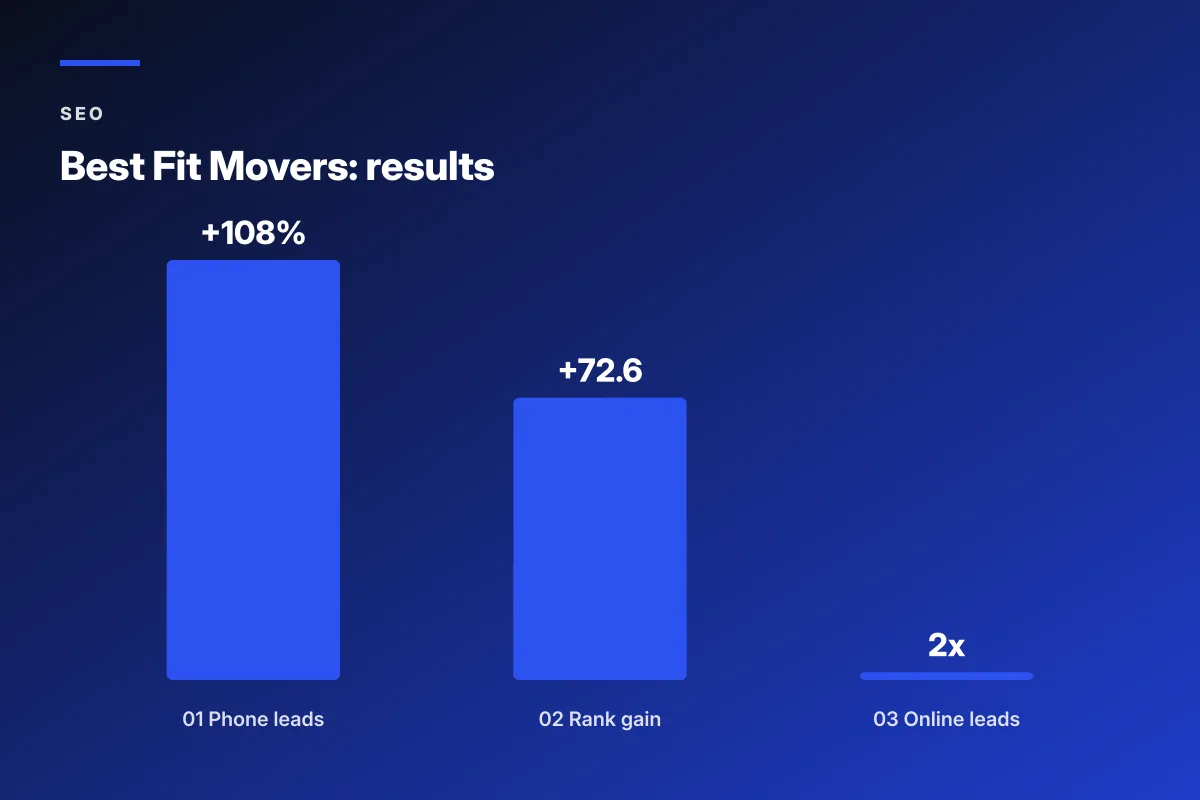
We ran a full engagement covering website redesign, local SEO, content strategy, and lead generation. The redesign brought site speed under 2 seconds, added structured schema for the moving services, and rebuilt the service area pages with local keyword targeting. Content covered the buyer journey from research to booking, with 8 pieces of long-form content ranking for high-intent moving-related terms in San Diego. Phone-call leads climbed 108 percent, average keyword rank gained 72.6 positions across the tracked set, and online leads doubled. A real engagement looks like this when the vendor and client stay aligned.
Why the work compounded
Three factors compounded the outcome. First, the redesign fixed the technical debt that had capped every previous vendor’s work. Second, the content targeted specific buyer intent, not vague brand-awareness keywords. Third, the local citations and reviews stack got cleaned and rebuilt, which pulled the map pack rank up alongside the organic rank. When those three factors line up, results come faster than the honest 8-to-16-week local timeline. When any of them break, results stall.
What the work cost and returned
The redesign was a fixed-fee project. The ongoing SEO retainer sat in the mid-band for local service SEO, around $2,800 per month. Over 12 months, the retainer plus project totaled about $52,000. Return on that spend, tracked across doubled online leads and 108 percent more phone leads, worked out to a payback window under 8 months once the map pack pushed into the top 3 for their key moving-related keyword set. This is exactly what a healthy small-business search engine optimization services engagement should produce. That is a mid-band retainer producing a top-tier outcome because the technical foundation was fixed.
Every SEO buyer asks the same question in month two: is the vendor actually doing anything or just charging me. The honest answer is that most of the work in month two is invisible from your side of the dashboard. You are watching for rank movement while the vendor is publishing content, fixing site speed on the mobile menu, and emailing 30 editors to place a link. It looks like nothing is happening until suddenly you notice you rank for something you did not before. Then it looks like magic. It was neither. It was 40 hours of unglamorous work.
Common misunderstandings about what SEO services do
Most buyers walk into SEO with three misconceptions. That it can be one-time. That it can guarantee positions. That it will show up in week two. All three are wrong, and all three cause preventable retainer failures.
SEO is not a project you finish. It is a program you run. Content needs to keep publishing because your competitors keep publishing. Links need to keep coming because old links decay and new pages need signals. Technical work needs to keep running because sites break and algorithms shift. A vendor who promises a done SEO project is either misunderstanding the discipline or selling a shape of work you should not buy. Ask for a program, not a project, if the goal is sustained rankings.
The guarantee myth
Nobody can guarantee rankings because nobody controls Google. What a vendor can guarantee is process, deliverables, reporting cadence, and defined exit terms. Any vendor promising a specific position on a specific keyword by a specific date is either overpromising or planning to game the search index. The Google Search Central guidance on manual actions covers what happens when index gaming gets caught. The penalty box is not where you want your site.
The timeline myth
SEO does not show real results in week two. What you should expect in the first 30 days is planning and setup, not rankings. Vendors who promise week-two rankings are either working with an already-strong site or lying about the timeline. Local businesses on the map pack can move in 8 to 16 weeks if the Google Business Profile is clean. National rankings take 3 to 12 months. Set the timeline expectation on day one and the retainer runs smoother through months 4 and 5 when patience matters most.
Search engine optimization services scope by industry
Search engine optimization services scope varies by industry. Healthcare needs YMYL content review, clinical reviewer sign-off, and HIPAA-compliant forms. Legal needs jurisdictional accuracy and bar-admitted author schema. Ecommerce needs product schema and catalog structure. Home services needs map pack expertise and review generation. The scope shape follows the industry, not the retainer number.
Industry specialization pays off because the specialist already knows the buyers, the language, the competitive set, and the compliance requirements. A generalist can do adequate work in any vertical, but a specialist will outperform on the same retainer. Look for search engine optimization services vendors with 3-plus current clients in your industry, published content specifically about your industry’s SEO, and existing relationships with your industry’s publications. Those three signals separate specialists from generalists claiming coverage.
Healthcare and dental scope
Healthcare and dental SEO scope needs clinical reviewer workflow, physician schema, appointment booking integration, and HIPAA-aware form handling. Content needs a licensed practitioner to review it before publish. Author schema needs the practitioner’s name, credentials, and license state. Our Dental SEO Services Built for Local Map Dominance shows how the scope maps to a single-location practice, and our broader healthcare service page covers multi-specialty and hospital scope.
Local service scope
Local service SEO scope needs Google Business Profile optimization, service area page templates, review generation systems, and citation building or cleanup. The map pack rank matters more than the classic organic rank for many local queries, so the strategy tilts toward local signals. Content covers service-specific queries and neighborhood-specific queries. Our Home Services SEO Built for Local Map Pack Dominance shows the scope breakdown for HVAC, plumbing, roofing, and adjacent verticals. Deeper context on how organic ranking factors shift lives on the Ahrefs Google ranking factors overview and on the Moz Beginners Guide to SEO, both of which we reference on client kickoff calls.
In-house team versus SEO services agency
The in-house-versus-agency question comes up on every call about what are search engine optimization services delivery. Neither option is universally better. In-house wins on institutional memory and direct alignment. Agency wins on speed to specialist talent and tooling access. The right choice depends on your growth stage and how much SEO you actually need.
A senior in-house SEO manager costs $95,000 to $160,000 fully loaded, plus $8,000 to $20,000 per year in tooling, plus $30,000 to $80,000 in content production budget. Total 12-month cost lands at $130,000 to $260,000 for one person’s output. A comparable agency retainer at $6,000 per month costs $72,000 per year and delivers 3 to 5 specialists on your account. The math favors agency for most businesses under $50 million in revenue. Above that, in-house becomes viable because you can staff enough people to justify the fixed costs.
The hybrid model
Most well-run SEO programs at $50 million to $500 million businesses run a hybrid. One in-house SEO manager who owns the strategy and relationships, plus an agency that handles content, technical, and link work at scale. The manager acts as the client-side lead and the agency acts as the execution engine. The hybrid gives you institutional memory and specialist depth without the cost of a full in-house team. Ask your prospective agency whether they work well with an in-house counterpart, because not all agencies do.
The pure agency model
The pure agency model fits businesses under $50 million in revenue. You outsource strategy and execution to a single vendor who owns the whole program. This works when you have one internal point of contact who can approve content, sign off on technical changes, and read reports. It fails when the internal owner rotates every 12 months or when nobody owns SEO on the client side. Pick your internal owner before you sign the retainer, and set their SEO responsibilities in writing.
Wrapping the definition
What are search engine optimization services. Four buckets of continuous work that raise your visibility in unpaid search results. Technical, content, links, reporting. Any real engagement covers all four. Any package missing one of them is not what you should buy. Cost sits at $500 to $30,000 monthly depending on scope. Payback lands between 6 and 24 months depending on business size.
If you are evaluating what are search engine optimization services vendors right now, use the 5-check vetting framework. References, strategy sample, monthly report sample, tool access, exit terms. Pass all five, sign. Skip the vendors who cannot pass. The vetting takes a week and saves you 12 months of wasted retainer. If you want to see how our own delivery stacks against the framework, we publish scope, pricing, and exit terms openly. Bring your business specifics to a call and we will show you exactly what the first 90 days would look like on your account. Our Local Search Engine Optimization Services post covers the local-focused variant if that fits your business better.
Frequently asked questions
What are search engine optimization services in one sentence?
Search engine optimization services are the paid work an agency, freelancer, or in-house team does to raise a website's visibility in unpaid search engine results, covering four main buckets: technical work on the site, content matched to how people actually search, links earned from other trusted sites, and monthly reporting on what moved. The work runs continuously because search rankings do not respond to one-time pushes, competitors keep publishing, and Google's algorithm keeps updating. Any real SEO engagement covers all four buckets. Any package missing one of them is not real SEO regardless of what the proposal says. Cost, timeline, and scope vary by business size and industry.
What is search engine optimization services scope in the first month?
Month one of a real SEO engagement covers four planning deliverables: a technical audit of the current site, keyword research for the target market, a 90-day content plan with specific pieces named, and a link acquisition strategy. Expect 40 to 80 hours of vendor time across those four items in the first 30 days. The month-one output should be a written strategy document you can read and understand, not a slide deck of stock chart images. Little ranking movement happens in month one because the work is diagnostic and planning. Ranking gains start showing between month 4 and month 6 for most retainers, sooner for local map pack work and later for national keyword targets.
How does search engine optimization services description differ from SEA?
SEO is search engine optimization, which covers the unpaid or organic side of search results. SEA is search engine advertising, which covers the paid ad side. SEO takes 3 to 12 months to show real results and compounds after that because ranked content continues to earn traffic at zero marginal cost. SEA works day one because you are paying per click, but stops the day you pause the budget. Most healthy digital marketing programs run both because they complement each other. SEO builds the long-term traffic asset. SEA fills the pipeline while SEO ramps and captures high-intent searches at moments when organic rank alone is not enough.
How much do search engine optimization services cost per month?
Monthly retainer costs sit in four honest bands. Local solo work runs $500 to $1,500 per month. Small business retainers run $1,500 to $4,000 per month. Mid-market retainers run $4,000 to $10,000 per month. Enterprise retainers run $10,000 to $30,000 per month. The number that fits depends on how competitive your market is, how many pages the site needs, and how big a link and content budget you can sustain over 12 to 24 months. Below $500 monthly is usually a citation checklist without strategy. Above $30,000 monthly implies enterprise complexity. Cheap SEO rarely produces results in competitive markets. Overpriced SEO usually pays for account management layers you may not need.
How long do search engine optimization services take to show results?
Timelines vary by scope. Local map pack results with a properly optimized Google Business Profile and 30 to 50 clean citations show movement in 8 to 16 weeks. National organic rankings on competitive keywords take 8 to 24 months depending on domain authority, page count, and competitive backlink volume. New domains with no backlinks take longer than established domains. Niche B2B markets rank faster than saturated consumer markets. A brand new site in a competitive niche should expect 6 to 12 months to reach first-page rankings on target keywords. Set the expectation on day one so the retainer runs smoothly through months 4 and 5 when patience matters most.
Can search engine optimization services guarantee rankings?
No vendor can guarantee specific rankings because no vendor controls Google's algorithm. What a real vendor can guarantee is process, deliverables, reporting cadence, and defined exit terms. Any vendor promising a specific position on a specific keyword by a specific date is either overpromising or planning to game the search index in ways that risk a manual action. Manual actions from Google can deindex an entire site, which takes months to recover from and sometimes never fully resolves. If a proposal includes a ranking guarantee, treat it as a hard warning sign and walk away. Reputable vendors set expectations around movement and process, not around guarantees they cannot deliver.
Do search engine optimization services still work in the age of AI Overviews?
Yes, though the work has shifted. Google AI Overviews changed how search results pay out by pulling answer snippets directly into the results page. Content that ranks in the age of AI Overviews shares three properties: answer-first paragraphs of 40 to 60 words directly under every question heading, comparison tables that structure key data for extraction, and first-person action language where honest because AI systems weight first-hand experience signals. Vendors who adapted to these shifts kept client rankings stable through the 2024 and 2025 core updates. Vendors who did not adapt saw client rankings drop 15 to 40 percent. Ask your prospective vendor how they optimize for AI Overview extraction before signing anything.
Book your free 30-minute strategy call.
No spam, no sales rep. We use your email to schedule your call with a senior strategist. That is it.
More from the blog
View all articles → SEO
SEO Organic Search Engine Optimization Services That Grow Real Traffic
Read article SEO
SEO SEO for Pet Groomers That Fills the Appointment Book Weekly
Read article SEO
SEO