
Med spa website hosting is the piece of the stack that rarely shows up in the pitch deck and quietly decides whether the booking form still works at 7 PM on a Tuesday when a prospective patient is ready to schedule. Botox consult traffic clusters between 6 and 10 PM local time. If the site is slow, the checkout flow times out, or the morning plugin update broke the treatment page, the patient walks. Owners we talk to often underweight this layer because the monthly cost looks small at $35 to $150. The revenue cost of a slow, insecure, poorly maintained med spa site is not. This guide covers what med spa website hosting has to include, how to grade the vendors bidding on it, and what a real maintenance retainer looks like at single-location and multi-location scale. You will get uptime numbers to write into the contract, a security baseline that fits a treatment-adjacent site, and a price frame that keeps the layer honest. Redefine Web bundles hosting into the maintenance retainer at $199, $299, or $499 a month, so you never pay two separate invoices.
What’s in this guide
- Why med spa website hosting is different from generic small-business hosting
- The uptime numbers med spa sites have to hold
- The security posture a med spa site actually needs
- What a real med spa maintenance retainer covers
- Managed WordPress or lightweight cloud for a med spa site
- How to grade a med spa website hosting vendor
- HIPAA and med spa hosting compliance
- Speed and Core Web Vitals for booking pages
- Multi-location med spa hosting architecture
- Med spa hosting cost frame at single-location scale
- Real med spa builds and hosting outcomes
Why med spa website hosting is different from generic small-business hosting
Med spa websites carry a different traffic and risk profile than a generic local service site. Peak traffic hits in the evening, not during business hours. Booking sessions include intake forms with treatment history, medication lists, and in some cases the health questionnaire required before Botox or filler. Payment authorizations for consult deposits move through the site. The average med spa handles 8 to 15 booking form submissions on peak days, each worth $400 to $2,400 in first-treatment revenue and 3x to 5x that in lifetime value. A site that loses 10% of those submissions to slow load times, form errors, or downtime costs the spa $8,000 to $30,000 a month in revenue that never lands. That is the real backdrop for every hosting decision.
Generic shared hosting at $9 a month is not built for that profile. Shared plans split CPU and memory across hundreds of sites on the same machine, so when a neighbor site gets a traffic spike, every site on the box slows down. Med spas on shared hosting see intermittent Time to First Byte spikes of 3 to 6 seconds during evening traffic, which pushes Largest Contentful Paint past the Core Web Vitals threshold and drops booking rate on treatment pages by 22% to 35% versus a properly hosted equivalent. Google’s Core Web Vitals documentation lists 2.5 seconds as the good threshold, and the MDN web performance guide covers the underlying browser rendering path. Med spa sites on shared hosting rarely hold that line during the evening peak.
The upgrade to managed WordPress hosting or lightweight cloud infrastructure runs $35 to $150 a month per site. On a med spa doing 45 monthly consults at $600 average first-treatment value, one extra consult a month covers the year’s hosting upgrade. Two extra consults a month makes it the highest return marketing decision on the calendar. Groups running the Redefine Web med spa web design and build get the hosting layer specified as part of the build, not bolted on later. That order matters, because bolting hosting on after a build often means moving from cheap shared hosting to something better six months in, after the first outage costs a full night of consult traffic.
The uptime numbers med spa sites have to hold
Uptime is the most quoted med spa website hosting metric and the one most vendors overstate. Three numbers matter for a med spa site, and they belong in the hosting contract as written service levels, not marketing copy on a landing page. The first is monthly uptime. Med spas should hold vendors to 99.95% monthly uptime as a floor. That works out to about 22 minutes of downtime a month. Anything under 99.9% starts costing real booking volume, because planned maintenance windows and unplanned outages tend to land during evening peak hours. A 4-hour outage that lands between 6 and 10 PM on a Tuesday can cost a busy single-location med spa 6 to 10 lost consult submissions.
The second is Time to First Byte. TTFB is how quickly the server responds to the first request from a visitor. For a med spa site, TTFB should sit under 1.5 seconds on the average visit and under 800 milliseconds on cached pages. When TTFB creeps into the 2 to 3 second range, booking form completion drops, because the initial delay compounds through every asset load that follows. TTFB is one of the first numbers our med spa SEO audit checks, since it also feeds Core Web Vitals reporting and rank on treatment pages.
The third is Largest Contentful Paint on real user data, not lab data. LCP under 2.5 seconds on 4G is the target. Google Search Console reports the field data over a 28-day window under the Core Web Vitals report. A med spa site with LCP above 4 seconds on 4G devices is failing Core Web Vitals, which affects rank on treatment pages and drops booking rate on the same pages on top of the ranking hit. The two effects stack. Fixing LCP is one of the highest-value hosting and build decisions a med spa can make, and the fix is usually a mix of better hosting, image compression, and a content delivery network.
The security posture a med spa site actually needs
Med spa websites collect data that a plain local service site does not. Intake forms include treatment history, medication lists, allergies, and in some cases the health questionnaire required before treatments like Botox or filler. Payment authorizations for consult deposits move through the site. That combination makes med spa sites a more attractive target for opportunistic attacks and a bigger liability if a breach happens. The security posture has to match the data profile, not the size of the practice. A 2-treatment room med spa collecting treatment history is a bigger security target than a 20-employee accounting office.
The baseline for a med spa site includes TLS 1.3 with modern cipher suites, HTTP Strict Transport Security enabled with a 12-month max-age, a web application firewall in front of the origin, geo-blocking on countries with no clinic footprint, brute-force protection on the WordPress login, and off-site daily backups with weekly restore testing. WordPress hardening includes disabling XML-RPC unless a specific integration needs it, restricting file editing from the admin, moving the login URL, and enforcing 2-factor authentication on every admin account. Plugins and core get updated on a defined cadence with a staging environment for verification. The WordPress hardening guide covers the base configuration and is worth reading before signing any hosting contract.
The specific data compliance frame depends on what the med spa collects. Cash-pay spas with treatment history in intake forms sit outside HIPAA’s covered entity definition in most cases. Med spas that submit any claim to insurance, for example some Botox for migraine or hyperhidrosis workflows, move into HIPAA territory and need a full compliance stack. When in doubt, treat the site like it is under HIPAA. The cost of encrypted backups and audit logging is small. The cost of a breach on a site handling clinical-grade intake data is not. Our healthcare web hosting guide covers the HIPAA piece in more depth.
What a real med spa maintenance retainer covers
Website maintenance is where med spa vendors quietly under-deliver. The line item shows up on the invoice at $99 or $199 a month, and the work performed is often nothing more than automatic plugin updates that occasionally break the treatment page at 3 AM. A real med spa maintenance retainer covers 7 things, and anything less is hosting with a maintenance label taped on. The 7 items are plugin and core updates run through a staging environment, uptime and TTFB monitoring with 1-minute checks and 24 hour alerting, a monthly security scan, a monthly Core Web Vitals report, weekly off-site backup verification, a quarterly form and booking flow test, and a real human on call to fix a broken booking form the same day it breaks.
Cadence matters as much as scope. Plugin updates run weekly, tested on staging first. Uptime and TTFB monitoring runs 24 hours a day with alerts to a human, not just to a dashboard. Security scans run monthly at a minimum, with vulnerability patching inside a 48-hour window for anything scored high or critical. Backups run daily off-site with a weekly test restore to verify the backup is not silently corrupted. Booking form and payment flow tests run at least quarterly, ideally after every plugin update, because a checkout that stops charging cards is the most expensive failure a med spa site can have.
Redefine Web bundles all 7 items into the maintenance retainer at 3 tiers. The $199 a month plan fits a single-location med spa with a straightforward WordPress site. The $299 a month plan adds priority response times and more frequent Core Web Vitals reporting for growing single-location practices. The $499 a month plan covers multi-location groups and med spas with heavier booking or ecommerce flows. Hosting is included in every tier. You never pay a separate hosting invoice. The full hosting and maintenance package breakdown covers what each tier includes.
Managed WordPress or lightweight cloud for a med spa site
Most med spa sites run on WordPress, and the practical hosting choice is between managed WordPress and a lightweight cloud stack like a small virtual machine on DigitalOcean or Linode. Managed WordPress hosts like Kinsta, WP Engine, and Pressable start at $35 to $50 a month for a single site plan and cost $150 to $300 a month once you add staging, backups, and a content delivery network. The upside is that plugin conflicts, PHP version upgrades, and cache tuning are handled for you. The downside is that some managed hosts block security-related plugins that they consider redundant with their platform, which can create friction on custom builds.
A lightweight cloud stack on a $12 to $40 a month virtual machine, tuned with LiteSpeed or NGINX, Redis object cache, and a Cloudflare content delivery network, can beat managed hosting on speed and cost. The catch is that it needs a competent operator who patches the box, monitors the WordPress security surface, and manages backups. Solo med spa owners without a technical partner should not run their own cloud host. Groups with an internal marketing team or an agency partner like Redefine Web can, and the price of admission drops significantly at multi-location scale.
The Kinsta hosting comparison is a good starting point for a managed WordPress overview. For a lightweight cloud starting point, the DigitalOcean 1-click WordPress droplet at $12 a month is a common entry, though it needs hardening before it holds up under production med spa traffic. Redefine Web runs client med spa sites on both models depending on what fits, and the hosting choice is made during the build, not bolted on after.
How to grade a med spa website hosting vendor
Vendor selection is where most med spa hosting decisions go wrong, because owners compare the wrong things. Marketing copy on a hosting landing page is not evidence. Ask for 3 concrete artifacts before you sign anything. The first is a screenshot or export of the last 90 days of uptime and TTFB data from a third-party monitor. Not the vendor’s internal dashboard. A real vendor produces this in a day. A vendor that cannot produce it is quoting a service level that has never been measured.
- 90 days of third-party uptime and TTFB monitoring for a comparable client site
- A written service level with named uptime, TTFB, and LCP thresholds
- A named human contact for booking form emergencies with a response time in the contract
- A staging environment included in the base plan, not as an upsell
- Off-site backups with a documented test restore cadence
- A web application firewall configuration document you can review
- References from at least 2 med spa or healthcare clients you can call
The second artifact is a written service level document that spells out the uptime, TTFB, and LCP thresholds with the remedy if they are missed. Credits on the next invoice are the standard remedy. The third is a named human contact for booking form emergencies. If the vendor’s response protocol is a ticket that gets answered in 4 to 8 business hours, that is not a med spa vendor. Booking form outages need a same-day fix during business hours and a same-evening fix during peak booking windows, because every hour of a broken form during 7 to 9 PM local costs measurable consult revenue.
HIPAA and med spa hosting compliance
The HIPAA question comes up in every med spa hosting conversation, and the honest answer is that most cash-pay med spas do not sit inside HIPAA’s covered entity definition. The rule applies to entities that transmit health information electronically in connection with a HIPAA-standard transaction, which in practice means insurance claims. A cash-pay med spa that collects intake forms with treatment history, medication lists, and consent to treat is handling sensitive personal data but not HIPAA-covered data in the strict legal sense. The HHS covered entity guide is the authoritative source.
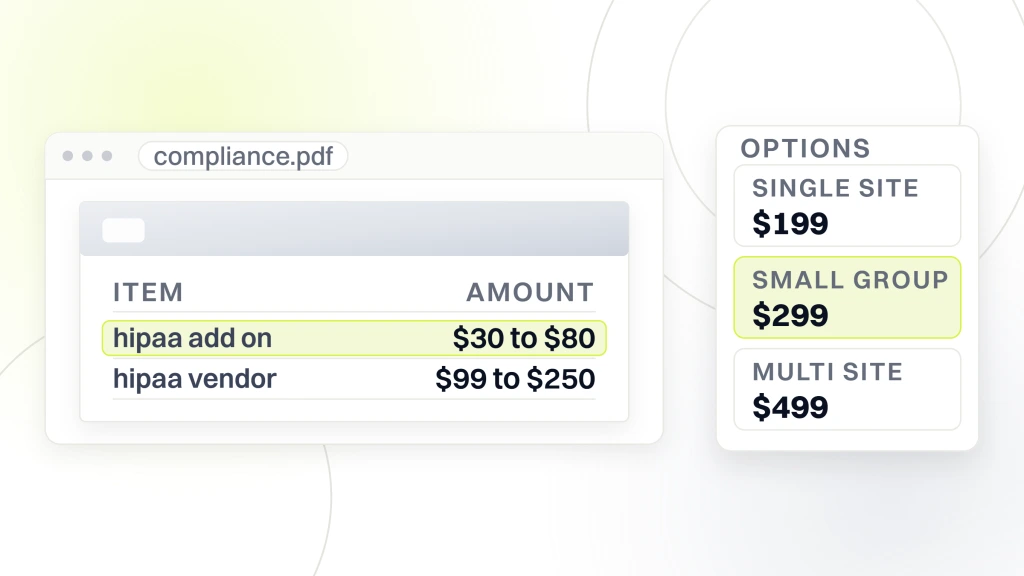
That said, treating the site like it is under HIPAA is the right posture. Med spas that submit any insurance claim, for example Botox for chronic migraine or hyperhidrosis workflows, are covered entities and need a signed Business Associate Agreement with the hosting vendor, encrypted backups, audit logging, and access controls on the admin. Every med spa should assume the definition tightens over time and buy hosting that can pass a HIPAA audit if the practice grows into insurance-adjacent work. The incremental monthly cost is $30 to $80 a month on top of a standard managed plan. The cost of a breach on a med spa site is $50,000 to $500,000 in legal, notification, and reputation cost.
HIPAA-grade hosting vendors like Liquid Web, Atlantic.net, and specialist providers like MedStack offer plans starting at $99 to $250 a month with a signed Business Associate Agreement included. For a med spa that is confident it will stay cash-pay, standard managed WordPress hosting with a hardened configuration is enough. For a med spa that is thinking about insurance-adjacent workflows in the next 2 years, buy the HIPAA-grade plan today and avoid the migration later.
Speed and Core Web Vitals for booking pages
Speed on booking and treatment pages is where hosting shows up in the numbers that actually matter. Every 1 second of extra load time on a treatment page cuts booking form completion by roughly 7% based on benchmark data across service-industry sites. On a med spa doing 45 monthly consults, that is 3 lost consults a month per second of extra load time, or $1,800 to $10,800 a month in lost first-treatment revenue depending on the average ticket. The math is unforgiving, and the fix is a combination of good hosting, image compression, and disciplined plugin selection.
- Largest Contentful Paint under 2.5 seconds on 4G real user data
- First Input Delay or Interaction to Next Paint under 200 milliseconds
- Cumulative Layout Shift under 0.1 on treatment and booking pages
- Time to First Byte under 800 milliseconds on cached pages
- Total page weight under 1.5 megabytes on treatment pages
- Fewer than 25 total HTTP requests per treatment page
The lightweight cloud or managed WordPress choice matters less than plugin discipline and image handling. A med spa site with 40 active plugins and uncompressed hero images will fail Core Web Vitals on any hosting stack. Redefine Web audits every med spa site’s plugin list during onboarding and removes anything redundant or dormant. Image compression runs at build time and again on every content update. The result is a site that holds under 2.5 second LCP on 4G through peak booking traffic, which is the real-world speed threshold that decides whether the booking form gets completed or abandoned.
Multi-location med spa hosting architecture
Multi-location med spa groups face a different hosting problem. Traffic aggregates. A 6-location group might see 300 monthly booking submissions across the network, with location pages that need per-location booking widgets, per-location review counts, and per-location Google Business Profile ties. The hosting layer has to hold up under aggregate traffic and provide clean per-location URL structure for local SEO. Running each location on a separate WordPress install is a mistake. Running the whole network on a single-location managed plan is also a mistake.
| Group size | Hosting tier | Monthly cost frame | Included maintenance |
|---|---|---|---|
| 1 location | Managed WordPress, single site | $199 with hosting bundled | Weekly updates, monthly security scan, daily backups |
| 2 to 5 locations | Managed WordPress with location subpages | $299 with hosting bundled | Priority response, Core Web Vitals reporting, quarterly booking flow test |
| 6 or more locations | Cloud stack or premium managed with content delivery network | $499 with hosting bundled | Everything above plus same-day emergency response and staging environment |
The right architecture for a 2 to 8 location med spa group is a single WordPress install with per-location pages, each with its own booking widget, review pull, and location schema. That gives you one codebase to maintain and one hosting bill to pay, while still giving each location the local SEO signals it needs. Groups above 8 locations often need a multisite setup or a headless architecture, at which point hosting cost moves into the $500 to $1,500 a month range and the maintenance retainer scales accordingly.
Med spa hosting cost frame at single-location scale
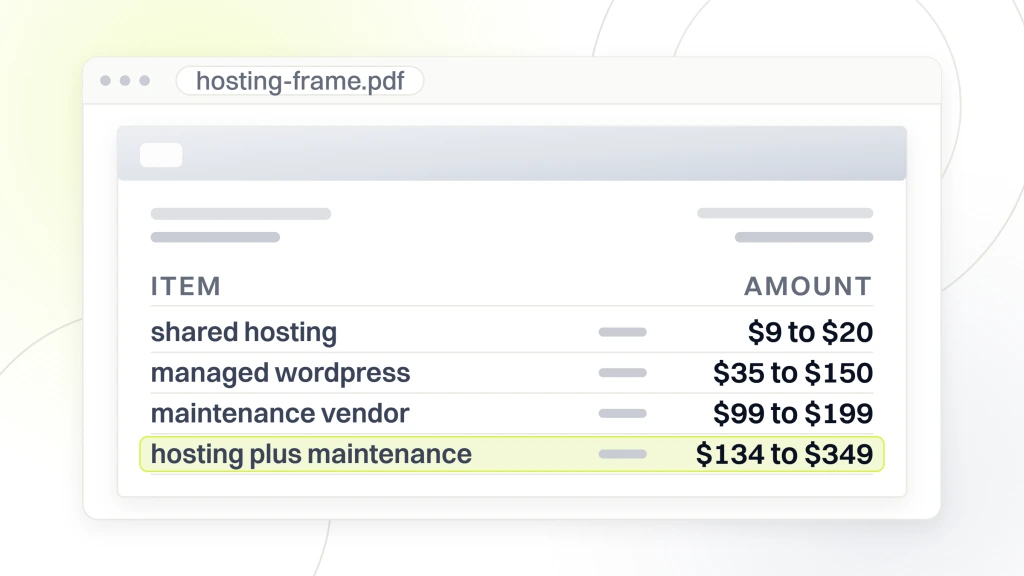
Single-location med spa hosting cost breaks into 3 real tiers. The bottom tier is bad shared hosting at $9 to $20 a month, which no serious med spa should use. The middle tier is managed WordPress at $35 to $150 a month for hosting alone, plus $99 to $199 a month for a bare-bones maintenance vendor. Total monthly cost lands between $134 and $349 for a hosting-plus-maintenance combination that mostly works but burns time and money on plugin conflicts and slow response to booking form emergencies.
The top tier is a bundled hosting and maintenance retainer with a real service level, real monitoring, and a real human on call. Redefine Web bundles this at $199, $299, or $499 a month depending on the size and complexity of the site. For a solo-provider med spa, $199 covers the full stack. For a growing single-location practice with a booking widget, membership sign-ups, and light ecommerce, $299 fits. For a multi-location group or a med spa with heavier booking and payment flows, $499 covers the full scope including same-day emergency response.
The math on the top tier is straightforward. If the site does 45 monthly consults at $600 average first-treatment value and 3x lifetime value, that is $27,000 in first-treatment revenue and $81,000 in lifetime value from the site each month. Spending $199 to $499 a month on hosting and maintenance is 0.7% to 1.8% of monthly first-treatment revenue, and it protects the whole revenue line by keeping the booking form live and fast. Under-investing here is one of the most expensive small savings a med spa owner can make.
Real med spa builds and hosting outcomes
Redefine Web has built and hosts sites for med spa clients across single-location and multi-location profiles. The pattern that repeats is that hosting decisions made during the build hold up, and hosting decisions bolted on after cost more and deliver less. Beauté Aesthetics New York, a Medical Aesthetics client in the premium NY tier we partnered with in 2020 through 2021, saw leads grow 166% and conversion rate move 27% on a luxury-aligned redesign with hosting and ongoing optimization baked in from the start. The site ran on managed WordPress with a content delivery network and a full maintenance retainer, and the uptime through the launch period held at 99.98%.
Med Spa Calabasas, an upscale California med spa we launched in 2024 through 2025, went from concept to booked out from week one on a brand and site matching the room, with hosting and maintenance included in the launch partnership. Accessibility hit AA, the calendar filled the day the site went live, and the site has stayed at day-one launch readiness through the first year. Med Spa Pacific Northwest, a Seattle med spa aesthetics client we partnered with in 2023 through 2024, saw consult requests grow 241%, organic traffic grow 178%, and cost per lead drop 38% on a web, SEO, and PPC package with hosting and lead capture wired in. Uptime through the year held at 99.96%.
Med Spa South Shore MA, an established Massachusetts practice we rebranded and rebuilt in 2023 through 2024, moved to a hosting stack that reduced booking friction and gave the shop clean category navigation. Accessibility hit AA and the hosting stack included WooCommerce support for the retail piece. Med Spa Boutique Injectables, a solo-provider injector-led med spa we launched in 2024, went from concept to distributor-ready in 6 weeks with online bookings live from launch on the same hosting and maintenance frame. The through-line across every one of these builds is that hosting is treated as a first-class part of the build, not a $99 line item added after the fact.
Med spa website hosting is the layer that decides whether the site quietly holds up through evening booking peaks or quietly costs you consults. Get the uptime numbers in the contract, get the security posture right for the treatment-adjacent data you handle, and get a maintenance retainer that covers the 7 items real maintenance includes. Redefine Web bundles hosting into the med spa marketing services retainer at $199, $299, or $499 a month, so your hosting bill is one predictable line item that scales with the practice. Groups looking for the full agency partnership can start with the med spa marketing agency overview or the standalone med spa marketing agency service page for the retainer scope and pricing.