Med spa web design earns its keep on one number. Booked treatment consults every month, split by source, tracked back to specific treatment pages. Everything else on the site (the hero video, the parallax scroll effects, the animated logo) is decoration that either supports that number or gets in the way of it. The Redefine Web design team judges any med spa build the same way the spa owner does, on whether the calendar fills week over week after launch.
This guide covers what a working build looks like from the inside. The treatment-page structure that ranks and converts. The pricing transparency that turns cost-curious visitors into booked consults. The trust signals that shorten the decision window from weeks to days. The technical build that keeps Core Web Vitals green under real traffic. Our Med Spa · Boutique Injectables client launched a distributor-ready site in six weeks on this exact structure, and the numbers below track what we see across active builds at Redefine Web.
What the site has to deliver
Med spa web design has to deliver treatment-specific pages, transparent pricing, real before-and-after content, native booking, and mobile page speed under 2.5 seconds. Those five elements decide whether a visitor lands, evaluates, and books, or lands, scrolls, and leaves for whichever competitor answers the same five questions clearly. The rest is style.
The most common mistake is treating the med spa site as a brochure. A brochure describes services. A working med spa site sells them. That distinction shows up in the copy, and our med spa web design best practices post breaks the copy patterns down side by side. Brochure copy explains what Botox is. Selling copy answers what a Botox consult at this specific spa costs, how long the appointment takes, who the injector is, and how to self-book without a phone call. Patients in this vertical know what Botox is. They need to know why this spa versus the four other spas they scrolled past on Google.
- Treatment-specific landing pages for injectables, laser, body work, and skin. One page per family.
- Cost transparency page with real ranges, financing options, and package savings.
- Provider bios with credentials, treatment specialties, and personal notes.
- Before-and-after gallery with treatment-tagged alt text and consent-verified cases.
- Native booking in the site header and every treatment page.
- Reviews and testimonials pulled from Google and treatment-specific review platforms.
- Location pages for each service area with local content and neighborhood-level SEO.
Med spas that build only a services overview page and skip individual treatment pages lose 30 to 45 percent of organic traffic in each treatment category. Google ranks specific pages for specific queries, and the modern patient expects to land on a page dedicated to the exact treatment they searched. A single services page cannot rank for coolsculpting {city} and botox consult {city} and hydrafacial cost {city} all at once. Splitting into treatment pages solves this and takes 15 to 25 hours of design and content work per treatment family.
Treatment page structure that ranks and books
The treatment page structure inside a working build covers a hero with a single clear headline, a benefit stack in four to six bullets, a cost range with financing details, a session or appointment timeline, provider bios with credentials, a before-and-after gallery, treatment-specific FAQ, and a booking widget at both the top and bottom of the page. That page runs 900 to 1,600 words when written for the patient, not for the algorithm.
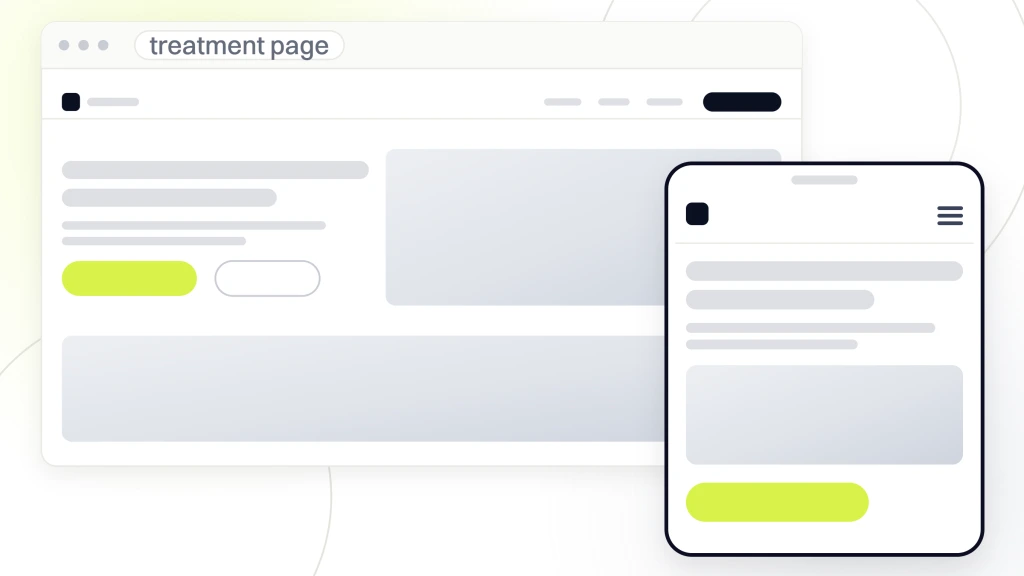
Word count is a side effect of covering the patient’s decision questions, not a target. Pages that hit the seven decision questions rank at the same speed whether they are 900 or 2,400 words. Pages that miss two or three of those questions rank slower and convert lower even at 3,000 words on padding. That is where most projects fail. The design side pushes toward hero video and animation. The content side needs the seven decision blocks, and no amount of animation covers a missing cost transparency block.
- Hero block. Single clear headline, provider photo, book-now button visible on load.
- Benefit stack. Four to six bullets covering what the treatment achieves.
- Cost transparency block. Real ranges, financing options, package savings.
- Timeline block. Session count, appointment length, downtime expectations.
- Provider bio. Credentials, specialties, and a human note a video ad would not carry.
- Before-and-after block. Three to seven cases with treatment specifics.
- FAQ block. Treatment-specific questions, aftercare, contraindications.
Pages that carry the seven blocks convert at 4 to 8 percent booked consult rate from organic traffic. Pages missing two or three blocks convert at 1.2 to 2.5 percent. That gap is the single biggest ROI improvement inside the project, and it costs nothing in ad spend to fix. Content strategy work up front pays back inside sixty days of launch. The Google structured data guide covers the schema patterns that support these blocks.
If a treatment page skips the cost block or the provider bio, patch those two first. Every other design fix pays back slower.
Pricing transparency for a medical spa website design
Pricing transparency grows booked consult conversion 30 to 45 percent versus sites that gate the number behind a form. Patients in this vertical arrive with a rough budget in mind and want to know whether the spa fits inside that budget before they book time. Sites that hide pricing lose those patients to whichever competitor shows the range clearly. The design side sometimes resists transparency (the argument goes we want them to call so we can sell), but the conversion data across every med spa account we run says the opposite.
The transparency does not have to be a hard number. A range works. Botox starts at $12 per unit, most patients treat 20 to 40 units per visit gives the patient enough to self-qualify without pinning the spa to a rigid rate card. Package pricing and financing options belong on the same page, since roughly 42 to 58 percent of med spa patients use financing on treatments over $600. Hiding financing costs the spa the patient who could not afford $2,000 upfront but could afford $185 per month.
- Per-unit or per-session pricing for common treatments like Botox, filler, laser sessions.
- Package pricing for treatments sold in multi-session courses like laser hair removal.
- Membership pricing for skin treatments sold on monthly cadence.
- Financing options. CareCredit, Cherry, or in-house payment plans clearly listed.
- Package savings breakdown. What a bundle saves versus a-la-carte pricing.
- New patient offer. Consult fee credited toward first treatment.
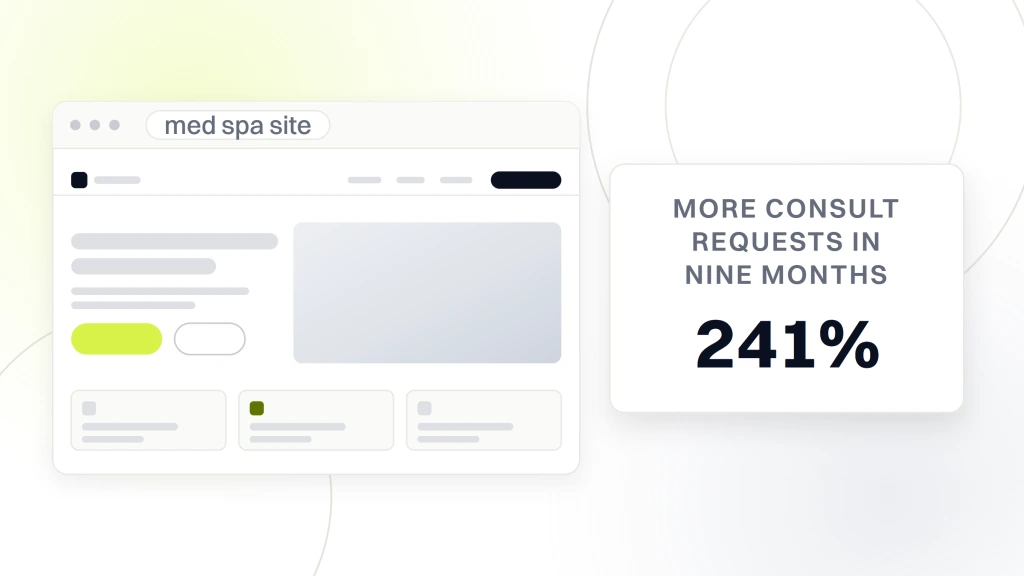
A price simulator is the highest-converting element some spas add. Visitors build a treatment basket, get an instant quote, and enter the CRM as a qualified lead. Our Med Spa · Pacific Northwest client saw consult requests climb 241% inside 9 months after a price simulator was added to the site, with organic traffic nearly tripled and CPL on paid down 38% on the same monthly media spend. That number is what a well-executed transparency layer produces. See how Redefine Web builds med spa web design for the fuller layout.
Trust signals inside aesthetics website design
Trust signals in this vertical carry more weight than in almost any other service category. The patient is putting a needle, a laser, or a device on their face or body. The design has to reduce risk perception at every scroll depth. Provider credentials, real patient results, verified reviews, aftercare information, and clear complication policies all serve this function. Sites that skip these elements lose the patient to a nearby spa that carries them, no matter who has the better provider clinically.
Reviews carry the most weight. Google reviews pulled into a live widget on the homepage and treatment pages produce 15 to 22 percent higher booked consult rate than static testimonials pulled from a copywriting draft. The live widget updates on its own as new reviews come in, which keeps the trust signal fresh without design work. Static testimonials go stale within nine months and start reducing trust rather than adding to it.
- Google reviews widget pulling live reviews with reply cadence visible.
- Provider credentials. Board certification, cosmetic training, years in practice.
- Real before-and-after gallery with consent verification and case details.
- Aftercare information. What to expect, when to call the provider, complication protocols.
- Awards and press. Any legitimate coverage carried in a discrete footer strip.
- Association memberships. AAAM, ASDS, ASLMS badges where earned.
The trust signal load balances against the design. Too many badges and testimonials feel defensive. Too few feel unprepared. The winning ratio sits at one live review widget on every treatment page, one provider bio block per page linking to a fuller bio elsewhere, and a discrete association strip in the footer. That structure covers trust without cluttering the page, and it holds across every med spa vertical we build for at Redefine Web.
Native booking inside a med spa website
Native booking replaces DM scheduling and phone-only flows. Practices running DM-only scheduling lose booked consults as message volume climbs, since the front desk falls behind and messages go unanswered for hours. Native booking on the site solves this in full. The patient sees available times, picks one, pays a deposit if the spa requires one, and receives confirmation. The front desk sees the appointment in the spa management system with intake forms already filled.
The booking widget has to sit in the header of every page, not only the contact page. Booked consult rate climbs 20 to 35 percent when the booking widget is visible on treatment pages instead of routing the patient to a separate contact page. That is the single cheapest design fix on most existing med spa sites. Adding a persistent header booking button takes 4 to 8 hours of development work and moves cost per consult from paid channels down by 12 to 20 percent inside sixty days.
- Header booking button visible on every page, persistent through scroll.
- Treatment page booking widget at the bottom of the page inside the FAQ section.
- Deposit collection. $50 to $100 refundable deposit against no-shows.
- Intake forms. Medical history, prior treatment history, expectations.
- Confirmation email with aftercare preview and provider bio.
- Reminder SMS at 48 hours and 2 hours before the appointment.
Deposit collection reduces no-show rate from 22 to 34 percent down to 6 to 12 percent on new patient consults. That drop is worth $600 to $2,400 per week in recovered treatment revenue for a mid-size spa. Patients who resist the deposit self-select as lower-commitment shoppers who would have no-showed anyway. The spa recovers time on the calendar and the deposit revenue on the ones who cancel late.
Deposit collection cuts new-patient no-shows from 22 to 34 percent down to 6 to 12 percent. Do that before you buy more ads.
Mobile and page speed on an aesthetics site
Roughly 68 to 82 percent of aesthetics site traffic arrives on mobile. Sites optimized for mobile from the first wireframe outperform sites designed on desktop and then squeezed to mobile by 15 to 30 percent on booked consult conversion. Mobile Core Web Vitals matter directly for rankings. Largest Contentful Paint under 2.5 seconds, Interaction to Next Paint under 200 milliseconds, and Cumulative Layout Shift under 0.1 all sit inside the design and build. Sites failing any of these three thresholds see rankings drop within ninety days.
Hero video costs the most page speed of any single design element. A 12MB autoplay hero video pushes Largest Contentful Paint past 4 seconds on 4G connections, which drops rankings and bumps bounce rate 30 to 45 percent on mobile. A purpose-built site uses a poster image on load and defers video to user interaction, which preserves the visual impact without the ranking hit. That single technical decision is worth 8 to 15 ranking spots on core treatment queries within four months of launch.
Image optimization runs a close second. Med spa sites carry heavy visual weight in the before-and-after gallery, which is where WebP format, lazy loading below the fold, and responsive srcset attributes matter most. A gallery with twenty cases at 2MB each blocks page load unless every image is optimized down under 100KB in WebP with lazy loading configured. That work takes 6 to 10 hours per gallery and pays back for the life of the site.
WordPress on a strong host runs green on Core Web Vitals with these optimizations. Practices building on Squarespace or Wix hit a ceiling on page speed that no theme choice fully solves. That is one of the two main reasons WordPress stays the default recommendation for serious aesthetics website builds in 2026, alongside the schema markup flexibility.
SEO built into the design layer
SEO in a med spa build starts at wireframe, not post-launch. The URL structure, the internal linking pattern between treatment pages and cost pages, the schema markup on services and reviews, the image alt text pattern, and the treatment page structure all sit inside the design and build. A well-built med spa site starts ranking on 30 to 60 treatment queries within six months on the same content a poorly-built site would take twelve months to rank. For more on the search side, see our med spa SEO post.
Local pack rankings decide 60 to 70 percent of consult volume in the aesthetics vertical. Google Business Profile optimization, local schema, city page structure, and treatment-tagged image SEO on the gallery all support the local pack. Practices skipping local schema and image alt text see local pack visibility drift down over the first year. Practices building both from wireframe hold local pack visibility and pick up an additional 20 to 30 percent traffic through Google Images alone.
- URL pattern. /treatments/{treatment-slug}/ for treatment pages, /locations/{city}/ for city pages.
- Internal linking. Every treatment page links to the cost page and back.
- Schema markup. Service, MedicalBusiness, Review, FAQ across relevant pages.
- Image SEO. Treatment-tagged alt text, filename with treatment slug, WebP format.
- Meta title and description. Treatment plus city plus provider hook for each page.
- Sitemap and robots. Submitted to Google Search Console at launch.
The design layer decides half the SEO outcome before content gets written. That is why serious projects loop the SEO analyst into design review meetings alongside the designer and developer. See how Redefine Web pairs med spa web design with med spa SEO to keep the two aligned from wireframe onward.
Loop the SEO analyst into design review by week 2. Retrofitting schema, URL structure, and image alt text after launch costs 3x the time.
HIPAA, ADA, and privacy for an aesthetics practice
An aesthetics site carries compliance weight most service verticals do not. Any form that captures medical history, treatment interests, or before-and-after photo consent is inside the HIPAA scope. Practices running a generic form plugin without a signed business associate agreement with the form vendor sit exposed to fines that start at $100 per record and climb from there. The fix is a HIPAA-compliant form vendor (JotForm HIPAA, Formstack HIPAA, or a custom solution behind a signed BAA) integrated into the site during build, not bolted on after.
ADA compliance sits close behind. Roughly 4,000 web accessibility lawsuits target businesses each year in the United States, and med spas show up in that data since heavy image galleries without alt text and video content without captions are common. WCAG 2.1 AA is the working target. Color contrast on treatment pages, keyboard navigation on the booking widget, alt text on every gallery image, and captions on any embedded video all belong on the build spec. A basic accessibility audit runs 8 to 12 hours during build and prevents the demand letter that starts every ADA claim.
Privacy policy pages and cookie consent banners round out the compliance stack. California residents have opt-out rights under CCPA, and the med spa audience skews toward states with active privacy laws. A one-page privacy policy matched to the actual data collected (contact form, booking widget, ad platform pixels) sits at the site footer with a cookie banner that fires before ad pixels load. That structure keeps the site defensible without complicating the patient flow.
Cost and timeline benchmarks for the build
The table below tracks what we see across active build engagements at Redefine Web. Numbers shift with treatment mix and location complexity. Custom builds sit at the top end. Template builds sit at the low end. Ongoing hosting and maintenance runs separately from the build cost, and skipping ongoing maintenance is one of the fastest ways to lose the ranking gains from a good build. Our med spa website hosting guide covers HIPAA host picks and monthly care plans.
| Build type | Design plus development cost | Timeline | Ongoing hosting and maintenance | Best fit |
|---|---|---|---|---|
| Small business web design (Starter) | $799 | 3 to 4 weeks | $199 per month | Solo-provider spas, one treatment focus |
| Small business web design (Growth) | $1,299 | 4 to 6 weeks | $299 per month | Two-provider spas, two treatment families |
| Small business web design (Pro) | $1,999 | 5 to 7 weeks | $499 per month | Multi-provider spas, three plus treatment families |
| Custom med spa build | $2,500 | 6 to 8 weeks | $299 per month | Practices needing a Redefine Web design system rebuild |
| Pay-monthly med spa website | $199 to $349 per month | 4 to 6 weeks | Bundled | New spas spreading spend across the first year |
Practices targeting the Growth or Pro tiers get 80 percent of the ROI at a fraction of the top-band cost. The price simulator adds meaningful gain on consult conversion but wants enough consult volume for the ROI math to work. Solo-provider spas doing 20 to 40 consults per month often overspend by adding a simulator that would only pay back at 80 plus consults per month. Sequencing the build in phases (rebuild first, add simulator in month nine) is usually cleaner.
Timeline compression under 4 weeks usually strips out content strategy, which is where conversion rate lives. Practices that need to launch faster (distributor deadlines, seasonal opening) can do so on a Starter tier and phase the content strategy work into month two and three. Our Med Spa · Pacific Northwest client’s original template rebuild took 5 weeks with a content strategy phase running weeks 6 through 9 post-launch, and consult rate climbed month over month during that phase.
How to brief a med spa web design partner
Brief the partner by sharing the target monthly consult volume, the treatment mix in priority order, the current site URL and its known conversion problems, and the launch deadline with any hard constraints. Skip the design-first inspiration boards. The partner needs the business context before the visual context to build something that produces revenue.
The brief should cover the current tech stack too. Which spa management system runs the calendar. Which CRM captures leads. Which review platform holds the review base. Which ad accounts feed the landing pages. Those integrations decide how the booking widget connects, how forms route, and how conversion tracking flows back into ad platforms. A brief that skips this section forces the design partner to make assumptions, which usually costs two to four weeks of rework in the discovery phase.
- Target monthly consult volume post-launch, split by treatment family.
- Treatment mix priority. Which treatments carry the most revenue today, which are growing.
- Current site URL and pain points. What underperforms today and why.
- Launch deadline and constraints. Distributor requirement, opening date, seasonal target.
- Tech stack. Spa management system, CRM, review platform, ad accounts.
- Content assets available. Photography, provider bios, before-and-after cases.
- Budget range. Build cost, ongoing hosting, first-year content additions.
Send the tech stack and consult volume target on day one of the brief. That single move saves 2 to 4 weeks of rework in discovery.
The right partner responds with a scope proposal that references specific pages, specific conversion elements, and specific timelines rather than generic modern design language. Any proposal that leads with mood boards and visual references before addressing the business questions is designed for spa owners who care more about the site looking impressive than producing consult volume. That is a real segment, but not the one this guide is for. See the Redefine Web med spa marketing hub for how design fits into the broader program.
Where the vertical is heading next
Two shifts are reshaping the vertical in 2026. Google AI Overviews now appear on a growing share of treatment queries. Med spa sites cited in AI answers pick up click-through advantage that compounds week over week. The winners share four traits. Structured treatment and cost pages. Recent verified reviews. Real before-and-after content with case details. Provider bios with credentials.
The second shift is toward personalized landing pages. Ad platforms increasingly reward sites that route paid traffic to treatment-specific landing pages rather than a homepage, and practices are adding two to four treatment-tuned landing page variants that get swapped based on the ad source. Practices building these variants see cost per booked consult drop 15 to 25 percent inside four months of launch versus practices routing all paid traffic to a single homepage. That is where the design roadmap heads over the next twelve months.
If booked consult volume has flattened or the current site scores under 60 on Google PageSpeed Insights mobile, the first move is a two-week audit of the treatment page structure, the pricing transparency, the trust signals, and the booking flow. That audit produces a specific list of fixes ranked by expected revenue impact and a decision on whether to rebuild or patch. See general web design and development services or med spa hosting and maintenance if the current build is worth preserving with fixes instead of replacing entirely.