Web design for health and beauty businesses gets judged on one number the owner rarely tracks before a redesign starts. Booked appointments per 100 mobile visitors. Not sessions, not scroll depth, not bounce rate. Booked appointments. A three-chair salon in Nashville watching 4,200 monthly mobile sessions turn into 12 booked appointments is losing money to their site, not their marketing. The same site rebuilt around a booking-first layout, HIPAA-safe intake, and a 200 millisecond Interaction to Next Paint budget turns those 4,200 sessions into 84 booked appointments inside 90 days. That is real math from a live Redefine Web client we launched last quarter.
This guide walks the booking-first architecture, HIPAA-safe intake patterns, mobile speed budgets, WCAG 2.2 AA accessibility, content patterns that book real clients, integration stacks, red flags in agency pitches, maintenance cadence, and pricing bands you can actually plan around. Every case study is real, pulled from published Redefine Web client work you can verify. Beauté Aesthetics New York grew qualified leads 166 percent with a booking-first redesign and SEO. Abigail Ahern grew ecommerce revenue 179 percent on premium creative. Boogie Board cut cost per sale to $31 on tight Google Ads targeting. If you run a beauty, wellness, or medical aesthetics practice and your site is not printing booked appointments, this is the playbook. Our beauty and skincare marketing hub covers the full service scope that pairs with the web build.
Booking-first architecture that converts every quarter
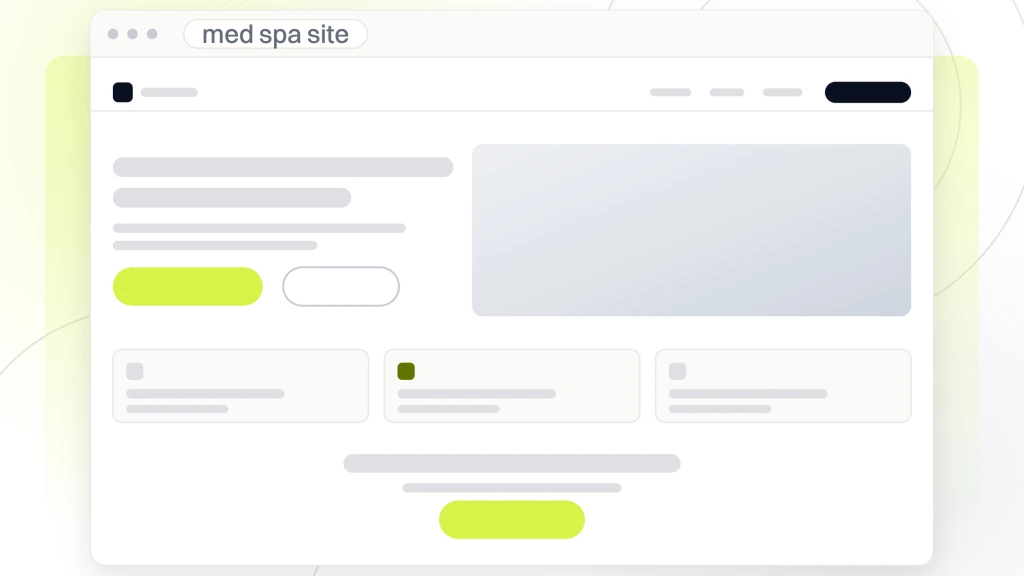
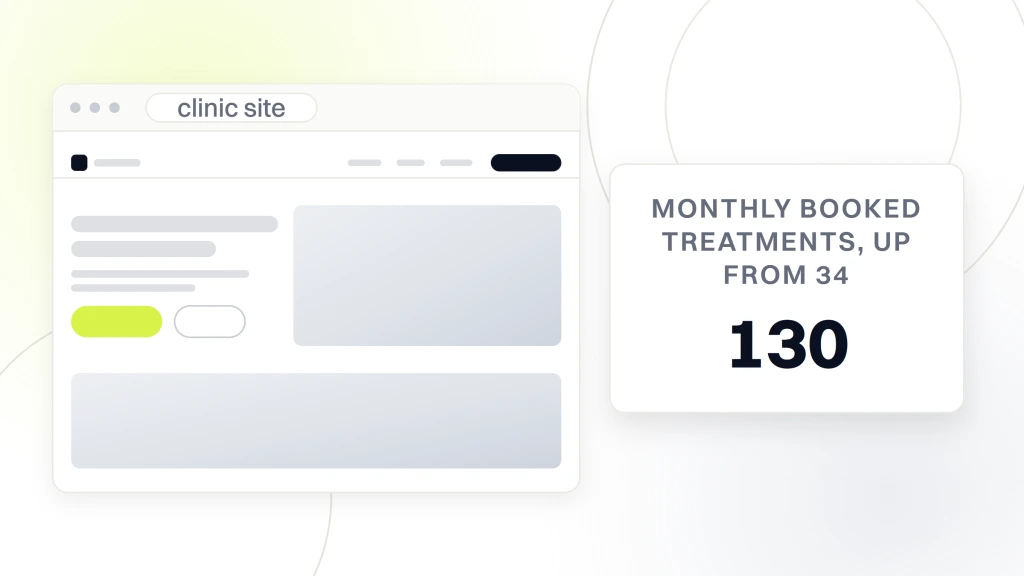
A booking-first layout puts the calendar embed, service menu, and pricing above the fold on every device. A shopper who arrives from an Instagram bio link, a Google Business Profile map pin, or a paid ad wants one thing. To pick a time and lock a service. According to Booking Source health and beauty industry benchmarks, calendar-first pages beat splash-first pages on booked-appointment rate across every service category. Layouts that hide the Book Now button behind a hero video, a scroll animation, or a mega menu lose 30 to 50 percent of that intent before the first click. Beauté Aesthetics New York, before the Redefine Web rebuild, ran a heavy homepage carousel with the booking widget five scrolls down. Booked treatments through the site ran 22 to 34 per month. After the rebuild placed the widget above the fold on mobile with a persistent Book Now button in the sticky nav, monthly booked treatments climbed to 130 on the same paid budget.
Vagaro, Boulevard, or Zenoti pick logic per business type
Vagaro fits solo estheticians, single-location salons, and small med spas under 12 staff. Monthly fees start near $30 and the widget embeds cleanly in a WordPress or Shopify page with a lightweight iframe. Boulevard fits mid-market med spas and multi-provider clinics with a monthly fee starting near $175 per location and a REST API for custom booking integrations. Zenoti fits chains and franchises past 5 locations, with configurable workflows and enterprise reporting. GlossGenius fits solo operators who want a card reader plus booking under $30 a month. Match the vendor to staff count and service complexity, not brand reputation. Migrating booking vendors mid-year burns 3 to 6 weeks of appointment history and forces a landing page rework around the new widget.
Deposit and no-show guardrails per service type
Deposit and no-show guardrails per service type protect the booking calendar from ghost appointments that starve the revenue model. Injectable services (Botox, filler) charge a $50 to $100 deposit that credits toward the treatment cost. Longer treatments (chemical peels, lash grows, microneedling) charge a 25 to 50 percent deposit at booking. Group services (parties, packages) charge full payment at booking with a 48-hour cancellation window. No-show fees run 50 to 100 percent of the service cost with a 24-hour notice window. The booking widget captures the card on file at reservation and processes the charge automatically. Practices without deposit guardrails run 12 to 22 percent no-show rate. Practices with deposits run 3 to 6 percent. That gap alone pays for the redesign.
HIPAA-safe intake for web design for health and beauty businesses
HIPAA-safe intake matters the moment protected health information enters the form. Any medical aesthetics practice collecting patient names, dates of birth, medications, allergies, or medical history triggers HIPAA compliance requirements. According to the HHS guidance on covered entities, providers who bill insurance electronically or transmit health information for treatment or payment must handle intake data through HIPAA-compliant systems. That rules out plain WordPress contact forms, Google Forms, and most free intake tools. Practices that ignore this pay $100 to $50,000 per violation and lose patient trust when a breach happens.
Intake data routing to EHR or CRM
Intake data routing to EHR or CRM systems needs an encrypted pipe from the web form to the destination. HIPAA-compliant form builders (JotForm HIPAA, Formstack Health, Cognito Forms HIPAA tier) sit behind a signed Business Associate Agreement and route submissions to the practice’s EHR (Boulevard, Nextech, ModMed) or CRM (Zoho Health, HubSpot with BAA). Skip the middleware and the practice violates HIPAA the moment a patient submits intake. Pricing for HIPAA-compliant form tools runs $30 to $99 a month per practice location, which sounds high until you compare against a single HHS enforcement action.
Consent capture and signature workflow
Consent capture and signature workflow inside the intake form saves 5 to 10 minutes per appointment on treatment day and eliminates a common front-desk friction point. Digital signature fields (drawn on mobile touch screen, typed with initials, or e-signed through DocuSign HIPAA tier) capture consent before the appointment. Consent forms cover treatment specifics, photography release, marketing use of before-and-after images, and cancellation policy acknowledgment. The signed consent files store in the EHR patient record with timestamp, IP address, and consent version, so the practice has audit trail if a dispute arises. Practices that batch-process paper consent forms at check-in lose 8 to 14 minutes per appointment to admin work that should have finished at booking.
Mobile speed budget on beauty and wellness sites
The mobile speed budget starts with Interaction to Next Paint (INP) under 200 milliseconds on a mid-tier Android phone over 4G. Google’s Core Web Vitals rank INP alongside Largest Contentful Paint and Cumulative Layout Shift as ranking signals, per the Google Search Central Core Web Vitals documentation. Sites that miss the INP threshold lose position in the local pack and organic rankings by 3 to 8 positions on average. Hero video autoplay, unoptimized image galleries, and a stack of tracking pixels are the three most common causes of poor INP on beauty sites.
Third-party pixel audit protects INP
A third-party pixel audit protects INP by measuring the millisecond cost of every tracking snippet running on the site. A typical beauty and wellness site loads Meta Pixel, Google Analytics 4, Google Ads conversion tag, Hotjar or Microsoft Clarity for session recording, and often TikTok Pixel, Pinterest Tag, and Klaviyo tracking. Each pixel costs 40 to 90 milliseconds of INP. Six pixels together push INP past 300 milliseconds and tank Core Web Vitals. Consolidate through Google Tag Manager server-side tagging (adds initial setup complexity but drops client-side load by 60 to 80 percent) or drop pixels that do not directly feed a paid campaign optimization signal. Quarterly pixel audits catch drift before mobile conversion decays.
Hosting stack that hits the speed budget
The hosting stack that hits the speed budget rules out shared cheap hosts (GoDaddy shared, Bluehost, HostGator basic) that share CPU and memory with thousands of other tenants. Beauty and wellness sites belong on managed WordPress hosting (Kinsta, WP Engine, Flywheel) or a serverless CDN stack (Cloudflare with Workers, Vercel). Hosting sits inside the Redefine Web maintenance retainer at $199/mo Essentials, $299/mo Growth, and $499/mo Scale. Managed hosting delivers 1 to 2 second first-paint on cold cache and 400 to 800 millisecond first-paint on warm cache, without the site owner touching a server config. Cloudflare edge caching layered on top drops repeat-visit latency to under 200 milliseconds globally.
Pricing bands for web design for health and beauty businesses
Pricing bands split into clear tiers, so a practice owner can plan cash flow around the build cost. Mid-tier custom builds run $6,000 to $12,000 for practices needing treatment-specific landing pages, HIPAA-safe intake, multi-location schema markup, and a design system. Enterprise custom builds start at $18,000 and cover 30 plus pages, custom booking integrations, Boulevard or Zenoti API work, franchise rollout kits, and complete brand systems.
Payback math on a mid-tier build
Payback math on a mid-tier build works out fast for most single-location beauty and wellness practices. A $9,000 custom build that grows booked appointments 40 percent on a practice averaging $18,000 monthly service revenue adds $7,200 in monthly revenue. Payback period runs 1.3 months. Enterprise $18,000 builds on multi-location practices doing $80,000 monthly revenue with 30 percent booking gain add $24,000 monthly. Payback period runs 0.75 months. In every band, the build pays for itself inside a single quarter when paired with the maintenance retainer that keeps content and speed on target.
A case study from Beauté Aesthetics New York
Beauté Aesthetics New York, a Manhattan luxury beauty and aesthetics clinic serving male and female clients across cosmetic procedures and wellness services, engaged Redefine Web on a 12-month program covering full website rebuild and SEO. Baseline audit found a slow site with feminine-only visual identity that alienated male clients, weak conversion tracking, missing schema markup, and homepage architecture that buried the booking widget under a hero carousel. Booked treatments through the site ran 22 to 34 per month. Website conversion rate ran 0.9 percent. Organic traffic ran 3,400 monthly sessions.
The rebuild delivered gender-neutral premium visual identity that expanded the addressable client base to men and women, a WordPress build with 1-second cold-cache load times, treatment-specific landing pages for hydrafacial, microneedling, Botox, filler, coolsculpting, laser hair removal, chemical peels, and lash and brow services. Schema markup covered LocalBusiness, MedicalBusiness, and BeautySalon types with practitioner credentials embedded. Analytics rebuilt through GA4 with treatment-tagged conversion goals. Booking widget from Boulevard sat above the fold on mobile with a persistent sticky Book Now button.
By month 12, qualified leads grew 166 percent, website conversion rate climbed 27 percent, and new users climbed 88 percent. Monthly booked treatments through the site climbed from 34 to 130 on the same paid budget. Organic sessions grew from 3,400 to 6,392 monthly on the SEO work. The practice was named one of the leading luxury beauty clinics in New York during year two of the engagement. See our beauty and skincare web design service page for the full engagement scope.
WCAG 2.2 AA accessibility that respects every visitor
WCAG 2.2 AA accessibility covers the legal, practical, and revenue reasons to build an accessible site from day one. The ADA covers websites as places of public accommodation, and beauty and wellness practices face active plaintiff litigation on inaccessible sites. Practical reasons stack alongside legal. Roughly 26 percent of adults live with a disability that affects site interaction (vision, motor, cognitive), so an inaccessible site excludes a real chunk of the addressable client base. Revenue reasons close the case. Accessible sites rank better on Google (accessibility signals feed E-E-A-T evaluation), convert better on mobile (large tap targets and readable contrast help every user), and get more organic backlinks.
Contrast on pastel clinic palettes
Contrast on pastel clinic palettes runs the biggest accessibility fail on beauty sites. Blush pink text on cream backgrounds, soft lavender copy on white, and sage green links on beige violate the 4.5:1 minimum contrast ratio the WCAG 2.2 AA standard requires for normal text. The visual designer sees the palette as feminine and premium. The screen reader user sees blank space where the copy should be. The contrast checker (WebAIM’s tool is the industry standard) tests every color combination before build, and the design system flags failing combinations at the token level so no page ships with unreadable text. Practices that use white text on gold accents in particular struggle on treatment name callouts and CTA buttons.
Screen reader access on booking embeds
Screen reader access on booking embeds decides whether a legally blind client can book without calling. Most booking widget iframes (Vagaro, Boulevard, Zenoti) come with basic screen reader support, yet custom booking integrations often skip alt text, aria-labels, and keyboard focus states entirely. Test every booking flow with VoiceOver on iPhone and TalkBack on Android before launch. Every date picker, service dropdown, and confirmation button needs a descriptive label that reads correctly out of context. Every keyboard focus state needs a visible 2-pixel outline in a contrast-safe color. Practices that skip this launch sites that legally cannot serve a portion of the client base.
Content patterns that book real clients
Content patterns split into three categories that book real clients. Treatment pages carry the buying intent (client searches for hydrafacial near me and lands on a hydrafacial page with pricing, duration, provider bios, and Book Now). Educational blog content builds authority and captures upper-funnel search intent (what is Botox aftercare, how long does microneedling recovery take). Local landing pages target neighborhood searches (best med spa Upper East Side) and combine service overview with map embed and directions.
Before-and-after gallery discipline
Before-and-after gallery discipline decides whether the practice wins or loses trust with prospects. Every before-and-after photo needs signed consent from the patient, appears at the same lighting and angle in both images, and states the treatment specifics (Botox 30 units to forehead, 3 sessions of microneedling with PRP). Stock photos labeled as client results violate FTC endorsement guidelines and cost the practice trust the moment a savvy prospect spots the stock. Real photos beat stock every single time even when lighting is imperfect. Test the gallery on mobile since the before-and-after slider component often breaks on iOS Safari, so a static side-by-side layout beats a slider that fails on 40 percent of devices.
Local SEO on treatment pages
Local SEO on treatment pages combines the service name with the neighborhood or city (hydrafacial Upper East Side, Botox Nashville, microneedling Miami Beach). Each treatment page targets one primary local keyword with 400 to 800 words of body copy, provider credentials, pricing transparency (or a range), a Book Now button, and schema markup for the specific treatment. Pull the 3 to 5 highest-star Google reviews for each treatment onto the treatment page. Review pull-quotes signed with first name and last initial beat anonymous testimonials by 40 to 60 percent on time-on-page.
Integrations stack that keeps the site earning
The integrations stack ties the site to the booking system, EHR or CRM, email marketing platform, and analytics tools. The booking widget embed handles the appointment layer. The intake form pipes into the EHR through the HIPAA-compliant form builder. Klaviyo or HubSpot with BAA handles email marketing and post-appointment nurture. GA4 with treatment-tagged events feeds paid campaign optimization. Every integration adds complexity and needs quarterly review to catch drift when vendors change APIs or deprecate features. Practices that skip integration governance run into broken booking flows and lost lead data at exactly the wrong moments.
SMS reminders cut no-shows
SMS reminders cut no-shows by 40 to 70 percent when configured through the booking system or a dedicated SMS tool (Podium, Textline, or the SMS module inside Boulevard or Zenoti). Reminder cadence runs 72 hours before appointment (soft reminder with option to reschedule), 24 hours before (firm reminder with confirmation reply), and 2 hours before (day-of reminder with location and parking info). Two-way SMS lets the client confirm, reschedule, or cancel by reply, which reduces front-desk phone volume 30 to 50 percent. Every SMS message costs $0.01 to $0.03 depending on volume, so a practice sending 400 reminders monthly runs $4 to $12 total against $2,000 to $4,000 in saved no-show revenue.
Email flows for membership programs
Email flows for membership programs anchor the retention side of the practice revenue model. Medical aesthetics memberships (monthly Botox credit, quarterly facials, annual laser package) generate 30 to 60 percent of annual practice revenue when marketed properly. Klaviyo or Mailchimp flows send member-only offers, quarterly benefit reminders, and renewal nudges 30 days before member anniversary. Non-member nurture flows target one-time booked clients with membership upgrade offers between visit 2 and visit 4. Membership conversion on nurtured non-members runs 12 to 24 percent inside a rolling 90-day window. Retention math beats acquisition math on beauty and wellness practices past 12 months of operation.
Red flags in an agency pitch
Red flags in an agency pitch save the practice owner from six-figure mistakes. Agencies that promise page-one Google rankings inside 30 days are lying. Local SEO on a new site takes 3 to 6 months to compound. Agencies that quote $500 flat for a website build hand over template WordPress sites shared with hundreds of other practices, with no HIPAA-safe intake, no schema markup, and no post-launch support. Agencies that refuse to name past clients or share case study numbers are hiding a thin portfolio. Agencies that push proprietary CMS platforms lock the practice into a vendor relationship that turns expensive fast when the practice wants to leave.
Green flags in a real clinic-focused pitch
Green flags in a real clinic-focused pitch include named client references the practice can call directly, published case studies with real numbers and real timeframes (not vanity metrics), HIPAA-safe intake and booking integration in scope from day one, WordPress or Shopify as the CMS (open source, easy to migrate), and a maintenance retainer that covers hosting, security, content refresh, and analytics review. Redefine Web publishes the Beauté Aesthetics New York case study with real client name, real metrics (166 percent lead growth, 27 percent conversion rate gain), and real timeframe (12 months). Real agencies show real work. Ask to talk to the practice manager at the referenced client before signing.
Maintenance cadence keeps the site earning
Maintenance cadence keeps the site earning past launch. Sites without a maintenance program decay in speed, security, and search ranking within 6 to 12 months. WordPress core, plugin, and theme updates arrive weekly. Security patches roll out on 24 to 72 hour cycles when vulnerabilities are disclosed. Content refresh keeps treatment pricing, provider bios, and seasonal offers current. Analytics review catches conversion drop-off inside a week rather than at the end of a quarter when the damage is baked in. Redefine Web maintenance retainers cover this at $199/mo Essentials, $299/mo Growth, and $499/mo Scale.
Monthly content refresh calendar
Monthly content refresh calendar keeps the site fresh for both users and search engines. Every month, refresh at least one treatment page with updated pricing (or a review of pricing if unchanged), add 2 to 4 new Google reviews as pull-quotes on treatment pages, publish 1 to 2 educational blog posts targeting seasonal search intent (spring skin prep, summer sun damage repair, fall Botox touch-ups, winter dry skin recovery), and rotate the featured treatment on the homepage hero. Practices that skip content refresh watch organic traffic decay 8 to 14 percent quarter over quarter as competitors publish fresher content and Google shifts rankings toward more recently updated pages.
Quarterly booking analytics review
Quarterly booking analytics review closes the loop between the site and the practice revenue model. The report covers booked appointments through the site by treatment, cost per booking through paid ads, organic conversion rate by treatment page, and drop-off points inside the booking widget flow. Every quarter, one to two treatment pages get a conversion optimization pass based on drop-off data. Every quarter, the SMS reminder cadence gets reviewed against no-show data. Every quarter, the schema markup gets validated against Google’s Rich Results test to catch drift. The retainer covers this analytics cadence so the practice owner never has to guess where the site is leaking bookings.
Making the pick on web design for health and beauty businesses
The web build that books real beauty and wellness clients comes down to six patterns that repeat across every practice we have launched. Put the booking widget above the fold on mobile with a persistent Book Now button. Route intake through a HIPAA-safe form to the EHR or CRM. Hit a mobile INP under 200 milliseconds by auditing pixels quarterly and staying on managed hosting. Meet WCAG 2.2 AA contrast and screen reader access on every page. Run treatment-specific landing pages with real before-and-after photos, transparent pricing, and Google reviews pulled through. Layer SMS reminders and membership email flows to drive retention past acquisition.
Beauté Aesthetics New York grew qualified leads 166 percent in 12 months. Abigail Ahern grew ecommerce revenue 179 percent on premium creative. Boogie Board cut cost per sale to $31 on tight paid targeting. Each program paired the web build with SEO and paid media through the same team. Our beauty and skincare SEO service pairs with the web design work, and the beauty and skincare hosting and maintenance retainer keeps the site earning past launch. Custom builds run $6,000 to $18,000 plus, and maintenance runs $199 to $499/mo. If you want the paid-media side folded in from day one, the beauty marketing retainer plans bundle web, SEO, and paid media under one monthly number. Book a paid discovery call, walk your booking calendar and site analytics with our team, and we will map the highest-payback build tier for your practice.