
A dental marketing agency should book real new patients, not impressions on a slide deck. If your last agency handed you a monthly report full of clicks and “brand awareness” and the front desk phone stayed quiet, you already know the gap. This guide walks through what a working dental marketing agency does month to month, what an honest price range looks like, and the 7 red flags that show up in most bad pitches. You’ll finish with a clear checklist, a shortlist scoring template, and enough language to run a discovery call without getting talked in circles by a rep reading from a slide deck.
Redefine Web runs programs across single-location practices and multi-location DSOs, so the numbers you read here are pulled from live accounts, not from a category page. We’ll name the deliverables, the reporting cadence, the accountability structure, the ownership clauses, and the specific promises that never age well. 97% of U.S. households now use the internet to compare providers before booking, so the stakes on this hire are higher than they were 3 years ago.
Dental marketing agencies pricing and what honest numbers look like
Agencies price on retainer plus ad spend, and honest partners keep the two lines separate. A blended “one number” quote hides where the money goes and lets a bad partner take a bigger cut of your spend as a management fee. Ask for the two lines up front, and ask which line the discount comes off if you cut budget mid-quarter.
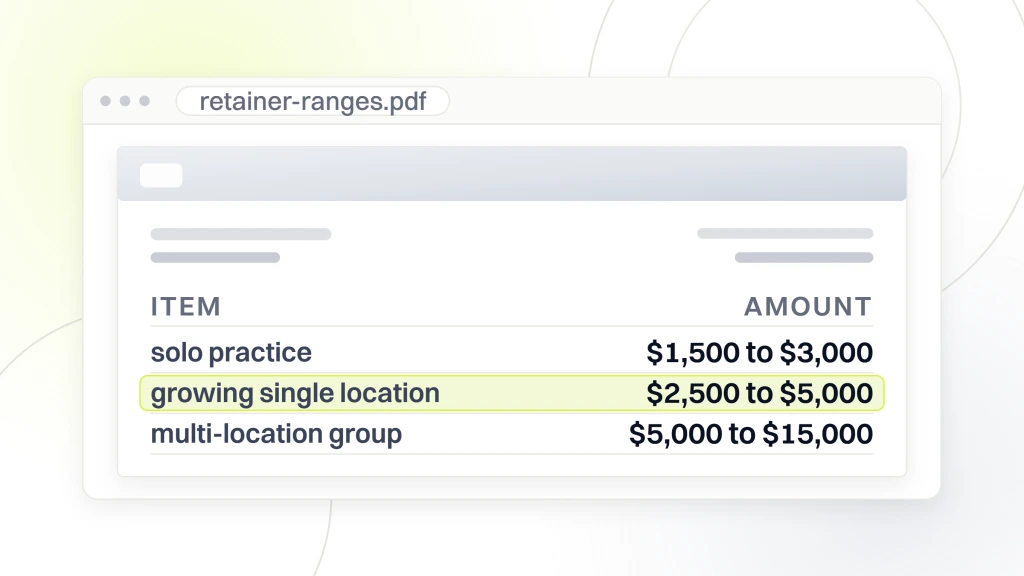
Retainer ranges by practice size
Solo practices sit at $1,500 to $3,000 per month for retainer. Growing single-location practices land at $2,500 to $5,000. Multi-location groups and small DSOs run $5,000 to $15,000 depending on locations, and their dental marketing strategies need to layer paid, organic, and reputation channels together. Ad spend sits on top and moves with your target patient volume. If a firm quotes you $800 per month for a full-service dental marketing services program, they’re either subcontracting the work overseas or skipping the reporting layer entirely.
Ad spend ranges you can plan around
Google Ads for a single-location practice runs $1,800 to $4,500 per month in a mid-competition market. Metro markets run higher. Meta ads for a supporting community campaign start at $600 and top out around $2,000. Adding LSA (Local Services Ads) on top adds $500 to $1,500 in most markets. Total program cost for a healthy single-location dental marketing program lands at $4,500 to $10,000 all in, retainer plus spend.
Contract structure to insist on
A 6-month initial commitment is standard, and for good reason. Paid campaigns need 60 days to stabilize and SEO needs 90 days to move. Anything shorter than 6 months is a firm quietly telling you they don’t expect to keep the account. Ownership clause on every ad account, GBP, analytics property, and landing page belongs to the practice, not the agency. If the pitch dodges the ownership question, walk. See our dental marketing plan for the planning template we hand new clients.
Red flags in a dental marketing firm pitch
Bad pitches share a few tells. Learn them and you save yourself 6 months of wasted retainer. The pattern is consistent across the underperforming agencies we replace, and a solo owner in Denver falls for the same 3 pitch lines as a 12-location DSO in Tampa.
Guaranteed rankings and guaranteed patient counts
No one controls the Google auction. Any agency guaranteeing a #1 ranking or a specific patient count is either lying or planning to blame you when the numbers miss. Real firms guarantee inputs (weekly campaign work, monthly reporting, quarterly reviews) and set outcome targets as ranges based on your market and starting position. A guarantee of “12 new patients per month or your money back” sounds attractive and never survives contact with a real practice funnel.
Ownership held hostage
Some firms build your Google Ads account, GBP (Google Business Profile), and landing pages inside their own accounts, then hand you the login only if you renew. That’s a hostage clause. If you leave, you lose the ad account history, the audience data, and the landing page assets, and you start from scratch. Ownership should transfer to the practice from day one. Ask to see the clause in writing before signing anything.
Blended budget with no line items
“$6,500 per month, all in” means the firm decides how much of your money goes to ads versus their pocket. That structure gets abused fast. Every honest quote separates retainer, ad spend, and any third-party tool costs (CallRail, schema builders, review platforms). If a firm resists the ask, they’re protecting a management fee that’s higher than they want you to see.
- Guaranteed #1 rankings. No one controls the Google auction.
- Guaranteed patient counts. Real agencies set ranges, not promises.
- Ownership held hostage. Your ad account belongs to you, not the firm.
- Blended budget. Retainer and ad spend must be separate line items.
- No named team members. A pitch with no assigned lead is a subcontractor pitch.
- Zero mention of front-desk conversion. They never scaled an account past $10K spend.
- 30-day contract. Paid needs 60 days to stabilize, SEO needs 90 to move.
The pattern holds outside dental. If a pitch triggers 2 or more of the 7 flags above, keep interviewing.
Dental marketing company vs freelancer vs in-house
Every practice weighing an outside partner also weighs the two alternatives. Hire a freelancer, or build the function in-house. Each option carries a real cost, and the right call depends on your patient volume target, budget size, and how much operational overhead you can absorb.
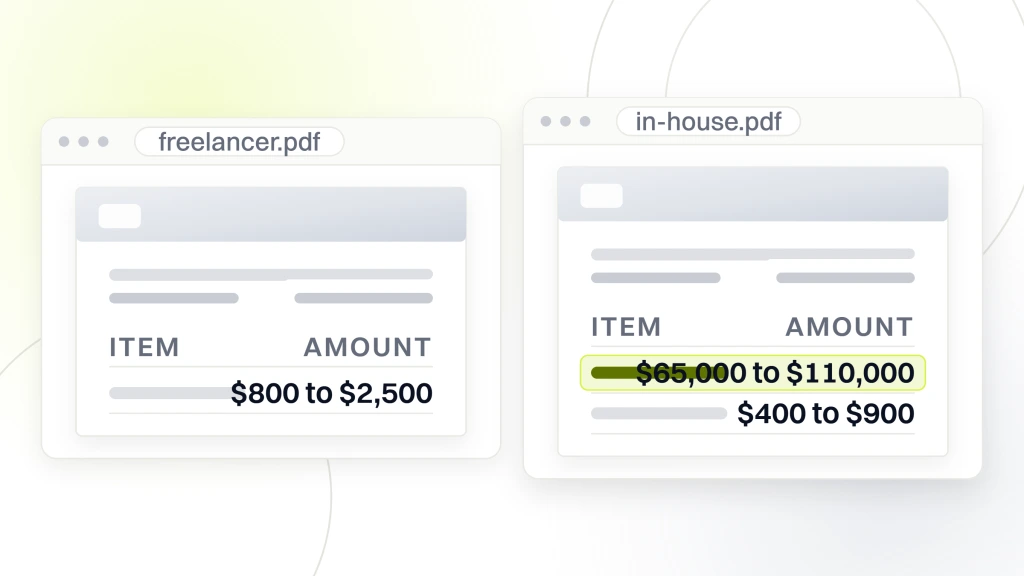
Freelancer path
A skilled freelancer costs $800 to $2,500 per month and can run either Google Ads or SEO well, rarely both at scale. Freelancers work best when your funnel needs one channel fixed, not 5 channels run in parallel. The bandwidth ceiling shows up fast when the practice needs landing pages, review workflow, and content published at the same time. Freelancers also lack the failover coverage a small team gives you when someone catches the flu the week you launch a campaign.
In-house marketing manager path
A dedicated in-house marketing manager costs $65,000 to $110,000 fully loaded, plus tools ($400 to $900 per month), plus ad spend. That path makes sense at 4+ locations or when new-patient targets top 200 per month across the group. Below that scale the fixed cost outweighs the flexibility. Most single-location practices that hire an in-house manager burn through 18 months before deciding the agency retainer is a better fit.
Dental marketing company path
A dental marketing company gives you a team (account lead, paid specialist, SEO specialist, designer, developer, project manager) for the price of a single in-house hire. The tradeoff is the account gets attention proportional to the retainer size. Small retainers get less lead time. Large retainers get more. Ask which lead is assigned to your account and whether they’ll be on every monthly call. See how dental marketing agency vs in-house stacks up in more detail.
Smile Design Dentistry 50-location rollout
Smile Design Dentistry runs 50+ dental offices as a DSO across Central Florida and Tampa Bay. When Redefine Web took over the account, the group was spending heavily on paid channels with limited tracking, broad targeting, and no paid social layer. Cost per call sat high across the network and lead quality varied wildly by market. The fix was a full account restructure, not a creative refresh.
What we changed
We rebuilt the Google Ads account structure market by market, added a full-funnel paid social layer, and produced location-specific landing pages with call and form tracking wired end to end. The GBP profile for each location got weekly posts, real photos, and a service category audit. The measurement layer routed every call into a location-attributed CallRail number, so the DSO could compare cost per booked visit by market for the first time.
What moved
PPC conversion rate climbed 20% as broader match types got replaced with intent-tight audiences. Cost per call fell 30% across the network. The optimized campaign structure launched successfully across 50+ locations without the market-by-market chaos DSOs usually see during a rollout. The Smile Design Dentistry case study details each channel’s contribution and the full attribution breakdown.
What the DSO owns after the rollout
Every ad account, every landing page, every tracking property, every GBP admin seat sits under the DSO’s login. That structure means if the group ever moves the account, nothing gets lost. It also means the group’s marketing team can inspect any campaign at any time without waiting on a report. Ownership is a big part of why the account ran clean through a full budget cycle. For multi-location groups, our dso dental marketing post covers the rollout patterns.
Reporting a dental marketing agency should produce
Reporting is the line between a working partner and a slideware firm. A monthly report should let you answer 3 questions in under 2 minutes. Which channel booked the most new patients. What was the cost per booked patient by channel. And which lever moves that number next month.
Numbers that belong on every report
New patient calls by channel, form fills by channel, cost per new patient by channel, average call length as a proxy for lead quality, GBP impressions and direction requests, top 10 organic keywords by ranking movement, and month-over-month trend on each of these. A report that shows clicks and impressions without cost per new patient is a dashboard, not a report. Dashboards belong under reports, not in place of them.
Reporting cadence
Weekly Slack update on spend pacing and any alerts. Monthly report and 30-minute call. Quarterly business review with strategy recommendations and budget adjustments. A firm that only shows up monthly is not close enough to your account to catch issues in real time. A firm that shows up daily is padding hours. Weekly plus monthly plus quarterly is the tested cadence at agency scale.
Attribution stack you should see documented
GA4 with UTMs on every paid campaign, CallRail with dynamic number insertion, a source field in the PMS (practice management system) like Dentrix, Eaglesoft, or Open Dental, plus a monthly reconciliation between GA4 and the PMS source field. The PMS source field is the piece 8 out of 10 agencies skip, and it’s the piece that separates “we booked leads” from “we booked patients.” Insist on it.
Benchmarks across dental marketing agencies
The table below shows what we see across active dental accounts running at Redefine Web scale. Numbers shift quarter over quarter with auction pressure. The shape holds across markets. The review base is the single biggest lever separating practices in the same band.
| Channel mix | Cost per booked patient | Lead-to-patient rate | New patients per month (single location) | Ramp to steady state |
|---|---|---|---|---|
| Google Ads only | $88 to $180 | 32% to 48% | 18 to 34 | 4 to 6 weeks |
| Google Ads + local SEO | $62 to $128 | 44% to 58% | 26 to 52 | 10 to 14 weeks |
| Full stack (Ads + SEO + Meta + reviews + landing) | $48 to $92 | 54% to 70% | 40 to 85 | 12 to 18 weeks |
| Weak or undermanaged program | $170 to $360 | 18% to 32% | 6 to 18 | Never stabilizes |
The full-stack row is where an agency earns its retainer. Cost per booked patient drops when the channels feed each other, not when any single channel gets magically cheaper. The undermanaged row is what you see when the agency treats the account as low-priority. That row usually has one fixable issue. A weak review base, a missing GBP piece, or a paid campaign spending on non-local queries. Repair the single biggest issue and the account moves from the bottom row to the middle row inside 60 to 90 days without any increase in ad spend, which is the fastest return on investment available in the dental marketing category. Practices that keep tolerating the undermanaged row usually rebuild from scratch with a new agency after 9 months and lose the audience data along the way.
Questions to ask a dental marketing agency on the call
Every discovery call answers or dodges the same 5 questions. Ask them in order and the picture clears inside 20 minutes. If the agency dodges more than one, keep interviewing. North County Dental Care, a 20-year Vista, CA practice, moved from several agencies to one and grew patient volume 1,000% from 2021 to 2024, with 12 to 16 new patients booked monthly.
The 5 questions
- Who is the lead on the account, and will they be on every monthly call?
- Can I see a real client dashboard, not a screenshot, showing cost per booked patient by channel?
- How do you attribute a booked patient back to the paid or organic source? Do you use a PMS source field?
- Who owns the ad accounts, GBP, and landing pages when the contract ends?
- What’s your realistic ramp timeline, and what changes if my starting review base is below 4.5 stars?
What good answers sound like
A named lead with credentials. A live dashboard shared on-screen. A written attribution stack, including the PMS source field. A one-page ownership summary. A ramp timeline that admits the first 60 days are the ramp, not steady state. Answers that sound rehearsed on any of these signal a firm that has run this pitch 400 times without ever running an account well.
What bad answers sound like
“Our team will be on the call.” “We can send you a case study.” “We use a proprietary attribution system.” “You’ll own everything at the end.” “We usually see results in the first month.” Each of these is a dodge. If you hear two of them, pass. See our how to choose a dental marketing company for the extended shortlist template.
How to fire a dental marketing firm cleanly
Firing an agency is clean when you own the accounts. It gets ugly when the firm parked everything inside their own logins. Run the account audit before the termination notice goes out, confirm admin access on every property, and export the last 6 months of campaign data. That sequence saves a rebuild later.
Account audit before the notice
Confirm you have admin access to Google Ads, Meta Business Manager, GA4, GBP, CallRail, and any landing page CMS. Export the last 6 months of campaign data. Screenshot the GBP dashboard, the analytics property, and the CallRail call logs. If you find you don’t have admin on any of these, that’s the first thing to request in writing before the termination notice goes out.
Notice period and asset transfer
Most contracts require 30 days notice. Use those 30 days to finalize the asset transfer, not to pause campaigns. Pausing campaigns during notice loses the account history and hurts the incoming agency’s first 60 days. Send a written asset transfer list with a target date, and copy your practice manager or COO on the thread so the timeline stays visible.
Onboarding the next agency
The next agency should ask for the audit files, the last 3 monthly reports, and any pending strategic recommendations from the outgoing firm. They should also ask what the last agency missed. Good agencies use that context to skip 4 weeks of discovery. Bad ones ignore it and repeat the mistakes. If you’re ready to move now, our dental marketing agency team can pick up the account inside 10 business days.
What changes for DSOs and multi-location groups
Multi-location dental marketing runs on a different operating model than single-location work. The channels stay the same. The reporting, the account structure, and the accountability all change. Get the operating model wrong on a 12-location group and the retainer disappears without producing patients.
Location-specific reporting
Every location needs a dedicated CallRail number, landing pages, GBP admin, citation profile, and cost per booked patient line on the monthly report. Group-level averages hide the underperforming locations and inflate the strong ones. Location-specific reporting is what lets a DSO reallocate spend fast when a market softens. Practices grouped under a single average lose 12% to 24% of their potential new patient volume when underperforming locations never surface. Reporting granularity is a lever, not a nice-to-have.
Standardization with local flex
DSOs need one core playbook (ad copy, offer structure, landing page format) with room for market-specific tweaks. That balance keeps the reporting clean and the launches fast. Groups that let every office build its own campaigns end up with 27 different tracking setups and zero comparability. Groups that lock everything down miss local nuance and lose share to independent practices next door. The middle path wins.
Rollout cadence
Rolling out a new campaign across 30+ locations takes 4 to 8 weeks depending on how many locations need GBP fixes first. Groups that try to launch all locations in the same week end up debugging in production. Launching in waves of 5 to 8 locations per week lets the team catch tracking issues before they compound. For the full multi-location breakdown, see our multi-location dental seo.
Where a dental marketing agency relationship goes wrong
Most agency relationships that fall apart share a small handful of failure patterns. Catch them early and you save the account. Wait too long and you rebuild the entire funnel with the next agency. The 3 patterns below cover roughly 80% of the churn we see when new practices come in from another firm.
The lead quietly rotates off
The named account lead you met on the pitch call quietly rotates off in month 3. By month 5 you’re getting emails from a project manager you never met. The named lead moved to a bigger account. The account slid down the priority list without an announcement. This is the most common pattern and the hardest to catch in real time. Ask on the pitch call whether the assigned lead stays for the full contract term.
Reporting quality drops
Month 1 report has cost per booked patient by channel. Month 4 report has clicks and impressions. Month 7 report has “engagement metrics.” Reporting quality drops when the agency loses attribution access, when a junior analyst takes over the deck, or when a strategic hire on the client side stopped asking hard questions. All 3 fixable if you catch them by month 4.
The front desk stops answering
Agency generates calls. Front desk misses 30% of them. Booked patient count stays flat. Practice blames agency. Agency blames front desk. Both are partly right. That’s why a working partner asks about call-answer rate in the first month and puts a monitoring loop in place if the rate slips below 85%. See our call tracking for dentists for the answer-rate benchmark data.
Where dental marketing agencies are heading next
The category is shifting fast. Google AI Overviews now show on 30% to 45% of dental search queries. Local Services Ads are eating a bigger slice of paid map traffic in eligible markets. Meta ad targeting keeps tightening as health-adjacent categories move under stricter policies. Agencies that keep up win share. Agencies that keep running 2020 playbooks lose accounts to the ones that adapted.
AI Overviews change the click math
Practices cited inside an AI Overview earn a click-through advantage on the queries that show one. The winners share 4 traits. Structured service pages with clear headings, recent Google reviews with response history, provider bylines with real credentials, and a GBP updated weekly. Agencies that ignore the AI Overview shift will watch organic patient volume flatten quarter over quarter.
LSA share climbs in eligible markets
Google Local Services Ads for dentists are live in most US metro markets now. LSAs run on a per-lead billing model and show above the map pack. Practices that qualify for the Google Guarantee capture a chunk of the mobile paid traffic that used to go to standard Google Ads. An agency that hasn’t tested LSAs in your market by month 3 is behind.
Attribution becomes the differentiator
As paid channels get more expensive, cost per booked patient becomes the metric that separates strong agencies from weak ones. Agencies with a real attribution stack (GA4 + CallRail + PMS source field) can prove which channel booked which patient and cut wasted spend. Agencies without that stack survive on trust and inertia, and get replaced the first time the practice hires a COO who asks for the numbers. For the current retainer breakdown, see our dental marketing cost.
If your dental marketing agency has plateaued the last 2 quarters, or reporting has drifted from cost-per-booked-patient into vanity metrics, a 2-week audit of the tracking stack, GBP setup, and paid campaign structure gives you a ranked list of fixes by revenue impact. Book the audit and start there.