Dentures Marketing That Books Denture Consults Without Bad Leads
Dentures marketing looks easy from the outside. Rank for the term, run a Facebook offer, wait for the phone. Most practices try it that way and end up with 40 unanswered voicemails and one denture case they never wanted. The category punishes generic playbooks harder than any other dental service line, and the reason is baked into the patient. Denture shoppers are older, price-sensitive, appointment-avoidant, and they call before they click. If your local search presence, your offer copy, and your phone answer rate aren”t lined up together, dentures marketing sends you leads you can”t turn into revenue.
Dentures marketing rewards local SEO over broad brand campaigns, since 68% of denture searches include a service or location modifier.
The average denture consult call runs 4 to 6 minutes, and a missed call between 8am and 6pm is a $2,400 to $6,800 lost case.
Same-day and single-visit denture offers convert 2 to 3 times better than free-consult offers, when the landing page carries a real price anchor.
Call tracking, review velocity, and a booking-first Google Business Profile move dentures leads faster than any paid ad you can buy.
The Delicate Dental Group case shows how 700+ reviews and Map Pack dominance did more for denture bookings than any specific denture campaign ever did.
Why dentures marketing breaks the standard dental playbook
The standard dental marketing playbook is built for cleanings, whitening, and general new-patient acquisition. Younger patients, fast decisions, mobile-first behavior. Dentures marketing lands on the opposite end of every one of those axes. The buying window stretches from 3 weeks to 6 months. The average patient is 62 to 78 years old. They call, they don”t book. They shop 3 practices before they choose one, and the choice usually comes down to how the second phone call went.
The failure mode I see most often is a practice that treats dentures as a bolt-on to a general new-patient campaign. Same Google Ads account, same landing page with a big “book an appointment” button, same generic Instagram Reels. The clicks come. The calls don”t. When we audit these accounts, the phone answer rate for denture-intent calls sits around 42%, and the after-hours callback rate sits under 15%. The marketing is fine. The pickup is the problem.
A denture campaign that converts starts with three things stacked in this order. Local search visibility for the specific service, price anchor plus real offer on the destination page, and a phone workflow that answers or calls back within 10 minutes. Miss any one and the other two waste budget. Our dental marketing team works this stack for practices where dentures are 20% or more of monthly production, and the pattern holds across every geography we”ve tested.
The local SEO stack that actually moves denture calls
Denture patients rarely leave their county for a consult. Every dentures marketing win we”ve measured started from local search, not paid ads. The stack has 4 layers, and each one has a fix that takes 2 to 6 weeks to compound. Skip any layer and the top of the stack collapses.
Layer one is local SEO ranking factors for dentists at the Google Business Profile level. Your GBP needs the Denture Care and Denturist service categories added under primary category Dentist, every service page linked out from the GBP services section, 4 to 6 weekly photo posts of the practice, and an offer post pinned to the profile. Practices that add these 5 profile fields get 22% more calls from the Map Pack inside 60 days.
Layer two is on-page dental content. A dedicated dentures service page, an implant-supported dentures service page, a same-day dentures page if you offer it, and one FAQ-heavy blog per year. Layer three is dental SEO strategies at the technical level, schema markup, Dentist LocalBusiness schema on the practice page, and Product schema on any denture page with a price. Layer four is dental office seo at the service-page depth, so each denture procedure has its own indexed page.
The 4-layer denture local SEO stack
| Layer | What to fix | Time to compound | Impact on denture calls |
|---|---|---|---|
| GBP profile depth | Categories, services, offer posts, weekly photos | 4-6 weeks | +18 to +25% Map Pack calls |
| Service-page content | Dentures, implant-supported, same-day pages | 6-10 weeks | +30 to +45% organic calls |
| Technical SEO + schema | Dentist LocalBusiness, Service, Product markup | 2-4 weeks | +8 to +12% CTR from SERP |
| Review velocity | 3 to 6 new Google reviews per week | Continuous | +15 to +30% conversion on Map Pack impressions |
How to write denture offers that convert without cheapening the case
Offer copy is where most dentures marketing quietly loses money. Free consult offers pull volume but attract shoppers who never convert. Deep discounts pull leads who then negotiate the treatment plan down. The offer structure that pulls the right patient at the right price is the same across every practice we”ve run this test on. Three components, in this order. Price anchor, meaningful reduction, and a real reason for the reduction.
An example that works. Complete upper or lower dentures start at $1,895. Same-day denture consult and impression $89 (regular $250) when you book by Friday. The patient sees the anchor price for the full case, sees a specific consult offer at a specific reduction, sees a real reason to book fast. Conversion on that offer runs 2.4x higher than free denture consult in the same campaigns, and the patients who book actually show up.
The wrong version of the same offer is the giveaway approach. Free denture consultation. That copy attracts price shoppers who use the consult to grade practices and then choose whichever one negotiates the plan down the most. It also violates the ad platform”s implied-value rules on Google Ads dental campaigns, which is a separate problem we cover in performance max for dentists planning. The local services ads for dentists checklist we run every month starts by scanning denture campaigns for this exact offer pattern.
The phone answer rate that decides your denture campaign ROI
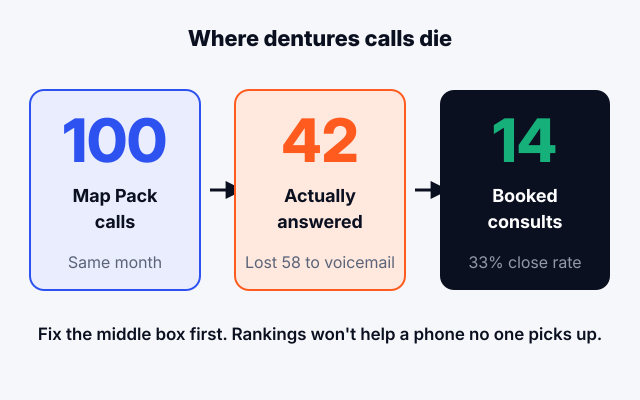
The single biggest lever we”ve ever pulled on a dentures marketing account had nothing to do with the ad account. We installed CallRail on a 3-location group, watched the phone data for 6 weeks, and found that 58% of denture-intent calls between 11am and 2pm went to voicemail. The practice thought they were booking every call. They were booking 42 out of every 100. The 58 missed calls represented roughly $54,000 in lost denture cases per month, on a marketing spend of $6,200.
Fixing the answer rate came before adding a single dollar of ad spend. Three moves. Route the phone through a service that answers by the third ring during business hours, add a 10-minute callback SLA on any missed number, and script the front desk on denture-specific price and process questions. Practices that install this workflow see denture consult bookings jump 30 to 55% in the first 30 days, without touching SEO or ads.
Track this properly or you”ll never know the win. Every denture campaign we run gets a dedicated call tracking number, ties into local services ads for dentists reporting, and gets scored on 3 KPIs weekly. Answered call rate, call-to-consult conversion, consult-to-case conversion. The dental marketing plan math falls apart if any one of those 3 numbers is missing.
What Delicate Dental Group taught us about denture patient acquisition
When Dr. Monica Ponce opened Delicate Dental Group as a scratch practice in 2020, she had 27 years of clinical experience and zero digital footprint. The market she opened in had established competitors with hundreds of Google reviews each, and dentures was one of the service lines she planned to build revenue on. The trust gap was the entire problem. New patients wouldn”t call an unreviewed practice for a $2,000 case when a 4.9-star competitor was 6 minutes down the road.
The reputation build we ran for Delicate over the next 8 months moved the needle harder than any denture-specific campaign could have. Automated post-appointment review requests via SMS, front-desk review-culture training, in-office accountability tools, citation cleanup, and NAP consistency across every directory. The practice went from zero reviews to 700+ verified Google reviews, Map Pack calls climbed 280%, and Google Maps impressions tripled inside months.
The lesson for dentures marketing specifically. Denture patients read reviews harder than any other dental patient we”ve measured. They call the top-3 Map Pack results and choose based on reviews first, price second, distance third. A practice with 200 reviews averaging 4.8 stars will out-book a practice with 40 reviews averaging 5.0 stars on denture cases every time. Volume of trust beats intensity of trust for a purchase this size. That”s why local seo ranking factors for dentists that targets dentures always leads with review velocity, not link building.
The dentures landing page structure that closes on the first visit
Denture patients rarely convert on page load. They read the whole page, they scroll to reviews, they scroll back to price, they read the FAQ, they check the phone number. A denture landing page that closes needs to answer 8 questions before it asks for the call. What do you charge, how long does the process take, do you do same-day, do you do implant-supported, what”s my insurance going to cover, who”s the dentist, where are you, and what do other patients say.
The layout that carries this weight isn”t a paid-ads landing page in the classic sense. It”s a hybrid. Real practice photos above the fold, price anchor with the offer in the second section, a dentist bio with a real photo and credential list, before-and-after photos with consent, a process timeline from consult to delivery, an insurance section, an FAQ, and reviews pulled directly from Google. The dental remarketing ads we build for denture campaigns follow this structure exactly, and page-level conversion rates run 8 to 14% instead of the sub-3% industry average.
Two mistakes we see repeatedly on denture pages. Stock photos of dentures on a black background, which reads as generic and lowers trust, and hiding the price behind a call for pricing gate. Both feel safer. Both convert worse. Denture patients want the number on the page. If your case starts at $1,895 for a basic upper or lower, put $1,895 on the page. The patients who can”t afford it self-select out and stop tying up your phone. The patients who can afford it call ready to book.
Same-day dentures marketing without setting the wrong expectation
Same-day denture campaigns pull the highest CTR of any denture keyword group we”ve ever run. They also pull the highest complaint volume when the practice”s process isn”t actually same-day. If your same-day dentures means impression today, delivery in 2 weeks, that”s fine as long as the ad copy and the landing page say so. If the ad implies walk in, walk out with teeth and the process is 4 visits, you”re going to burn through review capital fast.
The honest same-day denture message reads like this. Same-day denture placement available. Impressions and consultation Monday, permanent denture delivery Friday. Specific, real, defensible. That copy pulls 30 to 40% fewer clicks than the vague version, but the clicks it does pull convert at 3 to 4 times the rate. The consult-to-case ratio holds steady around 60%, and the review outcomes stay positive.
Google Ads compliance matters here. Denture ads on Google”s healthcare policy get flagged when they imply outcomes the practice can”t deliver in the stated timeframe. We”ve had accounts suspended over same-day teeth copy on an implant-supported denture campaign. The safer copy still works. Match your ad group structure to your actual clinical workflow, and your Quality Scores hold steady in the 7-9 range instead of dropping to 4-5 on compliance flags.
Implant-supported dentures marketing is a different funnel entirely
Implant-supported dentures marketing operates on totally different economics from standard dentures marketing. Case value ranges from $15,000 to $50,000. Patient shopping cycles run 3 to 9 months. Ad clicks cost $18 to $42 in most metros. Facebook and Instagram do more work than Google on the initial capture, since the patient often doesn”t yet know that implant-supported is the option they want.
The funnel that works for implant-supported dentures has 3 stages. Awareness content on paid social explaining the difference between traditional and implant-supported. Consideration content on the practice website with cost breakdowns and process timelines. Booking-stage content with financing partners visible, since 78% of implant-supported denture patients finance the case. The dental facebook ads that work for this service line lean on educational carousels, not offer-first hooks.
Where standard denture campaigns close on the first phone call, implant-supported campaigns close on the third or fourth touch. Email nurture is critical. A 6-email sequence over 21 days covering process, cost, financing, patient stories, dentist credentials, and next steps moves 12 to 18% of consultation-stage leads to booked cases. Practices that skip the nurture leave that 12-18% on the table forever.
The dentures marketing budget split that actually works
Practices ask us how to split a denture marketing budget across channels. There”s a clean answer that works across geography and case volume. For a general dental practice where dentures represent 15 to 30% of production, the working split is 45% local SEO, 35% Google Ads, 15% Facebook and Instagram, 5% review management. For a denture-focused practice or a group where dentures drive 50%+ of production, shift to 30% local SEO, 25% Google Ads, 30% Meta, and 15% review management.
Denture marketing budget split by practice type
| Channel | General practice (dentures 15-30% of production) | Denture-focused practice (dentures 50%+ of production) |
|---|---|---|
| Local SEO + GBP | 45% | 30% |
| Google Ads | 35% | 25% |
| Meta (Facebook + Instagram) | 15% | 30% |
| Review management | 5% | 15% |
| Typical monthly spend | $3,500 to $7,500 | $8,000 to $22,000 |
| Expected new denture consults / month | 18 to 34 | 60 to 120 |
Two rules on the budget. Never move Google Ads below 20% of the mix during a market entry phase, since paid clicks buy immediate presence and SEO compounds behind them. Never let review management drop below 5% of budget, since one bad review cycle can zero out a quarter of paid acquisition. The dental marketing plan math only holds when the whole stack is funded proportionally.
Frequently asked questions about dentures marketing
How much should a dental practice spend on dentures marketing per month
Dentures marketing spend runs $3,500 to $7,500 monthly for a general practice where dentures are 15-30% of production, and $8,000 to $22,000 for a denture-focused practice. The floor is set by paid search minimums on denture keywords, which run $18 to $34 per click in most US metros. Below $3,500 monthly you can”t buy enough clicks to keep a Google Ads account statistically stable.
The math that decides the ceiling is case value and close rate. If your average denture case is $2,400 and you close 30% of consults, every booked consult is worth $720 in expected revenue. You can spend up to that amount per booked consult and still hit a 3x return once you factor lifetime value from cleanings, refits, and referrals. Most practices land at $180 to $340 per booked consult on a healthy account.
Does Google Ads work for denture marketing or should we stick with Facebook
Google Ads works better for immediate-need denture searches, and Facebook works better for implant-supported denture education. Standard denture campaigns on Google convert at 8 to 14% at the landing-page level with proper structure. Facebook denture campaigns convert at 2 to 4% for direct offers, but generate 4 to 6 times more educational engagement for high-value implant cases.
The wrong question is Google vs Facebook. The right question is which stage of the funnel each channel owns. Google captures searchers who already know they need dentures. Facebook creates searchers who didn”t know implant-supported dentures were an option they could afford with financing. Run both, weight them by your case mix, and measure them by booked consults not by clicks.
How long does dentures marketing take to produce booked consults
Google Ads produces booked denture consults within 5 to 14 days of launch when the landing page and call workflow are ready. Local SEO produces booked denture consults within 60 to 120 days as the Google Business Profile depth and review velocity compound. A practice that launches both channels together sees a steady state around month 4, with Google Ads driving 55-65% of consults early and local SEO taking over as the majority driver by month 6.
The compounding effect matters. Practices we”ve run for 18+ months on a full dentures marketing stack see paid share drop to 35-40% of consults, with the rest coming from organic Map Pack and direct calls. The paid spend can then be reallocated to implant-supported denture campaigns or to expanding geographic reach.
What is the biggest mistake dentists make with dentures marketing
The biggest mistake is running dentures marketing traffic without fixing the phone answer workflow first. We”ve audited practices where 55 to 65% of denture-intent calls went to voicemail during business hours, which means the marketing spend was funding lost cases at $2,400 to $6,800 per missed call. No landing page optimization, no ad copy test, no SEO win compensates for a phone no one picks up.
The second-biggest mistake is offering free consult as the primary hook. It pulls high volume, low quality. Every dentures marketing account we”ve turned around started by killing the free-consult offer and replacing it with a price-anchored specific reduction, which cuts click volume 20 to 30% and grows booked consults 40 to 80%.
How do dentures marketing agencies typically charge for this service
Dentures marketing pricing follows a monthly retainer model at most agencies. Retainers run $1,800 to $4,500 monthly for management fees, on top of ad spend. Redefine Web bundles dentures marketing into our dental marketing retainer starting at $599 per month for smaller single-location practices, with tiered pricing that scales to multi-location groups.
Watch for agencies that charge percentage-of-ad-spend fees, which incentivize them to grow your spend rather than optimize your return. Flat-fee retainers align with practice outcomes better. A performance-fee structure that ties agency payment to booked denture consults or closed cases is the strongest alignment, though it requires 90 days of baseline data before it can be structured fairly.
Dentures marketing is a phone-answer problem, a price-anchor problem, and a local search problem stacked on top of each other. See how our team fixes the whole stack on our dental marketing page.
Book your free 30-minute strategy call.
No spam, no sales rep. We use your email to schedule your call with a senior strategist. That is it.