
Digital Marketing for Home Services
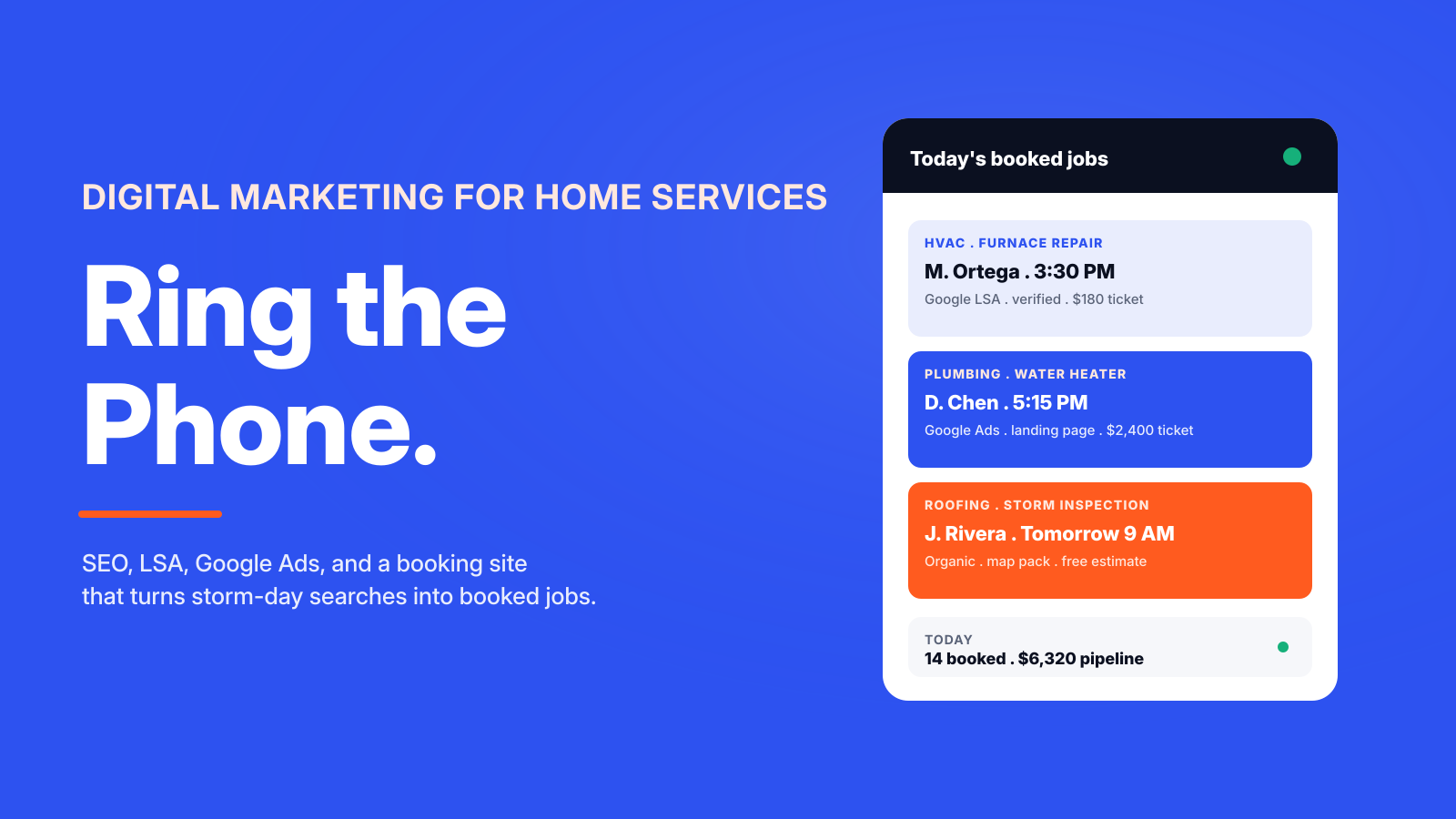
- Digital marketing for home services is a four-channel stack: Google Local Services Ads for pay-per-lead volume, Google Ads on high-intent search terms, local SEO for map pack ranking, and a booking-first website.
- Most profitable home services accounts split paid budget 60 percent to LSA and 40 percent to Google Ads, with SEO running in the background as a compounding lead source that lowers blended cost per lead over 6 to 12 months.
- The website is the multiplier: without click-to-call, online booking, service-area pages, and mobile speed, every paid dollar produces a fraction of the jobs it should.
- Seasonality drives the calendar: winter for HVAC heating and burst pipes, spring for roof storm work and drain lines, summer for AC and moving, fall for gutters and furnace tune-ups. Budget shifts by month or the account bleeds cash on the wrong season.
- McCormick Heating and Cooling grew from 60 service requests per year to 125 leads per month at a 15 dollar cost per lead using this exact stack, and doubled annual revenue over 24 months.
Digital marketing for home services is not one channel. It is four channels stitched together: Google Local Services Ads that pay per booked lead, Google Ads on high-intent search terms, local SEO built around the map pack and Google Business Profile, and a website that turns a 2 AM burst-pipe search into a job on the truck by breakfast. Skip any one of the four and the account bleeds cash on the other three. Run all four in sync and a $180 furnace repair call today turns into a $9,000 heat-pump install signed off Wednesday.
This is the working stack we run inside HVAC, plumbing, roofing, moving, cleaning, and home-renovation client accounts. It covers what each channel actually costs per lead in 2026, how to split the paid budget across LSA and Google Ads without cannibalizing yourself, what the booking-first website needs on the page, and how the seasonal calendar dictates where the dollars go month to month. For the wider 10-strategy view that stacks referrals, financing, and retention on top of the four channels, see our companion guide on marketing for home services. Real numbers from real accounts, no vanity metrics.

The four-channel stack every home services account runs on
Every home services shop we have taken from 30 leads a month to 130 has done it on the same four channels in the same order. Google Local Services Ads first, since Google pays them a Guaranteed badge and puts them above the paid search results. Google Search Ads second, on the exact-match keywords a homeowner types with intent (furnace repair, water heater leaking, roof leak, mover near me). Local SEO third, aimed at the map pack for those same terms. The website fourth, since none of the paid channels earn a cent if the phone does not get answered on the second ring.
Two of the four move fast. LSA and Google Ads produce booked leads in the first 7 to 21 days of a campaign turning on. Two of the four compound slow. Local SEO and website conversion improvements pay back over 3 to 9 months and keep paying long after the paid channels stall. Every account we run is a mix of fast wins and slow compounding. Home services owners who chase only the fast wins pay a premium every year they stay in market. Owners who chase only the slow ones starve for cash before the compounding hits.
Google Local Services Ads: pay per booked lead, not per click
Local Services Ads (LSA) sit above every other paid result on the mobile SERP for home services queries. Google verifies the business, runs a background check on owners and techs, and shows a Google Guaranteed badge next to the listing. The homeowner taps the listing, calls, texts, or requests a booking. The business pays only for leads Google routes through the LSA product, not per click.
Cost per lead on LSA ranges from $25 to $80 depending on trade and city. Plumbing repair leads in Dallas run $32 to $55. HVAC emergency leads in Chicago winter run $45 to $80. Roofing storm inspection leads in Oklahoma tornado season spike to $90 to $130. The trick is disputing the bad leads. Google credits back leads that were wrong-number, out-of-area, spam, or asking for a service the business does not offer, provided the shop disputes them within 14 days. Accounts that dispute nothing pay 20 to 35 percent more per booked job than accounts that dispute every non-qualifying lead. Our home services PPC team runs the dispute workflow daily inside every LSA account.
Setup requires proof of license, general liability insurance, and a Google-approved background check on every listed employee. Roofing and moving accounts need bond documentation on top of that, depending on state. Expect 3 to 6 weeks from application to green-badge active status. Do not turn on LSA before the intake team is trained to answer the phone within two rings and log every call in the CRM. Google penalizes response rate and unanswered calls in the ranking algorithm, and a shop that misses even 15 percent of LSA calls loses the top slot to the shop across town that answers 98 percent.
Google Ads on high-intent search: the other half of the paid budget
LSA covers the top three slots on mobile. Google Ads covers everything below LSA and above the organic map pack, which is still a top-of-screen position on a phone. Home services Google Ads campaigns work when they are built narrow: one campaign per service (furnace repair, AC install, water heater replacement, drain cleaning), one ad group per intent (emergency, replacement, estimate), tight geo targeting at the ZIP or 10-mile radius level, and negatives that filter out DIY searchers.
Cost per lead on Google Ads for home services runs $40 to $150. Emergency plumbing hits $60 to $90 in most metros. New-install AC leads run $110 to $180 since a homeowner shopping for a $9,000 heat pump takes longer to convert. Roofing full-replacement leads run $180 to $300. The trap most accounts fall into is broad-match keywords and Performance Max campaigns without exclusions. Both spend fast, both look busy in the dashboard, and both produce a fraction of the booked jobs a manually-managed Search campaign produces. Broad match and PMax are earned tactics, not starting tactics, and they belong in an account after month 4, not month 1.
Every Google Ads campaign needs a matched landing page. Sending furnace-repair traffic to the homepage cuts conversion rate roughly in half compared to sending it to a page that shows a furnace, a phone number, a promise (24-hour response, licensed techs, upfront pricing), and one call-to-action. Our home services web design engagements build one landing page per major service before the ads ever go live, and rebuild the homepage as the hub that points to each.
Local SEO and the map pack: the compounding channel
The Google map pack (three business listings that show up under the map for local searches) drives 44 percent of local search clicks per BrightLocal’s 2024 Local Consumer Review Survey. For home services queries it runs higher, closer to 50 percent, since homeowners in a hurry tap the top result without scrolling. Getting into the map pack for the money keywords (furnace repair, plumber near me, roofer, mover) is the single highest-return move a home services shop makes in year one.
Local SEO for home services runs on five moves. First, a fully optimized Google Business Profile with the primary category set to the exact service (Plumber, HVAC contractor, Roofing contractor, Moving company), 20-plus real photos of trucks, jobs, and techs, weekly GBP posts, and a Q&A section seeded with the questions homeowners actually ask. Second, structured citations across 40 to 60 directory sites with name, address, and phone matching the GBP exactly. Third, review generation targeting 4 to 8 new Google reviews per month through post-job SMS with a direct GBP review link. Fourth, service-area pages on the site, one per city or ZIP the shop covers. Fifth, on-page schema markup (LocalBusiness, HVACBusiness, Plumber) that tells Google what the business does and where.
SEO for home services takes 3 to 6 months to move the map pack for competitive terms in mid-sized cities, and 6 to 12 months in top-50 metros. The payoff is a cost per lead under $10 at scale, which is 3 to 8 times cheaper than LSA and Google Ads. Shops running home services SEO in parallel with paid channels see their blended cost per lead drop 30 to 45 percent between month 6 and month 12 as organic leads take a bigger share of the total.
The website is the multiplier every paid dollar runs through
A great LSA campaign pointed at a slow, cluttered, form-heavy website produces a fraction of the jobs it should. The website is not a brochure. It is the conversion surface every paid click, every map pack tap, and every referral call ends up on before the homeowner picks up the phone. Home services websites that convert at 7 to 15 percent (visit to booking or call) share the same seven traits: a click-to-call phone number in the header on mobile, a booking form under 4 fields, service-area coverage listed in the footer, real photos of the crew and trucks, upfront pricing on 3 to 5 core services, review stars visible above the fold, and a 2-second-or-under mobile load time.
The traits most home services sites miss are speed and mobile-first structure. A homeowner searching “water heater leaking” on a phone at 11 PM is not scrolling a hero video that takes 6 seconds to render. They are tapping the first phone number they see. Sites that pass Core Web Vitals on mobile convert 25 to 40 percent higher than sites that fail, and the fix is usually not a rebuild. It is a swap to a lightweight theme, compressed images, and a proper CDN. Our home services hosting and maintenance retainer keeps mobile speed inside the 2-second window every month, since Google Ads Quality Score and organic map pack ranking both penalize slow pages.
Cost per lead by channel and trade
Every home services trade has a different cost per lead across the four channels, driven by ticket size, urgency, and competition density. The table below is the working range we see across active client accounts in 2024 to 2026. Ranges tighten inside a single metro (a Denver plumber sees a $10 to $15 spread, not a $30 spread) and widen across metros. Use them as a sanity check on what the shop is paying today, not as targets to chase.
| Trade | LSA cost per lead | Google Ads cost per lead | Organic (SEO) at scale | Avg ticket size |
|---|---|---|---|---|
| HVAC repair | $35 to $75 | $60 to $120 | $6 to $12 | $180 to $650 |
| HVAC install | $60 to $110 | $110 to $180 | $10 to $20 | $5,000 to $12,000 |
| Plumbing repair | $32 to $55 | $50 to $90 | $5 to $10 | $220 to $850 |
| Plumbing install | $45 to $85 | $90 to $160 | $8 to $15 | $1,800 to $4,500 |
| Roofing repair | $40 to $80 | $70 to $130 | $7 to $14 | $400 to $1,800 |
| Roofing replacement | $65 to $130 | $180 to $300 | $12 to $25 | $12,000 to $28,000 |
| Moving (local) | $30 to $65 | $45 to $90 | $5 to $11 | $650 to $2,200 |
| Cleaning (residential) | $25 to $50 | $40 to $75 | $4 to $8 | $180 to $420 |
| Cleaning (commercial) | $50 to $110 | $85 to $170 | $8 to $18 | $1,200 to $4,800 monthly |
| Home renovation | $70 to $150 | $120 to $250 | $15 to $30 | $18,000 to $95,000 |
The pattern across every row: organic (SEO + map pack) is 4 to 10 times cheaper per lead than paid at scale, but takes 6 to 12 months to reach that scale. Paid delivers first-day booked leads, at a premium. That is the compounding math the four-channel stack solves. Pay the premium for LSA and Google Ads in months 1 to 6, invest in SEO and site conversion in parallel, and let organic take a growing share of the mix from month 7 forward. Shops running this stack see their blended cost per lead drop from the $65 to $95 range in month 1 to the $22 to $35 range by month 12.
Seasonality dictates where the dollars go
Home services demand is not flat across the calendar. Winter drives HVAC heating repair, burst pipe emergencies, and roof ice damming. Spring drives roof storm damage, drain line backups, and AC tune-ups. Summer drives AC repair and replacement, moving jobs (60 percent of annual moves happen May to September per U.S. Census data), and pool cleaning. Fall drives gutter work, furnace tune-ups, and pre-winter plumbing checks. A single-shop HVAC account that spends the same $8,000 in July as in January is either underinvesting in January (leaving revenue on the table) or overinvesting in July (bleeding cash on low-demand searches).
The working seasonal budget shift looks like this. HVAC accounts triple January and February spend versus May and September. Roofing accounts triple March through June spend around storm season. Moving accounts push 70 percent of annual budget into April through August. Cleaning accounts stay steadier but push a 20 percent bump in December (holiday deep-clean) and another in April to May (spring clean and move-out). Home renovation runs steady across the year with a small dip in December and a small bump in March through May. The seasonal budget table inside our home services marketing playbook breaks the peak and off-season spend ranges out by trade in one view.
Storm response is a separate line item. Roofing and tree service accounts on the coast (Florida, Texas, Carolinas) and in tornado alley (Oklahoma, Kansas, Missouri) run standby budgets that only activate when NOAA issues a warning inside their service area. A $2,000 daily standby budget across 5 hail days in April can produce 40 to 90 booked inspections, which is the year in one week for a mid-sized roofing shop. Shops that do not have the standby set up before the season starts miss the window.
How McCormick Heating and Cooling doubled revenue on the same four-channel stack
The clearest working example we can point to is McCormick Heating & Cooling, a 15-plus-year Greeley, Colorado HVAC provider that came to Redefine Web with strong community credibility and almost no online presence. Their prior year had produced 60 total service requests. Their website was outdated, had no keyword optimization, no clear service pages, and a bounce rate that told the story on its own. Bookings dropped hard in off-season, and competitors dominated Google results for every Greeley-area furnace and AC query.
The rebuild ran the same four channels laid out in this guide. Website first: new design with real team photography, HVAC-specific service pages for furnace repair, AC install, heat pump swap, and duct cleaning, conversion-focused CTAs, and click-to-call in the mobile header. SEO second: HVAC-specific keyword strategy targeting “Greeley furnace repair” and adjacent long-tail queries with real local intent, service-area pages for surrounding towns, and structured citations. Reviews third: a post-job workflow that grew Google reviews from sparse to 230-plus five-star ratings. Paid fourth: seasonal Google Ads and LSA management with spend pulled forward into shoulder seasons so booking surges did not depend on luck.
The result: 80 percent organic traffic growth, 125 monthly leads at a $15 cost per lead, 18x return on ad spend, and doubled annual revenue over 24 months. The shop expanded to two office locations. Reviews cleared 230-plus five-star. The same stack has since produced similar results for Berks Plumbing, a Pennsylvania plumbing shop that rebuilt from a single-page site into a full-funnel digital operation covering LSA, Google Ads, technical SEO, and service pages.
The 90-day rollout that stands up the stack
A shop starting from scratch stands the four-channel stack up in 90 days if the sequence is right. Days 1 through 21: website audit and rebuild if needed, GBP claim and optimization, review workflow set up, LSA application submitted (since verification takes 3 to 6 weeks). Days 22 through 45: Google Ads campaigns built out for the top 3 services with landing pages, SEO citations pushed out, service-area pages drafted. Days 46 through 75: LSA active with lead disputing running, Google Ads scaling on winning ad groups, first SEO ranking movement starts to show. Days 76 through 90: blended cost per lead drops as organic starts contributing, seasonal budget shift planned for the upcoming quarter.
The most common rollout mistake is turning on paid before the site and the phone workflow are ready. A shop that runs LSA and Google Ads with a slow site, no click-to-call, and a receptionist who lets calls roll to voicemail pays 40 to 60 percent more per booked job than it should. The fix is not more ad budget. The fix is 3 weeks of site work and one week of training the intake team. Our home services marketing retainer covers all four channels under one plan starting at $599 a month for a single-shop rollout, and scales up as the account grows.
By month 4, the shop should be running at target blended cost per lead, with a repeatable seasonal budget plan, a clear cost of acquisition per booked job, and an SEO track producing the first organic map-pack ranks for money keywords. Every month past 4 is optimization: dispute rate on LSA, negative keyword expansion on Google Ads, GBP posting cadence, new service-area pages, review generation velocity, and site conversion tweaks on the top-5 landing pages.
Frequently asked questions about digital marketing for home services
How much should a home services company spend on digital marketing per month?
A single-shop home services company should budget $2,500 to $8,000 per month all-in for digital marketing, with 55 to 70 percent of that on paid channels (LSA and Google Ads), 15 to 25 percent on SEO and content, and 10 to 20 percent on site maintenance, review tools, call tracking, and CRM. Multi-truck shops (5-plus trucks) run $8,000 to $22,000. Regional multi-location operators run $22,000 to $60,000.
The trap most shops fall into is spending 100 percent on paid ads and skipping the site, the SEO, and the intake workflow. A paid-only budget produces a plateau around month 4 that no amount of extra spend breaks through. The mix matters more than the total. A $4,000 monthly budget split across the four channels produces 30 to 60 percent more booked jobs than a $6,000 budget on Google Ads alone.
Is Google Local Services Ads better than Google Ads for home services?
Neither is better on its own. Google Local Services Ads and Google Ads cover different intents and different SERP positions for home services queries, and the profitable answer is to run both. LSA sits above every paid result on mobile, charges per verified lead not per click, and delivers a Google Guaranteed badge that raises click-through rate. Google Ads sits below LSA and above the organic map pack, gives full control over the keyword and landing page, and produces higher-ticket install and replacement leads more reliably than LSA.
The working split is 60 percent of paid budget to LSA and 40 percent to Google Ads for most trades. Roofing replacement and HVAC install tilt further toward Google Ads (55 to 65 percent) since the higher-consideration ticket benefits from a matched landing page. Emergency plumbing and drain cleaning tilt further toward LSA (65 to 75 percent) since the intent is immediate and the LSA click-to-call flow matches that intent perfectly.
How long does SEO take to move the map pack for home services?
Local SEO for home services moves the Google map pack in 3 to 6 months for mid-sized cities (population under 500,000) and 6 to 12 months for top-50 metros with heavy competition. The first ranking movement usually shows around week 8 to 12 on long-tail terms (city plus service plus qualifier, like “24 hour plumber near me in west Denver”). Money keywords (plumber near me, HVAC repair, roofer) take longer.
The variables that shorten the timeline are Google Business Profile completeness, review velocity (4-plus new reviews per month), on-page structure (service-area pages, schema markup, internal linking), and citation consistency across 40 to 60 directories. The variables that lengthen it are inconsistent name-address-phone data across old directories, a slow or non-mobile-friendly site, and low review velocity relative to the top 3 competitors in the map pack.
What is the best CRM for a home services digital marketing setup?
ServiceTitan, Housecall Pro, and Jobber are the three CRMs most home services shops standardize on, and each pairs cleanly with the four-channel digital marketing stack. ServiceTitan fits mid-to-large multi-truck operations with heavy dispatch and financing integrations. Housecall Pro fits 1 to 15 truck shops with strong marketing automation, review request workflows, and native integration with Wisetack and GreenSky for consumer financing. Jobber fits 1 to 8 truck shops with a lighter touch, cleaner UX for owner-operators, and good QuickBooks sync.
The digital marketing hook to any of the three is the same: LSA and Google Ads call tracking pipes into the CRM so every paid lead attributes to source, campaign, and ad group. Reviews trigger from the CRM through post-job SMS with a direct GBP review link. Financing offers (Wisetack, GreenSky, Synchrony) plug into the CRM invoice flow so a $9,000 heat pump quote turns into a same-day financed sale instead of a “we will think about it” call-back.
Do home services companies need social media in the digital marketing mix?
Facebook and Instagram are useful but not top-tier channels for home services digital marketing. Emergency and high-intent searches happen on Google, not on social feeds, and dollar-for-dollar Facebook Ads produce roughly 30 to 50 percent of the booked-job volume of Google Search Ads for the same trade. Where social pays off is retargeting (showing an ad to a homeowner who visited the water-heater-replacement page but did not call) and community trust building (Facebook page with real job photos, before-and-afters, and crew introductions).
Nextdoor deserves its own line: for residential home services in suburban markets, Nextdoor local recommendations produce 6 to 15 booked jobs per month in shops that stay active in neighborhood conversations without being spammy. It is one of the few social-adjacent platforms where home services search intent lives natively. TikTok and YouTube can build brand over 6 to 12 months for shops with the bandwidth to publish weekly, but neither is a starting move.
See how we run the full four-channel stack for HVAC, plumbing, roofing, moving, cleaning, and renovation crews at home services marketing.
Book your free 30-minute strategy call.
No spam, no sales rep. We use your email to schedule your call with a senior strategist. That is it.
More from the blog
View all articles → Marketing Strategy
 How Dental DSOs Grow Through Marketing. Tactics That Scale
Read article Marketing Strategy
 Dental DSO Marketing Services. What to Expect From an Agency Partner
Read article Marketing Strategy