
Ecommerce Digital Marketing Agency That Grows DTC Revenue
- One retainer covers paid, SEO, email, retention.
- Benchmarks decide budget before creative work starts.
- Attribution splits new customer from retention revenue.
- Abigail Ahern grew Shopify revenue 179 percent on rebuild.
- Retainer scope beats channel-by-channel patchwork every quarter.
- How an Ecommerce Digital Marketing Agency Reports Numbers
- Paid Media Benchmarks Inside an Ecommerce Digital Marketing Agency
- Ecommerce SEO Inside a Digital Marketing Agency Retainer
- Email and SMS Lifecycle Work Under Agency Retainer
- Real Work at an Ecommerce Digital Marketing Agency
- In-House Team vs Ecommerce Digital Marketing Agency
- Platform Fit Under Ecommerce Digital Marketing Agency Work
- How Do You Vet an Ecommerce Digital Marketing Agency Before Signing
- The First 90 Days With an Ecommerce Digital Marketing Agency
- Where an Ecommerce Digital Marketing Agency Fits the DTC Growth Stack
An top ecommerce marketing agencies worth a retainer runs paid media, ecommerce SEO, email, and retention as one connected plan, not four disconnected line items. Most direct-to-consumer brands pay three agencies to run three channels, get three sets of reports that never reconcile, and spend the fourth quarter arguing about who owned the ROAS drop. The stores that grow past 5 million in yearly revenue almost always consolidate under one retainer with one account team, and the ones that stay stuck below 2 million usually stay split across specialists who each optimize their own metric. Read our deeper walkthrough of ecommerce PPC management for DTC brands alongside for the paid media specifics.
This guide walks the retainer scope, the reporting math, the channel benchmarks, and the pricing tiers that decide whether an ecommerce digital marketing agency partnership works for a growing DTC brand. Every number below comes from real retainer accounts we run at Redefine Web across Shopify, WooCommerce, and BigCommerce stores from small starters to brands past 20 million in yearly revenue. Deeper reading on ecommerce digital marketing services and the monthly deliverable sheet lives on the sibling post.
How an Ecommerce Digital Marketing Agency Reports Numbers
Reporting decides whether the retainer stays or gets cut. Good ecommerce reporting splits revenue three ways: new customer revenue from paid prospecting, returning customer revenue from retention and organic, and branded search revenue that would come in without any spend. Weak reporting rolls the three together and claims total credit for the number the store already earned on brand equity.
The Attribution Split That Works
Attribution sits on three sources of truth: Shopify order data, Google Analytics 4 session and conversion data, and platform-level ad reporting from Meta and Google Ads. No single tool covers the full picture. Shopify shows revenue by first-click UTM. GA4 shows session paths across sessions and devices. Meta and Google claim last-touch revenue by pixel. A working attribution model reconciles the three by anchoring on Shopify for revenue truth and using GA4 for channel share.
The Metrics That Move Budget
- Blended ROAS across all paid channels combined, not just per-platform ROAS
- Marketing efficiency ratio (total revenue divided by total marketing spend) at the store level
- New customer acquisition cost split from returning customer acquisition cost
- Contribution margin per order after product cost, shipping, and payment fees
- Repeat purchase rate at 30, 60, and 90 days post-first-order
- Email and SMS revenue as a percentage of total revenue (target 25 to 35 percent for mid-market)
- Non-branded organic revenue split from branded organic revenue for a clean SEO signal
Stores that track all seven metrics honestly get a real read on which channels earn budget and which channels leech. Stores that track two or three usually cherry-pick the ones that look best, which delays every hard call the agency needs to make. Read HubSpot’s ecommerce marketing coverage for a broader view on how these metrics show up in agency reporting frameworks.
Paid Media Benchmarks Inside an Ecommerce Digital Marketing Agency
Benchmarks give the store owner a real read on whether the retainer is producing above or below the market. ROAS on Meta prospecting sits at 1.5 to 2.5 for most DTC brands at scale. Meta retargeting hits 3 to 6 ROAS when the audience library is fresh. Google Shopping ROAS ranges 3 to 8 depending on the product category and margin structure. Google branded search hits 8 to 20 ROAS but should get counted separately from unbranded because branded revenue would come in without the ad spend.
Marketing Efficiency Ratio as the North Star
Marketing efficiency ratio, or MER, divides total store revenue by total marketing spend for the period. A brand doing 100,000 a month in revenue on 25,000 in spend runs a 4.0 MER. That number cuts through channel-level ROAS noise because it captures the halo effect paid media has on branded search, direct traffic, and organic sessions. Most healthy mid-market DTC brands run at a 3.0 to 4.5 MER. Below 2.5 the business usually loses money on new customer acquisition. Above 5.0 the brand is under-spending relative to demand.
Contribution Margin Beats ROAS
Contribution margin per order matters more than ROAS because ROAS ignores product cost and fulfillment cost. An 80 dollar sale at a 4 ROAS on paid media, but a 45 dollar landed cost and 8 dollar shipping cost, leaves 7 dollars of contribution margin before the agency retainer, payment fees, and returns. Stores that ignore contribution margin scale spend into unprofitable territory. Stores that report contribution margin per order weekly catch the drift inside a month and adjust bids before the loss compounds.
Ecommerce SEO Inside a Digital Marketing Agency Retainer
Ecommerce SEO under an agency retainer covers technical audits, category page optimization, product page schema, blog content aligned to buyer intent, and internal linking discipline. Category pages carry the commercial rank. Product pages carry the SKU-level long-tail. Blog content pulls in early-funnel readers who bookmark the brand for later. A well-run agency separates the three page types in reporting to show which page type actually drives non-branded organic revenue.
Product page schema deserves special attention. Product schema with valid offer, availability, and review markup earns rich result eligibility on Google, and that visual placement drives 25 to 40 percent higher click-through rates than plain blue links per Search Engine Journal analysis. Brands that ship product schema across every SKU page usually see click-through rate improvements before organic ranking improvements even show up in Search Console. Deeper walkthroughs live on our ecommerce SEO service page.
Content Frequency and Depth
Content frequency for ecommerce SEO under a retainer usually runs two to four buyer-intent articles a month at 1,500 to 2,500 words each, plus category page rewrites on rotation. A brand publishing eight thin articles a month rarely outperforms a brand publishing three deep articles a month, because Google’s helpful content signals reward depth over volume. Two well-researched product comparison articles beat six generic ones every time. The agency should also run a quarterly content audit that retires pages with under 50 sessions over the last 90 days, since thin under-performers dilute topical authority across the whole domain.
Split retainers stop reconciling by Q4. Pull last month's ROAS from all three vendors. If the totals don't match, you're paying to argue about attribution.
Email and SMS Lifecycle Work Under Agency Retainer
Email and SMS lifecycle flows recover the revenue paid media leaves on the table. A working ecommerce brand runs at least five core flows: welcome series for new subscribers, abandoned cart flow, browse abandonment flow, post-purchase flow for cross-sell and reviews, and a win-back flow for lapsed customers. Klaviyo is the default email service provider for Shopify brands because the integration keeps ecommerce data live at the segment level.
Flow Revenue Benchmarks
Abandoned cart flows recover 8 to 15 percent of lost revenue at a working brand. Welcome flows drive 3 to 6 percent of monthly email revenue on their own. Post-purchase flows drive 5 to 10 percent through cross-sell and reorder timing. Total email revenue usually sits at 25 to 35 percent of store revenue for a mid-market DTC brand with strong flow work, and closer to 40 percent for beauty and consumables where repurchase frequency runs high. Any store where email revenue sits under 15 percent usually has a flow problem, not a list-size problem.
SMS Adds Ten Percent With Discipline
SMS drives another 8 to 12 percent of total store revenue when the send cadence stays disciplined at one to two messages a week. Over-sending burns opt-outs fast, and once a subscriber unsubscribes from SMS the reactivation cost is high. Stores that treat SMS as a supplement to email, not a replacement, usually keep the list healthy for years. Postscript, Klaviyo SMS, and Attentive all handle the send infrastructure. The right pick usually follows the email service provider choice for integration simplicity.
Real Work at an Ecommerce Digital Marketing Agency
Abigail Ahern, a luxury home decor brand out of London, partnered with Redefine Web in August 2020 to boost ecommerce revenue while protecting a premium brand identity. The brief centered on cutting the discount reliance that had trained buyers to wait for promotions, tightening Google Shopping campaign structure, and rebuilding category page SEO around non-branded high-intent search terms. The work spanned paid media and SEO under one retainer with one team.
Every store owner who has ever hired a paid-media agency knows the moment where a monthly report shows a 12 ROAS on branded search and the agency claims credit for the number. The store owner nods politely, thanks the agency, and wonders whether people typing the brand name into Google were going to buy anyway. They were. Branded ROAS belongs in a separate line on the report, and any agency that blends it with prospecting revenue is either careless or hoping the client will not notice.
The rebuild results across a 12-month window: ecommerce revenue grew 179 percent year over year. Paid search ROAS climbed from around 700 percent to 1,588 percent, more than doubling the previous year’s efficiency. Paid social ROAS reached 3,000 percent through disciplined retargeting and prospecting audience work. Conversion rate roughly doubled from the pre-partnership baseline. Category and product-level SEO captured non-branded search demand that had been leaking to Neotimber and other competitors during the previous cycle.
What made the Abigail Ahern engagement work was scope alignment. Paid media and SEO both reported into a single account team who could pull organic keyword data into paid keyword targeting, and pull paid audience learnings into SEO content planning. That kind of cross-channel loop rarely happens when a brand runs three specialist agencies in parallel. Deeper case work sits under the ecommerce marketing agency hub for reference.
In-House Team vs Ecommerce Digital Marketing Agency
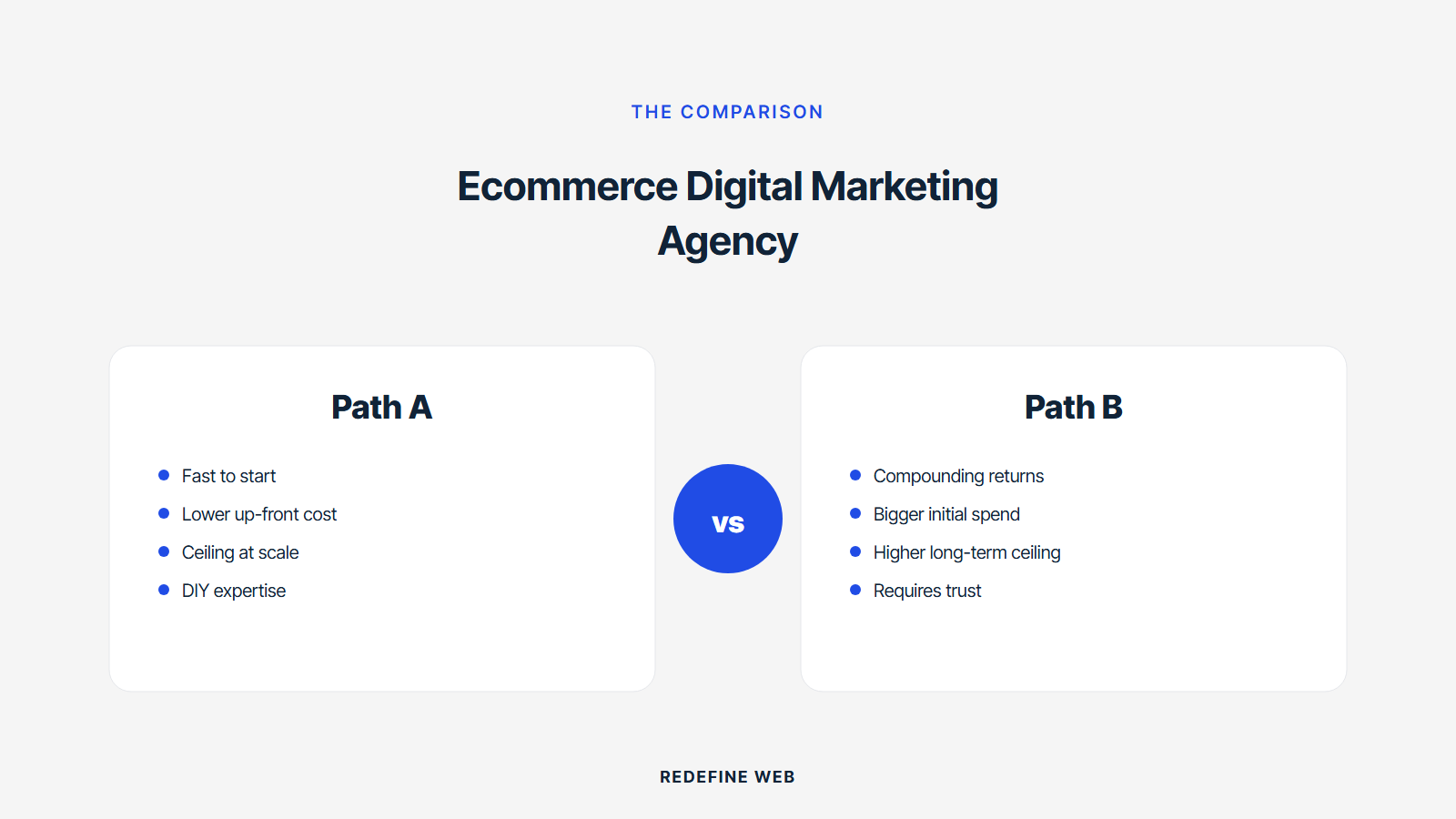
Store owners weigh in-house teams against agency retainers at least once a year, usually after a report shows a bad month or after a new investor asks the question. The comparison depends on brand stage, hiring capacity, and specialist skill needs across the four channels. In-house teams win on brand voice and speed of small changes. Agencies win on tooling depth, cross-account benchmarks, and specialist coverage across paid, SEO, email, and creative at the same time.
Cost Math Beyond the Retainer
An in-house paid media specialist costs 85,000 to 130,000 a year fully loaded. An in-house ecommerce SEO manager runs 75,000 to 110,000. A lifecycle email specialist runs 70,000 to 100,000. Creative production runs another 60,000 to 120,000 for a designer plus copywriter. Total loaded cost for a four-person in-house marketing team lands between 290,000 and 460,000 a year, before tools. Most brands under 8 million in yearly revenue cannot support that headcount, which is where the agency retainer conversation opens on its own.
Hybrid Models Work at Scale
Brands past 10 million in revenue often run hybrid: an in-house marketing director plus one in-house channel specialist, paired with an agency retainer covering the other channels and specialist tooling. The in-house director owns brand voice, roadmap, and cross-channel strategy. The agency covers execution depth on paid, SEO, and email. That split scales cleanly into the 30 to 50 million revenue range without either side burning out or losing the plot on what the brand voice should sound like on a Tuesday afternoon Meta ad.
Platform Fit Under Ecommerce Digital Marketing Agency Work
Platform choice affects retainer scope. Shopify simplifies tracking and Klaviyo integration but restricts backend customization. WooCommerce opens up backend flexibility on WordPress but takes more agency hours on tracking hygiene and site speed. BigCommerce handles B2B and hybrid stores with tiered pricing built in. A working ecommerce digital marketing agency treats all three as viable and picks based on the current business model, not on the platform the agency happens to prefer.
Shopify Dominates Mid-Market
Shopify covers roughly 70 percent of mid-market DTC brands an agency touches. Shopify Plus opens up B2B wholesale, checkout customization, and multi-currency selling. Klaviyo integrates natively for email and SMS. Google and Meta ad platforms plug into Shopify feeds without custom developer work. The Shopify app ecosystem covers reviews, subscription, upsell, and analytics with a few well-chosen apps rather than a heavy custom build. That platform simplicity keeps the agency focused on marketing work instead of engineering firefighting.
WooCommerce Fits Content-Heavy Brands
WooCommerce fits brands that already run WordPress for content and want a native ecommerce layer without a platform swap. Content-heavy brands with strong blog SEO usually keep WordPress and add WooCommerce rather than migrate the content to Shopify. The tradeoff sits in tracking hygiene and page speed: WooCommerce sites need more careful setup on GA4, Meta Pixel, and Core Web Vitals ecommerce website maintenance services than Shopify sites do. See our take on Shopify vs WooCommerce SEO for the deeper comparison. Read the Content Marketing Institute ecommerce guide alongside for external framing.
How Do You Vet an Ecommerce Digital Marketing Agency Before Signing
Vet the agency before the retainer starts by asking five specific questions that reveal whether the team has real depth or is pattern-matching sales scripts. The five questions cover reporting structure, team composition, ROAS targets, attribution method, and Shopify app choices. Real answers come with numbers and named team members.
The Five Vetting Questions
- Show me your reporting template and how it splits new customer revenue from returning customer revenue
- Which team member writes ad copy and product page copy directly, not a subcontractor across the world
- What is your target ROAS floor by product category, and what plays get you there
- How do you handle attribution across Meta, Google, Klaviyo, and Shopify without double-counting revenue
- Which Shopify or WooCommerce apps do you install as part of onboarding, and why each one
The agency that answers each question with real numbers and named team members earns the pilot conversation. The agency that dodges any of the five deserves a polite pass. Store owners who use these five questions on their next three agency sales calls usually spot the gap inside 20 minutes, which saves months of retainer disappointment later. Ask for three named client references at the store owner’s revenue tier, not case studies from Fortune 500 accounts that share nothing with a growth-stage DTC brand. Guides from Neil Patel’s ecommerce coverage cover the broader vetting rhythm for readers running the process for the first time.
The First 90 Days With an Ecommerce Digital Marketing Agency
The first 90 days set the tone for the whole partnership. Month one is audit and setup. Month two is quick wins and reporting foundation. Month three is optimization on real data and the first quarterly business review. Agencies that skip the audit and jump straight to campaign launches usually miss tracking gaps that make the first three months of data unusable.
Month One Deliverables
Month one delivers a written audit covering paid account structure, Shopify tracking integrity, GA4 event mapping, Klaviyo flow status, SEO baseline on top 20 pages, and a prioritized fix map. Nothing goes live yet, but every following month has a clear direction. Store owners who skip the audit usually rebuild the entire measurement layer six months in because the data was never trustworthy from day one. The 90-day framing rhymes with the ecommerce marketing retainer we scope for new brands.
Months Two and Three Execution
Month two runs the fixes: paid account restructures, Klaviyo flow builds, category page rewrites, GA4 event corrections, and creative rotation setup. Month three optimizes on real data and delivers the first quarterly business review with the store owner. By the end of month three the reporting cadence is locked, the tracking is clean, and the four channels are running under one plan. Real gains usually show inside month four and compound from month six onward. For a template-first walk of the same channel setup read our marketing plan for ecommerce guide.
Where an Ecommerce Digital Marketing Agency Fits the DTC Growth Stack
An ecommerce digital marketing agency sits between the brand’s product and merchandising teams and the acquisition surface where paid, SEO, email, and creative all meet. Product owns what gets sold. Merchandising owns how it gets priced and bundled. The agency owns how the offer meets the customer across every channel. When those three seats coordinate well, the store compounds. When they miscommunicate, retainer dollars vanish into channels the product side is not ready to support. For the plain ecommerce marketing definition and how the channels connect, that companion guide covers the full model.
The right agency also stays quiet about work it does not touch. If the brand runs its own influencer program, the agency should not muscle in. If the brand carries its own PR, the agency should stay coordinated but not competitive. Real agency partnerships name what is in scope and what is out, and they hold that line for the length of the contract. Fuzzy scope creates fuzzy accountability, and fuzzy accountability leads to unhappy quarterly business reviews.
Store owners ready to talk retainer scope with Redefine Web can start with a free tracking and paid account audit. That audit produces a written fix map and a channel-priority order before any retainer conversation. Whether the brand is a starter Shopify store doing 200,000 a year or a Scale-tier DTC brand pushing past 20 million, the audit-first pattern beats the demo-first pattern every quarter. That is the honest way an ecommerce digital marketing agency starts a working partnership. Read the deeper walk on our ecommerce digital marketing strategy guide for how these channels stack under one plan.
For the full playbook across paid, organic, email, SMS, and retention, see our companion post on ecommerce marketing strategies that drive DTC revenue.
Agency budgets pay back fastest against a store that already applied the core ecommerce web design tips covering PDPs, cart drawers, and mobile viewport. For the operational habits that keep these programs on rhythm, walk the best practices for ecommerce marketing deep read.
Frequently asked questions
What does an ecommerce digital marketing agency actually do?
An ecommerce digital marketing agency plans and runs the four channels that move online store revenue: paid media across Meta and Google, ecommerce SEO for category and product pages, email and SMS retention flows, and creative production tied to each channel. The retainer covers strategy, campaign builds, weekly optimization, monthly reporting, and quarterly business reviews. Strong agencies split reporting between new customer revenue and returning customer revenue so the store owner sees which spend brings first orders and which spend brings repeats. Weak agencies blend the two and claim credit for repeat customers who already knew the brand.
How much does an ecommerce digital marketing agency cost?
Ecommerce agency retainers run from around 599 dollars a month for a small starter package up to 25,000 dollars a month for enterprise DTC brands. A single-channel setup on Meta or Google alone starts near 2,000 to 4,000 dollars a month at a boutique agency. A full-stack retainer covering paid, SEO, email, and creative runs 5,000 to 12,000 a month for mid-market Shopify brands and 15,000 or more for stores over 10 million in yearly revenue. Media spend sits on top of retainer, and any agency that quotes a percentage-of-spend model without a floor tends to underserve accounts below 30,000 monthly spend.
How long does it take to see results from an ecommerce digital marketing agency?
Paid media on Meta and Google usually shows first ROAS signal inside two to three weeks once creative rotation begins. Ecommerce SEO takes three to six months for category page ranking gains and six to twelve months for compounding non-branded organic revenue. Email and SMS flows recover cart and post-purchase revenue in weeks four through eight after the flow builds go live. A full-stack retainer that covers all four channels usually shows meaningful revenue movement inside the first quarter and durable compounding inside the second and third quarters. Agencies that promise material gains inside 30 days across every channel are selling a story.
How do you pick the right ecommerce digital marketing agency for a DTC brand?
Ask five questions before signing. Show me your reporting template and how it splits new customer revenue from returning customer revenue. Which of your team writes ad copy and product page copy directly, not a subcontractor. What is your target ROAS floor by product category, and how do you get there. How do you handle attribution across Meta, Google, Klaviyo, and Shopify without double-counting revenue. Which Shopify apps do you install as part of onboarding, and why each one. The agency that answers each question with real numbers and named team members deserves the pilot. The agency that dodges deserves a pass.
What is the difference between a full-service ecommerce digital marketing agency and a specialist agency?
Full-service agencies run every channel under one retainer with one account team. Specialist agencies focus on one channel deeply: Meta only, Google Shopping only, or Klaviyo email only. Full-service works when the brand needs coordinated messaging across paid, organic, and email at the same creative pace. Specialist agencies work when the brand already runs a strong in-house team on the other channels and needs deeper skill in one place. Store owners that mix three specialist agencies usually spend more on coordination overhead than they save on channel depth, so full-service tends to win below 30 million in annual revenue.
Can an ecommerce digital marketing agency work with a Shopify or WooCommerce store equally well?
The right agency runs both platforms without preference and picks based on what the store already sits on. Shopify covers 70 percent of the mid-market DTC brands an agency touches, WooCommerce covers most of the WordPress-native and content-heavy brands, and BigCommerce handles a small pool of B2B and hybrid stores. Agencies that push a platform migration inside the first sales call rarely have a technical reason and often earn a build fee on the switch. Real agency guidance evaluates the current stack, the tracking integrity, and the conversion friction before recommending any platform change.
Book your free 30-minute strategy call.
No spam, no sales rep. We use your email to schedule your call with a senior strategist. That is it.
More from the blog
View all articles → Digital Marketing
 Dental Marketing Tips That Compound Into New Patients
Read article Digital Marketing
 Ecommerce Marketing Strategies That Drive Real DTC Revenue
Read article Digital Marketing