
Ecommerce SEO Audit Checklist and Priority Fixes for DTC
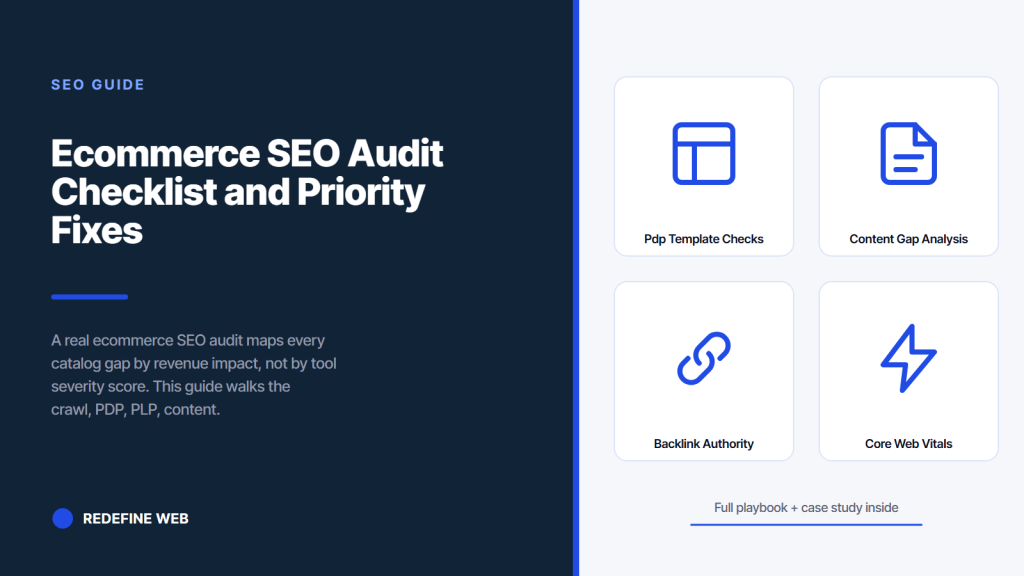
- Rank every audit fix by revenue impact, not tool severity.
- Template-level PDP and PLP fixes hit hundreds of URLs at once.
- Crawl budget waste sits inside faceted URLs and orphans.
- Content gap analysis filters raw exports by real buying intent.
- Mini audits every quarter, full audit annually.
- PDP template checks inside an ecommerce SEO audit
- PLP and category hub checks inside an ecommerce SEO audit
- Content gap analysis inside an ecommerce SEO audit
- Backlink and authority checks inside an ecommerce SEO audit
- Core Web Vitals and performance checks inside an ecommerce SEO audit
- Prioritization framework inside an ecommerce SEO audit
- Shopify vs WooCommerce differences inside an ecommerce SEO audit
- How often does an ecommerce SEO audit repeat
- A real ecommerce SEO audit that shipped for a DTC brand
- Where an ecommerce SEO audit fits the DTC growth stack
A DTC skincare brand paid $9,400 for an ecommerce seo audit deck last spring that ran 148 slides and produced a fix list of 372 items graded low to critical. Six months later, the team had closed 41 of them, mostly the easy ones a developer could handle inside a sprint. Organic revenue moved 2 percent. The founder asked whether the audit was the problem or SEO was just slow. The real problem was the audit. It ordered fixes by tool severity score, which weights title-tag length the same as a broken canonical stack. A workable audit ranks fixes by revenue impact, so the team runs the 12 changes that move numbers first and defers the 300 that never would have.
This guide covers the ecommerce seo audit our team runs for DTC brands between $500k and $40M annual revenue. Technical crawl checks that surface real crawl-budget waste. PDP and PLP template audits that fix 400 URLs at once. Content-gap analysis against competitor rankings. Priority-fix framework that queues the highest-impact changes across the first 90 days. Every checklist item and number below comes off real client audits our team ran in 2024 and 2025 across Shopify, WooCommerce, and headless stacks.
PDP template checks inside an ecommerce SEO audit
Product detail page checks carry the highest revenue impact of any surface in the audit because a PDP template fix touches every SKU at once. Our companion post on seo for ecommerce product pages covers the template-layer decisions in more depth. A store with 400 SKUs gets 400 pages of ranking improvement from one template change. The PDP audit checks the template layer first, then samples 30 to 50 PDPs to catch per-URL issues the template cannot fix.
| PDP check | Common failure | Revenue impact if fixed | Effort |
|---|---|---|---|
| H1 keyword modifier | Product name only, no category term | 3 to 8 percent per PDP | 2 dev hours template |
| Meta title format | Brand appended, keyword buried | 3 to 6 percent CTR gain | 1 dev hour |
| Description depth | Manufacturer syndication, 40 words | 8 to 14 percent per PDP | Writer hours per SKU |
| Schema stack | Product only, no Review or FAQ | Rich result eligibility | 4 to 8 dev hours |
| Image alt text | Empty or SKU code only | Image search traffic gain | Scriptable per SKU |
| Internal linking | Random related products | Passes link equity to hub | 6 to 10 dev hours |
| Review markup | Below fold, no HTML schema | 1 to 4 percent CVR gain | Template change |
Description depth against manufacturer syndication
Most DTC stores under $5M annual pull PDP descriptions straight from the manufacturer feed. Google reads this as duplicate content across every retailer selling the same SKU. Original 200 to 350 word descriptions covering use cases, sizing, comparisons, and 3 real buyer questions rank above the syndicated version in 8 to 14 weeks. Writing original copy for 400 SKUs takes 3 to 4 months at 6 SKUs per writer hour. The audit flags this at the template level rather than URL by URL because the fix scope is a writing project, not a code project. Founders scoping this after the audit should budget writer time before dev time.
PLP and category hub checks inside an ecommerce SEO audit
Product listing pages carry more organic revenue than any other page type on a DTC store, and they get the least audit attention. Most audit decks skip PLP copy entirely and grade the pages on title tag length. A real audit checks the category-level intent match, the on-page copy depth, the faceted navigation stack, and the internal linking pattern into and out of the hub.
Category-level intent match
Every PLP should rank for the category-level commercial buying query. The audit checks whether the URL, H1, title tag, and body copy all match the query intent. A category called Bath Bombs targeting the query best bath bombs for eczema fails the intent match. The category needs either a renamed URL (Bath Bombs for Sensitive Skin) or a new sub-category page with the tighter intent. Audit teams that flag intent mismatch at the URL level miss the template pattern. Audit teams that flag it at the category structure level surface the renaming or re-architecture work the store actually needs. Our writeup on ecommerce category page seo covers the category structure work at more length for teams past the audit stage.
PLP copy depth and placement
The audit checks whether every PLP renders 150 to 250 words of on-page copy above the product grid. Copy stuffed at the bottom of the page (the Shopify default) passes some ranking signal but bounces at 60 percent. Copy missing entirely leaves 4 to 9 positions of ranking on the table across the top 40 commercial keywords. The template-level fix wires a category description CMS field into the theme so the marketing team can write copy per category without dev support. Search Engine Journal ran a good breakdown on the technical audit checklist for ecommerce stores that covers the PLP surface for teams working audit fixes in-house.
Content gap analysis inside an ecommerce SEO audit
Content gap analysis compares the store’s ranking coverage against the top 3 to 5 competitors in the category. The gap surfaces the informational and commercial keywords the competitors rank for and the store does not. A real audit pulls this from Ahrefs Content Gap or Semrush Keyword Gap and filters the raw list down to queries with real buying intent, not vanity long-tail traffic.
Filtering raw gap data for real intent
Raw content gap exports from Ahrefs or Semrush usually run 3,000 to 15,000 keyword rows. Most rows are noise. The audit filters the list against three criteria before it lands in the fix plan. Keyword must have a monthly search volume above 100 in the target country. Keyword intent must map to commercial or informational buying stages (not navigational or transactional for a different brand). The competitor ranking must be in positions 1 to 20, which means the query is winnable. The filtered list usually lands at 40 to 200 real keywords the store should target across the next 12 months. That list feeds the pillar and cluster plan for the content team.
Mapping gap keywords to page types
Every filtered gap keyword gets mapped to a target page type. Commercial buying queries (best X, X vs Y, X reviews) map to existing PDPs, PLPs, or new comparison pages. Informational queries (how to solve problem, what causes symptom) map to blog posts inside the pillar structure. Long-tail SKU-specific queries map to individual PDPs the store already runs. Practices that skip the mapping step end up publishing blog posts for queries that would have better ranked on a PLP with 200 more words of copy. The mapping is the strategic call that the audit surfaces and the content team executes over the following six to twelve months.
A 372-item fix list ordered by tool severity moves nothing. Take your audit, add a column for expected revenue impact, sort by that. Top 12 fixes are your quarter.
Backlink and authority checks inside an ecommerce SEO audit
Backlink checks close the loop on the audit. Domain authority sets the ranking ceiling for every URL on the site, so a store with weak authority caps out at position 8 for head terms regardless of on-page work. The audit checks referring-domain count, anchor text distribution, toxic link exposure, and competitor gap on authority.
The four backlink checks that matter
- Referring domain count and growth rate. Stores gaining fewer than 3 to 5 new referring domains per month across a 90-day window are stalled on authority and cannot break past position 8 to 10 in competitive categories.
- Anchor text distribution. Overweighted exact-match commercial anchors (over 30 percent of links) signal manipulation risk. Healthy distribution runs 50 percent brand, 25 percent generic, 15 percent partial-match, 10 percent exact-match.
- Toxic link exposure. Links from PBN sites, expired-domain redirects, and comment spam networks carry algorithmic risk. The audit disavows the worst offenders through Search Console.
- Competitor authority gap. Top 3 competitor stores usually carry 2x to 5x the referring-domain count. The gap sets the outreach volume the store needs to close across the next 12 to 24 months.
Disavow discipline without over-scrubbing
Most audit decks disavow too many links or none at all. Over-disavowing kills legitimate editorial equity the store spent years building. Under-disavowing leaves algorithmic risk on the domain. The right discipline flags any link from a domain with under 10 referring domains itself, spam-score above 60, or clear PBN footprint (thin content, unrelated topic, expired-domain redirect trail). Everything else stays. Retainers that submit disavow files with 4,000 domains without human review usually damage rankings for six months before the team catches the mistake. Moz covers the disavow tool workflow for teams working link cleanup in-house before hiring outside help.
Core Web Vitals and performance checks inside an ecommerce SEO audit
Core Web Vitals sit inside the technical audit but deserve their own section because performance moves revenue faster than almost any other fix. Every 500 milliseconds of Largest Contentful Paint gain moves organic revenue 3 to 6 percent per Google’s own field data. On mobile PDPs, the gain climbs to 8 percent for stores starting above 4 seconds.
The three Core Web Vitals thresholds
Largest Contentful Paint under 2.5 seconds on mobile PDP and PLP. Interaction to Next Paint under 200 milliseconds. Cumulative Layout Shift under 0.1. The audit pulls field data from Chrome UX Report or PageSpeed Insights for the top 20 pages by traffic. Lab data from Lighthouse alone lies about real-user performance because it runs on a throttled desktop simulation, not on the mobile device the buyer actually uses.
The performance fixes that carry the audit
Image optimization sits at the top of most performance audits because unoptimized product images account for 40 to 70 percent of LCP time. WebP conversion, responsive srcset markup, and lazy loading below the fold usually cut LCP by 800 milliseconds to 1.4 seconds on Shopify stores. Third-party script bloat sits second. Every review widget, chat plugin, and analytics tag adds 100 to 400 milliseconds to interaction time. The audit ranks scripts by weight and flags the ones that can defer or ship async. Third-party CSS and font loading round out the top three. Web.dev covers Largest Contentful Paint optimization at engineering depth for teams working the fixes in-house.
Prioritization framework inside an ecommerce SEO audit
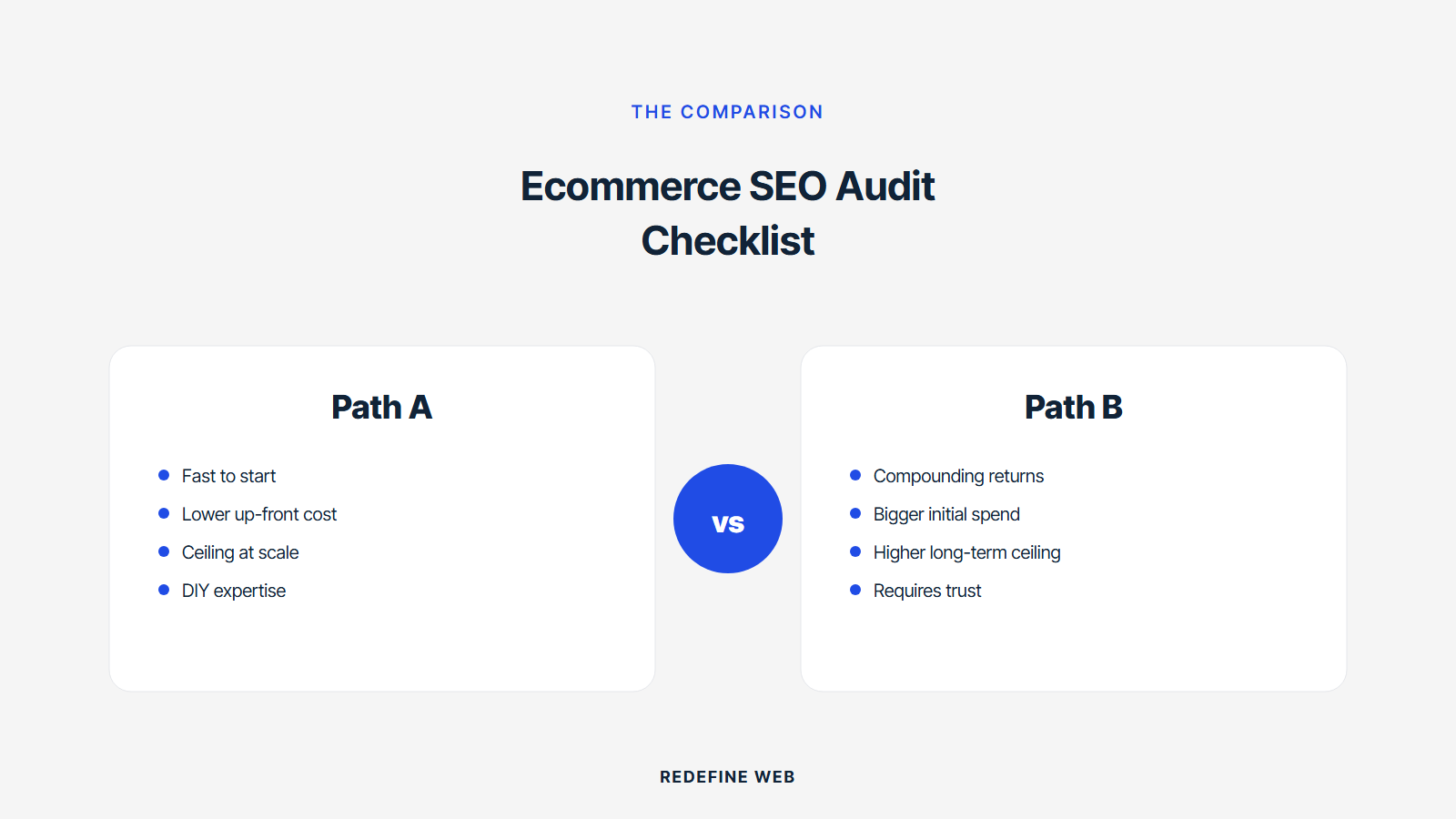
Prioritization is the artifact that separates a real audit from a slide dump. The framework ranks every issue by revenue impact per hour of effort, not by tool severity score. Fixes that move revenue 5 percent inside 90 days for 10 dev hours rank P0. Fixes that move revenue 0.5 percent for 40 dev hours rank P2 or defer entirely. Founders read the P0 tier first and start work the same day.
Every quarterly audit review meeting eventually reaches the moment where the developer asks why the 372-item fix list has 41 P0 items when the sprint holds 8 story points. The consultant explains that P0 is the top tier, that the ranking accounts for revenue impact, and that the team should pick the 8 most impactful P0 items for the sprint. Nobody in the room knows how to pick. The consultant then explains that a real P0 tier should hold 6 to 12 items sitewide, not 41. Somewhere in the corner of the audit deck, an ancient screenshot of a title-tag length warning is still being labeled critical severity by the tool that generated it.
The four tiers of the priority stack
- P0 ship this sprint. 6 to 12 items sitewide. Every item projected to move organic revenue 3 percent or more inside 90 days. Template-level fixes that touch hundreds of URLs at once.
- P1 ship this quarter. 15 to 30 items. Projected revenue impact 1 to 3 percent per item. Includes content pillar work, PDP description rewrites, and category structure changes.
- P2 next 6 months. 40 to 80 items. Projected impact under 1 percent per item but adds up. Includes tag page cleanup, blog post refreshes, and schema depth improvements.
- Defer. Everything else. Title-tag length warnings on internal search pages. Missing alt text on tag archive pages. Low-volume orphan pages. Tool severity is high, real impact is zero.
Effort estimates that hold up in sprint planning
Effort estimates in the audit should match sprint reality. Template-level fixes usually run 4 to 20 developer hours. Content rewrites run at the writer’s per-hour output rate (6 SKUs per hour for PDP descriptions, 400 words per hour for blog work). Schema stack rebuilds run 6 to 12 hours per template. Audits that estimate everything at 2 hours or leave estimates blank produce fix plans the dev team refuses to accept because the numbers do not match reality. Retainers that build audit estimates from real sprint data across previous engagements ship 80 percent of P0 items inside 90 days. Retainers that estimate blind ship 30 percent.
Shopify vs WooCommerce differences inside an ecommerce SEO audit
Platform choice changes what the audit finds. Shopify carries baked-in SEO defaults and locked template limits. WooCommerce carries plugin freedom and technical debt neither platform hides forever. A real audit runs different checks on each, then produces different priority stacks per platform.
Shopify audit focus
Shopify audits spend 40 percent of the check time on theme code (schema depth, template overrides, PLP copy blocks) and 60 percent on content, links, and category structure. The platform handles sitemaps, canonicals, mobile responsiveness, and basic Core Web Vitals on Dawn-based themes without dev work. The blockers show up in URL structure (forced /products/ and /collections/ prefixes), theme template rigidity that limits schema customization, and app ecosystem script bloat. Audit fixes concentrate on the theme code layer.
WooCommerce audit focus
WooCommerce audits spend 30 percent of the check time on plugin audit and cleanup, 25 percent on schema and template code, and 45 percent on content, links, and category structure. The platform’s plugin freedom cuts both ways. Full URL control and schema customization are real strengths. Plugin bloat (10 to 20 plugins on a mature store slow LCP past 4 seconds), stale WordPress instances that miss core updates, and plugin-driven schema stacks shipping broken JSON-LD are the blockers. Our comparison on shopify vs woocommerce seo covers the platform fork at more length for teams choosing between the two.
How often does an ecommerce SEO audit repeat
Audit cadence matters as much as the audit depth. One-time audits produce a 90-day fix list and then go stale as the site changes. Ongoing audits catch new issues before they compound. The right cadence depends on the store’s stage and change velocity, not on the retainer schedule.
Full audit versus mini audit rhythm
A full ecommerce seo audit runs once per year at the deep depth described in this guide. Mini audits run quarterly and check crawl budget shifts, ranking movement, new duplicate content from product launches, and Core Web Vitals regression. Monthly reviews check Search Console for new indexation errors and manual actions. Stores publishing more than 40 new pages monthly should run mini audits every 6 weeks instead of quarterly because the change velocity outpaces the standard cadence. Stores under 5 new pages monthly can stretch the mini audit to every 4 months.
What triggers a mid-cycle audit
Three events trigger a mid-cycle audit outside the regular rhythm. Platform migration (Shopify to Shopify Plus, WooCommerce to headless, replatform to BigCommerce) always warrants a fresh audit inside 30 days of launch because migration usually introduces canonical, redirect, and sitemap issues. Google algorithm updates that produce a 15 percent or larger organic revenue swing warrant a mid-cycle check of what changed. Catalog expansion above 40 percent (adding hundreds of new SKUs) warrants an audit of the new template performance and internal linking. Stores that skip the trigger-based audits usually catch the issues 6 to 12 months late, after ranking losses compound.
A real ecommerce SEO audit that shipped for a DTC brand
Custimy came to our team with a customer data platform for ecommerce operations running on a WordPress and custom PHP stack. The site consolidated data from CMS, email, analytics, customer service, and social media into a unified dashboard for DTC retailers. The founders needed organic search to work as a real acquisition channel for the SaaS product, not just a brand touchpoint. Organic traffic sat at 4,100 monthly sessions, most of them landing on three blog posts about customer data unification. Ranking coverage across the 40 top commercial keywords averaged position 24. The retainer was running $3,200 monthly with a Nordic SEO agency delivering two blog posts per month and quarterly rank reports.
Our team ran a full ecommerce seo audit across four weeks that produced a 47-item ranked fix list, a template-level diagnosis of the WordPress PLP and PDP-equivalent product pages, and a 90-day rollout plan split across three sprints. P0 tier held 8 items including a broken canonical stack across the product pages, missing Product and SoftwareApplication schema on every SKU, an unstructured internal linking pattern from blog to product pages, and 6 orphan PDPs the site had never linked from anywhere. P1 tier held 22 items including PLP copy depth, blog cluster consolidation, and a schema stack rebuild for the case study library. P2 tier held 17 items scheduled for months 4 through 6.
Over the following 14 months, Custimy shipped every P0 item inside 60 days, 19 of 22 P1 items inside 6 months, and 14 of 17 P2 items across the remaining window. Organic traffic climbed to 25,000 monthly visits. First-page ranking coverage held across 500+ keywords in the SaaS category. Average session duration on the SaaS product pages moved to 165 seconds from under 90 seconds. The audit did not cause all the gains alone. It made the site into an organized system where every page contributed to compounding growth instead of fighting itself for ranking.
Vertical variants like fashion SEO services for apparel and accessories brands need specific PDP variant and season keyword work on top of the base audit.
For pet DTC brands specifically, our guide on the pet industry SEO company covers the species-and-condition silo pattern that ecommerce SEO looks like inside a pet vertical.
Where an ecommerce SEO audit fits the DTC growth stack
An ecommerce seo audit sits at the top of every SEO engagement. Retainers that skip the audit and jump into monthly content deliverables produce content that ranks at position 40 for six months and then stalls because the underlying technical and template issues cap the ceiling. Audits done right run once at engagement kickoff, then quarterly mini-audits keep the fix list honest as the site evolves.
Our ecommerce seo hub covers the retainer scope for founders scoping a real SEO engagement that delivers fixes rather than reports. An ecommerce seo audit is the plan that decides which organic revenue investments compound and which stay stuck as isolated tactics for another 12 to 24 months. Founders scoping their first audit should ask for the three artifacts named at the top of this guide before signing anything. Retainers that promise a deck instead of a ranked fix list, a template diagnosis, and a 90-day rollout plan are selling something else under the audit label. The clearest test is asking for a sample deliverable from a previous engagement. Vendors who cannot show one usually cannot produce one.
For hybrid retailers with physical showrooms alongside the ecommerce catalog, our writeup on local seo for ecommerce businesses covers the four-surface local ranking stack that pairs with product and category work.
The Google SEO starter guide pairs cleanly with the audit framework above for teams pressure-testing agency audit proposals against Google’s own guidance before signing any retainer. Founders who read both alongside the technical audit checklist end up with SEO engagements that queue the highest-impact 12 fixes first and defer the 300 low-impact ones that never would have moved revenue anyway. That discipline is the difference between an audit that compounds and an audit that gathers dust in a shared drive.
The audit tells the team what to fix. The 90-day rollout plan tells the team when. The team runs the top 12 P0 items across the first three sprints, moves into P1 across the next quarter, and re-audits the following quarter to catch anything new. Stores that hold this rhythm produce compounding ranking gains across every content and template surface at once. Stores that treat the audit as a one-time deliverable stall at month three when the fix list runs out and nothing new lands on the team’s queue.
Frequently asked questions
What does an ecommerce seo audit actually cover?
An ecommerce seo audit covers six surfaces at real depth. Crawl and indexation checks that surface where Google is wasting budget on parameterized URLs and orphan pages. PDP template checks that fix 400 SKUs at once through one code change. PLP and category hub checks that grade intent match and copy depth. Content gap analysis against the top competitors in the category. Backlink and authority checks that set the ranking ceiling. Core Web Vitals and performance checks that pull LCP under 2.5 seconds on mobile. Audits that stop at title-tag length warnings and meta description scoring miss the surfaces that actually move DTC revenue.
How long does a real ecommerce seo audit take to run?
A full ecommerce seo audit takes 3 to 5 weeks to run properly on a store with 100 to 800 SKUs. Week one runs the technical crawl, indexation checks, and Core Web Vitals data pulls. Week two runs the PDP and PLP template audit plus content gap analysis. Week three runs the backlink audit, competitor benchmarking, and priority stack ranking. Weeks four and five build the 90-day rollout plan with named owners and sprint-ready effort estimates. Audits shipped in under two weeks usually skip the template diagnosis and produce URL-level fix lists that miss the highest-impact surfaces on the store.
How do you prioritize an ecommerce seo audit fix list?
Ecommerce seo audit fix lists prioritize by revenue impact per hour of effort, not by tool severity score. P0 items ship this sprint and are projected to move organic revenue 3 percent or more inside 90 days. A healthy P0 tier holds 6 to 12 items sitewide, not 41. P1 items ship this quarter with 1 to 3 percent revenue impact per item. P2 items ship across the next 6 months with under 1 percent per item but add up. Everything else defers. Fix lists that leave severity scoring on the tool default produce 300-item plans that DTC teams never work through, which is why most audits get shelved after the first sprint.
How much does a real ecommerce seo audit cost?
A real ecommerce seo audit costs between $5,000 and $18,000 depending on catalog size and platform complexity. Stores under 200 SKUs on Shopify land at the low end. Stores with 2,000 plus SKUs on WooCommerce or headless stacks land at the high end because plugin audits and template diagnosis take longer. Audits under $3,000 usually run on tool exports without human review and produce the 300-item fix list dumps that DTC teams cannot execute against. Audits above $25,000 typically bundle audit and 90-day execution together, which is fine when the pricing is transparent but confusing when the two get billed separately. Our team quotes audit-only engagements at $6,800 for stores in the middle bracket.
How often should a DTC store run an ecommerce seo audit?
DTC stores should run a full ecommerce seo audit once per year at real depth, then mini audits quarterly to catch new issues before they compound. Monthly Search Console reviews catch indexation errors and manual actions early. Three events trigger a mid-cycle audit outside the regular rhythm. Platform migrations warrant a fresh audit inside 30 days of launch. Google algorithm updates producing a 15 percent or larger organic revenue swing warrant a check of what changed. Catalog expansion above 40 percent warrants an audit of the new template performance and internal linking. Stores that skip trigger-based audits usually catch the issues 6 to 12 months late after ranking losses compound.
Book your free 30-minute strategy call.
No spam, no sales rep. We use your email to schedule your call with a senior strategist. That is it.
More from the blog
View all articles → SEO
SEO Organic Search Engine Optimization Services That Grow Real Traffic
Read article SEO
SEO SEO for Pet Groomers That Fills the Appointment Book Weekly
Read article SEO
SEO