Ecommerce SEO for Shopify and WooCommerce Stores
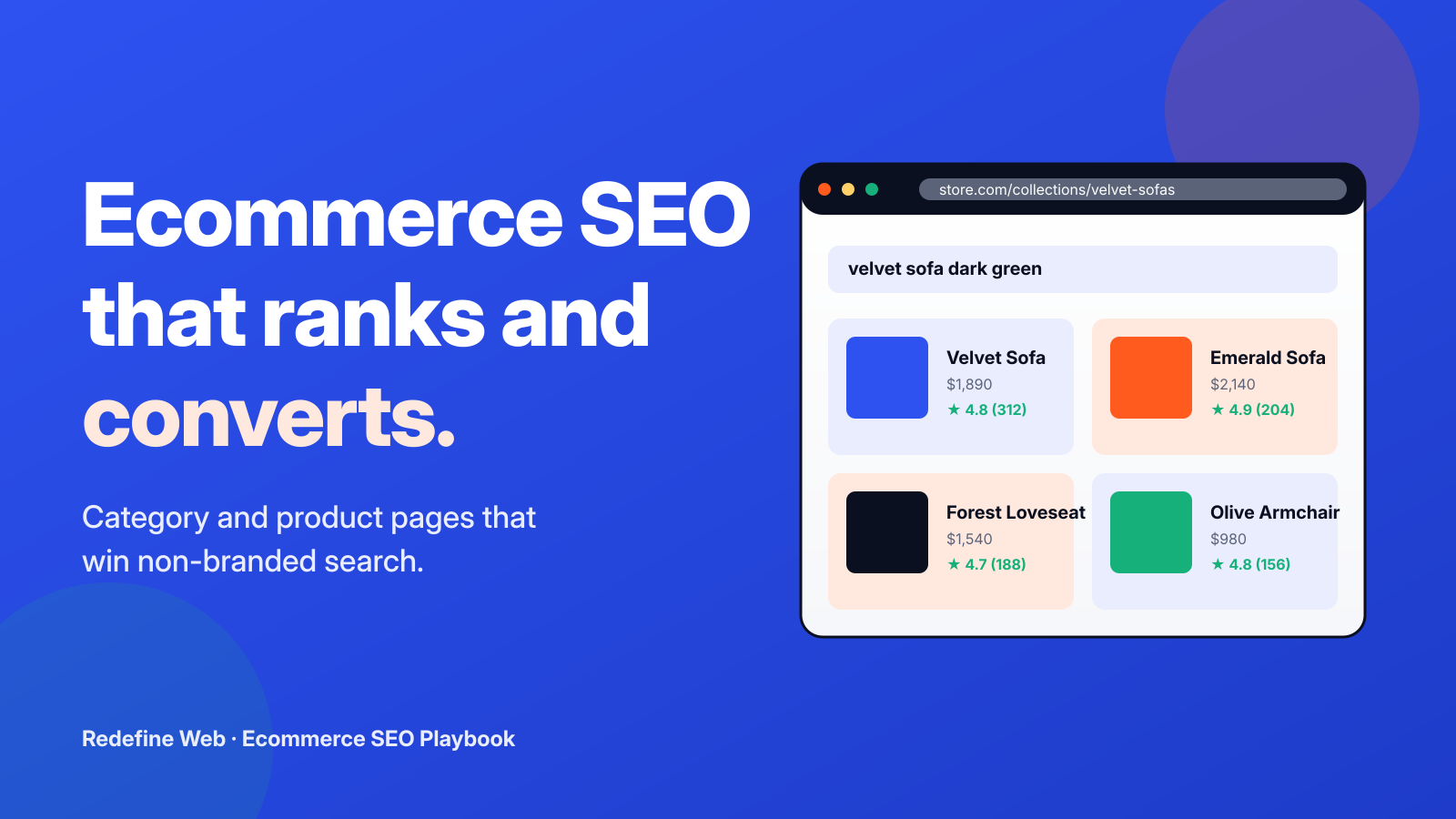
- Ecommerce SEO grows non-branded organic revenue at a fraction of paid CAC, with 43% of DTC ecommerce traffic coming from organic search.
- Category pages carry 55 to 70% of organic sessions and 60 to 80% of organic revenue on a healthy DTC store, so they are where the SEO work pays off first.
- Product schema, canonical hygiene on filtered URLs, and Core Web Vitals under 2.0s LCP are the three technical fixes that move rankings fastest.
- A 500-SKU DTC brand should budget $3,000 to $7,500 monthly for ecommerce SEO and expect non-branded traffic gains in three to five months.
- Abigail Ahern grew ecommerce revenue 179% and paid-search ROAS to 1,588% by restructuring category and product SEO around intent-driven traffic.
Ecommerce SEO is what turns a Shopify or WooCommerce store from a paid-media dependent business into one that earns free traffic every day. Get it right and non-branded search starts producing revenue at a fraction of your paid CAC. Get it wrong and you spend the next year buying every click. This guide walks the exact playbook we use on ecommerce SEO engagements, from category-page architecture and product schema to Core Web Vitals and the retention math that decides which SKUs deserve SEO investment in the first place.
What ecommerce SEO actually means
Ecommerce SEO is the process of ranking category, product, and buying-guide pages for the searches your customers already run. It is not a content marketing sideshow. Roughly 43% of all ecommerce traffic comes from organic Google search, and the shoppers who click those results convert at a higher rate than paid social visitors on nearly every DTC benchmark we have seen. That is the whole game. You are competing for the query, then converting the click.
The mistake most DTC stores make is treating ecommerce SEO like blog SEO. They build a Notion doc full of top-of-funnel guides and skip the pages that actually sell. The pages that sell are collection pages and product pages. On a healthy DTC site, category pages carry 55 to 70% of organic sessions and 60 to 80% of organic revenue. Product pages carry the next 20 to 30%. Blog content is the last 5 to 15% and only pays off if it links inward with a real buyer-intent anchor.
The ecommerce SEO services page lays out how we scope this by store size and revenue floor. Everything below is the reasoning behind that scope. If you are still deciding whether to keep SEO in-house or route it through an ecommerce marketing agency, the trade-off is usually cost per hour of senior attention against monthly retainer flexibility.
Site architecture that Google can actually crawl
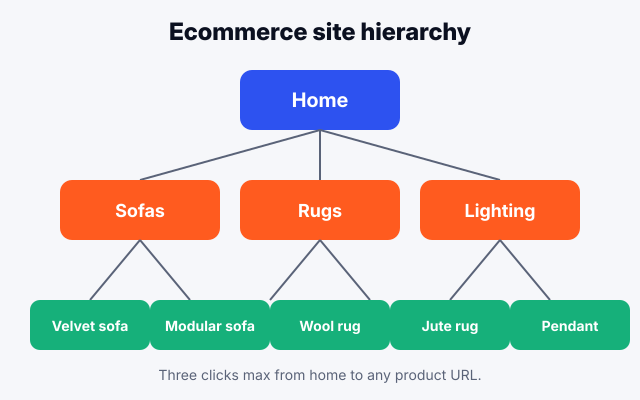
Every ecommerce SEO engagement starts here, since every downstream fix depends on it. If the URL structure is wrong, the on-page work rots. The goal is a shallow, keyword-mapped hierarchy where any product sits three clicks or fewer from the homepage.
Home links to major collections. Collections link to sub-collections when the vertical is broad enough to justify them (a rug collection can support wool, jute, and washable sub-collections; a candle line usually cannot). Sub-collections link to products. Products cross-link to related products in the same collection. Breadcrumbs mirror the hierarchy in HTML, not just visually, so crawlers read the parent-child relationship the same way a shopper does.
Two rules we enforce on every audit. First, collection URLs stay flat under a single /collections/ or /shop/ path. Do not nest sub-collections into the URL when the store is under 500 SKUs, since the extra path depth signals lower priority to Google. Second, product URLs never carry collection tokens. A single canonical product URL prevents the exact duplicate-content trap Shopify creates by default when the same product appears in multiple collections.
Keyword strategy for category and product pages
Ecommerce keyword research is different from content SEO. You are not chasing informational queries. You are mapping the exact commercial-intent terms shoppers type when they are ready to spend, then matching them to a page that already exists or needs to exist.
Collection pages target the plural, category-level term: velvet sofas, wool area rugs, ceramic pendant lights. Product pages target the branded or attribute-specific term: Ahern Riva emerald velvet sofa, hand-knotted wool rug 8×10 sage. Buying guides on the blog target the top-of-funnel research query like how to choose a velvet sofa, and their whole job is to link back to the collection with an anchor that includes the head term.
Density is a byproduct, not a target. Aim for the primary keyword in the H1, the first 100 words of intro copy above the product grid, the meta title, the meta description, and at least two H2 subheads. Then let the natural product names and shopper vocabulary do the rest. If you cannot hit natural placement, the page is targeting the wrong query.
Product page SEO that converts the click
A product page has two jobs at the same time. It has to rank for the query and it has to sell. Most stores over-optimize for one at the cost of the other.
The pattern that wins on both sides looks like this. H1 carries the full product name with the primary attribute (color, size, material). The first paragraph above the fold answers what it is, who it is for, and one specific detail a shopper would care about — dimensions, fabric weight, fit, care instructions. Then bullets. Then a Q&A block pulled from real customer questions (which doubles as an FAQPage schema block). Then reviews. Then related products with descriptive anchor text, not “you might also like”.
Product schema is table stakes. Every product page needs Product markup with name, image, brand, offers.price, offers.priceCurrency, offers.availability, and aggregateRating when review count is above five. This is what unlocks the price, rating, and stock chips in Google Shopping and organic results. Missing schema is the single most common reason a well-optimized product page gets ignored by the SERP.
Core Web Vitals as a ranking and revenue signal
Speed matters twice on an ecommerce site. It moves rankings and it moves conversion. A one-second improvement in LCP correlates with roughly an 8 to 10% gain in conversion rate on mobile DTC traffic. On Shopify and WooCommerce, the biggest gains come from three fixes: a hero image served through <picture> with AVIF and WebP fallbacks, deferred third-party scripts (loyalty widgets, chat, review carousel), and a lean above-the-fold CSS bundle.
| Metric | Google green threshold | Ecommerce target | Common blocker |
|---|---|---|---|
| LCP | Under 2.5s | Under 2.0s | Uncompressed hero image |
| INP | Under 200ms | Under 150ms | Chat widget on load |
| CLS | Under 0.1 | Under 0.05 | Review carousel without reserved height |
| TTFB | Under 800ms | Under 500ms | Uncached collection page |
On the ecommerce web design side of the same problem we walked through the checkout and cart fixes that stop conversion loss. The SEO angle here is different. You are not just protecting checkout, you are earning the click in the first place.
Content SEO that feeds category and product pages
Blog content only earns its place on an ecommerce site when it does two things: rank for a top-of-funnel query and link back into a commercial page with a real anchor. That is the whole rule. A style guide that ranks for how to style a velvet sofa is worth its word count only if it points internal links to /collections/velvet-sofas and to the three or four hero products inside that collection.
We tested this on multiple DTC clients last year. The stores that published 8 buying guides in a quarter, each linking to 2 to 4 commercial pages with descriptive anchors, saw a 22 to 35% gain in non-branded collection-page traffic over the following six months. The stores that published the same number of guides but skipped internal linking saw no meaningful change. Content works. Orphaned content does not.
How Abigail Ahern grew ecommerce revenue 179% on this stack
Abigail Ahern, a luxury home décor brand out of London, came to us with a paid-heavy program that was losing efficiency and a category-page footprint that was ranking for almost nothing outside the brand name. Their organic traffic was tied to Abigail Ahern sofa and a handful of related branded terms. Every non-branded search sent shoppers to competitors.
We restructured category and product pages around intent-driven terms, rewrote collection copy to sit above the product grid (not buried below), rebuilt the internal-link graph so every collection linked to its parent category and its hero products, and paired the SEO rebuild with a paid-media strategy that finally matched the brand’s premium positioning. In the first 12-month window, ecommerce revenue grew 179%, paid-search ROAS hit 1,588% (more than double the prior year), and paid-social ROAS reached 3,000% through disciplined retargeting and prospecting. No discount banners. No promo-code frenzy. Real category-page SEO paired with paid media that actually understood the customer.
Shopify SEO versus WooCommerce SEO in practice
The platform matters less than most agencies pretend. Both can rank. Both have the same three or four traps.
| Concern | Shopify | WooCommerce |
|---|---|---|
| URL structure | Forces /collections/ and /products/ in the path (cannot be removed) | Fully editable via permalinks |
| Duplicate product URLs | Same product across collections creates URL variants without proper canonicals | Native single canonical per product |
| Schema markup | Theme-dependent, often incomplete on non-Dawn themes | Handled cleanly by Rank Math, Yoast, or SEOPress |
| Page speed | Strong CDN out of the box, weakened by every app you add | Depends on host (LiteSpeed and Kinsta perform well, budget hosts do not) |
| Editorial control | Category copy limited by theme layout | Full block-editor control over collection copy |
The ecommerce website design page covers the platform-level tradeoffs in more depth. For SEO purposes, Shopify wins on speed and support and loses on URL flexibility. WooCommerce wins on control and loses on hosting hygiene when the store cheaps out on a $5 shared plan.
Technical SEO checks that actually move rankings
Every technical audit we run flags the same handful of issues on Shopify and WooCommerce stores. The list is short since most technical SEO problems on ecommerce sites are duplicate-content problems in a costume.
- Canonical tags on filtered collection URLs pointing back to the canonical collection, not to themselves
- Faceted navigation set to
noindex, followto preserve crawl budget without cutting internal linking - XML sitemap split by post type (products, collections, pages) with fewer than 50,000 URLs per file
- Robots directives that allow Googlebot into
/cartread-only paths but block/checkoutand account URLs - Hreflang tags on any store shipping to more than one country, mapped one-to-one across language variants
- Product variant URLs canonicalized to the parent product to prevent variant thrash in the index
The single highest-impact fix on most stores is the faceted navigation one. Filtered URLs can generate tens of thousands of thin duplicate variants. Handled well, they help shoppers narrow selection without wasting crawl budget. Handled badly, they crowd out the pages you want to rank.
How to measure ecommerce SEO past the vanity metrics
Sessions and rankings tell you nothing about revenue. Every ecommerce SEO engagement we run reports against four numbers. Non-branded organic sessions to commercial pages. Non-branded organic revenue attributed by GA4 last non-direct. Category-page-average position on the top 20 commercial keywords by search volume. And organic new-customer rate, which separates SEO growth from repeat-customer traffic that would have come back anyway.
Attribution honesty matters. GA4 last non-direct is directional, not precise. On any store running Meta and Google Ads at real volume, we validate SEO impact against Google Search Console clicks-per-page and a monthly incrementality read on the paid side. If organic non-branded revenue grows and paid holds flat, the SEO work is doing what it should. If both move together, we run a two-week paid-media pause on the affected categories to isolate the organic contribution.
The ecommerce marketing retainer page lists the reporting cadence and the specific dashboard tiles you get every month.
What ecommerce SEO costs and how long it takes
Ecommerce SEO pricing spreads wide since store size drives scope. A 50-SKU DTC brand on Shopify is a different job than a 40,000-SKU WooCommerce catalog with multi-warehouse inventory.
| Store size | Monthly retainer range | Time to non-branded traffic gain | Time to revenue gain |
|---|---|---|---|
| Under 100 SKUs (DTC) | $1,500 to $3,500 | 3 to 5 months | 5 to 8 months |
| 100 to 1,000 SKUs | $3,500 to $7,500 | 4 to 7 months | 7 to 12 months |
| 1,000 to 10,000 SKUs | $7,500 to $15,000 | 5 to 9 months | 9 to 14 months |
| 10,000+ SKUs (marketplace) | $15,000 and up | 6 to 12 months | 12 to 18 months |
Timing follows crawl budget and index freshness. Google needs to re-crawl the changed URLs, then re-evaluate them against the rest of the query set. On a 500-SKU store, that usually takes eight to twelve weeks after the technical rebuild goes live. Revenue lags traffic by another two to four months, since non-branded organic shoppers convert at a lower rate on first visit than branded shoppers. They need a second or third touch through remarketing before they buy.
The ecommerce marketing agency hub lays out how SEO fits alongside the paid-media side of the P&L. On the ecommerce PPC page you can see how we split budget between prospecting and remarketing to compress that lag.
Frequently asked questions about ecommerce SEO
How long does ecommerce SEO take to work
Ecommerce SEO typically shows non-branded traffic gains in three to five months and revenue gains in five to nine months. The technical rebuild and category-page optimization happens in the first 60 days. Google re-crawl and re-ranking takes another 30 to 90 days depending on site size. Revenue trails traffic since non-branded shoppers convert lower on first visit.
The variables that move that timeline are the size of the catalog, the depth of existing technical debt (redirect chains, orphaned URLs, broken canonicals), and how aggressively you rebuild the internal-link graph. Stores under 500 SKUs on modern themes rank fastest. Legacy catalogs with 5 years of migration crumbs take longer, since Googlebot has to re-learn the site.
Is ecommerce SEO worth it for small DTC brands
Yes, when the store has product-market fit and a paid CAC ceiling. Small DTC brands under $500K annual revenue often burn 60 to 75% of gross margin on paid CAC. Ecommerce SEO is the counterweight that grows non-branded organic revenue at a fraction of that cost. For pre-revenue brands still finding product-market fit, paid media is the right first move. SEO becomes the second layer once the offer converts.
What is the difference between ecommerce SEO and content SEO
Ecommerce SEO ranks commercial pages (collections, products) for buying-intent queries. Content SEO ranks blog posts and guides for research-intent queries. Both matter, but on a DTC store 70 to 85% of organic revenue comes from commercial page rankings. Content SEO is the multiplier, not the base. A blog full of top-of-funnel guides with no internal links to collections is a very expensive way to rank for words that never sell anything.
Do I need product schema on every product page
Yes. Product schema is the difference between showing up as a plain text result and showing up with price, rating, and stock chips in the SERP. Every product page needs Product markup with name, image, brand, offer price, currency, and availability. Add aggregateRating once the product has five or more reviews. Missing schema is the most common reason a well-optimized product page underperforms in Google Shopping and organic search.
Should I hire an ecommerce SEO agency or build it in-house
Build in-house when you have a dedicated ecommerce SEO lead with three years of DTC experience, a technical dev who owns the theme, and a content team that can produce two buying guides per month. Hire an agency when you do not have that trio. Most DTC brands under $3M annual revenue cannot justify the fully loaded cost of an in-house SEO team, which is why a retainer between $3,000 and $7,500 per month usually delivers better ROI than a $110K senior SEO hire.
How much should I budget for ecommerce SEO
Budget between 4 and 8% of expected non-branded organic revenue at the target. For a store aiming to grow non-branded organic to $1M annual, that is $3,300 to $6,600 per month. For $5M non-branded organic, budget $16,000 to $33,000 monthly across on-page work, technical fixes, content, and link earning. Under-budgeting is the reason most ecommerce SEO engagements stall at month six.
Want the same category-page rebuild that grew Abigail Ahern’s revenue 179%? See how our ecommerce SEO team scopes the first 90 days, from technical audit to the first collection-page rankings.
Book your free 30-minute strategy call.
No spam, no sales rep. We use your email to schedule your call with a senior strategist. That is it.