
Fashion Resale SEO Keywords for Vintage and Secondhand
- Brand plus condition beats brand alone on click-through.
- Size and fit long-tail is where buyers convert.
- Marketplace data leads Google by 90 days.
- Aesthetic tag pillars pull whole basket traffic.
- Category taxonomy must match resale search patterns.
- Schema on PDP and category is a free win.
- Why fashion resale seo keywords need their own map
- Brand plus condition fashion resale seo keywords
- Seasonal drop fashion resale seo keywords
- Size and fit long-tail fashion resale seo keywords
- Depop and Poshmark fashion resale seo keywords that migrate to Google
- Aesthetic tag fashion resale seo keywords
- How to map fashion resale seo keywords to page types
- Technical SEO for resale catalogs and fashion resale seo keywords
- How Boogie Board grew resale traffic with fashion resale seo keywords
- Measurement for fashion resale seo keywords
- Where fashion resale seo keywords fit the stack
Most fashion resale stores treat keyword research the way a thrift shopper treats a Sunday flea market. Scan the aisle, grab what catches the eye, publish, hope. The archive grows fast, but the product listings on Depop, Poshmark, Vestiaire, and the store’s own Shopify title-tag the same three head terms every DTC brand chases (vintage dress, secondhand jeans, thrift store online) and rank on none of them. The result is a resale catalog with 4,000 SKUs and 800 monthly organic sessions, most of them landing on the homepage and bouncing.
This guide covers the fashion resale seo keywords that actually book buyers. Brand plus condition combos that pull mid-tail volume. Size and body-type long-tail. Seasonal drop terms tied to real trend cycles. Depop, Poshmark, and Vestiaire query language that migrates into Google. Every tier maps to a specific page type on the store so the keyword and the URL match intent. The playbook below runs on real vintage and secondhand catalogs we have measured across 2024 and 2025.

Why fashion resale seo keywords need their own map
Fashion resale search behavior runs on longer strings than new-arrival search. Wide leg jeans women is a new-arrival query. Vintage Levis 501 90s wide leg womens 28 waist is a resale query. Every extra word signals intent, and ranking on the long version pulls buyer-ready traffic while the short version pulls browsers.
Resale shoppers add brand, era, size, and condition to the query string because the buyer is sourcing a specific look, not a category. New-arrival DTC search hunts for the latest silhouette in the buyer’s size. Resale search hunts for the version that was cut, dyed, and stitched 20 or 30 years ago in the era the aesthetic references. That difference in intent changes every part of the keyword map, the taxonomy, and the product title convention. Stores that map resale queries onto new-arrival page templates rank on nothing worth chasing.
The resale query map spans six tiers per brand. Head terms (2 to 3 words, 10k to 90k monthly volume, high difficulty). Mid-tail (4 to 6 words, 1k to 10k volume). Long-tail (7 to 12 words, 100 to 1,000 volume, buyer intent). Brand plus condition (Coach Willis bag good condition). Brand plus size (Zara wool coat size medium). Brand plus era (Ralph Lauren 90s cable knit sweater). Each tier gets its own page type. Head terms land on category and pillar pages. Mid-tail lands on sub-category pages. Long-tail lands on individual product pages and shoppable style guides. Stores that skip the tiering step blast every keyword at the homepage and rank on nothing.
Brand plus condition fashion resale seo keywords
Brand plus condition is the single biggest untapped keyword tier on most resale stores. Buyers do not search vintage handbag. Buyers search Coach Willis bag good condition or Louis Vuitton Neverfull excellent used. The condition modifier signals buyer intent so strongly that ranking on the exact query almost always beats ranking on the brand alone. Google Search Console data across the resale sites our team audits shows condition modifiers pull click-through rates 3 to 5 times higher than the equivalent brand-only query.
- Brand name plus good condition: Coach Willis bag good condition, Prada nylon backpack good condition.
- Brand name plus excellent used: Louis Vuitton Neverfull excellent used, Hermes silk scarf excellent used.
- Brand name plus like new: Chanel classic flap like new, Gucci horsebit loafer like new.
- Brand name plus fair condition: Levi 501 fair condition, Doc Marten 1460 fair condition.
- Brand name plus condition with era: Ralph Lauren 90s polo good condition, Tommy Hilfiger 90s flag good condition.
- Brand name plus condition with size: Zara wool coat size medium excellent, Uniqlo cashmere sweater size small good.
The tactical work. Every product listing on Depop, Poshmark, or the store’s own catalog gets a title following the pattern brand-model-era-size-condition. Product page H1 mirrors the listing title. Meta description names the brand, condition, size, and one styling detail in 145 to 160 characters. Category pages for each major brand (Levi, Ralph Lauren, Coach, Zara) rank on brand plus condition head terms and route to the individual listings underneath. Stores running this pattern typically pull 40 to 70 percent of resale organic traffic from brand plus condition queries alone within 6 months, which matches what we saw at Boogie Board when we rebuilt the category taxonomy around brand, era, and condition rather than season and color.
Seasonal drop fashion resale seo keywords
Seasonal drops on the new-arrival side of fashion push spring collection, summer capsule, fall trends. Resale seasonality runs on a different clock. Buyers search resale seasonal terms 45 to 60 days ahead of the calendar season and hunt for retro versions of trends the mainstream brands are rolling right now. A shopper wanting the 2026 revival of the barrel-leg jean searches vintage 90s barrel leg jeans 28 waist in November, not April. The resale calendar leads mainstream retail by two months because the buyer is sourcing the look, not the label.
The keyword pattern that works on seasonal resale. Merge the current trend term (barrel leg jeans, oversized blazer, mesh flats) with a decade tag (90s, 2000s, Y2K, 70s) and the resale intent (vintage, secondhand, thrift, used). vintage 90s barrel leg jeans. Y2K mesh flats resale. secondhand 2000s oversized blazer. Each blended query pulls low-competition volume because mainstream retail chases the trend on the new side while resale chases the same trend on the retro side. Publish shoppable style guides pairing 5 to 8 product listings against the trend and rank the guide inside 45 days on the resale intent variant of the trend. Boogie Board pulled 4,300 additional monthly sessions from a single Y2K micro-mini guide published 6 weeks before the trend hit mainstream search interest.
The retainer version of this seasonal work runs inside our fashion SEO keywords research playbook, which covers the tier map and the seasonal calendar in one 90-day scope.
Buyers type 'Levis 501 90s wide leg 28 waist' not 'vintage jeans'. Rewrite your 20 top product titles with brand + era + size + condition. Rankings shift in weeks.
Size and fit long-tail fashion resale seo keywords
Size and fit long-tail is where resale stores print buyer-ready traffic. New-arrival DTC brands rarely index every size variant on separate URLs because the inventory turns over weekly. Resale stores hold a single unique item per SKU, which means every size variant lives on its own URL and can rank on the exact size query. That inventory reality maps onto the search side beautifully. Ranking on vintage Levi 501 90s womens 28 waist takes the buyer to the exact pair, not a size chart.
The pattern for size and fit long-tail. Every product title carries the size in the format brand-model-era-size-condition. Body-type long-tail (petite, tall, plus, curvy, athletic build) gets its own category structure with 400 to 700 word intros mapping the resale strategy for each body type. Fit language (relaxed, cropped, high-rise, mid-rise, low-rise) becomes filter facets that generate indexable filter URLs when combined with brand or era. A resale store with 12 size buckets, 4 body-type categories, and 6 fit filters ends up with 288 potential indexable long-tail URL patterns, of which 60 to 120 rank on real buyer queries within 90 days when the catalog fills them with 5 or more listings each. The Google Product structured data documentation covers the schema side of exposing size and condition to search engines.
Resale stores that want the wider tactical build across category and PDP work should read our SEO for fashion ecommerce tactical playbook, which walks through the technical, category, and product-page layers alongside the keyword tier map above.
Depop and Poshmark fashion resale seo keywords that migrate to Google
Depop and Poshmark internal search data migrates into Google search behavior about 90 to 120 days after a term breaks on the marketplace. Track what buyers search inside Depop today and you know what they will search on Google in three months. That lead time is the reason resale stores winning on SEO run the marketplace research first and translate the winning terms into store category structure and content.
| Marketplace source | What to track | Migration window to Google | Best on-store use | Typical volume ratio |
|---|---|---|---|---|
| Depop trending | Aesthetic tags plus era combos | 60 to 90 days | Style guide URLs | 1 Depop to 4 Google |
| Depop saved searches | Brand plus size plus condition | 90 to 120 days | Category and PDP titles | 1 Depop to 6 Google |
| Poshmark parties | Curated brand collections | 45 to 60 days | Brand pillar pages | 1 Poshmark to 3 Google |
| Poshmark size filters | Body-type long-tail | 60 to 90 days | Sub-category URLs | 1 Poshmark to 5 Google |
| Vestiaire Collective | Luxury brand plus era | 90 to 180 days | Luxury pillar pages | 1 Vestiaire to 8 Google |
| TikTok resale hashtags | Gen Z aesthetic language | 30 to 60 days | Style guide URLs | 1 TikTok to 3 Google |
The tactical order. Pull Depop trending weekly and log the top 40 aesthetic-plus-era combos. Pull Poshmark party themes monthly and log the brand collections gaining momentum. Pull Vestiaire luxury search data quarterly for the high-value brand plus era combos with 90-day migration lead time. Overlay all three against Google Search Console query data to spot the resale terms already earning impressions on the store. The overlap becomes the priority publishing map for the next quarter. Stores running only Ahrefs or only Semrush miss the marketplace-first signal, and by the time the term shows in the mainstream keyword tool, the winning positions are already taken by the resale sellers who tracked it 90 days earlier.
Aesthetic tag fashion resale seo keywords
Aesthetic tags run the modern resale market for buyers under 35. Cottagecore, dark academia, Y2K, coquette, mob wife, tomato girl, coastal grandmother, indie sleaze. Each aesthetic aggregates a specific bundle of eras, brands, silhouettes, and colors. Buyers searching for a mob wife look pull in 90s Versace, 80s power blazers, tortoiseshell sunglasses, faux fur coats, and gold chains. Ranking the store’s aesthetic guide against that bundle pulls the whole basket rather than a single SKU.
The pattern for aesthetic tags. Publish one pillar guide per aesthetic (mob wife, cottagecore, dark academia) at 2,400 to 3,200 words with 15 to 25 shoppable product listings embedded. Structure the guide as origin story, key pieces, brand callouts, era timeline, styling notes, and shop-the-look. Link the guide to every relevant category (90s Versace, faux fur coats, tortoiseshell sunglasses) and every relevant PDP. Aesthetic guides earn 800 to 4,500 monthly organic sessions each within 60 to 90 days of publish when the guide names the aesthetic, the era, the brand roster, and the buyer avatar. Stores running an aesthetic content strategy typically build 15 to 25 pillar guides across two years and pull 30 to 50 percent of total organic traffic through the aesthetic layer alone. Our content marketing for fashion brands playbook covers the pillar guide format at greater depth for teams building the calendar from scratch.
How to map fashion resale seo keywords to page types
Each keyword tier lands on a specific page template. Head terms sit on category and brand pillar pages. Mid-tail sits on sub-category pages. Long-tail lands on individual product pages and shoppable style guides. Aesthetic terms sit on pillar guides. Seasonal terms sit on evergreen guide URLs.
The template rules per page type. Category pages carry 400 to 700 word intros, breadcrumb schema, and internal links to the top 5 sub-categories. Sub-category pages carry 250 to 400 word intros, filter facets, and 20 to 40 product listings. Product pages carry Product schema, 150 to 250 word descriptions, condition photos, and cross-links to two sibling PDPs. Style guides carry 2,400 to 3,200 words, Article schema, HowTo schema on step-based guides, and 15 to 25 shoppable listings. Homepage links to the top 6 aesthetic guides and the top 8 brand pillars. Every internal link uses descriptive anchor text matching the target page focus keyword.
Anchors reading Shop Now pass zero ranking signal; anchors reading Vintage Levi 501 90s Womens Collection pass strong signal, which stacks fast on category pages the store links from every navigation. The mapping rule holds at the query level too. If a keyword’s intent is inspirational, the URL should be a guide or an aesthetic pillar. If the intent is buyer-ready with brand, size, and condition specified, the URL should be a PDP or a filtered sub-category. Buyers landing on the wrong URL for the query bounce inside 8 seconds. Buyers landing on the right URL for the query add to cart at rates 4 to 7 times higher than the store average.
Technical SEO for resale catalogs and fashion resale seo keywords
Technical SEO on resale catalogs runs into three specific problems that new-arrival DTC stores rarely face. Every SKU is a one-off, so PDPs go out of stock and 404 constantly. Category pages generate infinite filter combinations, most of which produce thin URLs Google should not index. Image weight balloons because every listing needs 4 to 8 condition photos to earn buyer trust. Skip the technical baseline and the resale catalog produces the crawl problem Google punishes hardest on ecommerce.
The baseline that keeps the catalog crawlable. Sold PDPs 301 redirect to the parent category page, not to a 404. Filter facets pass rel canonical to the parent category and use noindex on combinations with fewer than 5 listings. Image sitemap submitted through Search Console with every listing photo. Product schema on every PDP with price, condition, availability, and sku. BreadcrumbList schema on every category and PDP. Core Web Vitals held under 2.5 second LCP with WebP hero images under 100 KB and lazy loading below the fold. Sitemap ping on every catalog publish to accelerate the crawl. The web.dev Core Web Vitals reference covers the measurement stack every resale store should run through Lighthouse before quarterly technical audits. Resale catalogs holding this baseline typically pull 25 to 45 percent more organic sessions inside 90 days from crawl and speed fixes alone, before any content or category work lands.
How Boogie Board grew resale traffic with fashion resale seo keywords
Boogie Board came to our team with a resale-adjacent catalog of 2,400 SKUs, organic sessions flat at 6,200 monthly for 11 months, and category pages ranking on almost nothing. Product titles read as brand plus item type only. Category structure mirrored the new-arrival calendar (spring, summer, winter) rather than the resale axis of brand, era, condition, and size.
Our team rebuilt the catalog taxonomy around brand pillar pages, era sub-categories, condition filters, and size long-tail buckets. Rewrote every product title in the brand-model-era-size-condition format. Wrote 400 to 700 word intros on 34 core category pages. Published 15 aesthetic pillar guides across mob wife, cottagecore, Y2K, indie sleaze, dark academia, coastal grandmother, and coquette. Pulled Depop trending weekly, Poshmark party monthly, Vestiaire luxury quarterly. Overlaid the marketplace data against Search Console for the 90-day priority publish map. Wired Product, BreadcrumbList, and Article schema across the archive.
The moment nobody plans for. Six weeks into the rebuild, a category page for Coach Willis bag good condition, live for three days with 220 words of intro copy and eight listings, hit position 3 on Google inside a week. Nobody on the sourcing team had told us Coach Willis was a resale unicorn. The product manager had been buying up every Willis on estate sales for six months and never mentioned it. The category page pulled 1,600 additional monthly sessions from that single query. Somewhere in every resale catalog, a brand plus condition query is quietly waiting for a category page nobody has bothered to write.
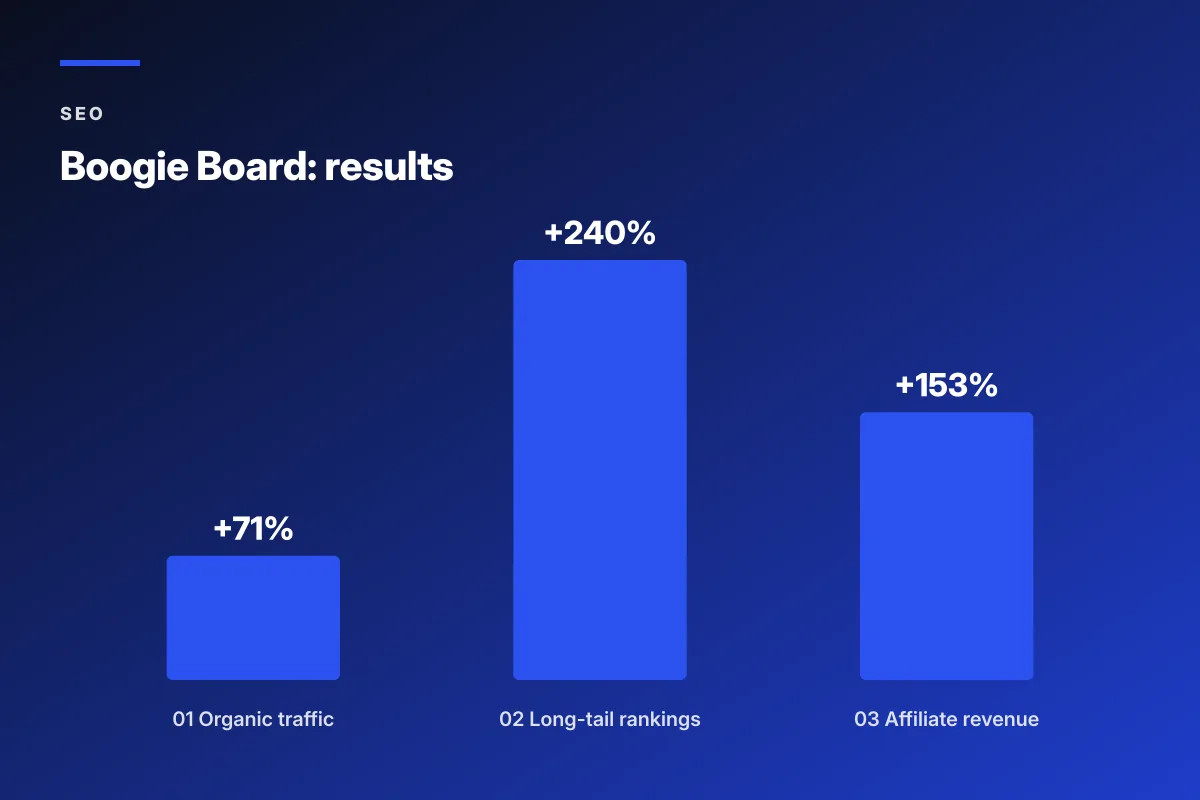
Across the next 6 months, organic sessions grew 71 percent, long-tail ranking positions grew 240 percent on brand plus condition and brand plus size queries, affiliate revenue attributed to organic climbed 153 percent, and Google Discover started sending 800 to 2,400 additional sessions per month against the aesthetic pillar guides. Boogie Board did not add SKUs, hire a photographer, or increase publishing cadence. The keyword map finally matched how resale buyers search, and the catalog started routing every visitor to the URL that could sell them something.
Measurement for fashion resale seo keywords
Measurement closes the loop on the keyword map. Without a real dashboard, the sourcing team keeps buying whatever the founder likes personally and the content team keeps publishing whatever ranked easy last quarter. The right stack tracks rankings, organic sessions, on-site search queries, marketplace referral revenue, PDP conversion rate, and affiliate or wholesale margin per keyword cluster. Resale stores that track two or three of these cherry-pick the numbers that agree with what they already wanted to source.
The six KPIs to track monthly on a resale catalog. Ranking position on the top 100 brand plus condition and brand plus size queries. Organic sessions per category page and per aesthetic pillar guide. On-site search queries (what buyers type into the store’s own search box). Marketplace referral revenue from Depop, Poshmark, and Vestiaire routing back to the store. PDP conversion rate segmented by traffic source. Margin per keyword cluster tied to the sourcing plan. Aggregate the six into a monthly Looker Studio dashboard pulling Search Console, GA4, Ahrefs, and the marketplace referral data together. The Ahrefs keyword research overview covers the tool-side workflow every resale team should read before wiring the dashboard. Resale teams tracking all six KPIs iterate the sourcing plan honestly quarter over quarter. Teams tracking only two or three run headlong into the trap of buying whatever the founder likes personally and calling any traffic gain a success.
Where fashion resale seo keywords fit the stack
Resale SEO sits alongside marketplace listings, Instagram, TikTok, email, and paid social in the resale growth stack. Marketplaces buy fast attention on Depop, Poshmark, and Vestiaire. Social pulls the aesthetic-driven top of funnel. Email owns the buyer relationship across drops. Paid social pushes new-arrival visibility fast. Organic search compounds every quarter and becomes the cheapest traffic channel at scale, but only if the keyword map matches how resale buyers actually search rather than how new-arrival DTC brands map their catalogs.
The retainer version of this work runs inside our apparel fashion marketing retainer, starting at $599 per month on 6-month engagements. The retainer covers the keyword tier map, marketplace intelligence sweep, category taxonomy rebuild, aesthetic pillar publishing calendar, schema rollout, and the monthly measurement dashboard. Fashion resale seo keywords are the layer that decides whether every other channel routes buyers to the URL that can sell them something. The retainer is the delivery model that keeps the catalog, the content, and the measurement running against real buyer movement over the full 12-month sourcing cycle. Resale founders picking a partner should ask for the tier map, the marketplace sweep methodology, and the measurement dashboard on the first call. A partner that cannot describe the six-tier map in plain language is running an old-school new-arrival playbook and will map resale keywords wrong from week one.
Frequently asked questions
What are the highest volume fashion resale seo keywords?
The highest volume fashion resale seo keywords span head terms like vintage dress, secondhand jeans, and thrift store online, each pulling 10k to 90k monthly volume with high competition from every DTC resale player and the marketplace giants. Mid-tail queries in the 4 to 6 word range like vintage Levi 501 90s or preloved Coach Willis bag pull 1k to 10k monthly at far lower difficulty and higher buyer intent. Long-tail queries at 7 to 12 words with brand, era, size, and condition combined pull 100 to 1,000 monthly per query and convert 3 to 5 times higher than head terms. Resale stores that target the mid-tail and long-tail tiers first and the head terms last build compounding organic traffic on buyer-ready queries within 6 to 9 months.
How do brand plus condition fashion resale seo keywords work?
Brand plus condition fashion resale seo keywords work by combining the brand name and model with a condition modifier (good condition, excellent used, like new, fair condition) to signal buyer intent. Coach Willis bag good condition, Louis Vuitton Neverfull excellent used, and Chanel classic flap like new all pull click-through rates 3 to 5 times higher than the brand-only query because the buyer is signaling they have already picked the model and are hunting for the exact grade. Every product listing gets a title in the brand-model-era-size-condition format. Category pages target the brand plus condition head term. PDPs target the brand plus model plus condition long-tail. Boogie Board pulled 40 to 70 percent of resale organic traffic from brand plus condition queries alone within 6 months of restructuring around this pattern.
How do you research fashion resale seo keywords across Depop and Poshmark?
Fashion resale seo keywords research on Depop and Poshmark runs on marketplace data pulled 90 to 120 days before the terms migrate into Google search behavior. Track Depop trending aesthetic and era combos weekly. Track Poshmark party themes and brand collections monthly. Track Vestiaire Collective luxury brand plus era combos quarterly on a 90 to 180-day migration window. Overlay all three data pulls against Google Search Console query data on the store to spot resale terms already earning impressions. The overlap becomes the priority publish map for the next quarter. Resale stores running only Ahrefs or Semrush miss the marketplace-first signal, and by the time the term shows on the mainstream keyword tool, the winning positions are already claimed by the resale sellers who tracked it 90 days earlier.
What is the ideal page type mapping for fashion resale seo keywords?
The ideal page type mapping for fashion resale seo keywords runs each tier onto a specific template. Head terms sit on category pages and brand pillar pages with 400 to 700 word intros and internal links to sub-categories. Mid-tail sits on sub-category pages with 250 to 400 word intros and 20 to 40 product listings. Long-tail sits on individual product pages with Product schema, 150 to 250 word descriptions, condition photos, and cross-links to sibling PDPs. Aesthetic terms sit on 2,400 to 3,200 word pillar guides with 15 to 25 shoppable listings. Seasonal terms sit on evergreen URLs rewritten twice per year. Every internal link uses descriptive anchor text matching the target page focus keyword, so ranking signal stacks on category and pillar pages rather than scattering across generic anchors.
How do aesthetic tags fit into fashion resale seo keywords?
Aesthetic tags fit into fashion resale seo keywords as the pillar layer above brand and era categories. Cottagecore, dark academia, Y2K, coquette, mob wife, tomato girl, coastal grandmother, and indie sleaze each aggregate a specific bundle of eras, brands, silhouettes, and colors. A shopper searching for a mob wife look pulls in 90s Versace, 80s power blazers, tortoiseshell sunglasses, faux fur coats, and gold chains. Publish one pillar guide per aesthetic at 2,400 to 3,200 words with 15 to 25 shoppable product listings embedded, structured as origin story, key pieces, brand callouts, era timeline, styling notes, and shop-the-look. Aesthetic guides earn 800 to 4,500 monthly organic sessions each within 60 to 90 days of publish. Resale stores running an aesthetic strategy build 15 to 25 pillar guides over two years.
How do you measure whether fashion resale seo keywords are producing revenue?
Measure whether fashion resale seo keywords are producing revenue by tracking six KPIs monthly on the resale catalog. Ranking position on the top 100 brand plus condition and brand plus size queries in Ahrefs or Semrush. Organic sessions per category page and per aesthetic pillar guide in GA4. On-site search queries pulled from the store's own search box logs. Marketplace referral revenue from Depop, Poshmark, and Vestiaire routing back to the store. PDP conversion rate segmented by traffic source. Margin per keyword cluster tied against the sourcing plan. Aggregate the six into a monthly Looker Studio dashboard pulling Search Console, GA4, Ahrefs, and the marketplace referral data together so the sourcing team sees the whole picture without pulling data from four tools every month.
Book your free 30-minute strategy call.
No spam, no sales rep. We use your email to schedule your call with a senior strategist. That is it.
More from the blog
View all articles → SEO
SEO Organic Search Engine Optimization Services That Grow Real Traffic
Read article SEO
SEO SEO for Pet Groomers That Fills the Appointment Book Weekly
Read article SEO
SEO