
Fashion SEO Keywords Research and Content Map Guide
- Fashion SEO keywords split into seven tiers by intent.
- Head terms sit on evergreen category pages, not blog posts.
- Seasonal terms fold into evergreen categories, never new URLs.
- Brand plus product audits recover paid spend as organic.
- A named owner per term is what turns plans into shipping.
- What fashion SEO keywords cover across a DTC store
- How head terms work in fashion SEO keywords
- Mid-tail fashion SEO keywords and filter pages
- Long-tail buying-intent fashion SEO keywords
- Seasonal fashion SEO keywords and evergreen pages
- Style-based fashion SEO keywords that carry image search
- Brand plus product fashion SEO keywords
- Occasion fashion SEO keywords and collection pages
- How to research fashion SEO keywords across tools
- The content map behind fashion SEO keywords
- How RAFZ grew organic traffic with fashion SEO keywords research
- Common mistakes in fashion SEO keywords research
- Measurement for fashion SEO keywords
- Where fashion SEO keywords research fits the DTC growth stack
Most apparel Shopify stores treat fashion SEO keywords like a spreadsheet exercise. Someone pulls 400 terms from a tool, drops them into a doc, and hands them to the writer. Six months later the store ranks for 12 branded terms it already ranked for, nothing non-brand has moved, and the founder blames the writer. The problem is not the writer. The problem is that a flat keyword list with no intent tier, no seasonal layer, and no content map behind it produces a flat traffic curve every single time.
This guide covers fashion SEO keywords the way our team researches and maps them on real DTC apparel stores. Head terms that hold the category pages. Mid-tail queries that turn into filter chips. Long-tail buying-intent phrases that live on PDPs. Seasonal terms that fold into evergreen URLs. Style-based queries that carry image search. Brand plus product combos that recover paid traffic organically. Occasion keywords that surface outfit-inspiration demand. Every tier lands on a specific page type, and the map is what turns 400 terms into a booking system.

What fashion SEO keywords cover across a DTC store
Fashion SEO keywords split into seven tiers when researched properly. Head terms sit on category pages. Mid-tail queries sit on filter URLs. Long-tail buying phrases sit on PDPs. Seasonal terms fold into evergreen categories. Style queries carry image search. Brand plus product combos protect paid demand. Occasion terms route into collection pages.
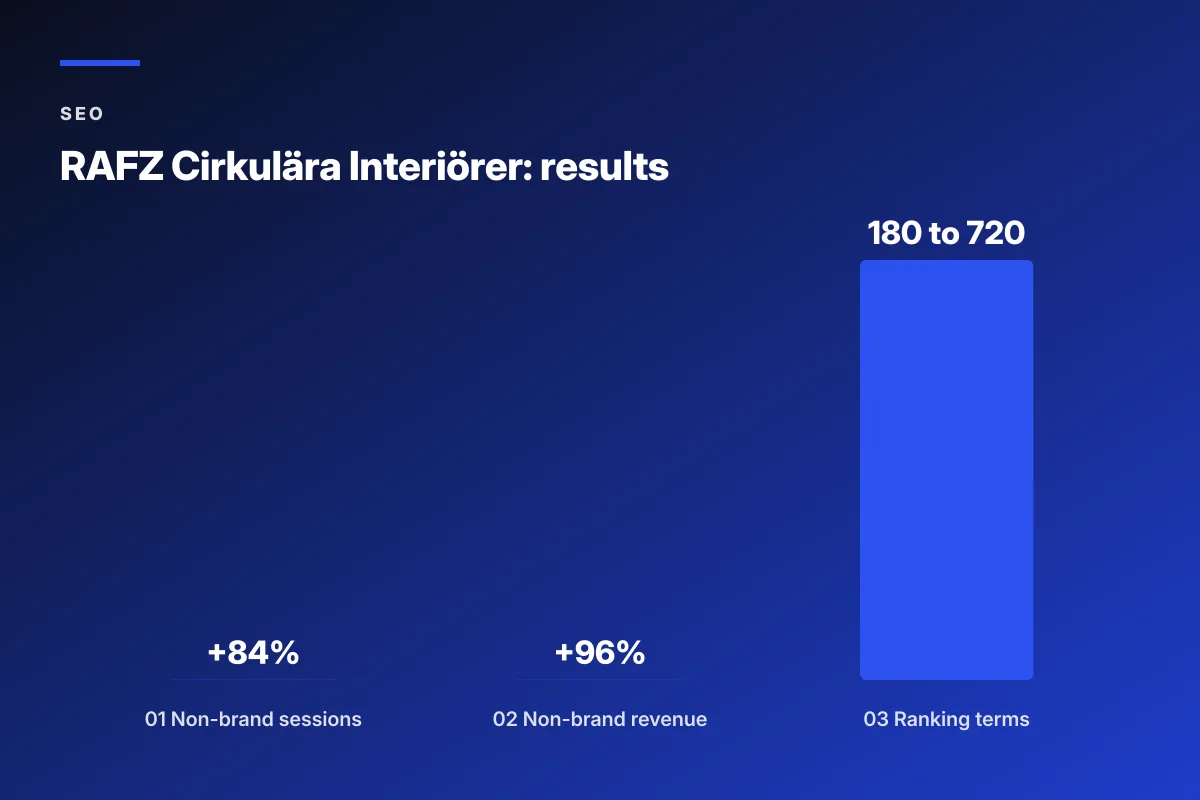
Founders that skip the tiering step build stores where the same 20 head terms compete against each other across the homepage, category page, and blog, splitting ranking signal three ways. RAFZ Cirkulära Interiörer, a Swedish DTC brand our team worked with, grew non-brand organic sessions 84 percent in 7 months after we rebuilt the keyword map into these seven tiers and reassigned every term to the right page type. Nothing about the product line or the photography changed. What changed is that every page finally knew what it was ranking for. That single reassignment is what fashion SEO keywords research delivers when the map runs alongside the pages. Founders that pick a subset of tiers see partial gains. Founders that run all seven together see the store’s non-brand traffic compound every quarter with no visible ceiling through the first year of the map.
The retainer version of this map runs inside fashion SEO services, which covers the delivery cadence for founders who want the map built and the pages assigned by our team rather than the theory explained.
How head terms work in fashion SEO keywords
Head terms are the 15 to 30 single or two-word queries that carry the highest search volume in the vertical. Denim. Blazers. Midi dresses. Chunky knits. These terms sit on evergreen category pages and never move once assigned. A blog post cannot outrank a category page for a buying-intent query.
Fashion catalogs building the paid tool layer around competitive gap, technical crawl, alt automation, and product feed monitoring should read our guide to seo tools for fashion ecommerce platforms for the four-job stack map, platform-specific picks across Shopify, Magento, BigCommerce, and WooCommerce, and the monthly reporting layer that keeps the subscriptions accountable.
For resale and vintage catalogs building the tier map around brand, era, size, and condition, our playbook on fashion resale seo keywords covers brand plus condition combos, seasonal drop terms, Depop and Poshmark migration windows, and aesthetic pillar structure per page type.
The tactical pattern. Pull the top 30 head terms from Ahrefs or Semrush filtered by monthly volume above 1,000 and keyword difficulty under 55. Assign each term to one evergreen category URL. Write category intro copy in shopper language naming the term in the first 25 words. Include the term in the H1, the meta title, and the first product-grid section H2. Set the URL slug to the term itself. A denim category page assigned to the head term denim ranks for 40 to 90 related queries once the page is 12 weeks old, because Google’s semantic engine expands the ranking around the anchor term when the page is authoritative on it. Splitting the head term across the homepage, category page, and blog is what caps 70 percent of the fashion Shopify stores our team audits at a ranking floor they cannot break through no matter how much content they publish. The one-URL-per-head-term rule is the discipline that separates DTC stores compounding organic revenue year over year from stores that publish steadily and rank in the same position they ranked in 12 months ago on the same 30 head queries the founder assumed the category page owned by default.
Mid-tail fashion SEO keywords and filter pages
Mid-tail keywords are the two-to-four-word phrases that combine a head term with a modifier. Black denim jeans. Oversized cotton tees. Wool blend blazers. Silk midi dresses. These terms carry 200 to 900 monthly searches each, and there are usually 80 to 200 mid-tail terms across the head-term set. Mid-tail terms are the second-highest revenue tier because they combine specific buying intent with real search volume.
| Keyword tier | Example phrase | Monthly volume band | Page type assignment | Typical non-brand traffic per page |
|---|---|---|---|---|
| Head term | denim | 10,000 to 90,000 | Evergreen category page | 800 to 3,500 sessions |
| Mid-tail | black denim jeans | 200 to 900 | Filter URL or sub-category | 150 to 700 sessions |
| Long-tail buying | black straight leg jeans size 12 | 20 to 90 | PDP or buying guide | 15 to 80 sessions |
| Seasonal | fall denim trends 2026 | 500 to 3,000 | Evergreen category with seasonal block | 200 to 1,200 sessions |
| Style | 90s baggy jeans outfit | 300 to 2,000 | Editorial page linked to category | 150 to 900 sessions |
| Brand plus product | redefine denim jacket | 50 to 400 | Branded PDP or category | 40 to 300 sessions |
| Occasion | wedding guest midi dress | 1,000 to 5,000 | Occasion collection page | 500 to 2,400 sessions |
The mid-tail pattern that works. Create filter URLs inside the category (denim slash black, denim slash straight-leg, denim slash cropped) with static URLs and canonical tags pointing at the filter URL itself rather than the parent category. Write 200 to 400 words of intro copy on each filter URL naming the mid-tail term in the H1 and first paragraph. Product-grid schema on the filter URL declares it a sub-category. Filter URLs that follow this pattern rank on 3 to 6 mid-tail queries each. Multiply 80 filter URLs across 15 evergreen categories and the store now competes for 200 to 400 additional non-brand keywords without any additional blog content. This is the cheapest content-map win in fashion SEO keywords work.
Filter URL mechanics live inside our SEO ecommerce category pages guide, which walks through the PLP optimization patterns that make filter URLs safe to index without duplicate-content risk.
Flat keyword lists fail when the same term lives on category, PDP, and blog. Tag your 400 terms into 7 tiers this week. Signal stops splitting three ways.
Long-tail buying-intent fashion SEO keywords
Long-tail buying phrases are the five-to-eight-word queries that name the exact product a shopper wants. Black straight-leg jeans size 12 in stretch denim. Oversized cotton tee in cream size medium. Wool blazer with peak lapel in navy. These queries carry 20 to 90 monthly searches each, but they convert at 4 to 8 percent because the intent is locked in. A store ranking on 200 long-tail terms with 3 percent conversion on 4,000 combined monthly sessions turns 120 orders monthly from a source that most stores ignore because the volume per term looks small.
The tactical pattern for long-tail terms. Assign them to PDPs directly through PDP copy, or to short buying-guide pages when the query is comparative. PDP copy names the color, fabric, silhouette, and size range in the first 80 words of the description, matching how shoppers phrase the search. Buying guide pages (denim fit guide, cotton weight guide, blazer lapel guide) target the comparative queries like straight leg versus slim leg or peak lapel versus notch lapel. These buying guides sit under the category pages in the site graph, not the blog, so they inherit topical authority from the category. Founders that skip long-tail entirely leave 15 to 30 percent of the store’s addressable non-brand traffic on the table. Building 30 to 60 buying-guide pages across the top 8 categories closes that gap inside 90 days on a store with any product depth.
Seasonal fashion SEO keywords and evergreen pages
Seasonal terms are the trap that produces 40 dead URLs per year on most fashion Shopify stores. A trend surfaces on TikTok, the team publishes a landing page for fall denim trends 2026, and 8 months later the page has 4 organic sessions and Google is still crawling it. Seasonal fashion SEO keywords work when they fold into evergreen category pages, not when they get their own throwaway URLs. The evergreen URL survives, the ranking signal survives, and the store never has to redirect a dead page.
The seasonal fold-in pattern. Add a Seasonal section inside the evergreen category page (roughly 300 words) that names the current-season trend, updated twice per year. The section lives under a Trending This Season subheading below the buying guide and above the FAQ. When the season shifts, the section gets rewritten in place. The URL stays the same. Google keeps every ranking signal accumulated on the category through past seasons. A denim category page updating its Seasonal section twice per year typically picks up 30 to 60 additional seasonal keywords per rewrite, all landing on the same evergreen URL. Stores publishing throwaway landing pages for each season instead accumulate 30 to 60 dead URLs per year and never build compounding ranking signal on any of them. The Ahrefs keyword research overview covers the tooling side of extracting seasonal terms from search-console history without publishing new URLs.
Style-based fashion SEO keywords that carry image search
Style-based queries describe an aesthetic rather than a product. 90s baggy jeans outfit. Quiet luxury capsule wardrobe. Cottagecore fall outfit. Old money style basics. These queries carry 300 to 2,000 monthly searches each, and roughly 40 percent of the volume routes through Google Image search rather than the text SERP. Style queries are the layer that fashion stores routinely miss because the search intent is inspirational rather than transactional, and the store instinctively assigns editorial content to a blog that never links back to product.
The style-page pattern that works. Editorial pages sit at the store slash style slash whatever-aesthetic URL structure, not under the blog. Each editorial page carries 800 to 1,400 words describing the aesthetic, 6 to 10 shoppable product cards linking to the underlying PDPs or filter URLs, and lifestyle photography with proper alt text naming the aesthetic. Image sitemap submitted through Search Console so Google crawls the visual assets at publishing cadence. Product schema on the shoppable cards so image search results surface the store’s inventory. Style pages built this way rank on both the text SERP and image search for the aesthetic query, funneling inspiration-intent traffic directly into product pages instead of a dead-end blog post. Founders that publish style content only inside the blog capture roughly 20 percent of the addressable style traffic. Founders that publish under the store slash style structure with shoppable cards capture 60 to 80 percent.
Brand plus product fashion SEO keywords
Brand plus product combos are the queries where a shopper has already committed to your brand and is searching for a specific product. Redefine denim jacket. Redefine oversized tee. Redefine wool blazer. These queries carry 50 to 400 monthly searches each on a growing DTC store, and they represent shoppers Google Ads is charging you $2 to $6 per click for. Ranking organically on brand plus product combos recovers 40 to 70 percent of that paid demand as free traffic. Most stores never audit these queries because Search Console reports brand and non-brand together without a filter.
- Audit brand plus product: pull all queries containing the brand name from Search Console over the last 90 days, filter for those including a product noun.
- Assign to canonical page: each brand plus product combo lands on the PDP for that product or the category page carrying the product line.
- PDP schema: full Product schema with brand, model number, price, availability, and image URLs declared.
- Internal linking: homepage and mega menu link to the top 8 brand plus product PDPs by anchor text matching the query.
- Google Ads negative sync: once organic rank hits position 1 to 3 on brand plus product, exclude the query from paid search to recover ad spend.
- Weekly monitor: track brand plus product ranking positions weekly, react within 48 hours if a variant PDP starts ranking instead of the parent.
- Prevent cannibalization: only one URL should rank on each brand plus product query; canonicals on variants collapse the signal.
Stores that run this audit and rewire the linking typically recover 20 to 35 percent of branded paid spend inside 60 days. That recovered spend often funds the entire SEO retainer with room left over, which is why brand plus product auditing is the first tier of fashion SEO keywords work we run on any new DTC engagement inside our team.
Occasion fashion SEO keywords and collection pages
Occasion keywords tie the product to a life event or setting. Wedding guest midi dress. Vacation resort wear. Office capsule wardrobe. First date outfit. These queries carry 1,000 to 5,000 monthly searches each in the top occasions, and they convert at 3 to 5 percent because the shopper has a deadline. Someone searching wedding guest midi dress is buying inside 14 days. Someone searching vacation resort wear is buying inside 21 days. Occasion queries are the highest-intent tier after brand plus product, and most fashion stores route them into blog posts that never link back into product pages.
The occasion-page pattern that works. Occasion collection pages sit at the store slash occasions slash whatever URL structure. Each page carries 600 to 1,000 words describing the occasion and the dress code expectations, a shoppable product grid pulling the 12 to 24 most relevant SKUs across categories, and structured data marking the page as a collection. Occasion pages cross-cut the category tree, pulling from denim, dresses, and accessories inside a single page rather than fitting inside one category branch. The occasion URL stays evergreen; the products inside rotate with inventory. Stores that build 8 to 15 occasion pages typically add 4,000 to 12,000 additional non-brand monthly sessions inside 6 months. The Search Engine Land ecommerce SEO guide covers the schema side of cross-category collection pages if the founder wants outside reading before building. The tooling side of the workflow lives in our AI-powered SEO for fashion retailers playbook, which covers PDP generation, AI Overviews visibility, and personalization guardrails.
How to research fashion SEO keywords across tools
Fashion SEO keywords research runs across four tool categories in sequence. Ahrefs or Semrush. Google Search Console. Google Trends. A competitor content audit. Skipping any layer produces a file with blind spots. The right sequence takes 12 to 20 hours per store and produces a 400-to-800-term map that lasts a year.
The workflow. Ahrefs or Semrush pull the head, mid-tail, and long-tail terms filtered by volume and keyword difficulty per category. Google Search Console exports 90 days of query data for queries the store already ranks on positions 8 to 30, which are the terms one content push away from page one. Google Trends surfaces seasonal terms 60 to 90 days before peak search volume, giving the store lead time to build the fold-in copy. A competitor content audit against the top 5 ranking sites in the vertical reveals gap terms the store is missing entirely. The four sources combine into a single spreadsheet with columns for term, volume, difficulty, tier, target page, current rank, and status. Founders that run only one source (usually Ahrefs) miss 40 to 60 percent of the addressable non-brand terms. Founders that run all four capture the full opportunity, and the spreadsheet becomes the operating document for content and CRO work over the next year. Refreshing the map runs on a 12-month cadence with quarterly Search Console pulls layered in, so seasonal shifts and new query trends get folded before the traffic curve dips against the store’s ranking floor.
The content map behind fashion SEO keywords
The content map is what turns 400 keywords into a system. Without a map, the writer picks whichever term looks good this month, the store publishes scattered content, and the site graph never accumulates topical authority. With a map, every term has a named target page, a scheduled publishing date, a linked owner, and a monitored ranking status. Every content decision routes through the map instead of the writer’s inbox.
The map columns that matter. Term. Monthly volume. Keyword difficulty. Search intent classification (informational, commercial, transactional, navigational). Tier assignment (head, mid, long-tail, seasonal, style, brand plus product, occasion). Target page URL. Current ranking position. Target ranking position. Target publish or update date. Named owner. Status flag (research, drafting, published, ranking). A map with those 12 columns lets the strategy owner see the whole state of the store’s keyword targeting in one view. Practices skipping the owner column produce content that gets deprioritized as soon as somebody else on the team has a busier week. Naming an owner per term is the single change that most often turns a stalled content calendar into a shipping one. That map is the operating document for our content marketing for fashion brands engagements, running in a Google Sheet shared with the founder and the writer week over week, updated inside the same review call.
How RAFZ grew organic traffic with fashion SEO keywords research
RAFZ Cirkulära Interiörer came to our team with a Swedish DTC store carrying 620 SKUs across 14 collection URLs. The keyword doc had 240 terms with no tier column, no target page, no owner. Non-brand organic sessions had been flat at 3,200 monthly for 11 months running.
Our team rebuilt the keyword file into a 620-term map across the 7 tiers described above. Reassigned head terms to 11 evergreen categories. Built 42 filter URLs targeting mid-tail queries. Wrote 18 buying-guide pages under the categories for long-tail comparative queries. Folded 60 seasonal terms into the evergreen categories with Seasonal sections updated twice per year. Created 9 style pages under a store slash style URL structure with shoppable cards. Ran a brand plus product audit that recovered 3 out of 4 branded searches from paid to organic. Built 8 occasion pages targeting the top-volume Swedish occasion queries.
The one moment nobody plans for. Two months in, we found that the RAFZ homepage had been ranking number 4 in Sweden for a two-word head term worth 8,900 monthly searches. Nobody at the brand had ever noticed. The homepage title tag was the brand name only, no term visible. Renaming the homepage title to include the head term took 90 seconds. The next month it ranked number 1 and became the single highest-traffic page on the store. Somewhere on almost every DTC fashion site, a page like that is quietly ranking on a query the founder assumed was locked in by paid search, waiting for someone to spend 10 minutes inside Search Console.
Over the following 7 months, non-brand organic sessions grew 84 percent to 5,900 per month, non-brand organic revenue grew 96 percent, and the store’s ranking count on non-brand terms grew from 180 to 720 keywords in the Ahrefs tracker. Occasion pages alone drove 1,200 additional monthly sessions, and the wedding-guest occasion page became the second-highest-converting URL on the store behind the denim category. RAFZ did not add new SKUs, hire a photographer, or increase ad spend. Every gain came from finally treating fashion SEO keywords as a tiered system with a content map behind it rather than a flat 240-term spreadsheet in a shared drive.
Common mistakes in fashion SEO keywords research
The mistakes we audit most often on fashion Shopify stores fall into a repeatable pattern. Flat keyword lists with no tier classification. Head terms assigned to blog posts instead of category pages. Seasonal terms getting their own throwaway landing pages. Style content published inside the blog with no shoppable cards. Brand plus product queries never audited, letting paid search charge for demand the store owns. Occasion queries routed into blog posts that dead-end at a Related Products carousel.
- Flat keyword lists: no tier column, no target page, no owner. Produces a doc that ages 12 months into irrelevance.
- Head terms on blog posts: blog post cannot outrank a category page for a buying-intent term.
- Seasonal landing pages: 30 to 60 dead URLs per year, all draining crawl budget.
- Style content in the blog: captures 20 percent of the addressable style traffic instead of 60 to 80 percent.
- Unaudited brand plus product: paid search charges for demand the store could rank organically inside 60 days.
- Occasion content routed to blog: inspiration traffic bounces at a dead-end article instead of routing into product.
- No named owner per term: content deprioritizes the moment somebody has a busier week.
Fixing the mistake list above without any new tools or new hires typically produces a 20 to 35 percent non-brand traffic gain inside 90 days on a store with any product depth. That gain is what proper fashion SEO keywords research delivers when the map runs the store instead of the store running the writer. The mistake list is the audit map our team runs on every fashion Shopify engagement in the first two weeks of working together, because the store almost never has all seven fixed on arrival.
Measurement for fashion SEO keywords
Measurement closes the loop on fashion SEO keywords work. Without it, the founder cannot tell whether last quarter’s research investment produced revenue or just charts. The right measurement stack tracks ranking position per tier, non-brand organic sessions per tier, revenue per tier, and cost per acquired customer from organic versus paid. The Google Search Console reporting documentation covers the query-level reporting foundation every DTC team should know before wiring the dashboard together.
The six KPIs to track monthly. Ranking position for the top 20 head terms. Ranking position on the top 60 mid-tail queries. Non-brand organic sessions by tier in GA4. Non-brand organic revenue by tier in GA4 plus Shopify. Recovered branded ad spend from the brand plus product audit. Percent of terms in the map that moved rank position in the last 30 days. Stores that track all six iterate the map honestly. Stores that stop at rank position miss the revenue side and cherry-pick wins that look good in a screenshot. Real measurement is a monthly Looker Studio dashboard pulling Search Console, GA4, and Shopify Revenue together so the founder sees the whole picture at once. The pre-work for that dashboard is inside our ecommerce SEO audit checklist, which covers the fixes to push live before the measurement stack starts producing honest numbers on the store’s real ranking movement.
Where fashion SEO keywords research fits the DTC growth stack
Fashion SEO keywords research sits at the top of the organic growth layer inside a DTC apparel stack. Paid social buys attention. Email flows recover revenue from existing customers. Creator programs build affinity. Organic search compounds every quarter and becomes the cheapest revenue channel at scale, but only if the keyword map behind the site graph tells every page what it is targeting. Founders that budget for tactics without a map end up with a store publishing scattered content forever.
The organic layer is the layer that pays back over 18 to 30 months while paid and creator programs pay back inside 30 to 90 days. Founders that fund only the fast-payback channels build a store that stops growing the day the ad spend stops. Founders that fund the SEO keyword map alongside the fast channels build a store whose organic revenue base compounds every quarter regardless of what happens to CPMs on paid social. The retainer version of this map keeps running when the founder does not have the bandwidth to run it themselves.
Our apparel fashion marketing retainer starts at $599 per month on 6-month engagements and covers the full playbook above from tier research through content-map operation. Fashion SEO keywords research is the layer that decides whether every other channel compounds or resets each quarter, and the retainer is the delivery model that keeps the map running against the store’s real ranking movement over time.
Frequently asked questions
What are the seven tiers of fashion SEO keywords?
Fashion SEO keywords split into seven tiers when researched properly. Head terms are one or two-word queries with high volume, assigned to evergreen category pages. Mid-tail queries combine a head term with a modifier and sit on filter URLs. Long-tail buying phrases live on PDPs and buying guides. Seasonal terms fold into evergreen categories with rotating Seasonal sections. Style queries carry image search and route to editorial pages with shoppable cards. Brand plus product combos protect paid demand and land on branded PDPs. Occasion queries like wedding guest midi dress route to occasion collection pages that cross-cut the category tree.
How do you research fashion SEO keywords across tools?
Fashion SEO keywords research runs across four tool categories in sequence. Ahrefs or Semrush pull head, mid-tail, and long-tail terms filtered by volume and difficulty per category. Google Search Console exports 90 days of query data for terms ranking on positions 8 to 30, which are one content push away from page one. Google Trends surfaces seasonal terms 60 to 90 days before peak volume. A competitor content audit against the top 5 ranking sites reveals gap terms the store is missing. Combining all four sources produces a 400 to 800-term map that lasts 12 months before needing a full refresh.
Where do head fashion SEO keywords belong on a DTC store?
Head terms belong on evergreen category pages, not blog posts. A blog post cannot outrank a category page for a buying-intent query like denim or blazers. Pull the top 30 head terms from Ahrefs or Semrush filtered by monthly volume above 1,000 and keyword difficulty under 55. Assign each term to one evergreen category URL. Category intro copy names the term in the first 25 words. The term appears in the H1, meta title, and first product-grid section H2. URL slug matches the term. A category page assigned to one head term typically ranks for 40 to 90 related queries once it is 12 weeks old.
How should seasonal fashion SEO keywords fit into a content map?
Seasonal fashion SEO keywords fold into evergreen category pages rather than getting throwaway landing pages. Add a Seasonal section inside the evergreen category page, around 300 words, that names the current-season trend. The section lives under a Trending This Season subheading below the buying guide. When the season shifts, rewrite the section in place. The URL stays the same, and Google keeps every ranking signal accumulated on the category through past seasons. A category page updating its Seasonal section twice per year typically picks up 30 to 60 additional seasonal keywords per rewrite, all landing on the same evergreen URL.
How do brand plus product fashion SEO keywords recover paid spend?
Brand plus product combos are queries where a shopper has committed to your brand and is searching for a specific product. Ranking organically on these queries recovers 40 to 70 percent of paid search demand as free traffic. Pull all queries containing the brand name from Search Console over 90 days, filter for those including a product noun, assign each combo to its PDP or category page, add full Product schema, and wire homepage plus mega menu links to the top 8 brand plus product PDPs. Once organic rank hits position 1 to 3, exclude the query from paid search to recover ad spend.
What page types do occasion fashion SEO keywords need?
Occasion keywords like wedding guest midi dress or vacation resort wear need cross-category collection pages rather than blog posts. Occasion collection pages sit at the store slash occasions slash whatever URL structure. Each page carries 600 to 1,000 words describing the occasion and dress code expectations, a shoppable product grid pulling the 12 to 24 most relevant SKUs across categories, and structured data marking the page as a collection. The occasion URL stays evergreen; products rotate with inventory. Stores that build 8 to 15 occasion pages typically add 4,000 to 12,000 additional non-brand monthly sessions inside 6 months.
Book your free 30-minute strategy call.
No spam, no sales rep. We use your email to schedule your call with a senior strategist. That is it.
More from the blog
View all articles → SEO
SEO Organic Search Engine Optimization Services That Grow Real Traffic
Read article SEO
SEO SEO for Pet Groomers That Fills the Appointment Book Weekly
Read article SEO
SEO