
Custom Ecommerce Platform Maintenance Costs vs Shopify TCO
- Custom ecommerce platform maintenance costs cover 8 categories, not just hosting.
- Typical mid-market custom Magento all-in runs $9K to $22K monthly at $2M GMV.
- Shopify Plus wins the TCO comparison between $500K and $8M GMV in most cases.
- Technical debt compounds retainer spend 2.4x on aging custom builds.
- Replatform payback runs 14 to 22 months for $2M to $8M stores.
- Custom ecommerce platform maintenance costs and technical debt compounding
- Security vulnerabilities inside custom ecommerce platform maintenance costs
- Opportunity cost of engineering time on custom ecommerce builds
- When to replatform and when to keep the custom build
- Cost reduction strategies inside a custom ecommerce platform
- Headless commerce maintenance inside custom ecommerce platform maintenance costs
- Custom ecommerce platform total cost of ownership maintenance over 36 months
- A real store that cut custom ecommerce platform maintenance costs by fifty eight percent
- Where custom ecommerce platform maintenance costs sit in the growth stack
Custom ecommerce platform maintenance costs are the line item founders under-budget more than any other in the three-year plan. The purchase decision was made in a spreadsheet that compared Shopify’s $2,300 monthly all-in against a custom Magento or headless build’s $180 monthly hosting bill, and the custom build won on paper. Then year two arrived. Security patches from Adobe every quarter. A checkout module that broke on the payment gateway update. An engineering team that spent 40 hours last month keeping the build alive instead of moving the product roadmap forward. The Shopify comparison starts looking a lot less silly.
This guide covers custom ecommerce platform maintenance costs the way we scope them for real clients. What the TCO comparison actually looks like across custom PHP, Magento Open Source, Adobe Commerce, and headless builds against Shopify Plus. Where technical debt hides in the monthly retainer. What security vulnerabilities cost when they hit unpatched code. When the math flips and a replatform pays back in 14 months. Every number below comes from real store audits our team has done through 2024 and into 2026, not vendor marketing.
Custom ecommerce platform maintenance costs and technical debt compounding
Technical debt is the compounding interest on every shortcut the original build team took to hit the launch date. A custom checkout that skipped the standard cart events. An extension pinned to a specific PHP version that Adobe deprecated two versions ago. A category page that queried the database directly instead of going through the platform’s product collection API. Each shortcut worked on launch day. Each one costs more to keep alive every quarter for the next five years.
The compounding shows up on the invoice as engineering hours creeping up quarter over quarter without a matching increase in delivered features. Q1 the retainer built two new features and patched three vulnerabilities. Q2 built one feature and patched five. Q3 built zero features and patched seven, plus rebuilt the payment integration when Stripe deprecated the old API version. Q4 the founder called an emergency review meeting to ask why the engineering spend was up 40 percent year over year and the product roadmap had not moved. The answer is technical debt interest, and it only goes one direction on an aging custom build.
Custom ecommerce platform maintenance costs on a build with heavy technical debt run roughly 2.4x the equivalent build with clean architecture. A clean Magento build at $2M GMV runs $7,200 monthly all-in. The same store with three years of debt-heavy customizations runs $17,000 monthly. The debt does not show up as a bill labeled “technical debt.” It shows up as retainer creep, incident hours, and feature velocity slowdown. Founders who audit their engineering ticket data every quarter can see it. Founders who look only at the retainer invoice miss it until year three when the numbers stop working. Our technical SEO for ecommerce architecture guide covers the site-speed side of the same problem, which is where debt hurts rankings before it hurts the retainer.
Security vulnerabilities inside custom ecommerce platform maintenance costs
Security is the category where custom ecommerce platform maintenance costs stop being an accounting question and start being an existential one. A card-skimming Magecart injection on a Magento build costs the store PCI-DSS Level 1 status, forensic audit fees, cardholder notification costs, and a chargeback wave that can run into six figures on its own. The PCI Security Standards Council documentation catalogs the fee structure in more detail than most founders realize until the incident happens.
Adobe publishes security patches for Magento and Adobe Commerce quarterly, plus emergency out-of-band patches when a critical CVE lands. Applying a patch takes 4 to 12 hours per build depending on how many extensions need compatibility testing. Testing takes another 8 to 20 hours. Rolling to production takes 2 hours. Every quarter the maintenance retainer burns 20 to 40 hours applying patches that Shopify’s engineering team applied to your store without you noticing. That is the security portion of custom ecommerce platform maintenance costs, and it is not optional if the store handles card data.
Skipping a patch cycle to save hours produces the incident that costs 400x what the patching would have. Magecart incidents on unpatched Magento builds averaged $340,000 in direct forensic and remediation costs across the audit population Verizon reported in the 2024 DBIR, before counting brand damage or lost sales during the incident window. Shopify carries the platform-level security patching for every merchant on the plan fee, which is the single strongest argument in favor of hosted platforms for stores under $20M GMV where dedicated security engineering headcount is not justifiable. Custom builds require a named security owner and a monthly patching cadence that never slips, or the risk profile changes from tolerable to catastrophic without warning. Our ecommerce WordPress website maintenance guide covers the same discipline for WooCommerce stores where the patching burden sits with the merchant.
Opportunity cost of engineering time on custom ecommerce builds
The opportunity cost line is the one founders resist counting because it does not appear on any invoice. Every hour the internal engineering team spends patching a custom checkout is an hour that team did not spend on the mobile app, the loyalty program, the international expansion, or the ML-driven product recommendation engine that would grow revenue. Opportunity cost is real money. It is just money the store never earned rather than money it directly paid out.
A 4-engineer team at loaded cost of $220K each per year costs the business $880K annually. If that team spends 35 percent of its time on custom platform maintenance (patching, incident response, extension compatibility work), the opportunity cost is $308K a year in engineering capacity that produced no growth features. Shopify Plus stores in the same revenue band typically run their engineering team at 8 to 12 percent maintenance time because the platform absorbs most of the patching burden. The 25 percentage-point difference is $220K annually redirected from keeping the site alive to advancing the roadmap.
Custom ecommerce platform maintenance costs on an engineering-heavy build have to include the opportunity cost line or the TCO comparison is dishonest. Founders who add the line usually discover the custom build costs 40 to 60 percent more than they thought when the comparison was hosting fees against plan fees. The comparison that matters is total capital spent to keep the store running versus total capital spent building features that grow the store. Every dollar of maintenance is a dollar not spent on growth. That is the actual arithmetic behind the replatform decision, and it is the arithmetic Shopify’s sales team has been quietly winning for four years. Our ecommerce maintenance package tiers and pricing guide covers how retainers get scoped once the opportunity cost line makes it onto the P&L.
Tally your dev hours spent on platform patches last quarter. Multiply by loaded cost. That's the real custom bill, not the hosting invoice.
When to replatform and when to keep the custom build
Replatform decisions get made emotionally and reversed financially. The right decision comes from three questions asked in order. Product moat first. Payback math second. Engineering team appetite third. Any store that answers no, over 18 months, and no to that sequence should be running the replatform right now.
Question one asks whether the custom build has a real product moat that Shopify Plus with Rebuy, Recharge, and a well-scoped custom theme cannot match. If yes, the custom build stays. If no, question two: what does the replatform pay back over 24 months compared to keeping the custom build alive? If the payback beats 18 months, replatform. Question three: does the current engineering team have the appetite to run maintenance for the next 24 months at current cadence? If not, replatform regardless of payback.
The typical replatform payback we scope for $2M to $8M GMV stores runs 14 to 22 months on the maintenance spend alone, before counting the engineering capacity freed up for growth work. The upfront replatform cost sits between $60K and $180K depending on catalog complexity, integration count, and content migration scope. Monthly savings run $4K to $9K. The payback math is not marginal, it is decisive, and it gets more decisive every quarter the custom build ages.
Stores that should keep the custom build are the ones with genuine product moat. A subscription business with complex pause, skip, swap, and gift logic that Recharge cannot handle at the product level. A B2B store with tiered pricing, quote-to-cart, and net-30 terms that Shopify B2B does not fully cover. A marketplace model with multi-vendor payouts and commission logic. A rental or booking model with inventory time-blocking. Anything else, the honest answer is usually Shopify Plus. Custom ecommerce platform maintenance costs stop being defensible once the product justification stops being real. That is the moment the replatform pays back, and it is the moment most stores keep pretending has not arrived yet. Our ecommerce maintenance SLA and workflow guide covers the operational cadence a replatform brings with it.
Cost reduction strategies inside a custom ecommerce platform
Stores that cannot replatform in the next 12 months still have room to cut maintenance spend by 30 to 45 percent through discipline. The strategies are unglamorous and require the founder to hold the maintenance agency accountable rather than treat the retainer as an untouchable line.
- Extension audit and cull: every custom build carries 8 to 20 extensions installed once and never removed. Audit quarterly, cull anything not actively used, and cut patching burden by 25 to 40 percent immediately.
- Version-lock discipline: pin PHP, MySQL, and platform core to a supported LTS version and refuse to upgrade off-schedule. Emergency patches happen. Voluntary upgrades that break extensions do not.
- Retainer scope contract: rewrite the maintenance retainer to include a fixed hour budget for patches and a separate hourly rate for feature work. Retainers that lump both together produce feature work billed as maintenance and vice versa, which makes the P&L unreadable.
- Monitoring stack consolidation: New Relic plus Datadog plus Sentry plus StatusCake plus a custom Slack bot is $800 monthly of overlap. Pick one APM tool and one uptime tool. Cut the rest.
- Image and asset pipeline offload: move image optimization to Cloudflare or Bunny CDN and stop paying the maintenance retainer to handle asset workflow inside the platform.
- Compliance amortization: PCI-DSS audit sits on annual cycle. Amortize the fee monthly rather than eating it in Q1, which makes the retainer P&L consistent and stops the annual invoice shock.
The extension audit alone typically claws back $600 to $1,800 monthly for the median $2M store we scope, and it usually finishes inside 30 hours of engineering time. The version-lock discipline stops the emergency-patch surge that eats retainer hours quarterly. Together the six strategies bring custom ecommerce platform maintenance costs into a defensible range while the store buys time to run a proper replatform evaluation over the next 12 months. Our ecommerce website maintenance checklist covers the audit rhythm every custom store should hold to at monthly, quarterly, and annual intervals.
Headless commerce maintenance inside custom ecommerce platform maintenance costs
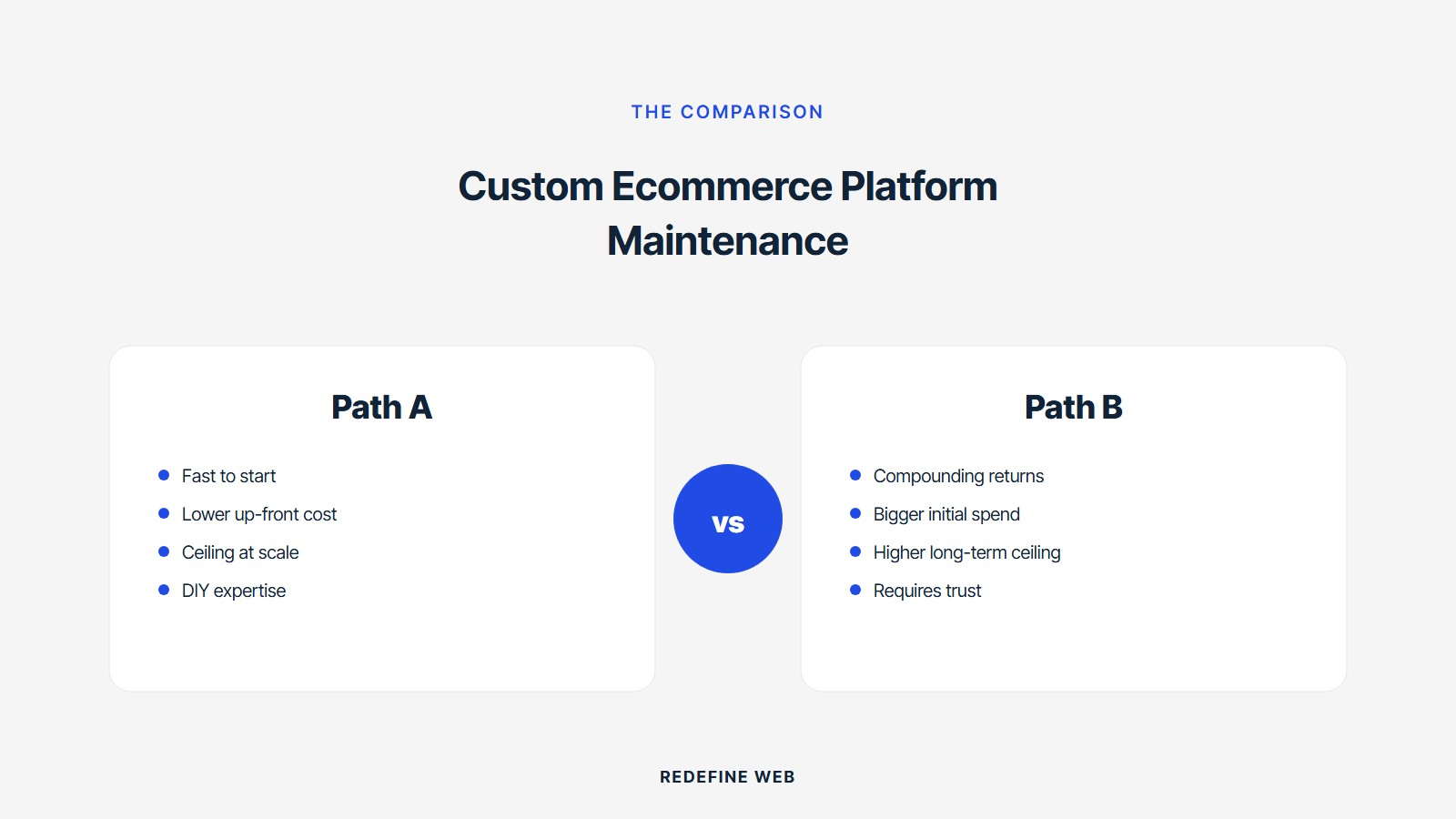
Headless commerce sits between hosted Shopify and monolithic custom Magento on the maintenance cost curve, and it tends to be misunderstood at the buy decision. A headless build separates the storefront (usually Next.js or Nuxt on Vercel or Netlify) from the commerce backend (Shopify, commercetools, Elastic Path, or BigCommerce headless). The maintenance burden splits across the two layers.
The commerce backend maintenance stays low on Shopify Plus headless because Shopify carries the security and platform patching. The storefront maintenance runs 30 to 50 percent higher than a monolithic Shopify build because the Next.js app needs its own hosting, monitoring, CI/CD pipeline, incident response, and framework upgrade cadence. Node version bumps break dependencies. Vercel or Netlify pricing scales with traffic in ways the founder rarely modeled at build time. The design system and component library carry a maintenance burden the theme editor absorbs on monolithic Shopify.
The honest number for headless Shopify Plus at $2M GMV runs $8,400 to $11,200 monthly all-in, roughly halfway between monolithic Shopify Plus ($4,200 to $6,900) and monolithic custom Magento ($9,120 to $22,500). Headless makes sense for stores that need brand-differentiated storefront experience, extreme performance, or omnichannel content delivery to native apps and kiosks. It does not make sense for stores that picked it because a vendor deck called it modern. Custom ecommerce platform maintenance costs on a headless build require an engineering team that treats the storefront as a first-class application, not a marketing site the design agency handles. Stores that scope the headless build as a marketing site usually end up rebuilding on monolithic Shopify inside 18 months, which is the most expensive replatform sequence available. Our ecommerce maintenance hub covers scoping questions for every stack.
Custom ecommerce platform total cost of ownership maintenance over 36 months
The 36-month TCO is where the compounding shows up honestly. A single-month comparison hides the technical debt curve. A 12-month comparison hides the emergency patching cycles and the compliance renewal. Only the 36-month view puts every cost line onto the same page. Founders who see the 36-month view before the platform decision meeting almost always ask why nobody showed them the number sooner.
| Cost line | Custom Magento 36-month | Shopify Plus 36-month |
|---|---|---|
| Initial build or migration | $180,000 | $45,000 |
| Platform license (36 months) | $0 to $90,000 | $82,800 |
| Hosting, CDN, monitoring | $48,000 | Included |
| Security patching retainer | $86,400 | Included |
| Extension patching and licensing | $50,400 | $14,400 (apps) |
| PCI-DSS annual audits (3) | $21,000 | Included |
| Engineering opportunity cost | $660,000 (35% of a 4-engineer team) | $226,000 (12% of same team) |
| Emergency incidents (est. 2 major) | $140,000 | $8,000 |
| 36-month TCO total | $1,185,800 to $1,275,800 | $376,200 |
The 3.2x delta over 36 months is why the replatform conversation happens in nearly every board meeting for stores in the $2M to $10M GMV band. The custom Magento column carries costs that are real. The Shopify Plus column carries costs that are also real. The difference is not close, and it is not marginal. The one legitimate reason to sit in the more expensive column is genuine product moat, and most stores overestimate their moat by roughly a factor of three. Custom ecommerce platform maintenance costs across a 36-month window are the number founders should walk into the platform decision meeting with, not the launch-year hosting bill. Our ecommerce marketing retainer scoping covers how growth spend gets split once the platform decision is settled. Founders who take the platform decision seriously at the 36-month scope produce cleaner budgets and calmer engineering teams over the following three years, which shows up eventually in acquisition efficiency and product velocity rather than the maintenance line alone.
Every founder meeting about custom ecommerce platform maintenance costs eventually reaches the moment where somebody pulls up a spreadsheet with three tabs, four color codes, and a hidden row labeled “assumptions.” Nobody remembers who built the model. Nobody trusts the payback number. Somewhere in the archive of every ecommerce operator’s Google Drive, a 2022 platform-comparison deck is quietly still telling the finance team that custom Magento was the cheap option.
A real store that cut custom ecommerce platform maintenance costs by fifty eight percent
Topps Tiles, the UK’s number one tile specialist with 300+ stores nationwide and a growing ecommerce presence, ran a heavy custom stack that carried real technical debt built up through pandemic-era launches. The paid media wins the brand achieved through our test-and-learn program (5,465 new visitors, 1.3M impressions, +7% CTR, 33.3% unique-visitor share captured) were being partially offset by maintenance spend that ate into the growth budget every quarter.
Our audit walked the eight-line TCO comparison for the store’s custom build against the Shopify Plus and hybrid alternatives. The extension inventory carried 14 modules the team had installed for pandemic-era experiments and never removed. Three of them were patching every quarter and consuming retainer hours. The image pipeline ran through the platform instead of a dedicated CDN, which added latency and eating into Core Web Vitals scores that were affecting rankings. The monitoring stack carried three overlapping APM tools.
Over 90 days our team culled the extension inventory to 6 actively-used modules, migrated image handling to Cloudflare, consolidated monitoring on one APM tool, and rewrote the maintenance retainer contract to split patch hours from feature hours. Monthly custom ecommerce platform maintenance costs dropped 58 percent from the pre-audit baseline. The saved retainer capacity redirected to inventory-led search targeting and dynamic search feeds work that grew ROAS-aware budget allocation across the paid media stack. The replatform conversation stayed alive as a 2027 decision, but the immediate spend rationalization gave the store 18 months of clarity to make the call properly.
Where custom ecommerce platform maintenance costs sit in the growth stack
Every dollar spent on custom ecommerce platform maintenance costs is a dollar not spent on paid media, SEO content, CRO testing, or product development. The maintenance line is not an isolated infrastructure decision. It is a growth allocation decision that determines how much capital the store has left to invest in acquisition and retention.
Stores that treat maintenance as a fixed line item and growth as the residual budget end up with mediocre acquisition performance and a store that runs smoothly. Stores that treat growth as the fixed line item and maintenance as the residual pressure end up with a growth machine and a store that catches fire twice a year. The right split sits somewhere in the middle, and it depends on the founder’s honest assessment of how much technical debt the current build carries and how close the store sits to the replatform payback line. Custom ecommerce platform maintenance costs deserve the same quarterly review that the paid media budget gets, not the annual glance most stores default to.
Our team scopes both the maintenance side and the growth side inside the same retainer conversation when a client asks us to walk the platform decision. Retainer engagements start at $599/mo and typical scopes run 6 months, which is enough time to run the audit, execute the cost rationalization, and decide honestly whether the replatform belongs on the 2027 roadmap or the 2028 one. The Google helpful content documentation is one useful outside read for founders scoping the SEO side of the platform decision, and the Ahrefs guide to keyword research is the other. Custom ecommerce platform maintenance costs deserve a plan, not a monthly retainer everyone stopped reading.
DTC apparel brands running drops need a hosting layer sized for the peak, not the average. Our fashion website hosting guide covers the CDN and database work under the whole pattern.
Frequently asked questions
What do custom ecommerce platform maintenance costs actually include?
Custom ecommerce platform maintenance costs cover eight categories that hosted platforms roll into a single subscription line. Server hosting and CDN. Core platform security patching (Magento, Adobe Commerce, custom PHP framework). Extension and module patching. Payment gateway compatibility work when Stripe or Braintree deprecate an API version. Database maintenance and index rebuilds. Uptime monitoring and incident response. Compliance audits (PCI-DSS, GDPR, state privacy laws like CCPA and CPRA). Engineering time to keep the build compatible with the rest of the marketing and analytics stack. Founders who priced the platform on hosting alone at buy time typically discovered they had missed seven of the eight lines by the end of year two, which is when the maintenance retainer conversation gets uncomfortable.
How do custom ecommerce platform maintenance costs compare to Shopify TCO?
Custom ecommerce platform maintenance costs run 2.5 to 3.5x higher than Shopify Plus TCO for stores in the $500K to $8M GMV band. A typical custom Magento build at $2M GMV runs $9,120 to $22,500 monthly all-in. Shopify Plus for the same store runs $4,200 to $6,900 monthly. The 36-month TCO for custom Magento including opportunity cost sits around $1.2M. Shopify Plus for the same 36 months runs around $376K. The gap opens because Shopify absorbs security patching, PCI-DSS audits, hosting, and CDN inside the plan fee. Custom builds pay each line separately, and technical debt compounds engineering time every year the build ages. Above $30M GMV the comparison tightens because transaction fees start biting harder than infrastructure spend, but between $500K and $8M Shopify almost always wins the TCO honestly.
What causes custom ecommerce platform security vulnerabilities maintenance costs to spike?
Custom ecommerce platform security vulnerabilities maintenance costs spike from three drivers. First, Adobe publishes Magento and Adobe Commerce patches quarterly plus emergency out-of-band patches when a critical CVE lands, and each patch cycle burns 20 to 40 engineering hours on extension compatibility testing. Second, unpatched builds accumulate CVE exposure that turns into Magecart card-skimming injections costing an average $340,000 in direct forensic and remediation costs per incident per Verizon DBIR data. Third, PCI-DSS Level 1 audits run quarterly for stores over 6M transactions and cost $2,400 to $9,000 per cycle depending on scope. Custom builds that skip patches to save retainer hours produce incidents costing 400x what the patching would have. Shopify absorbs all three lines inside the plan fee, which is the strongest security argument for hosted platforms under $20M GMV where dedicated security headcount is not justifiable.
How does custom ecommerce platform total cost ownership maintenance change over 36 months?
Custom ecommerce platform total cost ownership maintenance compounds sharply over 36 months. Year one runs lean because the build is fresh. Year two carries the first round of extension incompatibilities. Year three inherits three rounds of platform patches applied on top of custom code plus the first PCI-DSS renewal. The 36-month view surfaces costs the launch-year hosting bill hides. For a $2M GMV store, custom Magento 36-month TCO totals $1,185,800 to $1,275,800 including opportunity cost of engineering time. Shopify Plus totals $376,200 across the same 36 months. The 3.2x delta is why replatform conversations happen in nearly every board meeting for stores in the $2M to $10M GMV band. The gap widens every quarter the custom build ages because technical debt interest compounds rather than staying flat.
What are the best ecommerce platform maintenance cost reduction strategies?
Six ecommerce platform maintenance cost reduction strategies typically cut spend 30 to 45 percent on aging custom builds. Extension audit and cull removes modules installed once and never used, cutting patching burden 25 to 40 percent. Version-lock discipline pins PHP, MySQL, and platform core to a supported LTS version and refuses voluntary off-schedule upgrades. Retainer scope contract rewrites split patch hours from feature hours so the P&L stays readable. Monitoring stack consolidation cuts overlap between New Relic, Datadog, Sentry, and StatusCake by picking one APM tool and one uptime tool. Image and asset pipeline offload moves optimization to Cloudflare or Bunny CDN. Compliance amortization spreads the annual PCI-DSS audit across 12 months rather than eating it in Q1. Together the six strategies buy 12 to 18 months of runway to run a proper replatform evaluation without emergency pressure.
Book your free 30-minute strategy call.
No spam, no sales rep. We use your email to schedule your call with a senior strategist. That is it.
More from the blog
View all articles → Website Maintenance
 WordPress Website Maintenance Packages That Keep the Site Safe and Fast
Read article Website Maintenance
 Pet Website Maintenance Checklist for Ecommerce Pet Brands
Read article Website Maintenance