How to Hire a Healthcare SEO Agency
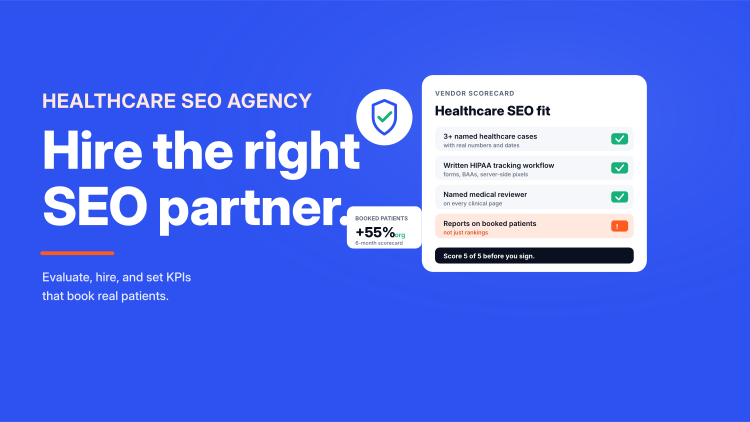
Hiring a healthcare SEO agency is a decision most practice owners get one shot at before losing 12 months of ranking momentum. Get it right and organic patient volume compounds for years. Get it wrong and the retainer runs, the rankings flatline, and the vendor blames “the algorithm” every quarter. This guide walks the actual evaluation, hiring, and KPI framework we wish every provider had before signing.
We’ve watched dozens of practices switch vendors after year one because the first agency sold “healthcare SEO” and delivered generic content plus a report full of rankings nobody could tie to a booked patient. The gap between a real healthcare SEO agency and a generalist repackaging home-services SEO is enormous. This post lays out what to ask, what to look for, and what to write into the contract.
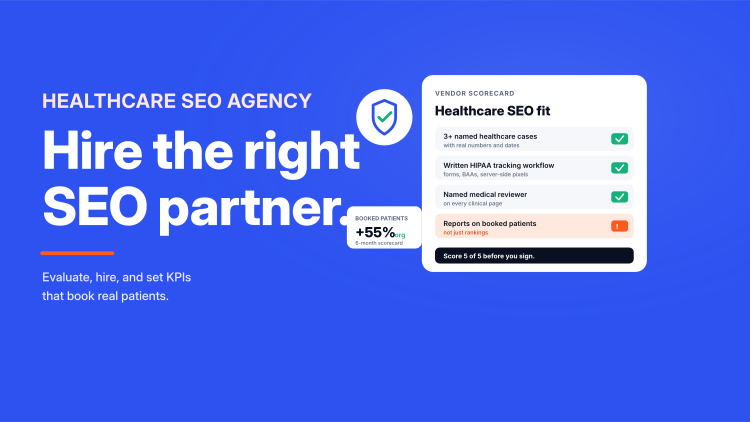
What a healthcare SEO agency actually does
A healthcare SEO agency runs four working layers at once: technical SEO, on-page SEO, local SEO, and content authority backed by E-E-A-T. The good ones stitch those layers into a single reporting view tied to booked patients, not just keyword rankings. The average ones push out blog posts and hope Google notices. The pattern separating the two is boring on purpose. Real healthcare SEO looks like publishing peer-reviewed content on a schedule while a technical team keeps the site fast, indexable, and HIPAA-safe.
The typical healthcare SEO agency scope covers a full technical audit in month one, a monthly content calendar with medical-reviewer sign-off, ongoing Google Business Profile management for every location, patient-review workflows, schema implementation, and monthly reporting that ties organic sessions to booking-page views to actual booked appointments. Our healthcare SEO services team runs all four layers as one program with a shared dashboard, because splitting them across three vendors is how compounding stalls.
What a healthcare SEO agency should not be: a content mill with no clinical review, a link-building shop that spams directories, or a reporting dashboard with rankings and nothing else. If a vendor’s deliverable list stops at “4 blog posts per month,” they are selling content and calling it strategy. A working healthcare SEO strategy sequences six work streams instead.
Why generalist SEO agencies fail on healthcare accounts
The biggest reason to hire a specialist over a generalist is Your Money or Your Life (YMYL). Google raters treat medical content on a stricter bar than almost any other topic, and the Search Quality Rater Guidelines spell that out in the medical sections. A generalist SEO agency writing service pages under a “Team” byline with no medical reviewer will hit a ranking ceiling by month 12 (the healthcare SEO pillar guide walks the exact E-E-A-T signals that break through it), and their client will never know why until the retainer runs out.
Three other reasons generalists lose on healthcare accounts. First, HIPAA. Most generalists have never handled a Business Associate Agreement (BAA), don’t know that client-side pixels on booking-confirmation pages are a HIPAA violation, and can’t explain server-side tracking without Googling it. Second, review velocity. Healthcare local pack rankings weigh recent, verified patient reviews heavier than in most other verticals, and generalists usually treat reviews as a one-time “get 50 reviews” project instead of a monthly workflow. Third, schema. MedicalOrganization, Physician, and MedicalCondition schema aren’t optional on healthcare service pages, and generalists usually push LocalBusiness schema and call it done.
The result: a generalist SEO agency can get a plumber to page one in 90 days on a shoestring, then take 18 months on a psychiatry group and still land on page two. It isn’t lack of effort. It’s the wrong playbook.
Signs you need a healthcare SEO agency vs a consultant
A healthcare SEO consultant is one senior operator working with your in-house team, usually for 10-20 hours per month, delivering strategy and audits but not execution. A healthcare SEO agency is a small team (SEO strategist, content writer, technical developer, local SEO specialist, account manager) delivering both strategy and execution end-to-end. Enterprise operators labeled as a healthcare SEO company add a third shape at the top of the market for multi-hospital systems. Which one fits depends on what your in-house team can actually get done without help.
| Situation | Consultant fit | Agency fit |
|---|---|---|
| 1-2 locations, no in-house marketer | Weak | Strong |
| Solid in-house marketer, no SEO experience | Strong | OK |
| 3+ locations, growing | OK | Strong |
| Hospital system or DSO | Strong | Strong |
| Cash-pay solo practice under $500K revenue | Weak | OK |
| Need HIPAA tracking rebuild | Weak | Strong |
| Just need audit + roadmap | Strong | Weak |
The honest test: read your last three monthly SEO reports. If your team can execute 80% of the recommendations without help, a healthcare SEO consultant is enough. If your team can execute 20% and the rest sits, an agency is going to cost less than the compounding delay of untackled work. Most solo practices we work with started with a consultant, hit a scale wall around location three, and moved to the full healthcare marketing team engagement.
The 5-question vendor screen for the first sales call
Every vendor call for a healthcare SEO agency gets easier once you have a fixed screen. Bring these five questions to the first meeting, take notes on how they answer (not just what they say), and you’ll separate the operators from the resellers inside 30 minutes.
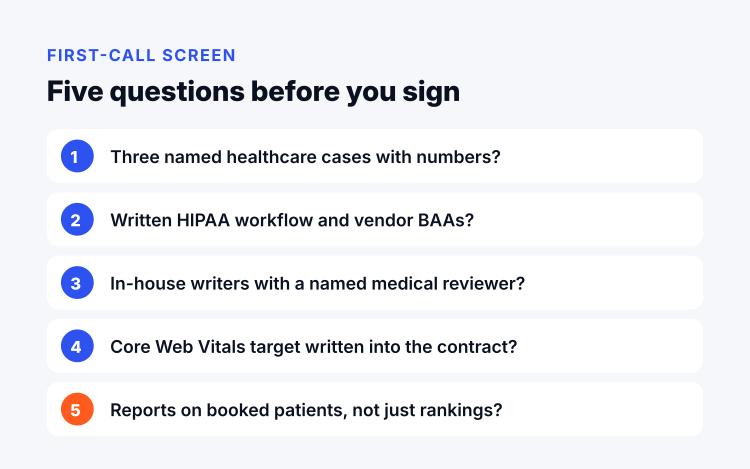
- Name three healthcare cases with real numbers and dates. Not “large healthcare brand.” Actual client names, actual timeframes, actual outcomes. A real healthcare SEO agency has these on hand.
- Walk your written HIPAA workflow. Server-side tracking pattern, form routing, vendor BAA list, and how you handle a suspected PHI leak. If they wing this, walk away.
- Do you write in-house with a named medical reviewer? Ask for the reviewer’s name and license. Outsourced content mills produce content the top-3 SERP winners already outrank.
- What Core Web Vitals target goes in the contract? “We’ll try” is not a target. “LCP under 2.5 seconds at 90th percentile by day 90” is a target.
- Show me your monthly reporting template. If rankings are the top-line metric, they are optimizing for rankings, not booked patients. Move on.
The best seo agency for healthcare answers all five in one call without stalling. The average one answers three and dodges two. The bad one changes the subject to their process deck.
Red flags in a healthcare SEO agency pitch
Red flags in a healthcare SEO sales pitch cluster into three categories: unverifiable claims, HIPAA blind spots, and vague reporting. Any one of these should slow the sale. Two of them together is a hard no.
- “We work with 200+ healthcare clients.” Ask for 10 names. Watch what happens.
- Case studies with no dates. “300% traffic increase” without “over 12 months in 2023-2024” is marketing math.
- Client-side pixels on booking-confirmation pages. HIPAA violation. Ask them to name the fix.
- No BAA on their own tooling. If their reporting tool touches patient-identifiable data and doesn’t have a BAA, that’s their liability plus yours.
- Guaranteed rankings. Nobody guarantees rankings. Vendors who do are either dumping backlinks or fabricating reports.
- Content written by “AI-assisted senior writers.” Usually means ChatGPT plus light edits. Google’s Search Quality Rater Guidelines flag exactly this pattern in YMYL.
- Short-term contract with a 90-day “onboarding fee.” Real healthcare SEO takes 6-12 months to compound. Vendors who structure contracts to churn clients before results land are optimizing for cash flow, not outcomes.
- Reporting deck built on rankings and impressions. Rankings are an input. Booked patients are the output. If the report leads with rankings, you’re paying for optics.
The tell that ties all of these together: the vendor talks about SEO as a service they sell, not as a patient-acquisition system they operate. Real healthcare SEO consultants and agencies operate the system. Resellers sell the service.
What to write into a healthcare SEO agency contract
The contract is where a healthcare SEO agency engagement gets serious. Anyone can pitch a good deck. Fewer will hold themselves to specific commitments on paper. When we onboard a new client, our contract spells out four things most vendor contracts leave vague.
Term length and out-clause: 6 months minimum with a 60-day exit clause after month three, no auto-renewal without written re-signature. This is the fair middle. It protects the agency from a churn-happy client who quits at month two before SEO compounds, and it protects the practice from a vendor who buries them in a 12-month lock-in and stops delivering after month four. Scope in writing: a list of what gets delivered each month, by page count, by content topic, by technical audit item, and by review workflow. Vague scope is how retainers get pocketed. Ownership: the practice owns the domain, the Google Business Profile, the content, the schema, the analytics accounts, and any tracking configuration built during the engagement. The agency does not hold accounts hostage on exit. Reporting cadence: monthly report by day five of the following month, quarterly strategy review, and a written notification if any KPI slides outside a set band.
The healthcare marketing retainer Redefine Web runs for clients follows this exact structure. Retainers start at $599 a month for a solo maintenance-plus-content program and scale by location count, provider count, and paid media scope. Every contract has the out-clause, the scope list, the ownership clause, and the reporting cadence written in. That’s the fair frame, and any healthcare SEO agency worth hiring will accept it on the first pass.
KPIs that tell you the healthcare SEO agency is working
Every healthcare SEO agency reports on rankings. The good ones report on three layers: inputs, intermediates, and outputs. Inputs are what the agency produces. Intermediates are how the site responds. Outputs are what the practice gets in booked-patient volume. Reporting on all three at once is how the agency proves it’s earning the retainer.
| KPI layer | Metric | Cadence | Target band by month 6 |
|---|---|---|---|
| Input | Non-branded keyword rankings for target city + specialty | Weekly | Top 20 on 40% of targets |
| Input | Content published with medical reviewer sign-off | Monthly | 4-8 pieces per month |
| Input | Core Web Vitals (LCP, INP, CLS) | Weekly | All three in green at 90th percentile |
| Intermediate | Organic sessions to service and city pages | Monthly | +40-70% vs baseline |
| Intermediate | Booking-page views from organic search | Monthly | +50-100% vs baseline |
| Intermediate | Google Business Profile calls + direction requests | Monthly | +30-60% vs baseline |
| Output | New patient bookings attributed to organic search | Monthly | Compounding month over month |
| Output | Booked-to-showed rate on organic-sourced patients | Quarterly | Flat or improving |
| Output | Blended organic cost per new patient acquired | Quarterly | Falling |
The target bands aren’t guarantees. They are honest ranges based on what a competently-run program hits inside six months on a technically sound site. Practices in high-competition metros (New York, LA, Miami) slide the intermediate bands out by 60-90 days. Practices in less contested markets often beat them.
When Peaceful Mind Psychology, a Melbourne psychology clinic, brought us in for a combined SEO and paid search rebuild, the KPI stack looked exactly like this table. Six months in, organic traffic was up 17%, monthly Google Ads impressions hit 8,000, and 55% of website conversions came from organic search. The clinic’s clinical work didn’t change. The reporting framework and the underlying SEO structure did. That’s the pattern a real healthcare SEO agency runs.
Healthcare SEO agency pricing (what to expect in 2026)
Pricing for a healthcare SEO agency varies more than most digital-marketing categories because scope varies more. A solo cash-pay clinic with one location isn’t the same engagement as a 15-location behavioral health group. Real ranges we see across the market in 2026, based on published pricing pages, RFP responses we’ve reviewed, and our own retainer stack:
- Solo practice, one location. $1,500-$3,500 per month for a full four-layer program.
- Multi-provider single location. $3,500-$7,500 per month. More provider pages, more content, more review management.
- Multi-location group (2-10 clinics). $7,500-$18,000 per month. City-page depth, location schema, cross-location review flow.
- Regional network or DSO-style rollup. $18,000-$45,000 per month. Enterprise SEO tooling, brand consolidation, migrations.
- Hospital system or IDN. Custom, usually $50,000+ per month. Central SEO operations plus per-service-line consulting.
Two pricing patterns to watch. Vendors under $999 per month usually cannot afford a real medical reviewer, a technical SEO engineer, and a local SEO specialist on the same account. They cover one of the four layers and skip the other three. Vendors over $10,000 per month for a solo practice are usually pricing hospital-scope teams onto a solo-scope engagement. Neither is inherently bad, but both are worth negotiating. Our healthcare web design pillar covers what a healthy production budget looks like on the design side of the same engagement, and the two often get bundled.
How a healthcare SEO agency plugs into the rest of your marketing
SEO doesn’t stand alone. The best healthcare SEO agencies plug into the rest of the practice’s marketing without asking to own it all. Three integration points usually decide whether the engagement compounds or stalls.
First, paid search. SEO and paid search share keywords, landing pages, and reporting. When they share data, blended cost per new patient drops 15-25% within 6-9 months. A healthcare PPC agency that shares a single reporting dashboard with SEO usually finds those savings first. When they don’t, the two channels compete for the same click and the practice pays twice. Second, website design and CRO. The best SEO in the world doesn’t book patients if the site loads in 5 seconds and buries the booking button. Fast, patient-first healthcare website design is how the SEO gain shows up in the booking dashboard. Any healthcare SEO agency that can’t work fluently with the practice’s web team is going to slow the whole program down. Third, patient reviews and reputation. Reviews feed local SEO, and local SEO feeds bookings. The agency should own the review workflow or hand it to a partner who does. Reviews are not a project. They are a monthly rhythm.
The pattern that separates a competent healthcare SEO agency from the rest is the willingness to admit what they don’t do. Vendors who claim SEO, paid search, web design, review management, HIPAA compliance, PR, and social under one roof are almost always doing one well and outsourcing the rest. Ask which is which.
When to fire a healthcare SEO agency (and how to do it clean)
The wrong reason to fire a healthcare SEO agency is a slow month three. Real SEO compounding starts around month six on a technically sound site and month nine on a site with legacy issues. Firing at month three is how practices burn 12 months restarting with the next vendor. The right reasons to fire are structural: the vendor missed contractual commitments, the reporting hides the input-intermediate-output layers, the medical reviewer disappeared, or the technical scope isn’t landing.
When you do exit, protect four things: your domain (don’t hand DNS control to the vendor), your Google Business Profile (make sure ownership is with the practice, not the agency), your analytics accounts (Google Analytics, Search Console, tag manager, all in practice-owned accounts), and your content (the vendor should provide a full export of published pages, briefs, and the content calendar). A clean exit takes 30-60 days if the ownership clauses were written into the contract. It takes six months of pain if they weren’t.
Frequently asked questions about healthcare SEO agencies
What does a healthcare SEO agency cost per month?
A healthcare SEO agency typically costs $1,500-$3,500 per month for a solo practice, $3,500-$7,500 for a multi-provider single location, $7,500-$18,000 for a multi-location group of 2-10 clinics, and $18,000-$45,000 for a regional network or DSO. Hospital systems usually run custom scopes above $50,000 per month. Pricing under $999 per month usually means the vendor is skipping either the technical, content, local, or reporting layer, and the missing layer will show up as flat rankings around month nine.
The market pattern that matters: healthcare SEO pricing tracks scope, not brand. A boutique healthcare SEO agency with five clients on a $5,000-$10,000 tier often produces better outcomes than a 200-client agency running the same practice on a $2,000 tier. Ask what’s in scope, ask who’s on the account, and ask for the reporting template before you compare pricing across vendors.
How do I know if a healthcare SEO agency is legit?
A legit healthcare SEO agency answers five things in a single first call: three named healthcare cases with real numbers and dates, a written HIPAA workflow with vendor BAAs, in-house content with a named medical reviewer, a Core Web Vitals target written into the contract, and monthly reporting that includes booked-patient KPIs rather than only rankings. If they land on all five without stalling, they operate the discipline. If they land on three and dodge two, they’re a generalist agency trying healthcare as an expansion.
The one non-answer that is a hard no: any vendor who guarantees rankings. Rankings depend on Google’s algorithm, competitor moves, and the site’s own technical health. Any healthcare SEO agency that guarantees a top-three ranking on a competitive term is either dumping backlinks (Google penalty risk), fabricating reports, or planning to churn the client before the delivery gap catches up. Real operators guarantee scope and process, not outcomes they don’t control.
What’s the difference between a healthcare SEO agency and a healthcare SEO consultant?
A healthcare SEO agency is a team (strategist, writer, developer, local specialist, account manager) delivering strategy plus execution end-to-end, usually 20-80 hours per month depending on scope. A healthcare SEO consultant is one senior operator delivering strategy, audits, and guidance for an in-house team that handles execution, usually 10-20 hours per month. The choice depends on whether your team can execute 80% of the recommendations without help or 20%.
Consultants tend to fit solid in-house marketing teams, single-provider clinics with a hands-on practice manager, or organizations that need audits and roadmaps without ongoing execution. Agencies tend to fit growing multi-location groups, practices with no in-house marketer, or engagements where the technical rebuild is significant. Most practices we work with start with a consultant, hit a scale wall, and move to the full agency engagement between year one and year two. Neither model is better in the abstract. Fit is what matters.
How long before a healthcare SEO agency shows results?
A healthcare SEO agency usually shows early rank movement in 90-120 days on long-tail terms, meaningful traffic gains at month 6, and material booked-patient volume between month 9 and month 12. That timeline assumes a technically sound site, real provider content, and a live Google Business Profile from day one. Competitive metros like New York, LA, Miami, and Chicago can slide the “meaningful traffic” mark to month 9 on head terms like “psychiatrist near me” or “dermatologist near me.”
The trap: firing the healthcare SEO agency at month three because “we haven’t seen enough” is how practices burn a year restarting with the next vendor. Real compounding kicks in around month six on the sites that are set up right. Practices that stay the course watch cost per new patient fall for 24-36 months on the same content. Practices that swap vendors at month three usually restart the timeline and pay the setup cost twice.
Can a healthcare SEO agency handle HIPAA-safe tracking?
Yes, but only about a quarter of general SEO agencies can, and they typically say so upfront. HIPAA-safe SEO tracking means server-side conversion tagging, hashed patient identifiers, BAAs with every third-party vendor that could touch patient data (analytics platform, tag manager, CRM, call tracker), and no client-side pixels on booking-confirmation pages. The 2022 HHS Office for Civil Rights guidance made this explicit, and the safe pattern didn’t shift much after the June 2024 court ruling.
The clean test: ask the vendor to name every third-party tool their tracking setup touches and confirm which of those tools they have a BAA with. If the answer is “we use Google Analytics with consent mode and that covers it,” they don’t understand HIPAA. If the answer is “server-side GA4 through our own tag server, BAA-covered call tracking, and PHI-safe form routing to a HIPAA CRM,” they get it. A healthcare SEO agency that gets it will also decline to install any tracking on a booking-confirmation page until the tag setup is BAA-covered end-to-end.
Should I hire a local healthcare SEO agency or a remote one?
Local versus remote matters less than specialty match for a healthcare SEO agency. Local SEO for the practice is about the practice’s location, not the agency’s. A specialist healthcare SEO agency in Chicago can rank a Miami dermatology group as effectively as a Miami-local generalist, because the SEO work happens on the practice’s site, Google Business Profile, and city pages, not in a physical office. Fit, case-study depth, and reporting rigor matter more than proximity.
Where a local agency can pull ahead: in-person quarterly reviews with the practice’s leadership, easier coordination with the practice’s front-office team on review workflows, and warmer relationships with local media for digital PR. Where a remote specialist pulls ahead: deeper healthcare-specific case studies, senior operators who wouldn’t otherwise be reachable in a smaller market, and pricing that isn’t inflated by local commercial real-estate costs. Pick on specialty first and geography second.
Ready to compare a healthcare SEO agency built on the framework above? Talk to our healthcare marketing team about a scoped SEO engagement, and get a first-90-days plan you can share with your partners before signing anything.
Book your free 30-minute strategy call.
No spam, no sales rep. We use your email to schedule your call with a senior strategist. That is it.