Healthcare SEO Company vs In-House Team

The label on the door tells you almost nothing about what you’re buying. A “healthcare SEO company” can be a 200-person enterprise operation, a 12-person specialist agency, or one senior operator with a laptop and a Notion doc. All three call themselves companies. All three price differently, deliver differently, and fit different problems. This guide walks the real shape of each option so a healthcare seo company decision maps to the problem in front of you, not the marketing on the sales page.
The pattern most practice owners run into: they ask three vendors for proposals, get quotes ranging from $1,500 to $28,000 per month for what looks like the same service, and can’t tell where the price comes from. It comes from what they’re actually selling. A consultant sells a brain and hours. An agency sells a team and a program. An enterprise SEO company sells scale, tooling, and centralized ops. Same category name, three different products.
Healthcare SEO company vs consultant vs agency at a glance
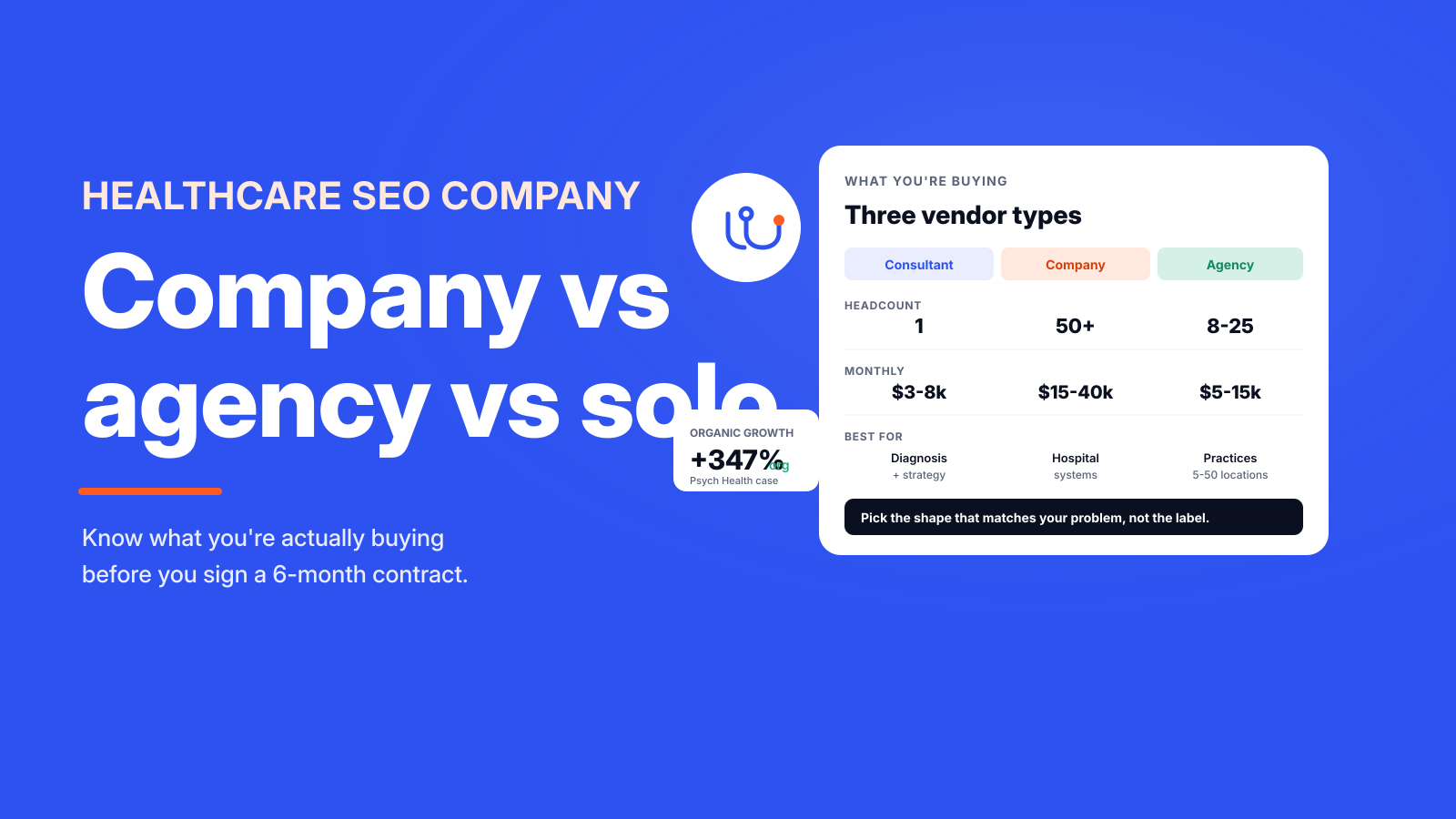
The three vendor shapes look similar from outside, so start with the working definition each one runs on. A healthcare SEO consultant is one senior operator delivering strategy, audits, and coaching for an in-house team that handles execution. A healthcare SEO agency is a small team (strategist, writer, developer, local specialist, account manager) delivering strategy and execution end-to-end. A healthcare SEO company at the enterprise scale is a 50+ headcount operation with centralized ops, proprietary tooling, and separate departments for content, technical, and reporting.
| Dimension | Consultant | Agency | Enterprise company |
|---|---|---|---|
| Headcount on your account | 1 | 3-8 | 8-25 (by department) |
| Monthly retainer | $3,000-$8,000 | $5,000-$15,000 | $15,000-$40,000+ |
| Engagement length | 3-6 months | 6-12 months | 12-24 months |
| What you’re buying | Diagnosis + strategy | Program + execution | Scale + centralized ops |
| Best fit | In-house team needs a brain | Practice needs a team | Multi-hospital system |
| Reporting depth | Deep, custom, low frequency | Standardized, monthly | Dashboarded, real-time |
| Speed to first win | Fast on diagnosis, slow on execution | 60-120 days on early wins | 90-180 days (bigger org, slower) |
The takeaway isn’t that one shape wins. It’s that the shape has to match the problem. A solo cash-pay dermatology clinic hiring an enterprise healthcare SEO company is paying for scale it can’t use. A five-hospital regional system hiring a solo consultant is asking one brain to hold a workload that needs eight. Match the shape to the problem, then compare within that tier.
What a healthcare SEO company actually delivers at each tier
Deliverable lists get vague in sales decks on purpose. It lets vendors sell the same one-page summary across every tier. The actual deliverables differ hard by tier, and the tier that matches your practice is the one where the deliverables solve real problems on your site this quarter.
Consultant tier deliverables. A full technical audit inside the first 30 days. A written 90-day roadmap tied to your existing team’s capacity. Monthly working sessions with your in-house marketer or practice manager. Direct-review of content drafts before they publish. A quarterly healthcare SEO strategy update. What a consultant does not deliver: hands-on content writing, page builds, tag manager configuration, or Google Business Profile management. If your team can’t execute those, you’re buying a plan that will sit.
Agency tier deliverables. Everything the consultant covers, plus execution. Four to eight pieces of content per month with a named medical reviewer on clinical pages. Monthly technical fixes pushed live through the site. Tag manager and analytics builds. Google Business Profile management for every location. Review-generation workflows tied to the practice’s EMR. A single monthly dashboard tying organic sessions to booking-page views to booked patients. Our healthcare SEO services team runs the agency shape end-to-end, and the deliverable list gets written into the contract in month one.
Enterprise company tier deliverables. Everything the agency covers, plus scale mechanics. A dedicated central SEO ops team. Custom in-house tooling on top of Screaming Frog, Ahrefs, and Semrush. Per-service-line content programs (cardiology, oncology, orthopedics) with rotating medical reviewers. Multi-brand governance (hospital, urgent care, physician group, foundation). Bi-weekly reporting cadence. Full-time program manager on the account. This tier is priced for systems with 10+ hospitals or 100+ physician practices under one parent brand.
Why the label healthcare SEO company hides real differences
Search “healthcare seo company” and the first page of results mixes all three tiers. A boutique three-person shop and a 200-person enterprise operator both use “company” in their name. The word has no legal or industry-defined meaning in SEO services. That’s what makes vendor screening hard for a first-time buyer. Two vendors quoting $4,500 and $18,000 per month for what looks like the same scope aren’t lying to you. They’re selling different products under the same label.
Three signals tell you which tier a vendor actually is, no matter what the sales page calls them. First, ask how many people work on your account, by role, from month one. A consultant answers “me.” An agency answers “five, here they are by role.” An enterprise company answers “the account team is eight, plus specialist rotation from four departments.” Second, ask for their three lowest and three highest monthly retainer figures across their current client roster. The spread tells you their real tier. A consultant runs a tight $5,000-$8,000 band. An agency runs $3,500-$15,000. An enterprise company runs $12,000-$60,000. Third, ask how they’d handle a project that’s obviously wrong for their tier. A consultant asked to run a 200-page migration will hand it off. An enterprise company asked to audit a solo cash-pay clinic will decline. Vendors who take every project regardless of fit are optimizing for revenue, not client outcomes.
How to pick between a healthcare SEO consultant, agency, or company
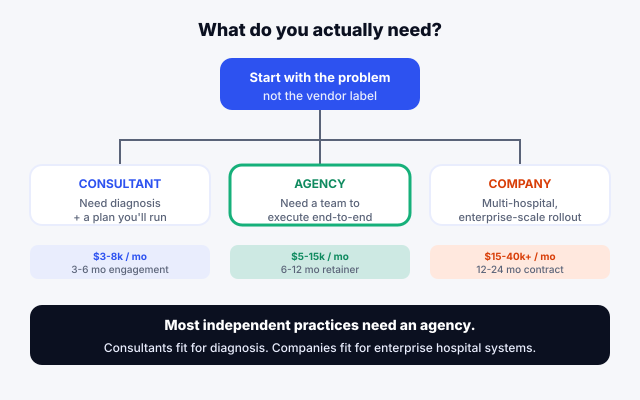
The decision comes down to two variables: what your in-house team can execute, and how big the SEO surface area actually is. Everything else is downstream.
Score your in-house team honestly on execution. Read your last three monthly SEO reports (or your last content and technical to-do list) and count what got done without external help. If 80% of the recommendations landed inside 30 days of the report, you have executional capacity, and a consultant will multiply it. If 30% landed, your team is holding the pen but not moving the work, and an agency is going to cost less than the compounding delay of untackled items. If under 20% landed, you don’t have an SEO function yet, and any tier will feel like starting from scratch. Start with an agency, plan for a two-year runway.
Score the surface area separately. A single-location clinic with 40 pages is a small surface. A 12-location group with 300 pages is a medium surface. A regional hospital system with 5,000 pages, 400 providers, and six service lines is an enterprise surface. Consultants can hold small and medium surfaces on the strategy side. Agencies can hold medium and light-enterprise surfaces on both strategy and execution. Only enterprise SEO companies have the ops depth to hold true enterprise surfaces without cutting corners.
Cross the two scores. High execution capacity plus small surface equals consultant. Low execution capacity plus medium surface equals agency. Any execution level plus true enterprise surface equals enterprise company, ideally paired with an internal SEO lead who owns the vendor relationship. The healthcare SEO agency evaluation guide walks the five-question vendor screen we run on every first sales call, and the same screen works one tier up or down with light adjustments.
Red flags across every healthcare SEO vendor tier
Some warning signs travel with vendors at every tier. The label on the door changes; the tells don’t. Any single one is a slow-down. Two together should stop the deal.
- No named medical reviewer on clinical content. Google’s Search Quality Rater Guidelines flag unreviewed YMYL content as a demotion signal. Any healthcare SEO vendor without a workflow for a licensed clinician to sign off on clinical pages will hit a ranking ceiling by month 12.
- Client-side pixels on booking-confirmation pages. Confirmed HIPAA violation per the 2022 HHS Office for Civil Rights guidance, refreshed in 2024. The vendor should be able to name the server-side replacement pattern in one sentence.
- “We work with 200+ healthcare clients.” Ask for 10 named cases with dates. If they can’t produce them, the count is inflated by lookalike verticals (dental, vet, chiro) filed under “healthcare” on the sales deck.
- Guaranteed rankings. Nobody guarantees rankings without either dumping links (Google penalty risk) or fabricating reports. Real vendors guarantee scope and process, not outcomes they don’t control.
- Reporting decks that lead with rankings. Rankings are an input. Booked patients are the output. If the top-line KPI is a ranking chart, the vendor is optimizing for optics.
- Auto-renew contracts with no exit clause. Fair contracts run 6 months minimum with a 60-day out clause after month three. Anything longer than 12 months with no out clause is designed to survive underperformance.
- Content described as “AI-assisted senior writers.” Usually means ChatGPT drafts with light editing. Google’s YMYL guidelines flag exactly this pattern, and the ranking hit lands 90-120 days after publish.
The tell that ties every red flag together: the vendor sells SEO as a service they push out, not as a patient-acquisition system they operate. Operators talk about the system. Resellers talk about the deliverables list.
Healthcare SEO company pricing in 2026
Retainer ranges shift by tier and by specialty. These are the honest ranges we see across the healthcare SEO market in 2026, based on published pricing pages, RFP responses we’ve reviewed, and our own retainer stack across mental health, dermatology, orthopedics, and multi-specialty groups.
| Practice profile | Consultant retainer | Agency retainer | Enterprise company retainer |
|---|---|---|---|
| Solo practice, one location | $3,000-$5,000 | $1,500-$3,500 | Not a fit |
| Multi-provider, single location | $4,000-$7,000 | $3,500-$7,500 | Not a fit |
| Multi-location group (2-10 clinics) | $5,000-$8,000 | $7,500-$18,000 | $15,000-$25,000 |
| Regional network (10-30 clinics) | Rare fit | $18,000-$35,000 | $20,000-$45,000 |
| Hospital system or IDN | Not a fit | Rare fit | $40,000-$120,000+ |
A note on the consultant column for solo practices: consultants often cost more per month than agencies at the solo tier. That’s not a mistake. A consultant sells hours of a senior brain. An agency sells a team on a program. The team is cheaper per hour on a solo scope. The consultant is worth the premium when the practice has an executional in-house marketer who needs strategy, not staffing. Under $999 per month at any tier usually means the vendor covers one of the four SEO layers (technical, on-page, local, content) and skips the other three.
When Psychological Health & Wellness Care, a national professional medical association supporting mental health practitioners, engaged us for a multi-channel rebuild, the underlying SEO structure was the piece most vendors would have skipped. Outreach was outdated, analytics couldn’t track campaign performance, and social engagement was low. We rebuilt the reporting stack, layered organic content with paid campaigns on LinkedIn, Facebook, and Twitter, and tied every channel to a single analytics view. Twelve months later organic search was up 347%, web traffic up 285%, lead generation up 238%, and conference attendance up 67%. The story that matters for vendor selection: none of that landed on a solo consultant scope, and none of it needed enterprise-hospital scale. It landed on a matched-tier agency engagement, which is where most healthcare practices sit.
What separates a specialist healthcare SEO company from a generalist
A generalist SEO company selling “healthcare” as one of 15 verticals will hit the same three walls every time. First, YMYL trust signals. Medical content ranks against a stricter bar under Google’s Search Quality Rater Guidelines, and the difference shows up in the Author, Reviewer, and Publisher signals on every clinical page. Generalists write under a “Team” byline and never staff a real medical reviewer. Second, HIPAA-safe tracking. A specialist knows the June 2024 court ruling, keeps a BAA with the analytics platform, and routes booking-confirmation events server-side. A generalist installs Google Analytics with consent mode and calls it done. Third, review velocity. Healthcare local pack rankings weigh recent verified reviews heavier than most verticals, and specialists run monthly review workflows tied to the EMR. Generalists treat reviews as a one-time project.
The healthcare SEO expert (or team, at higher tiers) will also know the EMR names your front office uses. Athenahealth, Epic, DrChrono, and eClinicalWorks each have different integration paths for review requests and patient-communication triggers. A specialist knows those paths before the kickoff call. A generalist finds out on-the-fly and passes the discovery cost to you. Our healthcare SEO pillar guide covers the specific technical patterns that separate the two, and the difference compounds every quarter.
When to hire, when to stay in-house, and when to switch tiers
The decision to hire external help at all follows a rough rule of thumb: if the practice’s SEO ceiling is above what one person can hold, external help pays back. If the ceiling is below, an in-house content coordinator plus a strong CMS often wins on ROI. That ceiling usually sits around two locations and 60 pages for most specialties.
Switching tiers is a different call. Practices that outgrow a consultant usually feel it as a strategy that keeps arriving on time and an execution list that keeps not landing. The consultant is fine. The scope has moved past what one operator can hold. Time to move to an agency. Practices that outgrow an agency usually feel it as a program that runs well but stops delivering marginal gains after month 18. The agency is at capacity on your account. Time to either expand the retainer inside the agency (deeper content programs, more locations, added CRO) or move to an enterprise company if the surface area has crossed into hospital-system territory. Downgrading tiers is rare but real. Enterprise clients whose ops team matures often move from enterprise SEO company to a boutique agency plus in-house lead, and cut retainer by 40-60% without losing performance. The right move usually shows up in the reporting a quarter before it’s obvious in the retainer conversation.
A useful framing: an SEO vendor should feel expensive when the scope is under-matched, right-priced when the scope is matched, and cheap when the practice has grown into a tier above what the vendor is running. When the vendor starts feeling cheap, it’s time to plan the upgrade. When it starts feeling expensive, it’s time to plan the tier change or the exit.
How a healthcare SEO company fits with the rest of your marketing stack
SEO doesn’t run alone at any tier. Three integration points decide whether the engagement compounds or gets stuck. Paid search: SEO and paid search share keywords, landing pages, and reporting, and running them on one dashboard drops blended cost per new patient 15-25% inside 6-9 months. A healthcare PPC agency integrated with the SEO program usually finds those savings first. Split the two vendors and the channels compete for the same click. Web design and CRO: the fastest SEO in the world doesn’t book patients if the site loads slow and hides the booking button. Patient-first healthcare website design is how the SEO gain shows up in the booking dashboard. Any healthcare SEO vendor that can’t work fluently with the web team is going to slow the program down. Reviews and reputation: reviews feed local SEO, and local SEO feeds bookings. The vendor should own the review workflow or partner with someone who does.
The pattern that separates a competent healthcare SEO company (at any tier) from the rest is the willingness to admit what they don’t do. Vendors who claim SEO, paid search, web design, review management, HIPAA compliance, PR, and social under one roof are almost always doing one well and outsourcing the rest. Ask which is which. The honest answer builds trust. The dodge tells you the same thing, just slower.
Contract terms that protect both sides
Every healthcare SEO vendor contract, at every tier, should spell out four things: term length with an out-clause, deliverables scope in writing, account ownership on exit, and reporting cadence. Term length: 6 months minimum with a 60-day exit clause after month three, no auto-renewal without written re-signature. Deliverables scope: a list of what gets delivered each month, by page count, content topic, technical audit item, and review workflow. Ownership: the practice owns the domain, the Google Business Profile, the content, the schema, the analytics accounts, and any tracking configuration built during the engagement. Reporting: monthly report by day five of the following month, quarterly strategy review, and a written notification if any KPI slides outside its target band. The healthcare marketing retainer Redefine Web offers follows this structure, and any vendor worth hiring will accept the same frame on the first pass.
Two clauses worth adding at the enterprise company tier: a data-processing addendum covering the HIPAA scope of every third-party tool the vendor’s setup touches, and a right-to-audit clause allowing an internal or external security team to review the vendor’s tracking configuration once per year. Those two clauses aren’t standard at boutique tiers but should be at enterprise scale. The healthcare web design pillar walks the technical hygiene on the site side of the same contract, and the two documents usually get bundled during procurement.
Frequently asked questions about healthcare SEO companies
What’s the difference between a healthcare SEO company and a healthcare SEO agency?
A healthcare SEO company is an umbrella label that covers three vendor shapes: solo consultant, boutique agency, and enterprise operation. A healthcare SEO agency is one specific shape inside that label, usually a 3-8 person team delivering strategy plus execution end-to-end for a $5,000-$15,000 monthly retainer. When a vendor calls itself a “company,” ask headcount and price band before you compare quotes. Two vendors marketing under the same word can be selling a $4,500 agency scope and a $22,000 enterprise scope.
The healthcare SEO company label also gets used by enterprise operators that run 50+ headcount, own proprietary tooling, and staff separate departments for content, technical, and reporting. That tier fits multi-hospital systems and physician networks with 100+ providers, and prices at $15,000-$40,000+ per month. The tier under it, the boutique agency, fits practices with 2-15 locations. The tier under that, the consultant, fits a single-location practice with a strong in-house marketer who owns execution.
How much does a healthcare SEO company cost per month?
A healthcare SEO company costs $1,500-$3,500 per month at the boutique-agency tier for a solo practice, $3,500-$7,500 for a multi-provider single location, $7,500-$18,000 for a multi-location group, and $15,000-$45,000 at the enterprise tier for regional networks and hospital systems. A consultant sits at $3,000-$8,000 per month regardless of practice size, priced on hours of a senior brain rather than team output. Pricing under $999 per month usually means the vendor covers one of the four SEO layers (technical, on-page, local, content) and skips the other three.
The market pattern that matters: healthcare SEO pricing tracks scope and headcount, not brand recognition. A boutique healthcare SEO company with five clients on a $5,000-$10,000 tier will often outperform a 200-client operator running the same practice on a $2,000 tier. Ask what’s in scope, ask who’s on the account by role, and ask for the reporting template before you compare pricing across three vendors quoting the same category name.
How do I know which tier of healthcare SEO company is right for us?
Match tier to two variables. Executional capacity of your in-house team: if 80% of last quarter’s SEO recommendations got done inside 30 days, a consultant multiplies your team; if 30% got done, you need an agency; if under 20% got done, start with an agency and plan a two-year runway. SEO surface area of your practice: single-location clinic with 40 pages is a small surface (consultant or boutique agency), a 12-location group with 300 pages is a medium surface (agency), a hospital system with 5,000 pages and 400 providers is an enterprise surface (enterprise company plus an internal SEO lead).
Cross the two variables. High capacity plus small surface equals consultant. Low capacity plus medium surface equals agency. Any capacity plus enterprise surface equals enterprise SEO company. The trap most first-time buyers fall into is picking on price rather than shape. A $2,000 enterprise-company plan and a $12,000 consultant hour block are both wrong for a five-location dermatology group. The right shape for that practice is a boutique agency at $7,500-$12,000, and the price bands cluster tightly when you filter by shape first.
How long does a healthcare SEO company take to show results?
A healthcare SEO company usually shows early rank movement in 90-120 days on long-tail terms, meaningful traffic gains at month 6, and material booked-patient volume between month 9 and month 12. That timeline assumes a technically sound site, real provider content, and a live Google Business Profile from day one. Competitive metros like New York, Los Angeles, Miami, and Chicago can slide the “meaningful traffic” mark to month 9 on head terms like “psychiatrist near me” or “dermatologist near me.” Enterprise SEO companies operating on hospital-system scopes usually run longer timelines (12-18 months on real traffic movement) simply from the larger surface area and the internal approval overhead.
The trap most practices fall into: firing the healthcare SEO company at month three for “not enough progress” is how a year of momentum gets burned restarting with the next vendor. Real compounding kicks in around month six on sites set up right. Practices that stay the course watch cost per new patient fall for 24-36 months on the same content. Practices that swap vendors every six months restart the timeline every time and pay the setup cost twice.
Can a healthcare SEO company handle HIPAA-safe tracking?
Yes, but only about one in four general SEO vendors can, and the specialists say so upfront. HIPAA-safe SEO tracking means server-side conversion tagging, hashed patient identifiers, BAAs with every third-party vendor that could touch patient data (analytics platform, tag manager, CRM, call tracker), and no client-side pixels on booking-confirmation pages. The 2022 HHS Office for Civil Rights guidance made this explicit, and the safe pattern didn’t shift much after the June 2024 court ruling on the OCR’s Meta Pixel enforcement.
The clean test on a first sales call: ask the vendor to name every third-party tool their tracking setup touches and confirm which of those tools they have a BAA with. If the answer is “we use Google Analytics with consent mode and that covers it,” the vendor doesn’t understand HIPAA. If the answer is “server-side GA4 through our own tag server, BAA-covered call tracking, and PHI-safe form routing to a HIPAA CRM,” the vendor gets it. A healthcare SEO company that gets it will also decline to install any tracking on a booking-confirmation page until the tag setup is BAA-covered end-to-end.
Should I hire a healthcare SEO consultant first, then move to an agency?
Often yes, and it’s a common path for growing practices. A healthcare SEO consultant costs less than an agency at the strategy layer, delivers a clean 90-day roadmap, and lets the practice test whether external SEO help changes the numbers before committing to a bigger scope. Practices with a strong in-house marketer often stay on the consultant tier for years. Practices without one usually move to a boutique agency between month six and month twelve, once it becomes obvious the roadmap keeps arriving and the execution list keeps stalling.
The one time to skip the consultant step and go straight to an agency: when the site has known technical debt (slow load, indexing problems, missing schema), when there’s no in-house marketer, and when the practice already has three or more locations. In that shape the consultant plan gets built, sits, and the practice pays for six months of a strategy that never lands. Skip the tier and start with the agency scope, and the same six months produce real work getting done.
Comparing a healthcare SEO company on the framework above? Talk to our healthcare marketing team about a scoped SEO engagement, and get a first-90-days plan you can share with your partners before signing anything.
Book your free 30-minute strategy call.
No spam, no sales rep. We use your email to schedule your call with a senior strategist. That is it.