Healthcare SEO Strategy for Providers

- A healthcare SEO strategy runs six work streams in parallel: technical foundation, keyword map, clinician-reviewed content, local + reviews, authority, and measurement.
- Sequencing matters more than tactics. Foundation and measurement go live first so every downstream number becomes checkable, then keyword map and local, then content and authority.
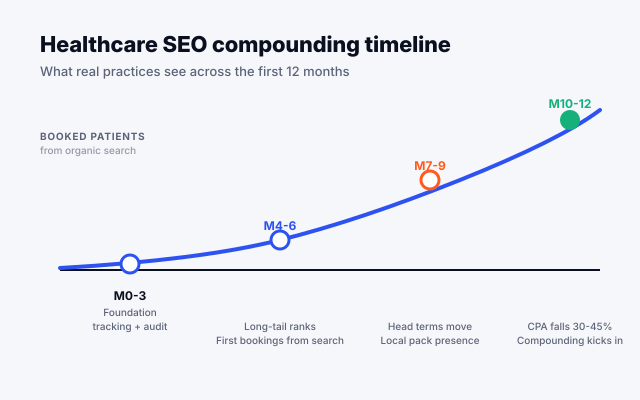
- Real timelines: first long-tail rankings at months 4-6, meaningful traffic at 6-9, material booked-patient volume between months 9 and 12 on well-sequenced sites.
- Budget bands cluster by practice size: $2,500-$5,500 for solo, $4,500-$9,000 for multi-provider single-location, $8,000-$18,000 for multi-location groups, $18,000-$40,000 for regional networks.
- The four leading indicators that signal the strategy is working before booked-patient numbers move: long-tail rank movement, local pack impressions, clean Search Console coverage, and 10-30 reviews per location per month.
Most healthcare SEO advice reads like a checklist: fix titles, add schema, publish blog posts. Real practices need something different. A healthcare SEO strategy is the plan that ties technical foundations, on-page SEO for healthcare, clinician-reviewed content, local presence, authority signals, and measurement into one machine that books patients on the calendar. Get the shape right and the moving parts compound for 24-36 months. Get it wrong and the same $60,000 a year of effort produces a graph that looks like a heartbeat with no direction.
This guide walks the framework we run for solo clinics through multi-location groups. Every layer maps to a real work stream on the account, a real budget line, and a real number you can check against your reporting dashboard. No hype. No 50-page keyword deck. A working plan you could hand to a practice manager on Monday morning.
What a healthcare SEO strategy actually contains
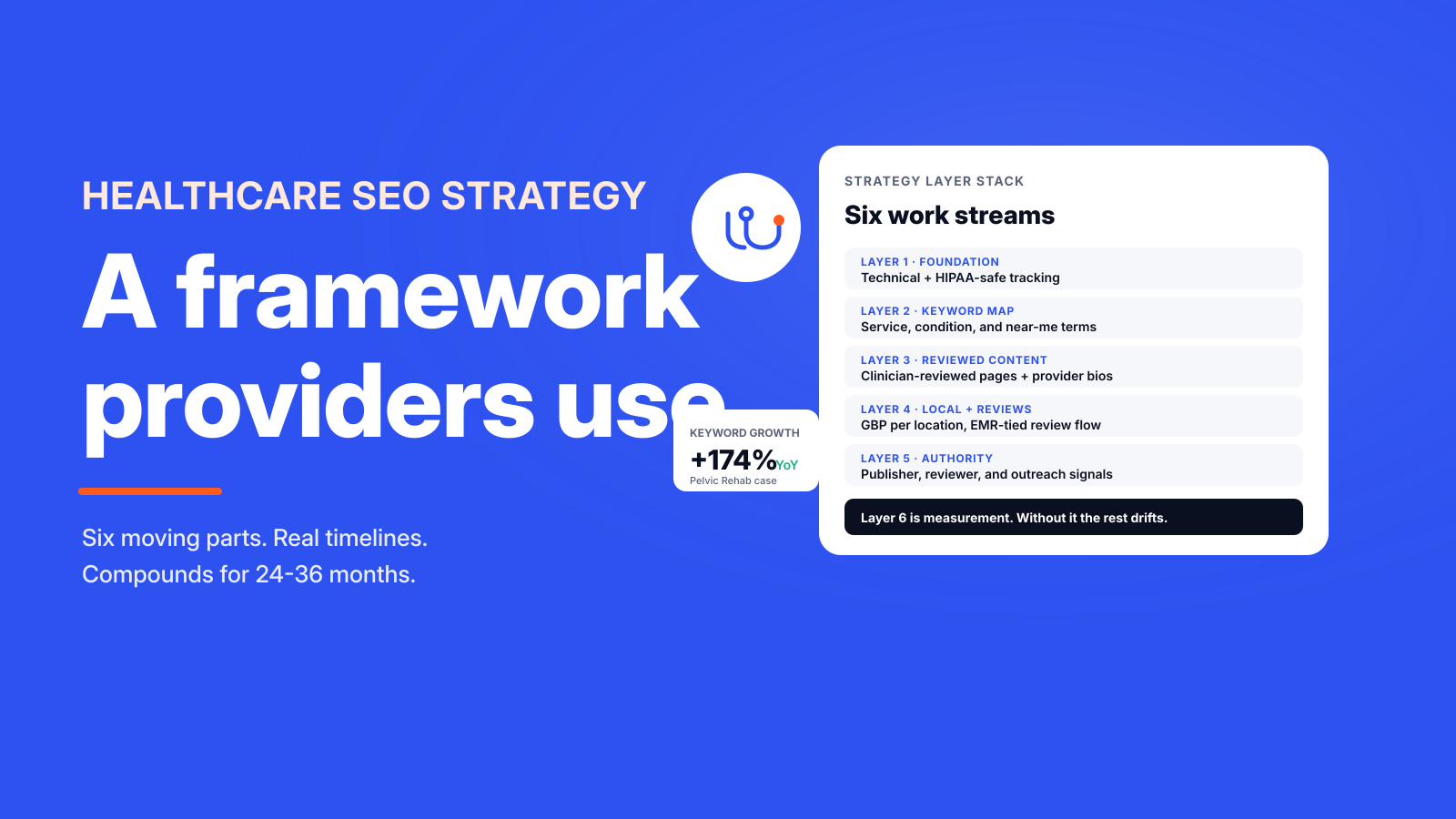
A working healthcare SEO strategy has six work streams running in parallel, not seven random tactics ordered by whichever agency built the deck. Technical foundation and HIPAA-safe tracking sit at layer one. Keyword mapping across service, condition, and near-me terms is layer two. Clinician-reviewed content pages plus provider bios sit at layer three. Local presence with Google Business Profile management and EMR-tied review flows is layer four. Authority signals (publisher structure, medical reviewer bylines, outreach) live at layer five. Measurement wraps the other five as layer six. Drop any one and the rest drifts.
The pattern most practices run into: they hire a vendor that runs three of six well and quietly skips the other three. Content shows up but tracking never gets fixed. Or tracking gets fixed but the content is generic. A real healthcare SEO strategy accounts for every layer from month one, even when the practice only funds the top two or three in the first quarter. The plan sequences the work; it doesn’t pretend the skipped layers don’t exist.
| Strategy layer | What it delivers | Owner on the account | First evidence |
|---|---|---|---|
| 1 · Foundation | Technical audit, HIPAA-safe tracking, schema, sitemap | Developer + SEO lead | Weeks 3-6 |
| 2 · Keyword map | Service, condition, and near-me term coverage | SEO strategist | Weeks 2-4 |
| 3 · Reviewed content | Clinician-reviewed pages, provider bios, condition guides | Writer + medical reviewer | Months 2-4 |
| 4 · Local + reviews | GBP per location, EMR-tied review workflow | Local specialist | Months 1-3 |
| 5 · Authority | Publisher signals, reviewer bylines, digital PR | Content director | Months 4-9 |
| 6 · Measurement | Booking-attribution dashboard tied to organic sessions | Analytics engineer | Weeks 4-8 |
Read the table as a sequencing plan, not a menu. Foundation and measurement go live first so every downstream number becomes checkable. Keyword map and local run in parallel through months one to three. Reviewed content publishes from month two forward. Authority is the slow-burn layer that decides ceiling. A healthcare SEO strategy that skips the sequencing is why practices spend 18 months producing content that ranks nowhere.
Layer one. Technical foundation and HIPAA-safe tracking
The layer nobody wants to fund is the layer that decides whether the other five compound or stall. Technical SEO for healthcare covers site speed (LCP under 2.5s on mobile per Google’s page-experience thresholds), a real XML sitemap, Organization and MedicalBusiness schema, canonical hygiene, and index-status monitoring. On a WordPress site the audit usually surfaces 15-40 fixable issues inside the first 30 days. On a site built on a proprietary healthcare CMS (Solutionreach, Kareo Marketing, ZocDoc profile-only builds), the audit surfaces access limits before it surfaces fixes.
HIPAA-safe tracking is the piece the average generalist vendor skips. The 2022 HHS Office for Civil Rights guidance on tracking technologies, refreshed in 2024, made it explicit: client-side pixels on booking-confirmation pages and any page that ties an identifiable person to a service line count as impermissible PHI disclosure. The safe pattern is server-side conversion tagging through a tag server the practice controls, BAAs signed with every third-party tool in the stack (analytics, call tracker, CRM), and event routing that hashes patient identifiers before they leave the site. A healthcare SEO strategy that puts a Facebook Pixel on a booking-thanks page is a healthcare SEO strategy that gets the practice into an OCR letter.
The right foundation stack for most practices under 30 locations: WordPress or a headless CMS on a HIPAA-compliant host, GA4 running through a self-owned server-side tag manager, a BAA-covered call tracker like CallRail Healthcare, and MedicalBusiness plus Physician schema on every provider page. Our healthcare website design team delivers that stack on every new build, and retrofits it on existing sites inside a 6-8 week engagement.
Layer two. Keyword mapping for healthcare practices
Healthcare keyword mapping runs on three axes. Service terms are what the practice does (“psychiatric evaluation,” “TMS therapy,” “pelvic floor physical therapy”). Condition terms are what the patient searches when they know the symptom but not the specialty (“chronic pelvic pain treatment,” “depression that won’t respond to medication,” “endometriosis specialist”). Near-me terms are the geographic combinations that carry local intent (“psychiatrist near me,” “pelvic pain doctor Manhattan,” “TMS therapy Atlanta”). A working healthcare SEO strategy covers all three axes, weighted by patient acquisition value.
The mistake most practices make on keyword research: they chase the head terms (“dermatologist,” “psychiatrist”) and skip the condition terms. Head terms are competitive, expensive, and often don’t convert because searchers at that stage are still comparing specialties. Condition terms convert. A patient searching “chronic pelvic pain treatment” is closer to booking than a patient searching “pelvic doctor.” A patient searching “TMS therapy depression that didn’t respond to SSRIs” is even closer. The healthcare SEO strategies that book real patients over-index on condition and near-me terms in the first 12 months and layer head terms in year two.
A useful sizing rule: the keyword map for a single-location clinic runs 60-120 terms. A multi-location group runs 200-500 terms. A hospital system runs 2,000+ terms with a taxonomy that maps to service lines. Anything smaller isn’t a keyword map; it’s a shortlist. Anything larger without taxonomy becomes noise the writer can’t use. Our healthcare SEO pillar guide walks the taxonomy templates we run for each practice shape, and the same taxonomy works across specialties with light editing.
Layer three. Clinician-reviewed content that ranks
Content is where healthcare SEO strategies most often break. Google’s Search Quality Rater Guidelines flag medical content under the YMYL (Your Money or Your Life) bar, and the raters check for real author expertise, medical review, and organizational credentials on every page. Generalist writers producing 1,200-word “5 signs of depression” posts under a “Team” byline hit a ranking ceiling by month twelve, and the ceiling is usually page three of the SERP.
The content stack that actually ranks in healthcare has three tiers. Provider bios written like real bios (education, residency, board certifications, publications, patient population, treatment philosophy) sit at the top of the trust hierarchy. Service and condition pages come next, each with a named medical reviewer, a “reviewed on [date]” timestamp, and citations to primary sources (peer-reviewed journals, CDC, NIH, specialty society guidelines). Educational content (the pillar and cluster posts patients read before they book) sits at the base, still written by a named writer and reviewed by a licensed clinician. Every layer gets Article schema plus the appropriate MedicalWebPage subtype.
A working content cadence for most practices: four to eight pieces per month, split roughly 40% condition guides, 30% service page rewrites, 20% provider content, 10% local content (city page updates, community events, screening announcements). The cadence looks slow on paper. It’s the cadence that compounds. Practices publishing 20 posts a month under a “Team” byline usually rank worse at month twelve than practices publishing four posts a month under a licensed reviewer’s name.
Layer four. Local SEO and review workflows tied to the EMR
Local SEO carries more weight in healthcare than in almost any other vertical. Patients search for care near where they live and work, Google local pack results dominate the mobile SERP for near-me queries, and Google Business Profile signals (reviews, categories, service list, photos, hours) decide who shows up. A healthcare SEO strategy without a real local layer is a strategy that gives up 40-60% of the addressable search volume before the first blog post publishes.
The local layer breaks into two work streams. Google Business Profile management runs continuously: primary category correct (Psychiatrist, not Doctor), secondary categories filled (Mental Health Service, Medical Clinic), service list complete with descriptions, product list populated for cash-pay offerings, weekly photo uploads from the practice, and posts published monthly with real content (screening events, new provider announcements, seasonal reminders). Every location gets its own profile. Multi-location groups need a spreadsheet governance model so the profiles don’t drift.
Review workflows tied to the EMR are the second stream. Athenahealth, Epic, DrChrono, and eClinicalWorks each expose different automation paths for triggering a review request after a completed visit. The pattern that works: the EMR triggers a HIPAA-safe SMS or email the day after the visit, the message routes through a BAA-covered platform (Podium Healthcare, BirdEye Healthcare, or an in-house build), the patient hits a routing page that filters positive feedback to Google and negative feedback to a private inbox. Practices running this workflow accumulate 10-30 new Google reviews per location per month, which is enough to move the local pack for most specialties inside 6 months.
Layer five. Authority signals and digital PR
Authority is the ceiling-setter. Two practices with matched foundations, keyword maps, and content stacks will diverge at month twelve based on their authority signals. Google’s clinical-content raters weigh the publisher (the practice’s overall trust posture on the web), the reviewer (the licensed clinician’s own footprint), and the topical authority (whether the site consistently covers a service area) heavier than any single on-page signal.
The publisher layer covers the site-wide trust posture: About page with real leadership, Contact page with NAP verified across every citation source, Privacy Policy and HIPAA Notice of Privacy Practices linked from every footer, provider licenses displayed with license numbers, and Trust badges (BBB, professional societies, HITRUST if applicable) placed honestly. The reviewer layer means the medical reviewers on the content have their own author pages, LinkedIn profiles that match, and Sameas links in Person schema tying the entities together. The topical authority layer builds over time as the site accumulates depth across a service area rather than spraying content across every specialty in the building.
Digital PR sits on top of the authority stack. The right approach for healthcare is not the standard “guest post on 40 blogs” playbook. Most of that footprint is thin and gets discounted. It’s earning coverage in specialty publications (Psychiatric Times, Journal of Family Practice, condition-specific patient advocacy sites), participating in professional associations, and contributing expert commentary to health journalism outlets. One placement in a real medical publication moves authority signals more than 40 guest posts on generic health blogs.
Layer six. Measurement that ties SEO to booked patients
Measurement is the layer that decides whether the other five keep getting funded. A healthcare SEO strategy that reports rankings and traffic is a healthcare SEO strategy that gets cut in a budget review. A strategy that reports booked patients per organic session, cost per new patient by service line, and lifetime value by acquisition channel gets its budget increased when Q3 tightens.
The measurement stack most practices need has four pieces. Server-side GA4 with the healthcare event set (form submissions, phone calls tracked through a BAA-covered call tracker, chat sessions, appointment-request events) is the base. Search Console pulled into the same reporting layer so keyword-to-URL performance is visible. Call tracking with dynamic number insertion by traffic source, so an organic call and a paid call don’t blend into one “phone number” attribution. And a monthly attribution dashboard tying organic sessions to booking-page views to booked patients, either built in Looker Studio or in a healthcare-specific tool like Health Grades’ analytics stack.
When Pelvic Rehabilitation Medicine, a 14-location pelvic-pain medical group operating across 10 states, came to us in 2023, the practice had strong clinical outcomes and a digital presence that couldn’t scale to match. The site’s technical foundation was outdated, content lived scattered across old blog posts nobody had updated, and there was no community layer for a patient population (pelvic pain affects more than 15% of women and 10% of men) that searches heavily for peer support before booking. We rebuilt the foundation, mapped keywords across pelvic pain, endometriosis, and specialist search terms, published clinician-reviewed content across service lines, and launched the Worthy Warrior patient community as a dedicated support hub. Twelve months later organic keyword rankings were up 174% year over year and organic traffic was up 166%. The community became the top patient touchpoint before booking. The story that matters for strategy: none of that landed on a single work stream. It landed on all six moving together.
Sequencing the work across 90 days, 6 months, and 12 months
The framework isn’t useful without a sequencing plan. Every practice we onboard follows roughly the same rhythm across the first 12 months, adjusted for practice size and existing baseline. The 90-day plan lands the foundation and measurement layers so the rest of the work becomes checkable. The 6-month plan puts content and local in motion. The 12-month plan turns on authority and starts compounding. Skipping a phase to “save time” is how practices end up 14 months in with rankings that don’t book anybody.
| Phase | Work streams active | Deliverable checkpoints | What to measure |
|---|---|---|---|
| Weeks 1-4 | Foundation, measurement, keyword map | Technical audit, GA4 server-side live, HIPAA tracking clean, keyword taxonomy signed off | Baseline organic sessions, baseline calls, indexed pages |
| Weeks 5-12 | + Local, content kickoff | GBP audit + optimization per location, first 8-12 content pieces live, review workflow live | Local pack impressions, review velocity, first long-tail ranks |
| Months 4-6 | + Content cadence, review scale | 24-32 content pieces published, 10-30 reviews per location per month, Search Console coverage clean | Non-brand organic sessions, top-20 rankings, booking-page conversion rate |
| Months 7-9 | + Authority, digital PR kickoff | Reviewer bylines live, publisher signals audited, first two PR placements | Head-term movement, authority score trend, cost per booked patient by service line |
| Months 10-12 | All six layers running | Program in steady state, quarterly strategy review, budget conversation for year two | Blended CPA, LTV by channel, share of local voice |
The sequencing rule that saves most practices from wasted spend: never fund a downstream layer before the upstream layers are running. Content published on a site with broken tracking is content whose ROI can’t be measured. Local optimization on a site with no reviewed content is a fast rank that stalls. Authority work on a site with no keyword map is PR that doesn’t tie back to anything. The healthcare SEO agency selection guide walks the vendor-side of this sequencing conversation, and the healthcare SEO company comparison covers how the tier of vendor changes what phases they can run in parallel versus serial.
Budget and staffing patterns for each practice size
A working healthcare SEO strategy has real budget bands attached, or the plan becomes fiction inside 90 days. The market pattern across our 2026 client roster and published pricing from healthcare-specialist vendors: solo cash-pay practices run $2,500-$5,500 per month, multi-provider single-location practices run $4,500-$9,000, multi-location groups (2-10 clinics) run $8,000-$18,000, regional networks (10-30 clinics) run $18,000-$40,000, and hospital systems run $40,000-$150,000+.
The staffing split inside those bands matters more than the total. A $10,000 monthly retainer that funds one lead strategist, one writer, and a shared local specialist will move a multi-location group faster than a $14,000 retainer split across three junior generalists. Ask any healthcare SEO vendor for the retainer breakdown by role (hours per role per month) and the split tells you whether the money is buying a program or buying overhead.
In-house staffing patterns compound too. A practice with an in-house content coordinator plus an external agency runs 30-40% cheaper on retainer than a practice buying the same output fully-outsourced, because the coordinator handles review workflows, GBP updates, and provider content collection. Practices without any in-house SEO ownership need the external retainer to include a “practice liaison” role in the scope, or the strategy stalls whenever the vendor needs a clinician quote or a photo of the exam room.
Common healthcare SEO strategy mistakes and how to avoid them
Every practice we’ve onboarded arrived with the same three or four mistakes. Recognizing them is the fastest way to save the first 90 days from being another audit-and-restart cycle.
- Chasing head terms in month one. “Psychiatrist” and “dermatologist” are page-one aspirations, not month-one targets. The healthcare SEO strategies that produce booked patients in the first 6 months rank long-tail condition and near-me terms first, then earn head terms in year two.
- Publishing content under a “Team” byline. Google’s clinical raters demote unattributed medical content. Every clinical page needs a named writer and a named licensed reviewer, both with real author pages and Person schema linking to LinkedIn.
- Skipping HIPAA-safe tracking to move faster. Client-side pixels on booking-confirmation pages create OCR exposure, and the shortcut saves two weeks in month one at the cost of a compliance letter in month twelve.
- Treating reviews as a one-time project. The local pack rewards recent reviews. A one-time push of 40 reviews in month two decays inside a quarter. A monthly cadence of 10-30 reviews per location compounds for years, and the pattern shows up as the review-velocity signal in every healthcare SEO report worth reading.
- Reporting rankings and traffic without booked patients. Rankings are inputs. Booked patients are outputs. Strategies that never tie the two get their budget cut the first quarter revenue tightens.
- Splitting SEO and paid search across two vendors that don’t talk. Shared keywords, shared landing pages, and shared reporting drop blended cost per new patient 15-25% inside 6-9 months. Split vendors and the channels compete for the same click. Our healthcare PPC agency integrates with the SEO program on the same account team.
- Rebuilding the site without a redirect map. A healthcare website redesign that drops the 301 layer can vaporize 20-40% of organic sessions for 4-6 months as Google re-crawls the new URL set. The redirect map goes live before the redesign, not after.
The tell that ties every mistake together: the practice was buying tactics instead of a strategy. Tactics are what a generalist SEO vendor sells because tactics are checkable in a monthly report. A healthcare SEO strategy is the sequenced plan that makes the tactics compound. The difference shows up in the reporting a quarter before it shows up in the retainer conversation.
How the framework changes for specific healthcare specialties
The six-layer framework holds across specialties, but the weighting shifts. Mental health practices over-index on educational and condition content because patients search extensively before booking. Dermatology practices lean hard into local pack and reviews because most searches are near-me. Orthopedics leans into service-line content (ACL reconstruction, rotator cuff repair) tied to referring physician outreach. Multi-specialty groups need taxonomy work that no single-specialty practice needs. A healthcare SEO strategy that treats mental health and dermatology as one playbook underperforms both.
Cash-pay versus insurance-paid practices shift the strategy too. Cash-pay practices (concierge medicine, cosmetic dermatology, functional psychiatry, cash-pay pelvic PT) need higher-intent content because the patient is comparing against paying out of pocket. Insurance-paid practices need broader awareness content because the patient filters by insurance acceptance before comparing quality. Both need local optimization, but cash-pay practices weight photos, provider bios, and specialty-society badges heavier. Insurance-paid practices weight the insurance list and referral form flow.
The specialty-first strategy work usually happens in weeks 2-4 of onboarding, once the keyword map is in draft. Weighting decisions get documented and revisited at month 6 and month 12. Our healthcare marketing team runs the specialty-weighting session on every new account, and the same session runs at each annual strategy review as the practice’s service line mix shifts.
Frequently asked questions about healthcare SEO strategy
What is a healthcare SEO strategy?
A healthcare SEO strategy is the sequenced plan that ties technical foundations, keyword mapping, clinician-reviewed content, local presence, authority signals, and measurement into one machine that books patients from organic search. It’s not a checklist and it’s not a keyword deck. A working healthcare SEO strategy has six work streams running in parallel with defined owners, deliverables, and measurement checkpoints from week one. Solo clinics fund two or three streams at a time and sequence the rest. Multi-location groups fund all six from month one. Hospital systems layer service-line taxonomy on top of the six-layer base. The strategy exists to make sure the tactics compound rather than sit as isolated wins that decay when the next redesign lands.
How long does a healthcare SEO strategy take to show results?
A healthcare SEO strategy usually shows first long-tail rankings at months 4-6, meaningful organic traffic gains at months 6-9, and material booked-patient volume between months 9 and 12. That timeline assumes a technically sound site, real clinician-reviewed content, and a live Google Business Profile from week one. Competitive metros like New York, Los Angeles, Miami, and Chicago slide the “meaningful traffic” mark to month 9 on head terms. The trap most practices fall into: cutting the strategy at month three for “not enough progress” restarts the timeline every time a new vendor arrives. Real compounding kicks in around month six on well-sequenced strategies, and cost per new patient falls for 24-36 months on the same content.
How much should a practice budget for a healthcare SEO strategy?
Budget bands cluster by practice size and scope. Solo cash-pay practices run $2,500-$5,500 per month, multi-provider single-location practices run $4,500-$9,000, multi-location groups (2-10 clinics) run $8,000-$18,000, regional networks (10-30 clinics) run $18,000-$40,000, and hospital systems run $40,000-$150,000+ per month for a working healthcare SEO strategy. Anything under $999 per month usually funds one of the six layers and skips the other five, which produces reporting that looks like activity but doesn’t move booked patients. The staffing split inside the retainer matters more than the total: a $10,000 retainer that funds one lead strategist plus a writer plus a shared local specialist moves a practice faster than a $14,000 retainer split across three junior generalists.
Can a small practice run a healthcare SEO strategy in-house?
Yes, on a small enough surface area. A single-location clinic with 40-80 pages, a strong in-house marketer, and a licensed clinician willing to review 6-8 content pieces per month can hold layers 2, 3, and 4 (keyword map, content, local) with external help only on layer 1 (foundation) and layer 5 (authority). The DIY ceiling usually sits around two locations and 60 pages, above which the workload overwhelms one operator. Small practices that try to DIY the foundation and measurement layers without a technical SEO consultant tend to leave 15-30 fixable issues sitting for months. The pattern that works: fund the foundation and measurement layers externally once as a project, run the middle three layers in-house on a monthly cadence, revisit authority yearly. Practices that scale past two locations usually move to a boutique agency and keep the in-house coordinator role.
How is a healthcare SEO strategy different from a general SEO strategy?
Three layers change materially. HIPAA-safe tracking replaces the standard Google Analytics install because client-side pixels on booking-confirmation pages create OCR exposure under the 2022 guidance. Clinician-reviewed content replaces the standard blog cadence because Google’s YMYL raters demote unattributed medical content and reward the Publisher-Reviewer-Author trust chain. Local SEO carries heavier weight than most verticals because near-me search dominates healthcare mobile queries and reviews decide who shows up in the local pack. A healthcare SEO strategy weights specialty and cash-pay versus insurance-paid distinctions that don’t exist in most consumer verticals. Running a general SEO playbook on a healthcare account produces a reporting graph that looks fine and a compliance exposure that catches up around month twelve.
What signals a healthcare SEO strategy is working before the booked-patient numbers move?
Four leading indicators show up before booked patients do. Long-tail rankings in the top 20 for 15-40% of the mapped keyword set inside 90 days signals the foundation and content layers are aligned. Local pack impressions climbing month over month signals the local layer is working. Search Console coverage clean (no server errors, no soft 404s, no orphaned pages) signals the technical layer holds. And review velocity hitting 10-30 per location per month signals the local + review workflow is tied to the EMR properly. If all four move in the first 90 days, booked patients follow between months 6 and 12. If one or more stall, the strategy has a sequencing problem worth diagnosing before month 4.
Building a healthcare SEO strategy for your practice? Talk to our healthcare SEO services team about a scoped 90-day plan you can review with your partners before signing anything.
Book your free 30-minute strategy call.
No spam, no sales rep. We use your email to schedule your call with a senior strategist. That is it.