Client Dashboard →
Q4 capacity now open. Roadmap in 5 business days.
Book strategy call
Marketing Strategy

How to Choose a B2B SaaS Marketing Agency for Pipeline Growth
March 8, 2026 · 15 min read · By omorsarif
How to Choose a B2B SaaS Marketing Agency for Pipeline Growth
Key takeaways
  • How to choose a B2B SaaS marketing agency starts with a written six-axis scorecard, not gut, warm intros, or deck polish.
  • SaaS motion fit and attribution wiring together carry 45 of the 100 scorecard points because they predict retainer success at the 12-month mark.
  • Named case studies with ARR bands, motion, and timelines separate real SaaS operators from general B2B shops with SaaS on the landing page.
  • A specialist SaaS agency beats a fractional CMO or in-house build on cost per pipeline dollar under $10M ARR. Above $10M the calculus flips.
  • The 90-day retainer check is not about closed ARR yet. It is about a live CRM report by original source with a pipeline stage filter and a channel scoreboard.

Learning how to choose a B2B SaaS marketing agency is a $60,000 to $360,000 decision on the yearly retainer alone, plus every dollar of ad spend and pipeline it moves. Founders often pick on gut, deck polish, or a warm intro, then spend the next nine months unwinding a bad match. This piece walks through the six-part filter we hand SaaS founders on their agency shortlist, the trade-offs against a fractional CMO or an in-house team, and the intro-call questions that catch a deck-marketing shop inside twenty minutes.

Why the choice of a B2B SaaS marketing agency is different from a general B2B pick

SaaS revenue does not behave like services revenue, and the agency has to know the difference on day one. Recurring revenue, cohort retention, expansion MRR, and payback period do not map cleanly to project-based B2B marketing playbooks. A generalist B2B agency will run a paid search campaign and call the lead gen number the win. A specialist B2B SaaS marketing agency will grade the same campaign on activated trial signups, MRR added, and CAC payback in months.

The vocabulary test on the first call tells you almost everything. If the agency asks about the ACV band, the sales motion (product-led, sales-led, or hybrid), the annual logo churn, and the current MRR run rate before quoting anything, they have priced SaaS work before. If the intro deck opens with “we drive leads for tech companies” and the case studies do not name ARR or MRR numbers, you are looking at a general shop with SaaS on the landing page.

47%
of SaaS founders replace their marketing agency inside 14 months when the initial pick was made without a written scorecard.— Redefine Web internal data, 62 SaaS founder interviews 2022-2025

The six-part scorecard for shortlisting a B2B SaaS marketing agency

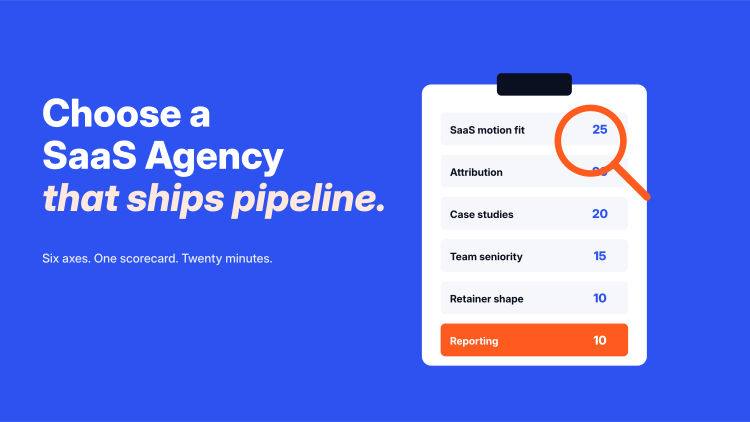
Every SaaS founder we work with gets a printed scorecard for the vendor shortlist call. Six categories, 100 points, weighted by the axis that actually predicts retainer success at the 12-month mark. The founders that use it cut the shortlist from ten agencies to two or three in one afternoon of calls.

Six-axis scorecard for how to choose a B2B SaaS marketing agency, with SaaS motion fit and attribution wiring as the top-weighted checks

A shortlist agency needs to clear 70 points to move to a proposal call. Below 70, they might still be a good fit for a general B2B account or an ecommerce account, but they are not the right match for a SaaS engagement with real ARR on the line. The best B2B SaaS marketing agencies we benchmark against consistently score in the 82 to 94 range on this scorecard.

Match the agency to the SaaS motion, not the other way around

The single biggest miss on agency picks is motion mismatch. A product-led SaaS founder hires a sales-led ABM agency, and six months later the retainer is running LinkedIn Sponsored InMail at $180 per lead while the product itself would have converted three times as many visitors on a smarter free-tier funnel. The reverse is worse. A $60K ACV enterprise SaaS hires a PLG-native agency, and the pipeline stays quiet since the agency has never run a six-figure ABM play.

Ask the agency to name the last three SaaS clients they took from contract to first pipeline dollar. Ask for the motion on each one. If two out of three match your motion and ACV band, the agency has real reps in your neighborhood. If all three are the opposite motion, keep looking. The full B2B SaaS go to market strategy the agency runs on new accounts should read like a checklist, not a manifesto.

Motion-to-channel mapping the agency should walk you through

Scorecard axisPointsWhat earns full marks
SaaS motion fit25Agency names your ACV band, motion, and pricing model on the intro call without prompting
Attribution wiring20Live HubSpot, Salesforce, or Marketo dashboard shown from a current SaaS client
Named case studies20Two SaaS clients with ARR movement, ACV band, and timeline stated verbatim
Team seniority on your account15Named strategist, PPC lead, and lifecycle owner will work the account, not a farm team
Retainer shape and pricing10Clear monthly retainer with a channel kill switch at 90 days
Reporting cadence10Weekly channel report, monthly pipeline review, quarterly business review calendared

When Rocket Software came to us, the founder had been running a generalist SaaS retainer for eleven months with almost no MRR movement on paid channels. The agency had never touched a subscriber-acquisition funnel. We rewrote the plan around onboarding tutorial flows, ConvertKit drip automation, and a coordinated launch across email, social, paid, and influencer. Activation grew 300%, 3,000 subscribers came in during the launch quarter, and the retention curve finally started compounding. Motion match on day one would have earned Rocket Software a year of growth.

Attribution wiring is where most agency picks fall apart

An agency that cannot demonstrate a live HubSpot, Salesforce, or Marketo dashboard from a current SaaS client on the intro call is guessing at attribution, and guessed attribution kills retainers by month six. Ask to see a real pipeline stage chart with the client name blurred but the numbers visible. Ask which UTM parameters and CRM tracking fields they set up in week one. Ask how they handle self-reported attribution (the “how did you hear about us” field) against multi-touch data.

The gclid, li_fat_id, and msclkid capture fields have to be wired into the CRM contact record on day one, or paid campaigns will never grade properly. UTM discipline on every campaign link, every gated asset, every webinar registration, and every partner referral is the difference between an agency that reports pipeline and one that reports impressions. Ask directly about the closed-loop report. If the agency does not know the phrase, they have not run a real SaaS retainer.

3.2x
the pipeline attribution accuracy when the agency wires gclid, li_fat_id, and msclkid to the CRM contact record in week one versus month three.— Redefine Web internal data, 41 SaaS attribution audits 2023-2025

Named case studies with real ARR numbers separate operators from marketers

Anonymous “SaaS client” case studies are a red flag. If the agency will not name the logo, the ARR band, and the timeline, either the results are not verifiable or the client would not agree to publish. Both are problems. Real SaaS clients on a real retainer with real ARR movement will let the agency name them once the results are in, since the reference network is worth more than the confidentiality.

When Hemmersbach GmbH, a New Jersey BI consultancy, brought us in, their pipeline was almost entirely founder-led outreach and word of mouth. There was no CRM, no landing-page automation, no lead capture beyond a contact form. We built the inbound engine end to end: Insightly CRM implementation, automated lead capture, landing pages tied to sales collateral, and a multi-channel campaign layer. Qualified leads moved 450%, landing-page conversion hit 47%, organic traffic grew 792%, and the sales team finally had a working attribution report. That is what a real SaaS agency reference sounds like.

Ask the agency for three references who are not on the case-study page. A working retainer with real pipeline should produce more happy clients than an agency has time to write up. If the reference list matches the case-study page one for one, the retainer roster is thinner than the deck suggests.

Agency versus fractional CMO versus in-house for a B2B SaaS pick

The agency choice is not always the right answer. A fractional CMO fits when the team already has one or two executors and needs senior strategy for 8 to 12 hours a week. A full in-house team fits above $10M ARR when the payback math on senior hires beats the agency retainer. Below that revenue line, a specialist B2B SaaS marketing agency almost always beats the alternatives on cost per pipeline dollar.

Your motionChannels the agency must have reps inAttribution stack expected
Product-led (under $5K ACV)SEO, content, lifecycle email, community, Product Hunt launchesHubSpot or Segment with product usage events wired to MRR
Hybrid ($5K to $30K ACV)SEO, paid search, G2 and Capterra ads, review programs, lifecycleHubSpot with pipeline stages, SDR handoff, revenue attribution
Sales-led ($30K+ ACV)ABM, LinkedIn Ads, intent data (6sense, Clearbit, Demandbase), eventsSalesforce with account-level attribution, opportunity source, closed-won tracking

The pick is not permanent. Most SaaS teams cycle through two or three of these arrangements between seed and Series C. The B2B SaaS marketing agency is usually the right first move since the retainer covers a full channel mix at a fraction of the fully loaded cost of the same seat mix in-house. Once the ARR run rate is proven and the channels are known, the calculus flips.

The intro-call questions that filter a shortlist in twenty minutes

Every SaaS founder we hand the scorecard to gets a paired call script. Seven questions, in order, that catch a deck-marketing agency inside twenty minutes. The agency either answers with concrete client stories, live dashboards, and quoted numbers, or the call stalls out and you move to the next name on the shortlist.

  • Show me a live HubSpot or Salesforce pipeline stage chart from a current SaaS client.
  • Name the last three SaaS clients you took from contract to first pipeline dollar with the ACV band and timeline.
  • Read me the CAC payback math on your best account this quarter.
  • Walk me through what happens at month four if a channel is not producing.
  • Who on the pod actually works the account week to week, and what is their SaaS background.
  • What does the first 90 days of the retainer look like in weeks, not slides.
  • What is the smallest engagement you take, and what does it get me.

Question one alone catches most deck-marketing shops. An agency that stalls on the live dashboard question has probably never wired attribution end to end on a real SaaS retainer. Question three catches the shops that talk in impressions instead of MRR. Question five catches the ones that pitch the founders on stage and staff the account with juniors. When TaxSlayer, an online tax-prep SaaS competing against industry giants, ran their agency search, this exact call script narrowed a shortlist of eight down to two in a single afternoon. The chosen agency delivered 158% paid e-File growth, 56% registration growth, and 23% lower cost per registration on the same quarterly budget the previous agency had been burning.

Red flags that show up before the retainer signs

Some warning signs are obvious. A proposal deck that opens with the agency’s growth story instead of your product is a sales-first culture that treats client onboarding as a checklist. A retainer contract without a channel kill switch at 90 days is a shop that never plans to be graded. A pricing sheet that only quotes the top tier is a team optimizing for annual contract value on their side, not results on yours. A senior partner on the intro call who disappears after signature is the classic bait and switch.

Softer signals matter too. Watch how the agency handles a hard question about a past client miss. Every real agency has one. If the answer is a rehearsed pivot back to a win, the culture does not learn from losses. If the answer is honest about what went wrong and what the retainer team changed after, that is a firm you can work with for 24 months. The B2B SaaS marketing strategy you sign onto has to survive its first bad quarter, and the agency’s honesty in the sales cycle is the earliest signal of how it will handle one on your account.

Retainer shape and pricing bands to expect

B2B SaaS marketing agency retainers run $4,000 to $30,000 per month across the founder market, with the band set by ACV, motion, and channel load. Our own SaaS marketing retainer starts at $599 for early-stage teams focused on one channel and scales up as PPC, SEO, and lifecycle stack on. The retainer shape matters as much as the number.

OptionMonthly cost bandFits whenCommon failure mode
Specialist SaaS agency$4K to $30KUnder $10M ARR, no senior marketing hire yetMotion mismatch, thin attribution, junior team on account
Fractional CMO$8K to $15K1 to 2 executors in-house, no strategy leadershipStrategy without execution, calendar drift, no channel accountability
In-house team$25K to $80KAbove $10M ARR, motion is proven, channels are knownSlow hire cycle, 6 to 9 month ramp, capex before revenue
Agency plus fractional CMO$15K to $40KSeries A to Series B, strategy plus execution both neededConfused ownership of pipeline number, RACI drift

Watch for retainer creep. An agency that adds a new deliverable every quarter without a matching price adjustment is either padding hours it does not spend or subsidizing the account with a junior team. Neither ends well. The retainer that scopes clearly, adjusts openly when the plan changes, and holds a monthly kill switch on non-producing channels is the one you keep for three years.

Frequently asked questions

How do I choose a B2B SaaS marketing agency without wasting three months on the wrong pick

The fastest way to choose a B2B SaaS marketing agency is to run every shortlist candidate through the six-part scorecard on the intro call. SaaS motion fit, attribution wiring, named case studies, team seniority on the account, retainer shape, and reporting cadence. An agency that clears 70 points on the scorecard has enough of the operator DNA to survive the first bad quarter. Below 70, the retainer risk is too high on ARR that matters.

Ten agency intro calls in one week, filtered by the scorecard, gets a serious founder to a final two or three by Friday. Two proposal calls the following week close the pick. Three months on the wrong agency starts when the founder skips the scorecard and picks on gut, warm intro, or deck polish.

What is the difference between a B2B SaaS marketing agency and a general B2B agency

A B2B SaaS marketing agency prices work against MRR, ARR, and CAC payback in months. A general B2B agency prices work against leads, MQLs, and impressions. The output looks similar in a first-quarter report. The retainer economics diverge fast since SaaS revenue compounds through retention and expansion, and only an agency that grades on cohort behavior will optimize for that.

Ask for the last three case studies. If ARR band, motion, and cohort retention appear as line items, you are looking at a SaaS specialist. If the report ends at lead volume and cost per lead, the agency will optimize for cheap leads at the expense of the accounts that actually pay back.

Should I hire a fractional CMO or a B2B SaaS marketing agency first

Hire a B2B SaaS marketing agency first if the team is under $5M ARR and does not have a senior marketing leader. The agency covers strategy plus execution across three or four channels at a monthly cost of $4K to $12K. A fractional CMO alone at $10K a month gives strategy without the executor bench, and the plan will drift by month three.

Between $5M and $20M ARR, the pairing works well. A fractional CMO owns strategy and vendor management. The agency owns execution across paid, organic, and lifecycle. Above $20M, the calculus flips toward a full in-house marketing bench, with an agency assist only on specialist channels the in-house team has not built.

How much should a B2B SaaS marketing agency cost per month

A B2B SaaS marketing agency runs $4,000 to $30,000 per month across the founder market. Under $5K ACV self-serve SaaS usually runs a $4K to $8K retainer focused on SEO, content, and lifecycle email. $5K to $30K ACV hybrid SaaS runs $8K to $18K with paid search, SEO, and G2 or Capterra ads layered in. $30K plus ACV sales-led SaaS runs $15K to $30K with ABM tooling and LinkedIn campaigns.

The retainer that quotes below the band for a full-funnel scope is either subsidizing with a junior team, taking a portfolio bet, or shorting a channel. The retainer that quotes above the band without a matching stack of ABM tooling, senior seat time, or specialist channels is padding hours. Ask for the seat mix and the hours per seat, and the math becomes obvious.

What contract length is standard for a B2B SaaS marketing agency

Most B2B SaaS marketing agency retainers run a six-month initial term with automatic renewal after. Six months is the minimum window that lets an agency wire attribution, launch the first campaign wave, get the second wave optimized on real data, and produce a fair grading report. Anything shorter grades the agency on setup work, which is not the point of the retainer.

Watch the kill switch clause. A good retainer holds a 90-day channel kill switch inside the six-month term. If paid search is not producing by the end of month three, the retainer reallocates that spend to a channel that is producing. That is a shop that grades work honestly.

How do I know if a B2B SaaS marketing agency is actually working after 90 days

By day 90 the retainer should show a live CRM report grouped by original source with a pipeline stage filter, a channel scoreboard with cost per opportunity and pipeline coverage, and one narrative slide that names what the plan learned in the first quarter and what changed for the next one. If the report is deck slides of impressions, sessions, and lead volume, the retainer is not graded on SaaS math.

Paid channels should be attributing pipeline into HubSpot or Salesforce by day 45. SEO takes longer, usually four to seven months to compound. The 90-day check is not about closed ARR yet. It is about whether the attribution wiring, channel scoreboard, and monthly cadence are in place to grade the next 90 days on real data.

Where to take the shortlist next

Once the scorecard filters the shortlist down to two or three real candidates, the next step is a proposal call with each finalist against the same brief. Our B2B SaaS marketing agency team works the same six-axis frame across SaaS PPC, SaaS SEO, and SaaS website design. For teams that want to see how the retainer scopes at the earliest stage, the SaaS marketing retainer plans start at $599 per month and grade every 90 days.

Share this article
OS
Written by

omorsarif — Founder

Stop guessing. Start ranking.

Book your free 30-minute strategy call.

No spam, no sales rep. We use your email to schedule your call with a senior strategist. That is it.

A senior strategist, not a sales rep.
A plain breakdown of what is working and what is not.
Three fixes you can keep, whether you hire us or not.
Zero obligation. Keep the notes either way.
SaaS stageTypical retainer bandIncluded channelsReporting cadence
Pre-seed to seed$599 to $4KOne channel, foundation buildBi-weekly channel review
Seed to Series A$4K to $8KContent and SEO or paid searchWeekly channel, monthly pipeline
Series A to Series B$8K to $18KFull-funnel hybrid stackWeekly channel, monthly pipeline, quarterly business review
Series B and up$15K to $30K plusABM tooling, LinkedIn campaigns, RevOps assistWeekly, monthly, quarterly, board-ready deck