
How to Market a Home Services Business Profitably
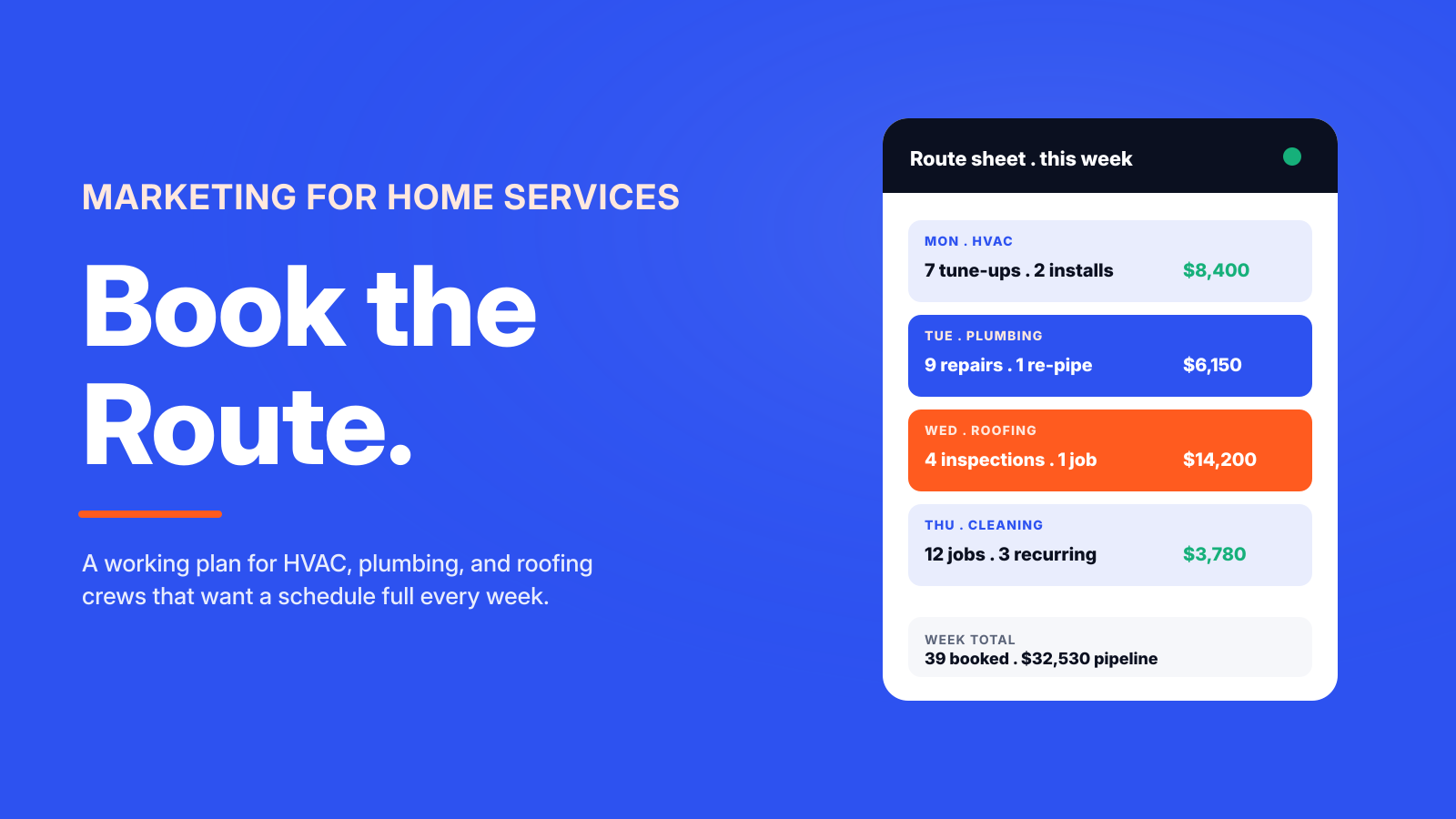
- Marketing for home services works when ten strategies stack on top of each other: sharp positioning, a booking-first website, local SEO for the map pack, LSA plus Google Ads at a 60/40 paid split, a review engine, financing offers, a referral engine, seasonal budget shifts, retention loops, and lead-source tracking.
- The website is the multiplier under every strategy. A site that converts 7 to 15 percent of visitors to booked jobs doubles the return of every ad dollar and every organic click that lands on it.
- Referrals are the cheapest booked jobs a home services shop gets, close at 2 to 4 times the paid-lead rate, and typically produce 8 to 22 percent of monthly volume within 90 days of turning on a $50 homeowner offer plus a $25 to $75 technician bonus.
- Seasonality dictates budget. HVAC accounts triple January and February spend over May, roofing accounts triple March through June around storm season, and moving accounts push 70 percent of annual budget into April through August.
- HP Roofing, a Dublin 1969-founded roofing leader, ran this stack for 4 months and won a €120,000 commercial project in the first week of the new site going live, followed by 20 to 30 monthly leads and 10x return on marketing investment.
Marketing for home services is not about running a single ad or picking a “best” channel. It is about stacking ten repeatable moves that stack the phone with pre-qualified jobs by 7 AM on a Monday. Some of the ten are obvious (Google Ads, a fast site, five-star reviews). Some are the ones most HVAC, plumbing, and roofing owners skip until year three (a paid-referral engine, a financing offer built into the quote, a retention loop that turns a $180 furnace tune-up into an $8,400 install two winters later).
What follows is the 10-strategy playbook we run inside home services accounts that grew from one truck to a dispatched fleet. Every strategy has real numbers next to it, drawn from live client work in HVAC, plumbing, roofing, moving, and cleaning across US, Canadian, Irish, and UK markets. Just what actually moves the schedule. For a wider set of tactical moves ranked by cost per booked job, see the companion piece on home services marketing ideas.

Nail the positioning before you spend a dollar on ads
Every profitable home services shop we have worked with can finish this sentence in six words or fewer: “We are the [trade] that [specific promise].” Not “quality service since 1998.” Not “family-owned and trusted.” Real positioning sounds like “24-hour drain cleaning with upfront pricing,” “same-day AC repair or the diagnostic is free,” or “roof inspections done inside 48 hours of a hail storm.” One promise, checkable on the phone, backed by an operational commitment the crew can actually keep.
Positioning is the input to every other marketing move. The Google Ads headline, the landing page hero, the LSA business description, the review request email, the truck wrap, the yard sign, the invoice footer. All ten of the strategies below get sharper when the positioning is one clean sentence instead of five vague ones. Shops with fuzzy positioning pay 30 to 55 percent more per booked job than shops with a specific, provable promise. Vague positioning makes every ad look interchangeable with the shop across town.
Build a booking-first website not a brochure
A home services website has one job: turn a homeowner who is holding a phone at 11 PM with water on the floor into a booked appointment before they scroll. The seven traits of a booking-first site are simple. A click-to-call number in the mobile header at all times. A booking form under 4 fields. Service-area coverage listed in the footer. Real photos of the crew and the trucks (not stock imagery of smiling actors in fake uniforms). Upfront pricing on 3 to 5 core services. Review stars above the fold with a link to Google. Under-2-second mobile load time.
Home services sites that meet those seven traits convert visitors to booked jobs at 7 to 15 percent. Sites that miss two or more convert at 1 to 3 percent. The difference between the two is not a rebuild, it is a focused conversion pass. Our home services web design team runs that pass in 3 to 5 weeks and typically doubles conversion rate on the existing traffic before a single ad dollar is added. Doubling conversion doubles the return on every other strategy on this list, so it goes second only to positioning.
Rank in the local map pack with focused SEO
The Google map pack drives roughly 44 percent of clicks on local search results (BrightLocal 2024 Local Consumer Review Survey), and for high-intent home services queries the share runs closer to 50 percent. Ranking in the top three of the map pack for money keywords (plumber near me, furnace repair, roofer, mover) is the single highest-return move a home services shop makes in year one. Cost per lead from the map pack at scale runs $4 to $12, which is 4 to 10 times cheaper than paid channels.
Local SEO for home services rests on five moves. A fully optimized Google Business Profile with the primary category set exactly (Plumber, HVAC contractor, Roofing contractor). Structured citations across 40 to 60 directories with matching name, address, and phone. Review generation targeting 4 to 8 new Google reviews per month. Service-area pages on the site, one per city or ZIP the shop covers. On-page schema markup (LocalBusiness, HVACBusiness, Plumber) that tells Google what the business does and where. Run home services SEO in parallel with paid channels and blended cost per lead drops 30 to 45 percent between month 6 and month 12.
Turn on Google Local Services Ads and Google Ads together
Google Local Services Ads (LSA) and Google Ads on high-intent search terms are the two paid channels that carry the first-year lead flow. LSA sits above every paid search result on mobile, charges per verified lead not per click, and shows a Google Guaranteed badge that raises click-through rate. Google Ads sits below LSA and above the organic map pack, gives full control over keyword and landing page, and produces higher-ticket install and replacement leads.
The working split is 60 percent of paid budget to LSA and 40 percent to Google Ads for most trades. Roofing replacement and HVAC install tilt further toward Google Ads (55 to 65 percent) since the higher-consideration ticket benefits from a matched landing page. Emergency plumbing and drain cleaning tilt further toward LSA (65 to 75 percent) since the intent is immediate and the LSA click-to-call flow matches that intent. Our home services PPC team runs the dispute workflow inside every LSA account, since accounts that dispute nothing pay 20 to 35 percent more per booked job than accounts that dispute every non-qualifying lead. For a deeper look at the four-channel paid + organic mix, see our guide on digital marketing for home services.
Run a review engine that pulls 4 to 8 new reviews a month
Reviews are the currency of home services marketing. Homeowners tap the shop with 187 five-star reviews over the shop with 34, every time, and both LSA and the map pack algorithm weight review velocity and rating in ranking. A shop pulling 4 to 8 new Google reviews per month typically outranks a competitor with a higher lifetime count but flat velocity. Google reads the velocity as a signal the business is active.
The engine is simple. Every completed job triggers a text message from the CRM (ServiceTitan, Housecall Pro, or Jobber) with a one-tap link to the Google Business Profile review page. The message goes out within 90 minutes of job completion, when the homeowner still has the tech’s name and the fix fresh in memory. Response rate on that timing runs 18 to 32 percent, versus 3 to 6 percent on a next-day email. Never buy reviews, never write them, never route negatives through a private form to filter them, since Google and the FTC both catch and penalize that.
Bake a financing offer into every quote
The single-largest close rate lever we have found on high-ticket home services (HVAC install, roof replacement, water heater swap, whole-home re-pipe) is financing shown at quote time. A $9,000 heat pump quoted as “$9,000 up front” closes at 22 to 34 percent. The same $9,000 quoted as “$139 a month, 84 months, zero down through Wisetack” closes at 46 to 61 percent. That is not a marketing trick. That is the truth about how homeowners actually pay for large home repairs.
The three financing partners home services shops standardize on are Wisetack, GreenSky, and Synchrony. Wisetack is the easiest integration (Housecall Pro, Jobber, and ServiceTitan all have native connections) and offers 3, 6, 12, 24, 36, 48, and 60-month terms with soft credit checks. GreenSky handles longer terms (84 to 120 months) for large jobs. Synchrony is the legacy standard used by manufacturer programs (Carrier, Trane, Lennox). The marketing move is to price everything as a monthly payment on the quote, in the ad, and on the landing page. The financing offer is the marketing message.
Build a referral engine that pays homeowners and technicians
Referrals are the cheapest booked jobs a home services shop ever gets, and they close at 2 to 4 times the rate of paid leads. Most shops treat referrals as accidental. Profitable ones treat referrals as a paid channel with a budget line and a workflow. The working structure has three parts: a homeowner referral offer (typically $50 off next service or a $50 gift card per booked referral), a technician bonus for named-referral jobs ($25 to $75 per completed referral job), and an automated follow-up 14 days after every completed job asking for the referral with a shareable link.
The referral engine typically produces 8 to 22 percent of monthly booked jobs within 90 days of turning it on, at a fully-loaded cost per lead of $12 to $28 (the offer plus the tech bonus plus the CRM automation cost). That is competitive with organic map pack traffic and roughly 3 to 6 times cheaper than LSA. Shops that never build the referral engine leave the cheapest lead source on the table year after year. The referral engine sits at the top of a broader stack of home services marketing ideas ranked by real cost per booked job.
Shift budget by season instead of running a flat monthly plan
Home services demand is not flat across the calendar. Winter drives HVAC heating repair, burst pipe emergencies, and roof ice damming. Spring drives roof storm damage, drain line backups, and AC tune-ups. Summer drives AC repair and replacement, and moving jobs (60 percent of annual moves fall between May and September per U.S. Census data). Fall drives gutter work, furnace tune-ups, and pre-winter plumbing checks. A shop spending the same $8,000 in July as in January is either underinvesting in the demand months or wasting spend in the flat ones.
The seasonal budget shift table below is the working plan we run for single-shop clients. Multi-truck operations follow the same shape at higher dollar levels. Ranges reflect metro competition (a plumber in Phoenix spends differently than one in rural Vermont) but the shape of the curve is consistent across trades.
| Trade | Peak months | Peak monthly spend | Off-season monthly spend | Storm/standby budget |
|---|---|---|---|---|
| HVAC | Dec to Feb, Jun to Aug | $6,500 to $12,000 | $2,500 to $4,500 | Not applicable |
| Plumbing | Dec to Feb (freeze), May (drains) | $5,500 to $10,000 | $2,500 to $4,000 | $1,500/day freeze events |
| Roofing | Mar to Jun (storms), Sep to Oct | $8,000 to $15,000 | $2,000 to $3,500 | $2,000/day hail alerts |
| Moving | May to Aug | $5,000 to $9,500 | $1,500 to $3,000 | Not applicable |
| Cleaning (residential) | Apr to May, Nov to Dec | $3,500 to $6,500 | $2,000 to $3,500 | Not applicable |
| Home renovation | Mar to Jun | $7,500 to $14,000 | $3,500 to $6,000 | Not applicable |
Build a retention loop that turns one job into three
Every booked home services job is worth more than the ticket. A $180 furnace tune-up in November is often the first step in a $9,000 heat pump install two winters later. A drain cleaning today buys the shot at re-piping the whole basement three years from now. Shops that treat every completed job as the start of a relationship, not the end of a transaction, grow annual revenue per customer 2 to 4 times faster than shops that never follow up.
The retention loop has four moves. A post-job thank-you SMS at 24 hours. A satisfaction check at 30 days with a referral ask. A seasonal reminder email at 6 months (spring AC tune-up, fall furnace tune-up, gutter clean before winter). A maintenance-plan enrollment offer at 12 months (typically $18 to $32 monthly for HVAC, $12 to $25 monthly for plumbing) that gives priority scheduling and a small discount on repairs. Shops with a mature maintenance-plan base of 400+ members see 55 to 70 percent of their winter repair volume come from that base at a lower cost per booked job than any paid channel.
Track every lead source so the marketing budget stops guessing
The home services shops that grow past $3M in annual revenue all track the same three numbers per channel: cost per lead, cost per booked job, and cost per closed-revenue dollar. LSA, Google Ads, SEO, referrals, direct mail, yard signs, truck wraps, radio, and door hangers all get a call-tracking number so the CRM knows which channel produced the phone ringing. Without that, the marketing budget is a coin flip.
The three tools most shops run are CallRail (call tracking with dynamic number insertion by source), Google Analytics 4 with conversion events piped into the CRM, and the CRM’s own lead attribution field (ServiceTitan, Housecall Pro, and Jobber all support it). With those three wired, a shop can see at month-end that LSA cost $52 per booked job, referrals cost $18, Google Ads cost $91, and the truck wrap cost $340. That transparency lets a shop kill the losers and double the winners without arguing about it.
How HP Roofing turned a 55-year-old brand into 20-30 leads a month
The working example that ties every strategy on this list together is HP Roofing, a Dublin roofing company established in 1969 with 25 roofers on the crew and five decades of reputation across Ireland. Strong offline brand. Trusted for domestic and commercial work. Zero digital presence to match. Their old website had no SEO, no conversion structure, and no lead tracking. Founder John McEvoy had almost no confidence in digital tools since none of the prior attempts had shown him a real return.
The rebuild ran the same strategies laid out above. Positioning first: a conversion-first website that made the domestic-plus-commercial roofing scope obvious in the hero. SEO second: a competitive roofing keyword strategy targeting the Dublin market and surrounding counties. GMB optimization third: top-of-map-pack visibility for roofing searches across the service area. Google Ads fourth: fast-flowing lead generation the day the campaigns went live. Lead tracking fifth: end-to-end pipeline measurement so every result linked back to the marketing move that produced it.
The result inside 4 months: a €120,000 commercial project won in the first week of the new site going live, an ongoing pipeline of 20 to 30 qualified roofing leads per month split across SEO and Google Ads, and a 10x return on marketing investment verified against tracked closed revenue. The same stack has since produced comparable results for D&F Plumbing, a Portland plumbing shop that rebranded as the “Plumb Perfect” trusted local expert and ran a full rebuild of website, local SEO, and multi-channel paid to grow bookings across their service area.
Frequently asked questions about marketing for home services
What is the best marketing strategy for a home services business?
The best marketing strategy for a home services business stacks three moves at the same time: a booking-first website that converts at 7 to 15 percent, Google Local Services Ads and Google Ads running the paid budget at a 60/40 split, and a local SEO track working toward the top three of the Google map pack for money keywords. None of the three works alone. The website without traffic sits idle. The paid channels without a converting site burn cash. The SEO track without paid support starves for jobs during the 6 to 12 months it takes to compound.
A single-shop HVAC, plumbing, or roofing operation with all three moves running typically hits 80 to 150 booked jobs per month at a blended cost per lead of $22 to $38 by month 12. A shop running only one of the three moves plateaus at 25 to 60 booked jobs and a blended cost per lead of $65 to $110, roughly 2 to 3 times what the full stack produces.
How much does home services marketing cost per month?
A single-shop home services business should budget $2,500 to $8,000 per month on marketing, with 55 to 70 percent on paid channels (LSA and Google Ads), 15 to 25 percent on SEO and content, and 10 to 20 percent on site maintenance, review tools, call tracking, and CRM. Multi-truck operations (5-plus trucks) run $8,000 to $22,000 per month. Regional multi-location operators run $22,000 to $60,000. Retainer plans that bundle all four channels usually start around $599 a month for a single-shop rollout and scale up as truck count and service-area radius grow.
The mix matters more than the total dollar figure. A $4,000 monthly budget split across paid, SEO, and site work produces 30 to 60 percent more booked jobs than a $6,000 budget spent only on Google Ads. Owners who ask “how much should I spend” are asking the second question. The first question is “how is the budget split.”
How long does it take home services marketing to produce booked jobs?
Paid channels (Google Local Services Ads and Google Ads) produce booked jobs inside 7 to 21 days of the campaigns turning on, once the landing page and phone workflow are ready. Local SEO produces the first ranking movement around week 8 to 12 for long-tail terms (city plus service plus qualifier) and 3 to 6 months for money keywords in mid-sized cities. Top-50 metros take 6 to 12 months to move the map pack for competitive terms like “plumber near me” or “HVAC repair.”
Referral engines usually start producing named referrals inside 30 to 60 days of the follow-up automation going live, once the base of completed jobs from the paid channels has enough volume to trigger meaningful referral flow. Retention loops (maintenance plans, seasonal reminder campaigns) take 6 to 12 months to build a meaningful base but then produce 55 to 70 percent of winter repair volume for shops that stay disciplined about the enrollment ask.
What marketing channels work best for HVAC plumbing and roofing?
Google Local Services Ads, Google Ads on high-intent search terms, local SEO with a strong Google Business Profile, and a booking-first website are the four channels that carry the load for HVAC, plumbing, and roofing marketing. Referrals and retention loops add a fifth and sixth once the base of completed jobs is large enough to feed them. Facebook and Instagram are useful for retargeting and community trust but rarely worth more than 10 to 15 percent of the total marketing budget for these trades.
Nextdoor is the underrated channel for residential HVAC, plumbing, and cleaning in suburban markets, where neighborhood recommendations produce 6 to 15 booked jobs per month for shops that stay active in local conversations. Roofing tilts toward Google Ads and storm-response standby budgets more heavily than the other trades since a single hail day can produce a full month of inspections. Moving companies rely more on Google Ads plus content marketing than plumbing or HVAC since moves are planned 3 to 8 weeks out and the search happens on a laptop, not a phone at 11 PM.
Do I need a marketing agency for my home services business?
A home services business under $500,000 in annual revenue can usually run marketing in-house with a bookkeeper or office manager handling the LSA dispute workflow and a freelance help for the site and SEO. Above $500,000 in annual revenue, an agency retainer covering the four channels (paid, SEO, web, tracking) typically pays back 4 to 12 times what it costs in year one. The operational tempo of running LSA disputes, Google Ads negatives, GBP posts, review workflows, and site conversion tests every week is more than an owner or office manager can hold on top of running the trucks.
The wrong reason to hire an agency is “we want more leads.” The right reason is “we have leads but we cannot tell which channel produced which booked job, and we cannot free up 15 hours a week to run the tracking, disputes, and testing that separate a $22 blended cost per lead from a $75 one.” An agency earns the retainer on operational tempo and reporting discipline, not on secret channels.
See how the full 10-strategy playbook runs inside HVAC, plumbing, roofing, moving, and cleaning accounts at home services marketing, or start with the home services marketing retainer that covers all four channels under one monthly plan.
Book your free 30-minute strategy call.
No spam, no sales rep. We use your email to schedule your call with a senior strategist. That is it.
More from the blog
View all articles → Marketing Strategy
 How Dental DSOs Grow Through Marketing. Tactics That Scale
Read article Marketing Strategy
 Dental DSO Marketing Services. What to Expect From an Agency Partner
Read article Marketing Strategy