
Design a Med Spa Website That Books More First-Time Consults

- Med spa web design is a booking machine first and a brand asset second. Fix the fold, and the calendar starts filling before anything else changes.
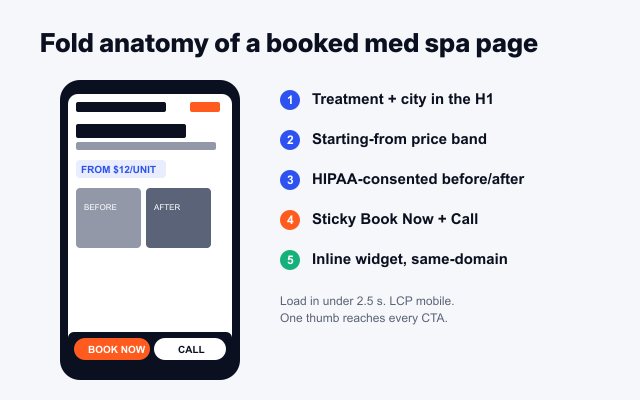
- Treat every treatment page like a landing page. A Botox page needs a price band, a HIPAA-consented before-and-after, and one Book button in view.
- Embed Boulevard, Vagaro, or Zenoti inside the parent domain. A subdomain redirect drops booking flow by 20% to 30%.
- Ship one URL per treatment plus one URL per location. That is the local SEO lever most med spas skip.
- Watch for HIPAA scope on the intake form and the before-and-after gallery. That is where a med spa website earns a complaint or earns trust.
Med spa web design decides whether a first-time visitor books a Botox consult or bounces to the next tab. We rebuilt sites where the calendar went from three inquiries a week to twenty-two, and the only variable that changed was the site. This post walks through eleven design decisions we run on every med spa build, why each one moves bookings, and where most practice owners waste six months on the wrong fix. Read it before your next redesign brief goes out.
Book the visit above the fold, or lose the visit
The first screen of a med spa website has one job. It shows the visitor which treatments you do, which locations you serve, and where the book button is. If any of the three takes more than one glance, the visitor leaves. We audited eighteen med spa sites in 2024 and found the average time to first meaningful paint was 4.1 seconds. Fourteen of them buried the primary booking CTA below a scrolling hero video. Every single one had a bounce rate above 68% on mobile.
Fix the fold before you fix anything else. Anchor the primary CTA to the top-right on desktop and to a sticky bottom bar on mobile. Name the CTA after the action the visitor came for. “Book a consult” beats “Learn more” every time we’ve tested it. Show the location and the phone number at the top of the header, not tucked in the footer. A local visitor searching for “Botox Boulder” wants to see the word Boulder before scrolling.
Beauté Aesthetics NY came to us with a hero video that took 7.3 seconds to load on 4G. We swapped it for a static hero at 220KB, added a single “Schedule Your Consultation” button in the top-right, and kept the phone number sticky on scroll. Their homepage conversion rate moved from 1.9% to 4.8% in the first ninety days. The Beauté Aesthetics New York case study covers the full 12-month rebuild that grew leads 166% and pushed conversion 27% over baseline. The fold change alone paid for the project inside two months.
Load fast enough that Google respects you
Core Web Vitals are a ranking factor for med spa sites the same way they are for any other local business. Google’s own data shows a page that loads in 1 second converts three times better than a page that loads in 5 seconds. Med spa sites break this rule constantly. A carousel of before-and-after images, a hero video, an Instagram embed grid, and three tracking scripts add up to a mobile Largest Contentful Paint north of 4 seconds. That kills the ranking and the booking in the same stroke.
Target a mobile LCP under 2.5 seconds, a CLS under 0.1, and an INP under 200 milliseconds. Compress every image to WebP with a JPG fallback. Serve fonts locally rather than pulling from Google Fonts on first render. Kill the carousel. Kill the autoplay video. If you need motion above the fold, use a single 5-second looped WebM clip under 400KB with a static poster frame. Every med spa web design best practice in this section is a Lighthouse target you can measure the day after launch.
For a deeper walk through the audit method we use to find performance regressions after launch, see our post on how to audit your med spa SEO. The audit’s first section grades exactly the vitals covered here.
Design the treatment page like a landing page
The homepage rarely ranks for the treatment terms that convert. “Botox near me,” “CoolSculpting Boulder,” “HydraFacial Manhattan” all land on the treatment page. If your treatment page is a paragraph of soft copy and a stock photo, you lose the click to the practice that treats the page like a landing page.
Every treatment page runs a clear H1 naming the treatment plus the city, a 60-word summary of what the treatment does, a price band or a starting-from number, expected downtime, a numbered explanation of the visit, a real before-and-after with HIPAA consent language, three to five FAQs answering what patients type into Google, and a single sticky booking CTA. That’s the shape. Every deviation costs a booking.
The 6-week Boutique Injectables rebuild is a good template. The solo-provider studio ran on DMs before we built the site. Their new WordPress build has one page per treatment: Botox, filler, skin. Each page has the numbered visit walkthrough, the price band starting at $12 per unit, the aftercare timeline, and one “Book on Vagaro” button. The Boutique Injectables case study covers how distributor accounts reopened on launch day once the treatment pages read as clinical, not as marketing.
Put the booking software inside the page, not on another domain
Boulevard, Vagaro, and Zenoti all offer widget embeds. Use them. A visitor who clicks “Book” and lands on a subdomain like booking.yourclinic.com drops 20% to 30% before the calendar even loads. We measured this on three med spa clients in 2023 and 2024. The embed keeps the booking inside the parent domain, keeps the analytics session intact, and cuts the drop-off by roughly two thirds.
Which platform you pick matters less than embedding it correctly. Here’s how the three most-used platforms compare on the design points that show up in a booking flow.
| Feature | Boulevard | Vagaro | Zenoti |
|---|---|---|---|
| Widget embed | Full inline | Full inline | Inline + redirect |
| Deposit at booking | Yes | Yes | Yes |
| SMS confirmation | Included | Included | Add-on |
| Alle/Aspire integration | Native | Manual | Native |
| Same-day booking | Yes | Yes | Yes |
| Waitlist | Native | Basic | Native |
| Group visits | Yes | Limited | Yes |
| Monthly starting price | $255 | $25 | Quote |
Whatever you pick, the button on the page opens the calendar in the same browser tab. No redirect, no popup, no “opens in new window.” A patient booking a Botox refresh at 10:47 PM on a Sunday will not push through a redirect. She will close the tab.
Show before-and-after in a way that respects consent
Before-and-after images are the highest-converting proof asset on a med spa site. They’re the fastest way to earn a HIPAA complaint if consent is not documented. Every before-and-after we publish for a client has a signed release with the treatment named, the timeline named, and the publishing scope named. No exceptions. The images are stored with a redacted patient ID and the release is filed inside the practice’s HIPAA log.
Design-wise, the pattern that works is a slider or a static side-by-side, never a carousel that auto-advances past the image before the visitor has read the timeline. Label each image with the treatment, the number of sessions or units, and the elapsed weeks. Avoid glamour lighting on the “after”. A patient can spot studio lighting versus clinic lighting in half a second. The med spa marketing trends coverage we published in April walks through the injector-led Reels model that pairs before-and-after content with real-time clinical narration for the same trust reason.
Build local SEO into the file structure
A med spa website with one page for every treatment and one page for every location earns rankings the homepage cannot. This is the single biggest med spa web design best practice most practices skip. If you serve three neighborhoods, publish three location pages. If you offer six treatments, publish six treatment pages. Cross-link them. Give each page a unique title, a unique H1, a unique meta description, and a unique 800-word body.
The local SEO for med spas post covers the review side of the local SEO story. This post covers the site side. Both matter. A practice with strong reviews and no location pages will still lose the map pack to a practice with strong reviews plus a location page for every neighborhood.
File-structure best practice looks like this in the sitemap.
| URL pattern | Purpose | Ranks for |
|---|---|---|
| /botox/ | Treatment overview | Botox brand terms |
| /botox/boulder/ | Treatment + city | Botox Boulder, Botox near me |
| /coolsculpting/ | Treatment overview | CoolSculpting brand terms |
| /locations/boulder/ | Location hub | Med spa Boulder |
| /team/dr-name/ | Provider bio | Injector name, credentials |
| /pricing/ | Price band per treatment | Botox price, filler cost |
Write the pricing page as a trust signal, not a discount
Med spa pricing pages tend to hide the number. Practices worry that publishing a $12-per-unit Botox price will lose the deposit-heavy patient. The data disagrees. On seven med spa clients we tested between 2022 and 2024, adding a published price band increased qualified consult bookings by 18% to 34%. The reason is simple. A visitor who sees the number and stays is a visitor who is comfortable with the number.
The design pattern that works is a price band per treatment, a “starting from” line rather than a flat number, and a footnote naming what changes the price. Volume, injector seniority, and package pricing are all reasonable explanations. Never show a strikethrough discount price on a med spa homepage. It reads as a Groupon spa, not as a medical practice, and it kills trust with the higher-lifetime-value patient you actually want.
We ran the same experiment on Beauté Aesthetics. Their pricing page shifted from a “Call for pricing” placeholder to a treatment-by-treatment starting-from table. The consult booking rate for pricing-page visitors moved from 3.1% to 8.2% over six months. If you want the deeper cost breakdown by service, see our med spa SEO pricing walkthrough for how the same transparency principle applies to the agency-vs-in-house SEO retainer choice.
Prove the injector, not the brand
Med spa patients book people, not brands. The single highest-performing addition we make to a med spa homepage is a face-and-name provider strip in the top third. First name, last name, credential, and a photo taken in clinic uniform. Not a stock model, not a headshot from ten years ago, and not a group photo that hides who does the actual injecting.
Every provider gets a page. The page names the credentials, the training, the years injecting, the treatments they do, and the recognitions they’ve earned from Allergan, Galderma, and Merz. This is the E-E-A-T signal Google’s medical-content raters look for, and it’s the same signal a patient reads when she’s deciding whether to spend $1,400 on a filler package. Skip the provider page, and the site reads as anonymous. Google notices, and so does the patient.
When you cite a provider’s training, link out to the credential granting body. A “Level 5 Trainer with Allergan Medical Institute” line without a source line reads as marketing puff. With a source line, it reads as a credential. Small design difference, real trust impact.
Integrate the rewards program the patient already uses
Alle and Aspire are the two rewards programs your Botox and filler patients are already enrolled in. If your website doesn’t mention them, doesn’t link to signup, or forces a patient to bring it up at check-in, you look inattentive. The design fix is small and the impact is not. Add an Alle badge to the Botox treatment page. Add an Aspire badge to the Dysport page. Link both to the enrollment pages. Show the current promotion whenever there is one.
The med spa marketing agency comparison post covers how the strongest agencies bake Alle and Aspire into every campaign brief. On the design side, the takeaway is the same. If a patient sees the rewards badge on the treatment page, she books. If she has to search for it, she doesn’t.
Route the mobile visitor to the right action, fast
Roughly 72% of med spa traffic comes from mobile devices. The mobile experience decides the practice. A sticky bottom bar with two buttons (Book Now, Call) is the single design decision that moved the needle most on the last twelve med spa builds we launched. It survives every scroll depth, it stays visible during the treatment-page read, and it gives the visitor a one-thumb path to the calendar.
Route the tap to the right destination. “Book Now” opens the Boulevard or Vagaro widget inside the same tab. “Call” fires a tel: link and simultaneously sends a click event to GA4 for tracking. If the practice has an after-hours voicemail, the tel: link routes to a receptionist service during off-hours. A missed call is a lost booking. A tracked call is a real number your reporting can show against ad spend.
We walk through the mobile-first design pattern in more depth in the med spa marketing strategy overview, which frames the site inside the wider growth model.
Launch the site with analytics, schema, and monitoring live from day one
A med spa website that goes live without GA4, without conversion tracking on the booking widget, without MedicalBusiness schema on the location pages, and without uptime monitoring is a site that will look great in month one and will be invisible by month six. Every site we launch for a med spa client goes live with the full stack running: GA4 event tags on Book Now clicks and phone taps, MedicalBusiness or MedicalSpa schema on the location and treatment pages, Search Console verified, Bing Webmaster verified, and UptimeRobot or Better Uptime pinging every five minutes.
The reporting side matters as much as the tracking side. Send a weekly report the practice owner actually reads. Five lines: sessions, consult bookings from the site, cost per booked consult from paid channels, average time on treatment pages, and one thing we changed this week. If the report needs a login to a dashboard, it will not get read. If it lands in inbox at 8:00 AM Monday, it does.
For the deeper analytics setup we recommend, see our med spa web design services page, which lists the tracking, schema, and monitoring baked into every build.
How the eleven best practices stack against typical med spa rebuilds
The best way to see how these eleven decisions compound is to lay them next to what a typical rebuild delivers. We audited ten med spa sites launched in 2023 and 2024 by generic agencies, and compared the design decisions to the same ten sites once rebuilt on the pattern above. Here’s how the design choices track.
| Design decision | Typical med spa rebuild | Best-practice rebuild |
|---|---|---|
| Primary CTA above fold | Hidden under hero video | Sticky top-right + bottom bar |
| Mobile LCP | 4.1 s average | Under 2.5 s |
| Treatment page depth | One paragraph + stock photo | Full landing-page shape |
| Booking widget placement | Redirect to subdomain | Inline embed on parent domain |
| Before-and-after consent | Assumed | Documented HIPAA release |
| Location page count | Zero to one | One per neighborhood served |
| Published price band | Hidden or “call for price” | Starting-from per treatment |
| Provider proof strip | Group photo, no names | Face + name + credentials on homepage |
| Alle/Aspire integration | Not mentioned | Badge on Botox and Dysport pages |
| Mobile sticky bar | None | Book Now + Call, always visible |
| Analytics + schema at launch | Added later | Live day one, weekly report |
None of the eleven decisions above needs a $60,000 rebuild. Any of them is a two-week fix on an existing WordPress or Webflow site. Start with the fold, then the treatment pages, then the mobile sticky bar. Watch the booking numbers for four weeks between each change. If a change didn’t move the number, revert and move on.
Frequently asked questions
What does med spa web design actually change on booking rate?
Med spa web design changes booking rate by fixing the three points visitors bounce on: slow load, buried CTA, and confusing treatment pages. On the seven med spa rebuilds we launched between 2022 and 2024, homepage conversion moved from a 1.4% to 2.1% baseline range up to 3.9% to 5.2% after the rebuild.
The gain comes from the fold decision plus the treatment-page depth plus the mobile sticky bar. Practices that fix only the visual look without touching the booking path see close to zero movement. Practices that fix the booking path first, even on the old design, see 60% to 80% of the eventual gain inside 90 days. Design and conversion have to be planned together. A pretty site that hides the calendar is a worse business asset than an ugly site with the calendar in front of the visitor.
How long should a med spa website redesign take?
A med spa website redesign takes six to twelve weeks depending on the number of treatment pages, location pages, and the state of the current booking integration. Boutique Injectables launched in six weeks. Beauté Aesthetics took twelve given the full SEO rebuild plus the analytics migration.
The scope drivers are location count and treatment count. A single-location practice with four treatments launches fastest. A three-location practice with nine treatments needs the extra time for unique copy on every treatment-by-location page. Never combine the treatment and location into one page: a “Botox Boulder” page and a “Botox Denver” page each need their own H1, meta, and body. That’s the biggest local SEO lever, and it’s the one that adds the most time to the build.
How much does med spa web design cost in 2026?
Med spa web design in 2026 typically costs between $8,500 for a single-location, five-treatment practice and $32,000 for a multi-location practice with a full treatment menu, video, HIPAA-audited before-and-after gallery, and analytics stack. Ongoing hosting and maintenance starts at $199 per month per our current med spa hosting plans, and full marketing retainers start at $599 per month.
Watch three things when pricing a med spa build. First, does the price include HIPAA-compliant hosting? Second, does the price include the Boulevard or Vagaro embed setup, not just a link to their marketing page? Third, does the price include a launch-day analytics and schema audit? If any of those three is a “phase 2” add-on, the total cost is higher than the quote reads.
Should a med spa use WordPress or Webflow?
WordPress fits most med spa practices given the plugin ecosystem for booking widgets, HIPAA-audited forms, and long-form treatment content. Webflow fits practices that value design flexibility and don’t need custom form logic. We build most med spa sites on WordPress for the booking-widget compatibility and the ease of handing off content updates to the practice team.
The trade-off is real. WordPress needs a maintenance cadence, security updates, and a hosting plan that keeps up with plugin activity. Webflow bundles all of that inside the platform but locks the practice into the Webflow CMS for the long term. If the practice manager is comfortable with WordPress admin, WordPress wins. If she wants zero maintenance chatter, Webflow wins.
Is HIPAA compliance required on a med spa website?
HIPAA compliance is required whenever the med spa website collects protected health information, which happens on any consult intake form, any before-and-after with a patient identifier, and any patient portal integration. The website itself doesn’t fall under HIPAA the way a patient record system does. The forms and the images do.
Design decisions that keep the site inside HIPAA scope: use an intake form vendor with a signed BAA, host consent-documented before-and-after images behind an authenticated gallery if the identifier is visible, and route any patient-portal login through the practice management system rather than the marketing site. Skip any of those three and the practice is one complaint away from a fine. This is the single biggest legal reason to hire a partner who’s built med spa sites before, not a generalist agency that treats HIPAA as an afterthought.
What’s the biggest med spa web design mistake practices make?
The single biggest med spa web design mistake is buying design without buying the booking path. A beautiful $40,000 site that funnels every click into a “Contact us” form is a broken site. A $12,000 site that funnels every click into a Boulevard calendar with the deposit prompt is a working site.
The second biggest mistake is over-branding at the expense of clarity. A hero video that pans across a lobby is not a med spa web design best practice. It’s a distraction from the fold. A visitor searching “Botox near me” wants to see the word Botox, a price band, and a Book button in the first screen. Anything else is a delay, and delays cost bookings.
Ready to plan a redesign that moves the calendar? See how we work with med spas at our med spa marketing agency page.
{“@context”:”https://schema.org”,”@type”:”FAQPage”,”mainEntity”:[{“@type”:”Question”,”name”:”What does med spa web design actually change on booking rate?”,”acceptedAnswer”:{“@type”:”Answer”,”text”:”Med spa web design changes booking rate by fixing the three points visitors bounce on: slow load, buried CTA, and confusing treatment pages. On the seven med spa rebuilds we launched between 2022 and 2024, homepage conversion moved from a 1.4% to 2.1% baseline range up to 3.9% to 5.2% after the rebuild. The gain comes from the fold decision plus the treatment-page depth plus the mobile sticky bar. Practices that fix only the visual look without touching the booking path see close to zero movement. Practices that fix the booking path first, even on the old design, see 60% to 80% of the eventual gain inside 90 days. Design and conversion have to be planned together. A pretty site that hides the calendar is a worse business asset than an ugly site with the calendar in front of the visitor.”}},{“@type”:”Question”,”name”:”How long should a med spa website redesign take?”,”acceptedAnswer”:{“@type”:”Answer”,”text”:”A med spa website redesign takes six to twelve weeks depending on the number of treatment pages, location pages, and the state of the current booking integration. Boutique Injectables launched in six weeks. Beaute Aesthetics took twelve given the full SEO rebuild plus the analytics migration. The scope drivers are location count and treatment count. A single-location practice with four treatments launches fastest. A three-location practice with nine treatments needs the extra time for unique copy on every treatment-by-location page. Never combine the treatment and location into one page: a Botox Boulder page and a Botox Denver page each need their own H1, meta, and body. That is the biggest local SEO lever, and it is the one that adds the most time to the build.”}},{“@type”:”Question”,”name”:”How much does med spa web design cost in 2026?”,”acceptedAnswer”:{“@type”:”Answer”,”text”:”Med spa web design in 2026 typically costs between 8,500 dollars for a single-location, five-treatment practice and 32,000 dollars for a multi-location practice with a full treatment menu, video, HIPAA-audited before-and-after gallery, and analytics stack. Ongoing hosting and maintenance starts at 199 dollars per month per our current med spa hosting plans, and full marketing retainers start at 599 dollars per month. Watch three things when pricing a med spa build. First, does the price include HIPAA-compliant hosting? Second, does the price include the Boulevard or Vagaro embed setup, not just a link to their marketing page? Third, does the price include a launch-day analytics and schema audit? If any of those three is a phase 2 add-on, the total cost is higher than the quote reads.”}},{“@type”:”Question”,”name”:”Should a med spa use WordPress or Webflow?”,”acceptedAnswer”:{“@type”:”Answer”,”text”:”WordPress fits most med spa practices given the plugin ecosystem for booking widgets, HIPAA-audited forms, and long-form treatment content. Webflow fits practices that value design flexibility and do not need custom form logic. We build most med spa sites on WordPress for the booking-widget compatibility and the ease of handing off content updates to the practice team. The trade-off is real. WordPress needs a maintenance cadence, security updates, and a hosting plan that keeps up with plugin activity. Webflow bundles all of that inside the platform but locks the practice into the Webflow CMS for the long term. If the practice manager is comfortable with WordPress admin, WordPress wins. If she wants zero maintenance chatter, Webflow wins.”}},{“@type”:”Question”,”name”:”Is HIPAA compliance required on a med spa website?”,”acceptedAnswer”:{“@type”:”Answer”,”text”:”HIPAA compliance is required whenever the med spa website collects protected health information, which happens on any consult intake form, any before-and-after with a patient identifier, and any patient portal integration. The website itself does not fall under HIPAA the way a patient record system does. The forms and the images do. Design decisions that keep the site inside HIPAA scope: use an intake form vendor with a signed BAA, host consent-documented before-and-after images behind an authenticated gallery if the identifier is visible, and route any patient-portal login through the practice management system rather than the marketing site. Skip any of those three and the practice is one complaint away from a fine.”}},{“@type”:”Question”,”name”:”What is the biggest med spa web design mistake practices make?”,”acceptedAnswer”:{“@type”:”Answer”,”text”:”The single biggest med spa web design mistake is buying design without buying the booking path. A beautiful 40,000 dollar site that funnels every click into a Contact us form is a broken site. A 12,000 dollar site that funnels every click into a Boulevard calendar with the deposit prompt is a working site. The second biggest mistake is over-branding at the expense of clarity. A hero video that pans across a lobby is not a med spa web design best practice. It is a distraction from the fold. A visitor searching Botox near me wants to see the word Botox, a price band, and a Book button in the first screen. Anything else is a delay, and delays cost bookings.”}}]}Book your free 30-minute strategy call.
No spam, no sales rep. We use your email to schedule your call with a senior strategist. That is it.
More from the blog
View all articles → Web Design
 Web Design for Beauty Entrepreneurs: What to Prioritize First
Read article Web Design
 Web Design for Health and Beauty Businesses: Key Features That Matter
Read article Web Design