Dental billboard ads still work in 2026, but not the way most agencies pitch them. Outdoor media buys can produce measurable new patient volume when the campaign runs alongside a working digital funnel, targets a specific 3 to 5 mile catchment, and uses creative that a driver can process in under 6 seconds. The billboards that fail read like a hospital ad on a highway, get treated as brand-building only, and never tie back to a call tracking number the practice can attribute. The $8,000 per month buy that made sense in 2015 rarely makes sense today without the digital wrapper around it.
This guide covers dental billboard ads in 2026. Static billboards versus digital screens. Where to buy. How to price a campaign. What creative works. How to measure results. And how to decide if the money would produce better returns on Meta, TikTok, or Google Search instead. Every recommendation pulls from real campaigns our team ran or audited across solo GPs and multi-location groups between 2023 and 2026.
Do dental billboard ads still work in 2026
Dental billboard ads still work in 2026 for practices with the right geography, the right offer, and a digital funnel to capture aided-recall traffic. Standalone billboard buys without a digital wrapper deliver only 20 to 40 percent of integrated campaign results at the same monthly cost. That gap is not a small tweak. It is the reason so many practice owners think outdoor media is dead, when the truth is they ran it wrong.
Attribution is the deciding factor
Practices that run billboard ads without attribution rarely know if the ads work. Practices that layer a call tracking number, a QR code, and a branded search gain analysis can measure billboard-driven bookings within 5 to 10 percent accuracy. The difference between the two approaches is not creative or media buy. It is measurement discipline. Investing $300 in a dedicated call tracking number and a monthly branded search report turns billboards from a gut-feel investment into a spreadsheet decision. VP Dental saw a +100% jump in new monthly patients over 12 months once the same measurement stack ran across every channel, billboard included.
Reach frequency and effective impressions
Billboard media buys produce reach and frequency numbers from the outdoor media vendor. A typical 4-week billboard campaign in a mid-size metro delivers 1.5 to 3 million impressions with a frequency of 20 to 30 exposures per unique viewer. That frequency is what makes billboards work for brand build. Below 15 exposures per unique viewer, the awareness gain falls off sharply. Practices that buy 2 or 3 week campaigns rarely see meaningful patient volume from the buy since the frequency never crosses the awareness threshold.
What drives dental billboard ad success
Three variables drive billboard ad success in dental. Location relative to the practice, ideally under 2 miles. Creative simplicity, ideally 6 words or fewer plus one image. And digital funnel integration, ideally call tracking plus branded search analysis. Practices that hit all three see 15 to 40 percent growth in booked patient volume during the campaign window. Practices that miss any one of the three usually see no measurable growth and cancel the buy at the end of the contract.
Static versus digital dental billboard ads
Static and digital dental billboard ads deliver different economics. Static billboards run 24 hours per day for the contract window. Digital billboards rotate across 6 to 10 advertisers with each ad shown for 8 seconds every rotation. The cost per impression sits in a similar range, but the exposure characteristics differ. Practices should choose based on catchment size and creative flexibility rather than pure cost per impression math.
When static billboards win
Static billboards win when the location sits along a commute corridor where drivers see the same sign every workday. That daily repetition drives the frequency that produces awareness gain. Rural or small metro practices with limited highway coverage often get better economics from static since the same billboard reaches the same drivers 200 to 300 times per year. A 24 by 12 static billboard along a US highway typically prices at $2,500 to $5,500 per month depending on the market.
When digital billboards win
Digital billboards win when the practice needs creative flexibility across multiple messages, when the campaign window is short, or when the practice wants to daypart specific hours. Digital billboards allow ad rotation across 3 to 6 different creatives inside one buy. Dayparting lets the practice target commute hours only, dropping cost per impression 30 to 40 percent versus a 24 hour buy. Digital billboard prices in a mid-size metro run $1,800 to $4,500 per month for a rotating spot.
Programmatic outdoor as a third option
Programmatic outdoor advertising through vendors like Vistar Media, Broadsign, and StackAdapt lets practices buy digital billboards inside a self-serve platform with real-time bidding. Minimum spend runs $3,000 to $8,000 per month. The platform trades control for measurement rigor with anonymized mobile device ID matching that ties billboard exposure to app-based conversions. Practices with existing programmatic display experience often prefer this route since the reporting integrates directly with the digital dashboard alongside our Dental PPC Management program.
Pricing dental billboard ads by market and format
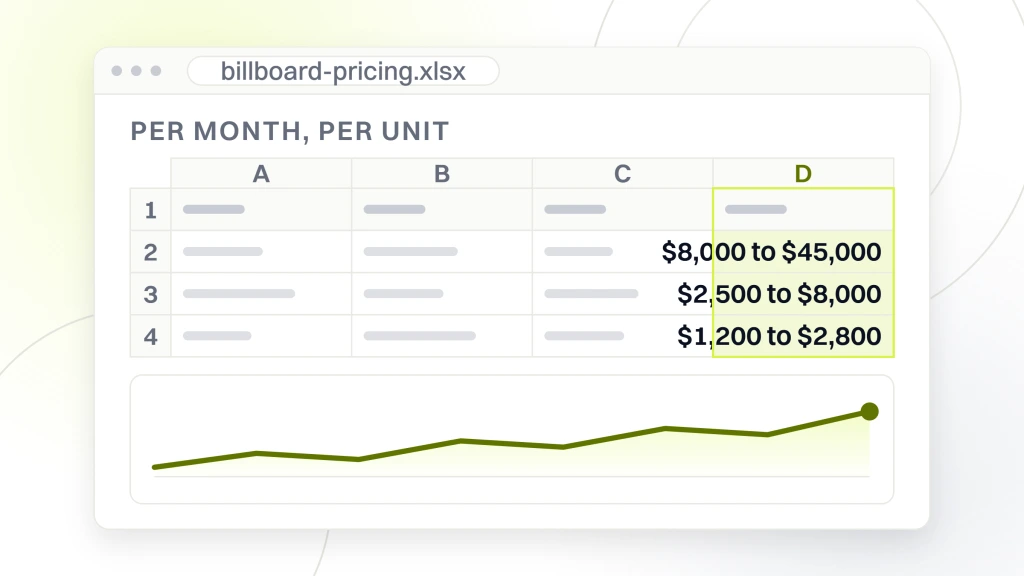
Dental billboard ads pricing varies by market size, format, and location quality. A top-tier billboard in Los Angeles prices at $20,000 to $45,000 per month. The same billboard format in a small metro like Wichita prices at $1,200 to $2,800 per month. Practices should build market-specific benchmarks before negotiating with outdoor media vendors. The pricing ranges below cover three market tiers our team has worked with.
Top 25 markets
Top 25 markets like New York, Los Angeles, Chicago, and Dallas price billboards at $8,000 to $45,000 per month per unit. Digital billboards in these markets often run in the 4,000 to 15,000 range for a rotating spot. Practices in these markets should typically skip billboards when the campaign covers fewer than 3 to 6 units simultaneously. Single-unit buys in top markets rarely produce measurable patient gain since the reach floor is too high to hit with one board.
Mid-size markets 26 to 100
Mid-size markets like Nashville, Austin, and Kansas City price billboards at $2,500 to $8,000 per month per unit. Digital billboards run $1,800 to $4,500 for a rotating spot. This is the sweet spot for dental billboard ads. A single static billboard along a commute corridor within 3 miles of the practice can produce measurable growth for a solo practice at a monthly cost that fits inside a $5,000 total marketing budget.
Small markets under 100
Small markets price billboards at $800 to $2,500 per month per unit. Digital billboards in these markets often do not exist. Static is the only option in many rural areas. This is the strongest economic case for dental billboard ads. A single billboard on a small town main road can drive 8 to 15 net-new patients per month at a monthly cost of $1,500. The catchment is small enough that a single billboard achieves saturation reach within 60 days.
Creative that works on dental billboard ads
Creative on dental billboard ads has one rule. A driver at 60 miles per hour has 6 seconds to see and understand the message. That constraint drives every creative decision. Six words or fewer. One primary visual. One call to action. Anything more gets lost. Practices that clutter the billboard with insurance carrier logos, hours, and phone numbers see zero gain since the driver never processes any single element of the crowded design.
The 6 second rule
The 6 second rule sets the design constraint. A billboard should communicate one thing in 6 seconds. Practice name plus location. Or specific offer plus phone number. Or specific procedure plus website. Never all three. Never any two combined with detailed pricing or insurance information. The billboards that outperform are usually shockingly simple. The billboards that fail almost always try to say too much in too little time.
Copy that works
Copy that works on dental billboards falls into three formats. Straightforward practice branding like Smith Family Dentistry Exit 12. Specific offer copy like New Patient Exam $99. Or procedure-specific copy like Same Day Crowns 555-0100. Each format tests differently across markets. Solo practices often start with branding to build recognition. Practices with strong offers move to specific offer copy in month three. Procedure-specific copy works best for high-value elective procedures like implants or Invisalign.
Visual design principles
Visual design on dental billboards follows three principles. High contrast between text and background so the message reads at 400 feet. Bold sans-serif font at 36 inches minimum. One primary image that reinforces the copy without competing for attention. Photos of smiling patients typically outperform photos of dentists or dental instruments. Coverage of outdoor creative best practices at thinkwithgoogle.com and the Out of Home Advertising Association at oaaa.org both publish detailed guides worth reading before commissioning creative.
Dental billboard ads compared to digital channels
Dental billboard ads compare unfavorably to digital channels on measurable cost per patient but favorably on brand build and geographic saturation. The table below shows the numbers across billboards, Google Search, Meta paid social, and local SEO for a typical mid-size metro dental practice. Use these numbers as benchmarks for a channel mix analysis, not as absolute rules that apply to every practice.
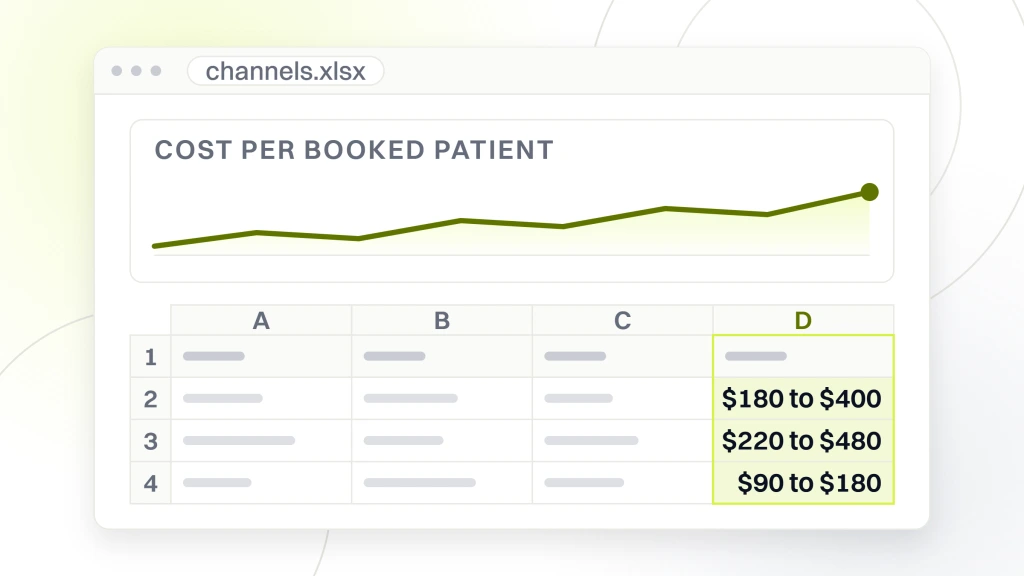
| Channel | Cost per booked patient | Time to first booking | Best use case |
|---|---|---|---|
| Static billboard | $180 to $400 | 30 to 60 days | Brand build in commute corridor |
| Digital billboard | $220 to $480 | 21 to 45 days | Multi-message flexibility |
| Google Search | $90 to $180 | 3 to 7 days | Existing demand capture |
| Meta paid social | $65 to $140 | 5 to 14 days | Volume patient acquisition |
| Local SEO | $45 to $110 | 90 to 180 days | Long-term compounding value |
| Radio ads | $150 to $340 | 21 to 45 days | Brand build alongside billboards |
| Direct mail | $110 to $260 | 14 to 30 days | Targeted neighborhood outreach |
Read the table with practice-specific context in mind. Billboards work best as a supplement to digital channels, not a replacement. A practice already running Google Search, Meta paid social, and local SEO at scale can layer billboards for brand build across a 3 to 5 mile catchment. A practice without the digital foundation should almost always spend first on Google Search or Meta before adding billboards. The digital-first sequence produces better economics inside the first six months of a marketing program build.
The cost per booked patient row is the most important number to read carefully. Billboards produce $180 to $400 bookings when the attribution is measured correctly with a dedicated call tracking number and branded search gain analysis. Without attribution, most practices report zero booked patients from billboards since they cannot see the aided-recall traffic. That measurement discipline turns billboards from a guessing game into a spreadsheet decision worth 8 to 15 percent of total marketing spend in some practice profiles. Smile Design Dentistry cut cost per call by 30 percent over 12 months by tightening the same attribution loop across paid channels.
Measurement for dental billboard ads campaigns
Measurement for dental billboard ads requires three specific mechanisms since billboards do not click. Call tracking with a dedicated number. Branded search gain analysis in Google Search Console. And unique QR codes on the creative for direct-to-website measurement. Together these three mechanisms typically capture 60 to 80 percent of billboard-driven bookings. The remaining 20 to 40 percent shows up as unattributed direct traffic that has to be inferred from year-over-year comparisons.
Call tracking number setup
The dedicated call tracking number should appear only on the billboard, never on the website, business cards, or Google Business Profile. That unique attribution lets every inbound call on the number get counted as a billboard-driven booking. CallRail, CallTrackingMetrics, and similar tools price this at $30 to $80 per month for a single number. The setup takes an hour and pairs cleanly with the reporting infrastructure our Dental SEO Services team runs on retainer. The measurement value across a 4 to 6 month billboard campaign runs into the thousands of dollars in decision-making clarity.
Branded search gain analysis
Branded search gain analysis compares searches for the practice name in the 4 weeks before the billboard campaign versus during the campaign. A well-run billboard typically drives 15 to 40 percent growth in branded search volume within 30 days of launch. The gain maps roughly to booked patients through the practice website booking widget. Google Search Console tracks this data automatically. Reviewing the branded search report monthly during the campaign gives the practice owner a clear read on billboard performance.
QR codes and short URLs
Modern billboards can include QR codes for direct-to-website measurement. Only about 5 to 15 percent of drivers scan the code, but every scan is attributable. Short URLs with UTM parameters work the same way for website visitors typing the URL directly. Both mechanisms produce clean attribution data that closes the reporting loop alongside the call tracking number. The combined data gives practice owners the confidence to renew billboard buys or reallocate the budget to other channels based on hard numbers.
Integrating dental billboard ads with digital campaigns
Integrating dental billboard ads with digital campaigns produces multiplicative results. Standalone billboards deliver base awareness gain. Integrated billboards with Meta retargeting, Google Search retargeting, and matched location targeting deliver 2 to 3x the booked patient volume at the same billboard cost. The integration cost adds $500 to $1,500 per month in digital media buys. The gain covers that added cost several times over in most well-planned campaigns.
Meta location retargeting
Meta location retargeting targets Facebook and Instagram users within a 3 mile radius of the billboard location. Users who saw the billboard on their commute get served matching creative on Meta later that day. The double exposure grows recall by 40 to 60 percent versus billboard alone. Meta ad spend for this layer runs $500 to $1,200 per month for a solo practice. The integration usually pays back inside 45 days of campaign launch on booked patient volume alone.
Google Search branded keyword coverage
Google Search branded keyword coverage protects the traffic the billboard drives. Drivers who see the billboard and later Google the practice name see the practice ad in position 1 followed by the organic listing. Without the branded ad, competitors can bid on the practice name and steal 15 to 30 percent of the branded traffic. Branded keyword campaigns run $100 to $400 per month depending on competition and market size, well worth it during a billboard campaign window.
Landing page for QR code traffic
The QR code on the billboard should route to a dedicated landing page rather than the homepage. That landing page repeats the billboard offer, includes the same call tracking number, and provides a fast mobile booking widget. Landing page conversion rates for QR traffic run 8 to 20 percent versus 1 to 3 percent for homepage traffic from the same source. Building the landing page costs $500 to $1,500 and pays back inside two weeks on any billboard campaign spending $3,000 monthly.
When to skip dental billboard ads entirely
Not every practice should run dental billboard ads. Several practice profiles produce much better economics from digital-only channels. Practices that fit any of the profiles below should skip billboards and reinvest the budget in Meta, Google Search, or local SEO. Forcing a billboard buy usually produces regret.
Practices under 750K collections
Practices under 750K in collections rarely have the marketing budget to support billboards plus the digital wrapper required to make them work. Total marketing spend at this size sits at $3,000 to $5,000 per month. A billboard buy consumes the entire budget without leaving room for Meta, Google Search, or landing page infrastructure. These practices should skip billboards and focus every dollar on Meta paid social plus branded search until collections cross 1M and the marketing budget grows accordingly.
Practices in top 10 metros
Practices in top 10 metros face billboard prices that require $8,000 to $25,000 monthly buys to hit the reach floor. Solo practices in these markets rarely have the ad budget to justify buys of that size. Multi-office groups can support it. Solo practices should typically skip billboards in top metros and focus the same budget on Google Search plus Meta paid social where the same dollars produce meaningfully more booked patients across a 90 day campaign window.
Practices without measurement discipline
Practices without measurement discipline should skip billboards regardless of budget or metro. Billboards produce ambiguous attribution that requires call tracking, branded search analysis, and QR code data to interpret. Practices unwilling to invest in the measurement layer will read the ambiguous results as failure and cancel the buy at contract end. The measurement layer costs $100 to $300 per month on top of the billboard buy but is the only way to read whether the campaign is actually working.
Working with a partner on dental billboard ads campaigns
Our team runs dental billboard ads campaigns for practices from solo GPs to multi-location groups as part of an integrated marketing program. Coverage includes outdoor media buying, creative production, digital wrapper strategy, and attribution measurement. The Dental Marketing Retainer starting at $1,499 per month covers the digital wrapper. Outdoor media buys and creative production bill separately at $3,000 to $12,000 per month depending on market and format. Practices interested in adding billboards to an existing digital program should scope this at the start of a quarter rather than mid-quarter. Pain Cure Clinic saw a +205% jump in patient appointments across an annual curve after a similar measurement-first rebuild across its channel mix.
Coverage on outdoor advertising strategy at the Out of Home Advertising Association tracks industry benchmarks worth reading quarterly. Coverage on dental billboard campaign case studies at Group Dentistry Now at groupdentistrynow.com tracks multi-location group buys that inform smaller practice strategy. Both sources publish useful benchmarks even for solo practices considering their first billboard campaign in the coming year alongside our Dental Website Design engagements that produce landing page infrastructure for QR code traffic.
What the retainer produces alongside billboards
The Dental Marketing Retainer alongside a billboard campaign produces the Meta retargeting, branded search protection, landing page infrastructure, and attribution measurement that convert billboard impressions into booked patients. Standalone billboard buys without the retainer wrapper typically produce 20 to 40 percent of the results integrated campaigns deliver. Practices already on the retainer add billboards as a layer with modest incremental scope. Practices without the retainer usually need to add it before layering billboards, sequenced as retainer first, billboards second across two consecutive quarters.
When to start with billboards
Start with billboards when the practice has a strong digital foundation, sits in a mid-size or small metro, and has $6,000 to $15,000 per month in total marketing budget available. Below that threshold, digital-only channels almost always produce better returns. Above that threshold, billboards become viable as a brand build layer on top of the digital program. Sequencing matters. Digital first. Billboards second. Never the other way around since the digital funnel is what converts the billboard-driven awareness into actual booked patients.
A final read on dental billboard ads in 2026
Dental billboard ads still work in 2026 for practices with the right geography, the right creative, and the digital funnel that captures aided-recall traffic. The $8,000 per month buy that made sense in 2015 rarely makes sense today without the digital wrapper around it. But an integrated $3,000 to $6,000 per month campaign in a mid-size metro can produce 20 to 40 net-new patients per month at $150 to $300 per booked patient when everything else is in place.
The deciding factor is not the billboard itself. It is the measurement discipline, the creative simplicity, and the digital integration around the billboard. Practices that invest $300 a month in measurement infrastructure and $500 to $1,500 a month in digital integration turn billboards from a legacy channel into measurable growth on top of an already-working marketing program. Practices that skip either layer usually cancel the billboard buy at the end of the first six months.