Dental remarketing ads are paid display, video, and social placements that follow up with people who already visited your practice site and left without booking. They run on the Google Display Network, YouTube, Facebook, and Instagram, targeted at cookie or pixel audiences your site collected during the first visit. That is the whole mechanic. A warm audience, a second touch, a lower cost per booked patient than any cold campaign will hit.
Around 95 to 98% of first-time website visitors leave without converting. For a practice, 95 out of every 100 people who found your implants page, your Invisalign page, or your new-patient special quietly disappeared. Most offices treat those visitors as gone. This channel treats them as pending.
I have run paid media for dental offices for the better part of a decade. The pattern is boring and consistent. Cold search costs $60 to $150 per booked consult. A properly structured retargeting stack costs $10 to $35 for the same booking, so you already paid to earn that visit once. This guide walks the audience structure, the creative cadence, the HIPAA guardrails, the numbers we see, and the specific mistakes that quietly kill the channel.
Table of contents
- What dental remarketing ads actually do
- Dental retargeting audience structure that pays back
- Creative rotation for retargeting for dental practices
- Frequency caps in dental practice remarketing ads
- HIPAA guardrails and compliant setup
- Real numbers from a practice running the channel
- Common mistakes that drain the budget
- Google versus Meta split
- Frequently asked questions
What dental remarketing ads actually do
These ads bring back a specific slice of your traffic: people who visited a service page, spent more than a token 8 seconds on it, and left before booking. They see your practice again on the next 5 to 10 sites they open, on YouTube pre-rolls, and inside Facebook and Instagram feeds. The goal is not one more click. The goal is the second impression at the moment the patient is genuinely ready to commit.
Google versus Meta as the two engines
Google Ads uses a tag on your site that adds each visitor to an audience list. Later, when that visitor loads any of the 2 million+ sites in the Display Network, watches a YouTube video, or types a related query in search, your ad qualifies to show. Meta works the same way with a pixel and the Conversions API, then serves those users inside Facebook, Instagram, Messenger, and Reels. Both hit the same person from different angles, and that is the point.
How the audience gets built
Set the Google Ads tag once, on every page. Set the Meta pixel once, on every page. Both platforms auto-build a 30, 60, 90, 180, and 540 day audience from that day forward. Split the base audience by page group inside the platform. For example, one list for anyone who visited /implants, another for /invisalign, another for /new-patient. That page-level split is what turns generic follow-up into a program that actually matches the service the patient was researching.
Why the channel books cheaper
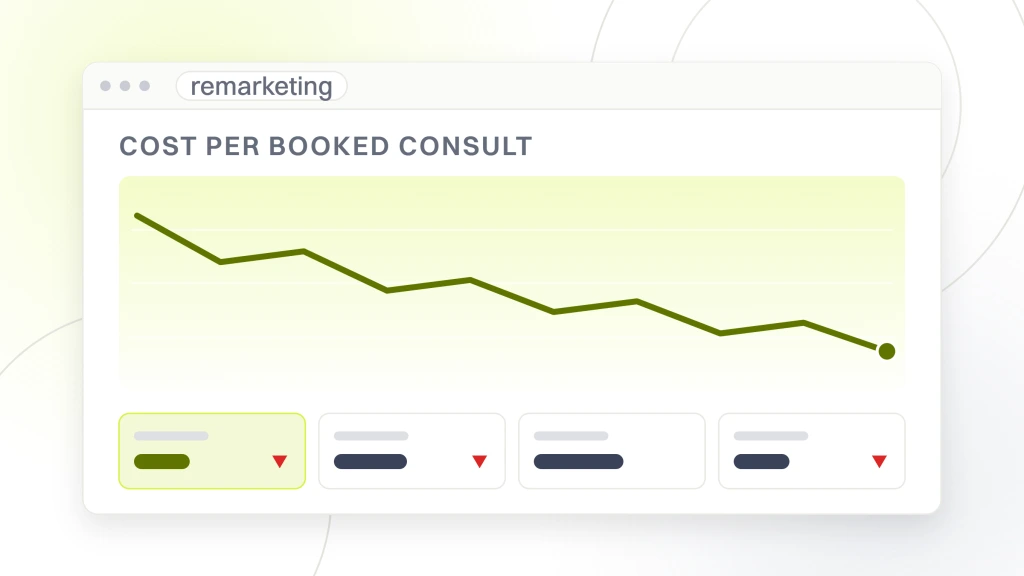
Cold clicks in dental verticals sit at $6 to $15 in most US metros, and $18 or more for competitive implants terms. Warm clicks sit at $0.50 to $2.00, so the audience is small, warm, and the auction is thin. Add a higher conversion rate on those clicks (15 to 25%, not the 5 to 10% you get from cold search), and cost per booked consult drops from $60 to $150 down to $10 to $35. Same practice, same site, roughly one third of the cost per patient.
Dental retargeting audience structure that pays back
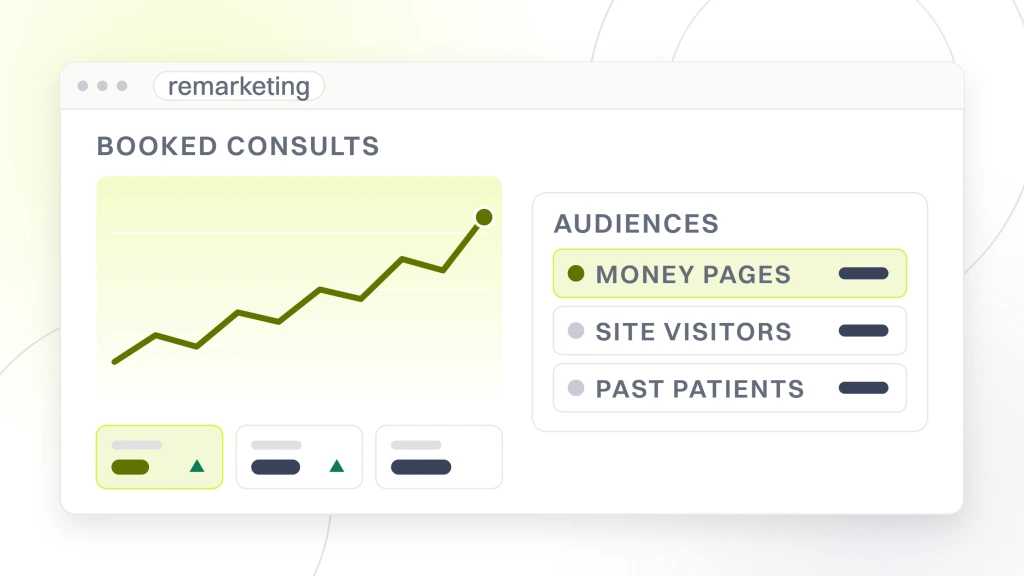
Three audiences carry 80% of the value. Almost every practice that struggles with retargeting for dental practices is running one blob of “all site visitors” and wondering why the numbers look mediocre. The fix is a page-based split, plus a hard exclusion for people who already booked.
Audience one, high-intent service pages
Anyone who hit /implants, /invisalign, /veneers, /emergency, or a similar money page in the last 30 days. They stayed long enough to read past the fold. This audience is small, usually 200 to 900 people at any moment for a single-location practice. It converts at 15 to 25% on creative that names the service and shows a real dentist face, not a stock photo.
Audience two, general site visitors 30 to 90 days
Everyone else who visited any page in the past 30 to 90 days, minus the high-intent group and minus converters. Bigger list, cooler intent. Use it for brand-level reminder creative: dentist face, practice exterior, a short “still comparing dentists?” hook. Book rate is lower (3 to 8%), and so is the CPM, so blended cost per booking stays healthy.
Audience three, cart-abandoners of dentistry
Anyone who started the online booking flow and dropped off before submitting. This is the closest a dental site gets to an abandoned cart. Tiny list, 20 to 80 people at a time, converts at 25 to 40%. Serve them a direct message: “You almost booked. Ready to finish?” Include the practice phone number in the ad copy so the friction-averse ones can skip the form.
Split remarketing by page group before spending a dollar. One blended audience wastes 40 to 60% of the budget on people who saw the About page and forgot you.
Creative rotation for retargeting for dental practices
The single biggest hidden killer of this channel is creative fatigue. Run the same ad for 60 days and CPMs climb 20 to 60% at the same time click-through drops 30 to 50%. Rotate on a 14-day cadence. Three creatives per audience keeps the math clean and the refresh manageable.
The proof creative
A real 5-star review, in a real patient photo, with the star rating and 1-line quote overlaid. No stock. Google and Meta both reward native-feeling creative with lower CPMs. The proof piece runs on audiences one and two and does the heaviest lifting for the first-time booker who is still comparing options.
The offer creative
A specific, dated new-patient offer. “$79 exam + x-rays through Aug 31” beats “New patients welcome” every time. Offer creative pushes the fence-sitter over the line, especially when the click lands on a page tuned for dental website conversion optimization. It gets its highest yield on audience three, the near-bookers, then on audience one, and light rotation only on audience two so the brand does not read as discount-first.
The dentist video creative
15 to 30 seconds of the actual dentist talking to camera. What service, why patients pick this practice, one clear call to action, phone number on screen the whole time. Run this on YouTube in-stream and on Meta Reels. Video creative is where practices that hate ads finally start booking calls, so the patient recognizes a face before they walk in the door.
Frequency caps in dental practice remarketing ads
Frequency is the number of times one person sees your ad in a set window. Too little and the campaign is a whisper. Too much and it is a stalker. Both hurt. The right cap sits at 3 to 5 impressions per person per day, and 15 to 20 per week. Above that, brand sentiment drops and clicks stop converting.
Why over-serving hurts
A patient researching an implant will look at 3 to 5 practices before calling. If yours shows up 40 times in three days at the same time the others show up twice, the patient does not read that as thorough, they read it as pushy. Reviews mention it. Booking rate on the eventual click actually falls, even when impression volume looks big and healthy in the dashboard.
Setting caps in Google Ads and Meta
In Google Ads, set frequency caps at the campaign level: 5 per day, 20 per week, per user. In Meta, use the “impressions” cap inside the campaign spending controls, or lean on the frequency column in reporting and adjust budget by audience size. Once the retargeting audience shrinks (fewer visitors this month), frequency naturally climbs. Trim budget accordingly, do not just keep the same spend and let each person see 50 ads.
Frequency and creative rotation together
Rotating creative every 14 days effectively resets fatigue even if a user has seen 40 impressions of the old ad. That is why the two rules pair. Fresh creative + capped frequency keeps the audience warm without burning them out. Skip either half and the channel decays inside a month.
Cap dental remarketing at 5 impressions per day and rotate creative every 14 days. Skip either rule and CPMs climb 20 to 60% inside a month.
HIPAA guardrails and compliant setup
Dental is a HIPAA covered vertical, and Google and Meta both explicitly restrict how patient data can be used in ad platforms. The short version: standard cookie-based retargeting on marketing pages is fine. Anything that ties a specific patient identity to a specific health condition inside an ad platform is not. Read the primary sources: Google Ads personalized advertising policy and HHS HIPAA covered entities guidance.
Website audiences are usually fine
Cookie-based lists built from visits to marketing pages (home, services, team, before-and-after gallery) do not carry protected health information. Google and Meta both allow these audiences for general dentistry, cosmetic dentistry, and pediatric dentistry. Where the platforms get twitchy is service categories they classify as sensitive (some surgical specialties). Check the categories list before launch.
Where CRM uploads change the calculation
Uploading a patient email list to Google Customer Match or Meta Custom Audiences is where practices get in trouble. That email list came from patients, so it may be protected health information under HIPAA, and Meta explicitly prohibits uploading data derived from a health condition. Safer path: only upload email lists collected from a public opt-in form (newsletter, guide download), not from the appointment scheduling system.
Pixels on booking forms
Do not fire the Meta pixel or Google conversion tag on a page that has a service selection dropdown (“Implants,” “Root canal”) until after the patient hits submit and lands on a generic thank-you page. Better: fire the pixel only on the thank-you page, and pass no service parameter. That is the cleanest way to avoid sending diagnostic-adjacent data to an ad platform.
Real numbers from a practice running the channel
Here is what the numbers look like on a single-location general practice with 4,500 monthly website visits and $1,200/mo split across retargeting on Google and Meta. Cold search runs a separate $2,800/mo campaign that feeds the traffic. The results below are typical, not best case.
| Metric | Cold search | Retargeting |
|---|---|---|
| Cost per click | $6 to $15 | $0.50 to $2.00 |
| Click-through rate | 3 to 5% | 0.5 to 1.2% |
| Conversion rate | 5 to 10% | 15 to 25% |
| Cost per booked consult | $60 to $150 | $10 to $35 |
| Booked-to-shown rate | 40 to 55% | 55 to 70% |
Audience one performance
High-intent service page visitors run at $10 to $18 per booked consult, and roughly 60 to 70% of those consults show up. The service-specific creative does most of the work: an implants ad to the implants audience, an Invisalign ad to the Invisalign audience. Blended, this segment produces around 40% of all bookings from a $1,200/mo budget.
Audience two performance
General 30-to-90 day visitors run at $22 to $35 per booked consult. Lower intent, lower conversion, but the audience is 5 to 10 times larger, so it produces the highest raw booking count of the three. It is the brand layer that keeps the phone ringing between big offer pushes.
Audience three performance
Booking-flow abandoners are the highest-yield tiny audience in the stack. Cost per booked consult drops to $6 to $12 and 70 to 80% show up. Volume is capped by how many people abandon the form each week (20 to 80), but on a per-dollar basis, this audience is 3 to 5x more efficient than the other two.
Cross-audience halo effect
Direct-attributed bookings understate the channel by 30 to 50%. A patient who sees the video ad on YouTube, then a proof ad on Instagram, then Googles the practice name and calls, credits as a “brand search” call. It is a follow-up booking wearing a search hat. Track branded search volume before and after launch to see the halo.
Booking-flow abandoners convert at 25 to 40% on retargeting. Build that audience first, even if the list stays under 100 people at any single moment.
Common mistakes that drain the budget
Every mistake below shows up in real dental accounts we audit. Each one drains 15 to 40% of the budget with no return. Fixing them takes hours, not weeks, and pays back inside the first billing cycle.
Not excluding converters
If a patient booked, exclude them from every retargeting audience for at least 90 days. Otherwise you are paying to show a “book now” ad to a person who is already on the schedule. Booked-patient exclusion lists live in the same audience manager. Refresh weekly. On a $1,200/mo budget this fix alone typically recovers $150 to $200 in wasted spend, and it is one of the top dental PPC mistakes we see in audits.
Running the same creative for months
Old creative rots quietly. Impressions still show, so it looks like the campaign is working. Meanwhile CTR is halving and CPMs are climbing. Set a calendar reminder every 14 days to rotate at least one creative per audience. If the practice cannot produce fresh assets that fast, precycle a pool of 6 to 9 creatives and rotate through them on a 3-week loop.
Ignoring mobile placement quality
The Google Display Network will happily place ads inside game apps where the click-through is 8-year-olds fat-fingering the banner. Exclude the mobile apps category and the “in-app” placement in every retargeting campaign. Same rule on Meta, exclude Audience Network so a specific test shows it converts. Both fixes cut junk clicks by 20 to 30% overnight.
Google versus Meta split
Both platforms retarget. Both work. The right split for most single-location practices is roughly 60/40 in favor of Google, so the display and YouTube inventory is wider and the search-remarketing intent is unmatched. Multi-location dental groups often flip that ratio, so Meta creative production scales more cheaply across offices.
Real proof point: our team ran a 12-month program for VP Dental that doubled new patient acquisition and added over $8,000 in monthly recurring revenue. Retargeting was the second-highest ROI channel in that stack, behind local SEO and ahead of cold search. Across the 50+ office Smile Design Dentistry portfolio, layered paid work drove cost per call down 30% over a 12-month curve. Both jobs used the exact 3-audience structure this guide lays out.
When to run Google-only
Budgets under $600/mo total spend. At that level, split attention between Google and Meta and neither hits statistical significance inside 90 days. Put it all on Google, use Display + YouTube + RLSA (remarketing lists for search ads), and lean on the search-remarketing overlap for the fastest booking signal.
When to lean Meta-heavier
Cosmetic-heavy practices, ortho, and multi-location groups. The visual-first creative Meta rewards fits before-and-after content, dentist video, and social proof. Flip the split to 40/60 Google/Meta and creative production becomes the constraint, which is a healthier problem than “we are out of audience.”
Attribution across both
Assume 30 to 40% of Meta-driven bookings will show up as “Google branded search” in analytics, and roughly 15 to 25% of Google-Display bookings will show up as “direct” or “Meta.” Do not try to fix this with UTM parameters alone. Track weekly cost per booked consult at the practice level, not the channel level. That is the number that pays the rent. For deeper mechanics, see our writeup on dental marketing attribution and the companion guide to dental marketing ROI.
Retargeting pairs best with the rest of a booking-focused stack. Automated recall and reminder sequences (see our guide to dental marketing automation) catch the patient after the click. Short-form video (dental video marketing) fuels the creative pool without expensive shoots. Cold acquisition on Meta (dental Facebook ads guide) feeds fresh visitors into the top of the funnel every week.
Launch your dental remarketing ads program this month
Three moves get a small practice from zero to bookings inside 30 days. First, install the Google Ads tag and Meta pixel on every page today and let audiences build for 2 weeks. Second, split those audiences into the 3 groups above and exclude converters. Third, launch 3 creatives per audience (video, proof, offer) at a $400 to $600 test budget and rotate every 14 days. That is the entire program, no complexity added.
If you would rather hand the setup to a team that has run this stack for practices from single-office to 50+ locations, our dental paid team can build, launch, and optimize the full program (Google + Meta + tracking) for a flat monthly retainer. The data trail is the same one we used to book $8,000 in new monthly revenue for VP Dental and cut cost per call 30% across Smile Design Dentistry. Bring us a site with any real traffic, we will bring the audiences, the creative rotation, and the weekly reporting the phone actually cares about.