Most Shopify and WooCommerce stores bleed 60% to 80% of paid traffic on the product page for reasons nobody at the founder’s last agency ever explained. Add-to-cart rates sit under 3% when they should sit at 8% to 14%. Category pages fail to rank once they came from a theme demo instead of a keyword map. Site speed craters on Black Friday, since the theme is dragging 14 apps and 3 megabytes of unused JavaScript behind it. The right top ecommerce web design examples company fixes those three problems in the same build. The wrong one buries the store’s revenue for 24 months and calls it a rebuild.
This guide walks through what a real ecommerce web design company does differently from the average Shopify freelancer. Which platforms they build on, and why one gets picked over another. When to hire a specialist shopify design agency instead of a full-service DTC shop. What pricing bands buy what deliverables. How conversion, SEO, and speed get wired together at the design stage rather than bolted on later. Every number below comes from stores we rebuilt between 2024 and 2026.
Conversion patterns an ecommerce web design company builds into the store
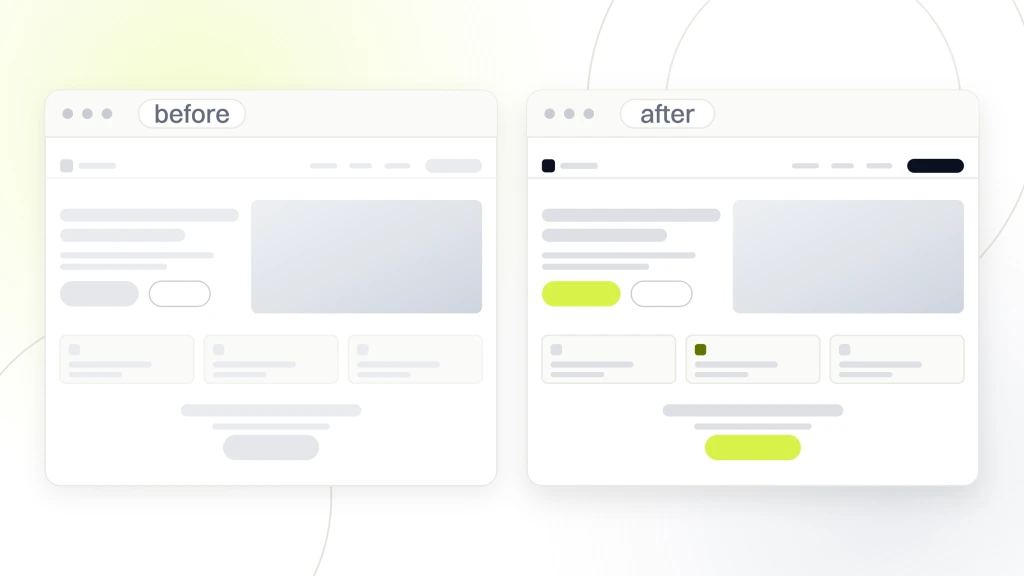
Conversion patterns are the reason the store starts making money after launch rather than just looking better on the founder’s Instagram. A theme install without conversion patterns wired into the templates lands at the same conversion rate as every other Dawn theme store, which is under 2% for cold traffic. An ecommerce web design company that has done this work before hands over a product template with 8 to 12 tested patterns already baked in. That gap is why two stores with the same traffic can post revenue numbers 3x apart in the first 90 days after launch.
Product detail page patterns that move add-to-cart rate
The strongest PDPs (product detail pages) share the same skeleton across categories. Product image gallery with 6 to 9 shots that cover hero, lifestyle, scale, detail, packaging, and ingredient views. Sticky add-to-cart bar on mobile past 800px scroll. Variant selector with photo swap, not just color swatch. Size guide inline expandable, not modal. Reviews block within the first 1200 pixels of the page. Shipping and return info in a bar under the price, not buried in the footer. Trust badges at the price row for secure checkout, 30-day returns, and shipping threshold. Related products by attribute similarity, not by best-seller. Shopify’s best-seller default is worse than nothing on niche catalogs. Bundle offer above the fold when average order value strategy calls for it.
Cart and checkout patterns that reduce drop-off
Cart drop-off sits at 68% to 74% industry average across DTC. The design patterns that shave 8 to 15 points off that number look the same on every store we rebuild. Free shipping progress bar in the cart drawer. Discount code field collapsed by default. An open discount field tells the shopper you expect a coupon. Guest checkout without account creation friction. Address autocomplete via Google Places. Payment method icons at the cart level for Apple Pay, Shop Pay, PayPal, and credit card. Single-page checkout on Shopify Plus via Checkout Extensibility. Post-purchase upsell page pulling a 5% to 12% take rate on the right offer. A DTC beauty brand we rebuilt in Q3 2024 pushed cart-to-order rate from 22% to 34% by wiring only the checkout patterns above.
SEO an ecommerce web design company builds into the design stage
SEO built at the design stage ranks category pages, product pages, and blog content from launch, instead of playing catch-up for 18 months as the store loses organic traffic. Every ecommerce web design company we would recommend hires or contracts a Shopify or WooCommerce SEO lead who signs off on templates before development starts. The lead reviews URL structure, meta template patterns, schema output, collection filters, faceted navigation rules, canonical setup, and internal linking scaffolds. So the store launches with rankable architecture, not with a fix list.
- URL structure and permalink rules locked in the theme, not on a per-product override.
- Meta title and meta description templates for product, collection, blog, and homepage.
- Product, Review, Breadcrumb, Organization, and BlogPosting schema output from templates.
- Faceted navigation rules that noindex parameterized URLs without dropping filter UX.
- Collection filter and sort URLs canonicalized to the parent collection.
- Internal linking scaffolds baked into templates for related products, cross-collection links, and blog to product.
- 301 redirect map planned during design phase, not scrambled together the night before launch.
- Rich results eligibility tested on staging via Google Search Console URL inspection.
The list above is the SEO template checklist every ecommerce web design company we respect runs during the design phase, not after launch when 40% of the ranking damage is baked in already. Founders shopping for an ecommerce web design company should ask to see the SEO template doc from the last two projects and read who signed off on each line.
URL structure and canonical rules
Shopify’s default URL structure duplicates products across every collection they belong to, which spawns duplicate content if the canonical tag fails to point back to the primary product URL. Most theme installs skip this. Our audits catch canonical bugs on 62% of Shopify sites we open. WooCommerce lets you customize permalinks all the way down, which is a bigger power and a bigger footgun. An ecommerce web design company that knows both platforms locks URLs, canonicals, and 301 maps at the design stage so nothing shatters on migration day.
Schema markup and rich results
Product schema, Review schema, Breadcrumb schema, and Organization schema output cleanly from every template the design team hands over. Most themes leave schema broken out of the box. Review schema without the required fields fails Google’s structured data test silently, and the star rating disappears from the search result. Fixing schema alone on a mid-size DTC catalog we rebuilt drove a 21% gain in organic click-through rate across the next 90 days, once the star ratings came back on branded and long-tail queries. The Google product schema documentation is the reference an ecommerce web design company should build against.
Speed and Core Web Vitals on Shopify and WooCommerce stores
Site speed is the layer that decides whether the design work compounds or fights itself. A store with 4-second Largest Contentful Paint on mobile ranks lower than a weaker-brand competitor at 1.8-second LCP on the same keyword set. Google treats Core Web Vitals as a genuine ranking factor for commercial search. A store at 4-second LCP converts 30% to 45% lower on paid traffic, once the ad click bounces before the hero image ever renders. Speed is not a nice-to-have on a DTC storefront. It is the tax the store pays on every impression the paid team buys.
App audit before the design phase starts
Every ecommerce web design company should audit installed apps before the design phase starts. A typical Shopify store carries 12 to 22 apps at rebuild time. Half do nothing measurable. Each app injects JavaScript that runs on every page whether the app is used there or not. Pulling 6 apps off an $8M skincare brand’s Shopify store cut mobile Largest Contentful Paint from 4.1 seconds to 1.6 seconds and pushed mobile conversion rate 18% higher inside 30 days. No design change. Just the app cleanup a real ecommerce web design company runs on day one.
Image, font, and code splitting
Image, font, and code splitting is where the technical design team earns the difference between a $30K and a $10K project. WebP or AVIF on every product image at multiple sizes served responsively. Fonts subsetted and preloaded. Third-party scripts deferred or removed. Critical CSS inlined. Lazy-loaded product grid on collection pages. On WooCommerce, the same work plus a serious caching layer like WP Rocket, LiteSpeed, or object caching on a managed host. An ecommerce web design company that ignores this hands over a store that fails Core Web Vitals inside 6 months of launch as apps and content pile on. So the technical brief in the SOW should call out each of those items by name.
Platform matching for an ecommerce web design company
Picking the platform is the call an ecommerce web design company should own before any pixel gets drawn. The right platform matches revenue band, catalog size, checkout customization needs, and the founder’s tolerance for developer overhead. The wrong pick locks the store into 3 years of workarounds. Below is the honest match, based on stores we have rebuilt on each stack.
- Shopify. Default for DTC brands under $10M in yearly revenue with a simple catalog and no unusual checkout needs. Fastest time to launch, cleanest app ecosystem, weakest content SEO story past 500 products.
- Shopify Plus. Starts making sense past $2M when you need checkout customization, wholesale channels, multi-store setup, or launch scripts for a big drop. License runs $2,300 to $2,500 per month at entry and scales past $40K at higher revenue.
- WooCommerce. Fits stores with heavy content marketing plans, complex catalog rules, or an existing WordPress site that already ranks. Requires a managed host and a real developer on retainer, not a hobbyist.
- BigCommerce. Fits international stores or B2B channels bolted onto a DTC catalog. Cleaner headless story than Shopify at the same tier.
- Wix and Squarespace. Fine under 100 SKUs and a founder who ships their own orders. Past that, the platform tax on speed and SEO gets ugly.
An ecommerce web design company that pushes every client toward the same platform is not doing platform matching. Ask them which stacks they shipped in the last 12 months and how they picked between them for a new client. If the answer is Shopify every time regardless of scope, you are talking to a Shopify-only shop, not an ecommerce web design company.
Pricing bands you should expect from an ecommerce web design company
Ecommerce web design pricing runs across four honest bands, plus a post-launch retainer. Anything cheaper than the bottom band is a theme install with a paint job. Anything priced above the top band without headless scope is padding. Redefine Web’s own ecommerce packages fall in the $2,500 to $7,500 SMB tier for small catalogs and start at $18K for full custom builds on mid-market rebuilds.
- Theme customization: $2K to $8K. Fits founders under $500K per year with a simple catalog. Premium theme, brand paint, basic conversion patterns wired in. No custom template engineering.
- Semi-custom: $10K to $30K. Fits $500K to $3M per year. Custom PDP, custom collection, custom homepage on a modified theme. Real conversion pattern work. Template SEO signed off before development.
- Custom design plus development: $18K to $90K. Fits $3M to $25M per year. Ground-up template rebuild, custom app work, migration plan, retainer to iterate past launch.
- Enterprise or headless: $90K to $400K. Fits $25M-plus brands. Headless front end, custom checkout, ERP integration, multi-store logic.
- Post-launch retainer: $199 to $499 per month for maintenance, $2K to $8K per month for design plus CRO iteration. Covers conversion testing, SEO content, and speed maintenance. Redefine Web maintenance tiers land at $199, $299, and $499 per month.
Any pitch that promises a $2,000 custom Shopify build is either lying about scope or shipping a theme install with a paint job. Any pitch above $90K without headless in the SOW is padding hours the store will never see the value of.
Questions to ask an ecommerce web design company before signing the contract
Interview three ecommerce web design companies against each other before signing. Ask the same 8 questions of each, write down the answers, and compare on the same axes. The answers separate a real design partner from a theme installer with a sales pitch.
- Show me the last 3 stores you built in my revenue range with permission to share numbers on year-over-year growth after launch.
- Which platforms have you built on in the last 12 months, and how do you pick between them for a new client?
- What is your process for template SEO before the design phase? Who signs off?
- Which conversion patterns do you build into every product template by default?
- What is your speed target for the launched store on mobile at 4G, and how do you enforce it?
- What does the post-launch iteration retainer include, and what does it cost?
- Which 4 apps are on your no-fly list for wrecking Core Web Vitals, and which 4 do you install by default?
- How do you handle the 301 redirect map on migration day, and who owns it if organic traffic drops the first month?
Any ecommerce web design company that answers the first question with case studies from stores 10 times smaller than yours or 10 times bigger is not the right fit. The best ecommerce web designers work a narrow revenue band well. Nobody builds equally well for the $200K Etsy graduate and the $50M multi-brand holding company. The founder who forces a mismatch on either side ends up rebuilding again 18 months later. Our ecommerce marketing agency hub covers the broader growth stack the design partner has to fit inside.
Red flags when interviewing ecommerce web designers
Red flags show up early if you know what to listen for. The most common ones we hear from founders who came to us after a bad rebuild follow a predictable pattern. Any ecommerce web design company that raises 3 of the flags below is not worth the deposit.
Sales-first behavior on the discovery call
Discovery calls that spend more time selling than diagnosing. Discovery decks that skip the technical audit and jump straight to a fixed quote. Portfolio stores with dead product links, since nobody on the team has kept the case-study list current. Refusal to share client names without a signed NDA that forbids reference calls. Design mockups shown in Figma but with no product template details, only homepages. Contracts that lock the store into a proprietary CMS or a licensed page builder that stops working the day the retainer ends.
Missing conversation about numbers
An ecommerce web design company that never asks about your current conversion rate, average order value, or cost per acquisition on paid traffic is not planning to move any of those numbers. They plan to hand over a pretty site and walk away. A store looks pretty for about 8 weeks after launch. It has to convert for 3 years. Any interview where the agency does not ask for GA4 access before the second call has ranked the pretty above the convert. Skip them.
Rebuild timeline an ecommerce web design company runs
A serious ecommerce web design company runs a rebuild across 14 to 20 weeks for a mid-size DTC catalog. Faster than that means somebody skipped either research, template SEO, or CRO testing. Slower than that means either the scope is enterprise headless or the agency is thin-staffed and stacking three projects on the same team.
| Weeks | Phase | What lands | Founder time required |
|---|---|---|---|
| 1 to 2 | Discovery and audit | Technical audit, competitive audit, keyword map, app inventory | 4 to 6 hours (interviews) |
| 3 to 5 | Wireframes and content plan | Homepage wire, PDP wire, category wire, content outline, SEO map | 3 to 4 hours (feedback) |
| 6 to 9 | Visual design and copy | High-fidelity mockups, product copy, category copy, brand system | 2 to 4 hours (review rounds) |
| 10 to 14 | Development and migration | Theme build, template engineering, product migration, 301 map | 2 hours (staging review) |
| 15 to 17 | QA and testing | Cross-browser, speed test, checkout test, accessibility test | 1 hour (sign-off) |
| 18 to 20 | Launch and stabilization | DNS cutover, rank monitoring, hotfix window, GA4 verification | 1 hour (go / no-go) |
Founder time is where most rebuilds fall behind. The design company can hit every weekly deadline and still miss launch by 6 weeks, once the founder takes 12 days to sign off on the wireframes. Any agency that hides the founder-time requirement in the sales phase is setting up a scope war later. Real design partners tell you upfront the rebuild needs 12 to 20 hours of founder attention across the arc, and they enforce weekly review windows so those hours land on the calendar.
A real DTC rebuild our ecommerce web design company ran
Abigail Ahern, the luxury home decor Shopify brand, came to us with a store that ranked well on the founder’s own name and almost nothing else. Category pages fought the discount-driven ad messaging that had been layered over the site for years. Product pages leaked traffic to competitors on non-branded searches. The luxury positioning got buried under Black Friday banners the founder had grown to hate but felt afraid to remove. The story looked familiar.
Our team ran a full-funnel rebuild against the timeline above. Category pages redesigned around editorial imagery and non-branded search demand the brand was previously missing entirely. Product templates rewired for a proper luxury gallery, ingredient and provenance blocks, and reviews above the fold, instead of buried under a fold-and-a-half of promotional junk. Shopping campaigns segmented per collection with bid logic tuned to margin, not volume. Category page copy went from thin to keyword-mapped depth, targeting the design-conscious searches the brand should have been ranking on all along. Schema rebuilt across product, review, breadcrumb, and organization. Retainer set at a monthly cadence tied to weekly ranking and revenue reporting.
Over the 12-month curve after launch, ecommerce revenue grew 179% year over year. Paid search return on ad spend hit 1,588%, more than doubling the previous year. Paid social return climbed to 3,000% through retargeting and prospecting on the new category and product templates. Conversion rate on the site doubled. None of that arrived from a discount banner. It arrived once an ecommerce web design company treated conversion, SEO, and paid media as one workstream at the design stage, then held the retainer to iterate the store past launch. Every review meeting eventually reaches the point where somebody says the site could use a small tweak, then looks down and sees the tweak needs 6 templates and 40 URL redirects. Small tweaks on a real store are never small tweaks.
Where an ecommerce web design company fits your overall stack
An ecommerce web design company sits at the middle of the DTC growth stack. It builds the store the paid media agency runs traffic to, the SEO agency ranks pages on, and the retention team emails a list off. Every one of those adjacent teams performs better against a store designed as a conversion system than against a theme install. Pick a rebuild partner who has watched all four of those teams work off a shared design and understands the tradeoffs. See our guide on fashion web design agency for apparel and accessories brands for the apparel-specific pattern set.
Our ecommerce website design services run this workstream on stores from $500K to $30M in yearly revenue. Picking the right ecommerce web design company is the call that decides whether the next 24 months of paid, organic, and email spend compound on a store that converts, or grind against a site that never worked as a system. Interview three companies. Ask them the same eight questions. Compare the answers on the same axes. Pick the one whose case studies match your revenue band, whose platform coverage matches your catalog, and whose retainer plan matches the pace of iteration your store needs after launch. Founders scoping a bundled build should read our piece on ecommerce web design and development for the timeline and pricing detail.
For founders sizing the budget before they compare vendors, our breakdown of ecommerce web design pricing covers tier ranges, package scope, and hidden costs by revenue band.