PPC ads for beauty salon owners break the moment one campaign covers hair color, keratin, cuts, and walk-in blowouts on a single bid. Price points sit $75 apart between services, search intent runs from “I want a haircut today” to “book Vivian for balayage in three weeks,” and the geographic draw for a $450 color service reaches four times further than the draw for a $65 cut. The Google Ads accounts we audit for beauty salons almost always run one campaign for the whole menu, which averages the bidding math down to nothing and burns 40 to 60% of the monthly spend on the lowest-margin services. Real PPC ads for beauty salon growth need service-level campaign structure, neighborhood-tight radius targeting, and creative built around the actual price point of each service.
This guide walks account structure for PPC ads for beauty salon owners in 2026, keyword mapping by service tier, radius targeting that mirrors real client draw, offer creative that matches salon retention economics, tracking that captures phone bookings alongside online widgets, budget bands from solo chairs to multi-location brands, and the Beauté Aesthetics New York program that pulled cost per booked treatment down 62% across a twelve-month build while growing paid booking volume 166%.
Offer creative that fits PPC ads for beauty salon economics
Creative angle inside PPC ads for beauty salon accounts picks the retention curve months before the client walks in. A 40% off first-visit banner grabs the click on Google, but the second-visit rate cracks and the client waits for the next promo email instead of rebooking. Value-add framing (complimentary olaplex with color, complimentary blowout with cut, complimentary brow shape with makeup) lands on the same first-visit ROAS but keeps the price sticker intact, so month 2 through month 12 doesn’t collapse. First-visit ROAS looks a touch softer on the value-add side, and 12-month client value runs 40 to 60% higher. The creative you pick in week 1 sets the retention curve for a year.
Value-add versus discount framing
Value-add versus discount framing has a documented effect on repeat rate. Salons running 40% off first visit see a 24 to 34% repeat rate inside 90 days. Salons running complimentary olaplex or complimentary conditioning with color see a 44 to 58% repeat rate in the same 90 days. Same client acquisition cost, dramatically different retention curve. Per Bain research on customer retention, a 5% climb in retention delivers 25 to 95% profit growth across service categories, so retention math tends to dominate acquisition math for salons past year one.
Creative rotation cadence
Creative on beauty salon PPC accounts starts to fatigue at the 6 to 10 week mark. Past 10 weeks, the same audience keeps seeing the same headline and the same before-and-after shot, and click-through rate slides 20 to 40% as the ad turns into wallpaper. A working rotation swaps in new transformation photography, a new offer angle tied to the season (winter gloss, spring color refresh, wedding party trial), new headline variants, and a new call-to-action. Accounts that keep this cadence hold a flat cost per booking across seasons. Accounts that let the same creative run six months watch cost per booking climb 30 to 60% by month five.
Tracking PPC ads for beauty salon booking outcomes
Bookings live in the salon software, and if the salon software doesn’t talk to Google Ads the bidding algorithm for PPC ads for beauty salon accounts is guessing. Vagaro, Booker, Mindbody, Boulevard, and Fresha all support conversion pixel wiring, but every one of them wires up differently and the setup is almost never right on day one. On the accounts we audit, the pixel fires only for direct traffic on the booking confirmation page, so paid clicks that bounce and return get logged as organic, and reported ROAS runs 30 to 60% below the real number. Fixing the tracking wire is a two-afternoon job that usually surfaces 30 to 60% of hidden ROAS the same week.
Call tracking for phone bookings
Phone bookings still carry 30 to 50% of the appointment book for beauty salons, and every one of those calls is invisible to Google Ads without a call tracking layer. Wiring CallRail or CallTrackingMetrics against a set of dynamic numbers rotated by keyword and campaign closes the gap. The paid ad and paid keyword that drove the call show up in the conversion column, and the bidding algorithm can weigh phone bookings the same as online widget bookings. Without the wire, the account optimizes toward the online-only slice of the audience and leaves the biggest booking pool unrepresented in the bid math.
Booking system conversion pixel
Every salon booking platform wires to Google Ads a little differently. Vagaro exposes a webhook that fires on completed bookings. Boulevard exposes a pixel URL on the confirmation page. Mindbody pushes API events that need a webhook middleman like Zapier or a custom endpoint. Fresha wires through a Google Tag Manager container tag. Each platform has a documented setup path and the whole job runs 3 to 6 hours for a competent implementer. Pay-back is usually the first week the bidding algorithm has clean data to work with. Our beauty website maintenance service handles the pixel wiring during onboarding.
Account structure that fits PPC ads for beauty salon menus
Account structure is where 70% of the wasted spend hides on PPC ads for beauty salon accounts. One campaign per salon menu forces Google to average bids across a $65 haircut, a $450 balayage, and a $180 keratin, so every service gets the wrong bid and the wrong audience. The fix is a dedicated campaign per service tier, so cost per click and cost per booking can drift into their natural ranges without dragging the other services down. Solo stylists start with 2 to 3 campaigns covering top-margin services. Small salons run 4 to 6 campaigns. Multi-location brands run 8 to 14 campaigns split by service and location.
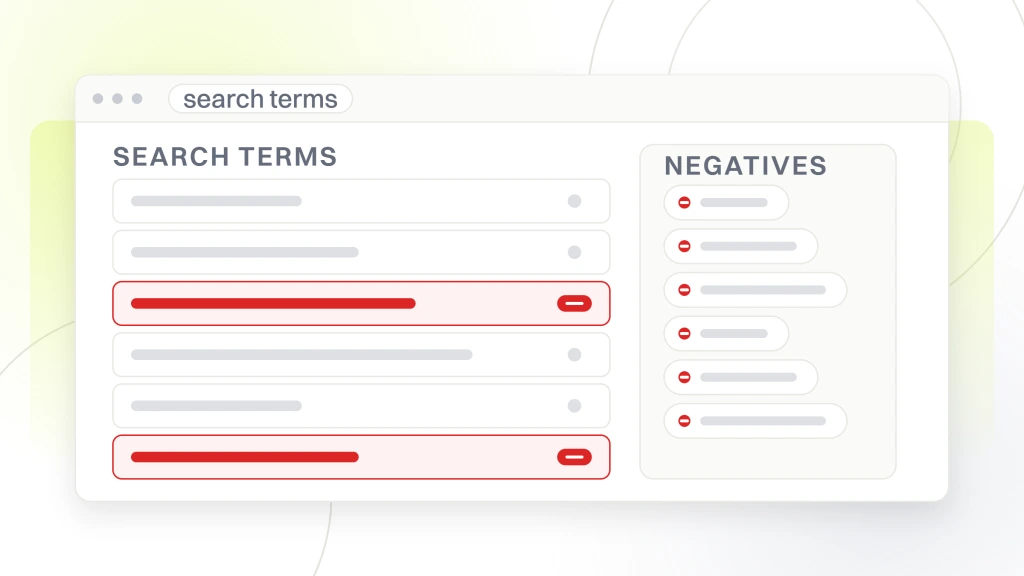
Service-tier campaigns and negative keywords
Each service campaign gets a tight keyword group (“balayage upper east side,” “balayage nyc,” “partial balayage midtown”) and a matched negative list that blocks the shopper searching for the wrong price band. A balayage campaign needs “cheap,” “free,” “student,” and “apprentice” as negatives so the $450 service doesn’t chase clicks looking for $60 chair-rental work. Weekly negative-keyword sweeps trim 8 to 18% of wasted click cost inside the first 60 days on most accounts we take over. Skip that habit and the same wasted queries keep firing month after month.
Radius targeting per service tier
Radius targeting has to match how far a client will actually drive for the service. A $65 blowout pulls from 1 to 2 miles. A $180 keratin pulls from 3 to 5 miles. A $450 color correction pulls from 8 to 15 miles. Running one radius across the whole menu either starves the color campaign of reachable shoppers or floods the blowout campaign with clicks that never convert. Per-campaign radius bid modifiers (100% at core radius, 60% at edge, minus 30% past the practical limit) push spend toward the shoppers most likely to book each service.
Budget bands for PPC ads for beauty salon owners
Budget scales with chair count and service mix, not with agency ambition. Solo stylists on chair rental run $400 to $900/mo on Google Ads plus $400/mo on Meta. Small salons at 3 to 6 chairs run $1,400 to $3,200/mo split across Google and Meta. Mid-size at 8 to 14 chairs run $3,400 to $7,200/mo. Multi-location brands run $8,000 to $22,000/mo across a portfolio of location-specific campaigns. Anything under $400/mo doesn’t have the frequency to build recognition inside the auction and usually returns nothing measurable. If the budget can’t clear $400/mo, spend it on Instagram content and referral cards instead.
Solo stylist minimum viable budget
A solo stylist on $400/mo Google Ads spend, targeting the top 2 to 3 highest-margin services on tight-match keywords in a 3-mile radius, will book 8 to 16 appointments a month at $24 to $40 cost per booking. Layering $400/mo Meta for portfolio Reels and a lookalike audience pushes the monthly total to 18 to 32 booked appointments. Under $400/mo, click volume drops below the threshold where Google’s bidding algorithm can optimize, and month-over-month numbers swing 40% either direction on chance alone. Solo stylists who try to build on $200/mo usually see three good months, three bad months, and give up on paid before the account stabilizes.
Multi-location scale economics
Multi-location accounts get real gains on Quality Score because every location under the same brand feeds into the parent account’s history. Multi-location salons at $8,000/mo typically hit $3.20 to $4.80 cost per click on service keywords, versus $5.40 to $8.20 for single-location competitors chasing the same terms. Cost per booking slides from $34 to $48 at single-location scale to $22 to $32 at multi-location scale. The scaling gains taper past $22,000/mo because most local markets saturate on the prime keywords at that spend level and the marginal click starts costing more than it books.
Managed retainer bands
Our own retainer bands for PPC ads for beauty salon accounts land at $999/mo for solo-chair accounts, $1,499/mo for small-salon builds, $2,499/mo for mid-size multi-service accounts, and from $4,500/mo for multi-location or luxury clinic programs. Ad spend runs separately on the salon’s own card so the client owns the account and the click history from day one. Anything that bundles agency fee and ad spend into a single number hides how much is really going to Google, and the day the contract ends the client walks away with none of the account equity they paid to build.
PPC ads for beauty salon case study from Beauté Aesthetics New York
Beauté Aesthetics New York, a Manhattan luxury beauty and aesthetics clinic, engaged Redefine Web on a twelve-month program that paired PPC restructure with SEO and web design. Baseline PPC ran one campaign covering every clinic service on a citywide radius. Cost per booked appointment sat at $84. Paid booking volume ran 22 to 34 per month on $4,200 monthly spend, and the account had been in that shape for over a year. The campaign architecture was the ceiling on the whole program.
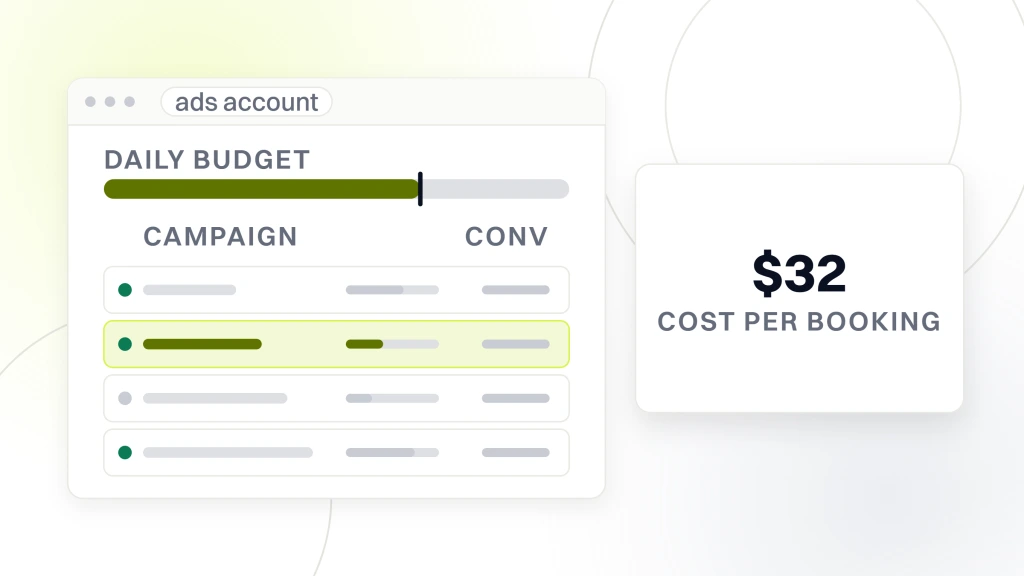
Month 1 split the account into 8 service campaigns for hydrafacial, microneedling, botox, filler, coolsculpting, laser hair removal, chemical peels, and lash and brow. Each campaign got a neighborhood-specific radius target with bid modifiers wired to actual client draw pattern per service. Landing pages got rebuilt with service-specific content and matched hero imagery. Conversion tracking got rewired through Boulevard booking system webhooks so paid conversions stopped disappearing into organic. Month 3 hit $48 cost per booking. Month 6 hit $38. Month 12 landed at $32 on the same $4,200 monthly spend.
Total paid bookings climbed from 34 monthly at baseline to 130 monthly by month 12. Cost per booking dropped 62%. The program also grew qualified leads 166%, new users 88%, and website conversion rate 27% across the same twelve months through paired SEO and site redesign work. See our beauty and skincare web design service for the landing page rebuild scope that partnered this PPC restructure.
Cross-vertical proof points
Two other Redefine Web programs speak to the same PPC discipline in adjacent verticals. A premium retail brand hit a 179% revenue climb and doubled conversion rate after a paired SEO plus paid-media restructure that swapped discount-led messaging for premium creative and rebuilt category-page depth. A separate ecommerce program managed $650K in ad spend, dropped cost per acquisition to $31, and boosted conversions 11% after tighter targeting, landing-page rebuilds, retargeting layers, and automated follow-ups replaced broad-audience click buying. Both programs read as beauty-adjacent because the underlying playbook is identical. Fix the tracking, split the campaigns, rebuild the landing pages, protect the price integrity, and the numbers move in the same shape.
Meta versus Google for PPC ads for beauty salon acquisition
Meta and Google buy two different audiences for PPC ads for beauty salon growth. Google buys shoppers who already typed the service name and are ready to book, and those clicks convert at 4 to 9% on service keywords. Meta buys shoppers scrolling Instagram or Facebook with no immediate intent, and those clicks convert at 1.4 to 3.2% on visual creative. Meta cost per click runs 40 to 60% lower than Google, but the conversion rate runs 50 to 70% lower too, so the two channels roughly wash on efficiency. Balanced portfolios run 60 to 70% of spend on Google and 30 to 40% on Meta for most salon categories. Under $1,500/mo total, run Google only and add Meta once Google is stable.
Instagram Reels for salon creative
Instagram Reels beat static image ads on Meta by 60 to 140% on cost per booking. Reels showing a real client transformation (consented, front-to-back), stylist commentary over the technique, and a short before-and-after cutaway drive engagement 3 to 5x higher than posed portfolio images. Reels also feed organic reach because the Instagram algorithm pushes engaging Reels into the Reels tab and Explore for free. Salons that post 4 to 8 Reels a week alongside the paid campaigns typically see paid ROAS climb 25 to 45% as the organic engagement pushes the paid creative’s Quality Score inside the auction.
Lookalike audiences from client lists
Lookalike audiences off the salon’s client list run 40 to 60% cheaper cost per booking than broad targeting on Meta. Uploading the top 500 to 2,000 highest-lifetime-value clients as a seed audience produces a 1% lookalike that shares behavioral signals with the salon’s best customers. Behavioral lookalikes beat demographic targeting because they capture people who follow the same beauty accounts and shop the same product brands as the existing high-value clients. Refreshing the seed list quarterly keeps the lookalike aligned with current acquisition patterns and stops the audience from drifting.
Seasonality inside PPC ads for beauty salon annual planning
Beauty spend runs on a predictable annual curve, and the budget flow inside PPC ads for beauty salon accounts should follow it. Q1 runs soft as clients pull back after holiday spending. Q2 spikes hard through March, April, May, and June on wedding season, prom, and spring color transitions. Q3 dips in July and August as clients travel and stay out of salons. Q4 spikes again from October through late December on holiday party prep, family photo prep, and gift card sales. Budget should shift 30 to 60% higher in Q2 and Q4, and 20 to 30% lower in Q1 and mid-Q3. Accounts that hold flat monthly spend across the year miss the Q2 and Q4 booking pools and overspend the Q3 softness.
Holiday gift card campaigns
Holiday gift card campaigns run from late October through late December on keywords like beauty salon gift card, hair salon gift certificate, and beauty gift card nyc. Gift card searches convert at 6 to 12% because the shopper intent is fully narrowed to a purchase. Salons that run gift card campaigns typically see 8 to 18% of Q4 revenue come from gift card sales, and gift card recipients redeem at 60 to 80% within 90 days, driving Q1 booking volume that would otherwise soften. Skipping the gift card campaign leaves the Q4 revenue on the table and hands a soft Q1 booking book to whoever bought the searches you didn’t.
Wedding season creative angles
Wedding season runs March through June on keywords like bridal hair nyc, wedding hair upper east side, and bridal party makeup manhattan. A bridal booking typically pulls the bride plus 4 to 12 attendants at a single event, so cost per booking looks higher ($60 to $120), and total appointment value runs $800 to $2,400. Bridal campaigns need a trial appointment as a lower-commitment first conversion, plus a bridal party group package as a booking upsell inside the confirmation flow. Salons without dedicated bridal campaigns miss 8 to 18% of possible Q2 revenue to competitors who set up the calendar and the creative in January.
Wrapping up PPC ads for beauty salon strategy and next steps
PPC ads for beauty salon growth that compound come down to six patterns. Split campaigns by service category with dedicated budgets and creative. Map keywords by service and layer negative keywords weekly. Set radius targeting per service tied to actual client draw. Choose value-add over discount offer framing to protect price integrity. Wire real conversion tracking including call tracking and booking system pixels. Shift budget with the annual curve to match category demand. Programs that run all six patterns inside our beauty and skincare marketing hub hit $32 to $48 cost per booking across service categories, versus $60 to $90 typical of unstructured accounts.
The Beauté Aesthetics New York twelve-month program dropped cost per booking 62% from $84 to $32 while growing paid booking volume from 34 to 130 monthly. If your salon needs a PPC audit and restructure, book a call and we will walk the last three beauty salon programs we ran end to end across single-location, multi-location, and luxury clinic categories.