
Search Engine Marketing for Optometrists That Books Exams
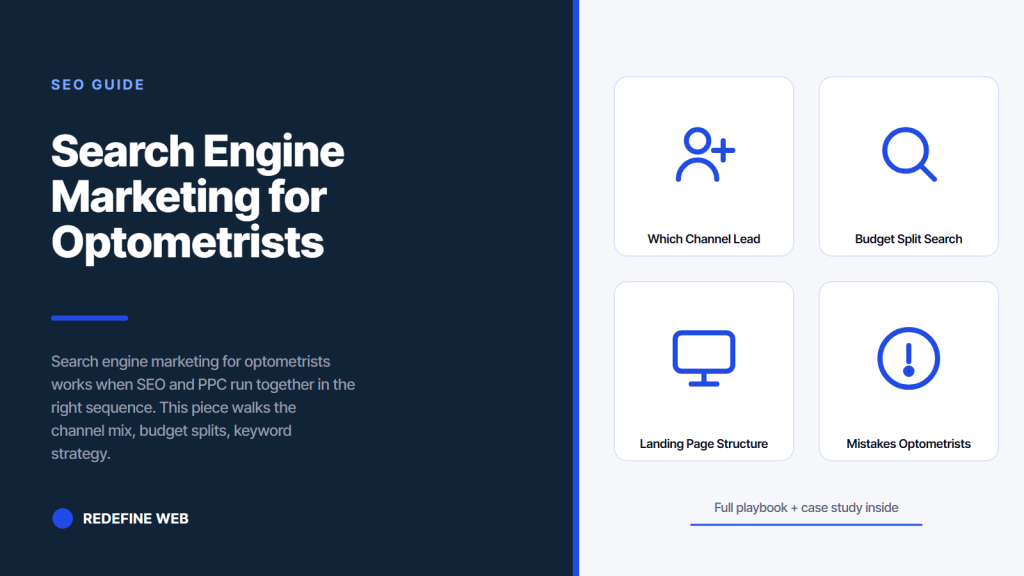
- SEM combines SEO and PPC on the same query intent set.
- PPC books exams in week one, SEO in month four.
- The right split is 60/40 PPC/SEO in year one.
- By year three the split flips to 30/70 PPC/SEO.
- Blended cost per exam settles at $22 to $38.
- Which channel to lead with in month one
- Budget split for search engine marketing for optometrists
- Shared keyword strategy for SEO and PPC
- Landing page structure that works for both channels
- How search engine marketing for optometrists tracks and reports
- What search engine marketing for optometrists costs
- How to set up search engine marketing for optometrists in 30 days
- Mistakes optometrists make with search engine marketing
- How search engine marketing for optometrists compounds by year three
Search engine marketing for optometrists covers two channels that most practices run as if they were separate line items: SEO (organic search rankings) and PPC (paid Google Ads). Both compete for the same query intent. Both feed the same booking pipeline. Both compound when run together and stall when run apart. The right sequence and budget split can drop cost per booked exam from $80 to $22 inside twelve months.
This piece walks the SEM channel mix for optometry, which channel to lead with in month one, the budget split shift from year one to year three, the shared keyword strategy, and the Vision Express numbers behind a 135.9% organic climb paired with a 62% appointment gain over six months. Real ad spend numbers from real accounts, real ranking timelines. You will finish with the SEM plan, budget cadence, and 30-day rollout ready to run this quarter. Read straight through in twelve minutes.
Which channel to lead with in month one
Lead with PPC in month one because it books exams the same week. A working Google Ads campaign for a solo optometry practice books 8 to 22 first exams inside 30 days. SEO takes 60 to 120 days to move the map pack. PPC funds the SEO ramp.
The month-one PPC campaign structure stays simple. One ad group for eye exam plus city, one for contacts fitting plus city, one for eyeglasses plus city, one for insurance carrier plus city (VSP eye doctor, EyeMed provider). Four ad groups, five to eight keywords each, three ads per group. Total budget $1,200 to $2,400 monthly at a $2 to $6 cost per click.
Month one SEO focuses on the fastest ranking wins: Google Business Profile completeness (primary category optometrist, three secondary categories, weekly photo uploads, current hours, service list), first review flow going live, technical audit on the existing website. Ranking gains from GBP work show in 2 to 6 weeks. Ranking gains from on-page SEO show in 6 to 10 weeks.
Read the Search Engine Journal local SEO guide for the current best-practice baseline. Our optometrist PPC services page walks the exact ad group structure that works for a solo practice launching month one.
The reporting cadence that works for owner-operators is a 30-minute weekly numbers call plus a 45-minute monthly deep-review. Anything more frequent burns owner time. Anything less frequent lets low-performing keywords compound wasted spend for weeks before anyone notices.
Budget split for search engine marketing for optometrists
The budget split for search engine marketing for optometrists shifts across three years. Year one runs 60/40 PPC/SEO because PPC produces the immediate schedule fills that fund the SEO build. Year two shifts to 45/55 as SEO rankings compound and organic traffic starts producing the majority of low-cost exams. Year three settles at 30/70 PPC/SEO because the organic traffic base becomes the foundation.
Year one dollar amounts for a solo practice: PPC $1,800 monthly, SEO $1,200 monthly. Total SEM $3,000 monthly. Attributable revenue at month twelve runs $18,000 to $32,000 monthly across both channels. Cost per booked exam blended across PPC and SEO settles at $28 to $42 by month twelve.
Year three dollar amounts for the same practice: PPC $900 monthly, SEO $2,100 monthly. Total SEM $3,000 monthly, same as year one but the mix flipped. Attributable revenue at month thirty-six runs $34,000 to $58,000 monthly because the organic traffic base compounds. Cost per booked exam blended settles at $18 to $28.
Multi-location groups run the same ratios at 2 to 4 times the dollar amount. A three-doctor group runs $5,400 to $10,800 monthly total SEM in year one. Our Optometrist marketing cost breakdown walks the full-stack budget for a private practice at three scale points.
| Year | PPC monthly | SEO monthly | Total SEM | Blended cost per exam |
|---|---|---|---|---|
| Year 1 | $1,800 | $1,200 | $3,000 | $28 to $42 |
| Year 2 | $1,350 | $1,650 | $3,000 | $22 to $34 |
| Year 3 | $900 | $2,100 | $3,000 | $18 to $28 |
Solo doctors sometimes ask whether Bing Ads is worth running alongside Google Ads. For optometry in 2026, Bing produces about 8 to 14% of the paid volume Google produces at a 30 to 45% lower cost per click. Add Bing in month four once the Google campaign is stabilized. Skip Bing entirely if the practice sits in a metro under 200,000 population.
Shared keyword strategy for SEO and PPC
The shared keyword strategy pulls from one master keyword universe of 60 to 120 terms. Every keyword gets tagged with intent (commercial, informational, navigational), volume (high, medium, low), and cost per click (from Google Keyword Planner). Both SEO and PPC pull from this universe. The tagging keeps the two channels from cannibalizing each other on the same intent.
The keyword universe splits into three tiers. Tier one (commercial intent, high volume): eye doctor near me, optometrist plus city, eye exam plus city, VSP provider near me. Both SEO and PPC target these because both channels compete for the same click. Tier two (medical intent, medium volume): dry eye treatment plus city, contact lens fitting plus city, glaucoma screening plus city. SEO leads because these queries have lower search volume but higher conversion.
Tier three (informational intent, high volume): how often should I get an eye exam, symptoms of dry eye, kids first eye exam. SEO leads because these queries do not convert on paid at ROI-positive rates. Blog content ranks for these queries and captures the top-of-funnel traffic that converts later on a return visit for a commercial query.
The keyword universe becomes the input for the content calendar too. Our SEO for optometrists piece walks the content strategy that ranks for the tier-three queries. The blog content compounds the SEO ranking base and reduces the paid budget needed to hold the tier-one clicks.
Practices splitting a budget across SEO and Ads on day one get half of both. Pick the one that answers a booked exam this month and go deep.
Landing page structure that works for both channels
The landing page that works for both PPC and SEO uses the same structure. Hero above the fold with the specific offer (eye exam $99 with VSP, or new-patient exam $79 for cash-pay). Booking form embedded in the hero (name, phone, insurance carrier, preferred day). Insurance carrier logos strip below the fold. Doctor bios with real photos and license numbers. FAQ block with structured data. Practice hours and address in the footer.
The structure works for both channels because both channels have the same visitor intent (find a nearby practice, verify insurance, book an exam). PPC visitors and SEO visitors behave the same once on the page. The only difference is the message match at the top: PPC lands on a page whose hero mirrors the ad copy. SEO lands on the same page whose hero mirrors the primary organic ranking keyword.
The FAQ block does double duty. On the SEO side, the FAQPage structured data feeds AI Overviews and Google People Also Ask. On the PPC side, the FAQ block raises the Quality Score by improving landing page relevance. The five FAQ questions to include: how much does an eye exam cost, does the practice take my insurance, how long does an exam take, do I need to bring anything, and when can I book.
Read Google’s Core Web Vitals guidance for the technical baseline. Mobile page speed under 2.5 seconds on 4G raises both organic ranking and Google Ads Quality Score. Our optometrist website design services team builds the landing page set to this exact spec on every engagement.
How search engine marketing for optometrists tracks and reports
Tracking search engine marketing for optometrists requires four systems working together: Google Ads (paid clicks), Google Analytics 4 (site sessions and events), Google Search Console (organic impressions and clicks), and a call tracking platform (CallRail or WhatConverts for phone bookings). All four flow into a single dashboard so the practice owner can read the numbers weekly.
The four numbers that matter each week: paid clicks and cost, organic clicks and top-3 ranking count, form submissions, and inbound calls tagged to marketing source. From these four, cost per booked exam calculates cleanly. Cost per booked exam is the single metric that determines whether the plan is working. Everything else is context.
The monthly report walks five sections. Total sessions by channel (paid, organic, direct, referral, social). Total conversions by channel (form fills plus tagged calls). Cost per conversion by channel. Top ten keywords ranking gains or losses. Recommendations for the next month. That report runs 4 to 6 pages and takes 45 minutes to compile from the tracking systems.
Every practice we onboard sees the same tracking gap on day one: paid campaigns run without call tracking, so the practice cannot tell which of the twelve inbound calls per day came from the Google Ads campaign. Fix that in week one. CallRail runs $65 monthly for a single tracking number and captures the missing 60% of paid conversions.
What search engine marketing for optometrists costs
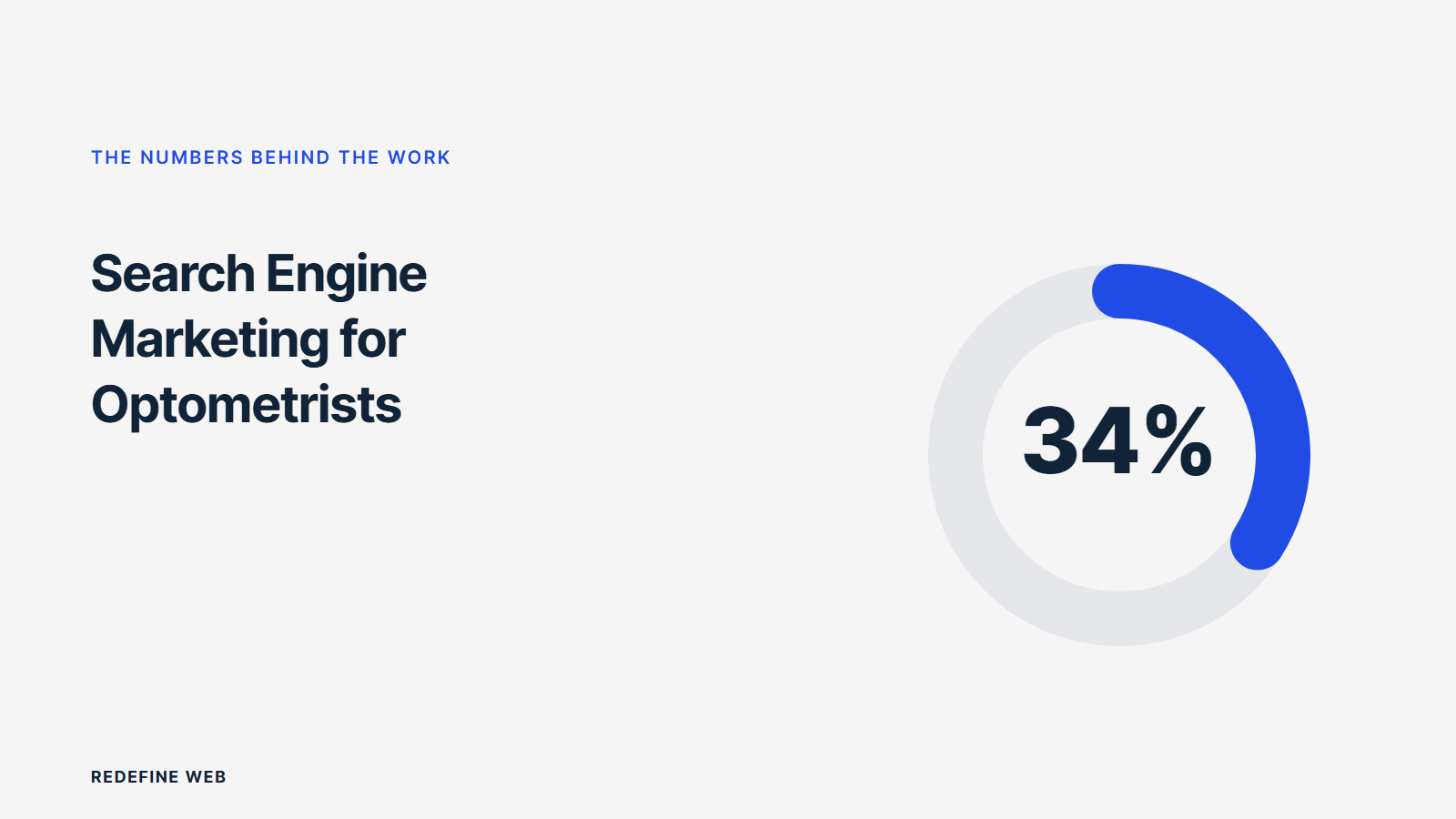
Search engine marketing for optometrists costs $2,400 to $6,800 per month for a solo practice depending on market density, campaign scope, and whether the practice uses an in-house team or an agency. Multi-location groups run $5,800 to $14,400 monthly. Costs sit at three layers: ad spend, agency management, and tools (tracking, keyword research, rank monitoring).
The ad spend layer runs $1,200 to $3,200 monthly on Google Ads for a solo practice. The agency management fee runs $800 to $2,400 monthly (typical structure is 15 to 25% of ad spend plus a base fee). The tools layer runs $200 to $600 monthly (CallRail $65, SEMrush $139, rank tracker $50). Total for a solo practice: $2,400 to $6,200 monthly all in.
Multi-location groups scale by ad spend, not by agency fee (agencies apply a volume discount at 3+ locations). A three-doctor group runs $3,600 to $9,600 ad spend, $1,800 to $3,600 management, $400 to $1,200 tools. Total $5,800 to $14,400. Attributable revenue at month twelve runs $58,000 to $124,000 monthly for a three-doctor group.
The retainer at our optometrist marketing retainer starts at $599 monthly for single-channel scope and scales to full-stack SEM plus content at $4,800 monthly. Most practices sign at the $1,600 to $3,200 range for single-location and $3,200 to $4,800 for multi-location groups.
Cash flow shape matters as much as absolute budget. Ad spend bills daily as clicks happen. Management fees bill monthly on the first. Tools bill monthly or annually depending on plan. Set a $500 cash reserve for the first month to absorb any billing spikes from a click-volume surge on a top-performing keyword before the automated bid caps kick in.
How to set up search engine marketing for optometrists in 30 days
The 30-day rollout runs in four weeks. Week one is tracking install and keyword research. Week two is landing page setup and PPC campaign launch. Week three is SEO technical audit and Google Business Profile completion. Week four is optimization based on week-one data.
Week one: install Google Analytics 4 with proper event tracking, install CallRail with a dedicated tracking number for the Google Ads campaign, pull the 60 to 120 keyword universe from Google Keyword Planner and SEMrush. Load the keywords into a master sheet tagged by intent and CPC.
Week two: build the first landing page (or update the existing one to the working structure), launch the four ad groups on Google Ads at 60% of the target monthly budget (leave headroom for optimization), verify the tracking pixels fire correctly on form submit and phone call.
Week three: complete the Google Business Profile (primary category, three secondaries, weekly photo upload cadence, service list, Q&A section seeded, first review request going out), run a full technical audit on the practice website (Core Web Vitals, structured data, schema, mobile speed), fix the top five technical issues.
Week four: read the week-one data from Google Ads (which keywords are converting at ROI-positive rates, which are burning budget), pause the low-performers, raise bids on the top three converters, add negative keywords for the wasted spend queries. Ranking gains from the SEO work start showing in weeks 6 to 10.
Mistakes optometrists make with search engine marketing
The mistakes we audit fall into five buckets. Running PPC or SEO alone (kills the compounding). Skipping call tracking (kills the attribution). Sending all paid traffic to the home page (kills the conversion rate). Cutting the SEO budget in month three because it has not produced yet (kills the compounding at the wrong moment). Ignoring the shared keyword universe (kills the ROI on both channels).
The PPC-only mistake is the most common. A practice runs Google Ads for two years, hits a ceiling at $55 cost per booked exam, and gives up on marketing entirely. The truth: adding SEO to the same keyword universe would have dropped the paid cost by 34% and added compounding organic traffic that produces exams at $12 to $18. Two channels, same budget, half the cost per exam.
The home page mistake is the second most costly. A practice sends all Google Ads traffic to the home page instead of a dedicated landing page. Conversion rate drops from 8% to 2.4% overnight. On $2,400 monthly spend, that is 800 wasted clicks per month. Build the dedicated landing page in week two and conversion recovers to the 6 to 10% baseline.
The SEO-cut mistake is the most damaging over 24 months. A practice runs the SEM plan for three months, sees SEO producing no direct bookings yet, and cuts the SEO budget. The problem: SEO produces the ranking gains in months 4 through 8, not month 3. Cutting SEO in month 3 kills the year-two compounding entirely. Hold the SEO budget for at least 8 months before evaluating.
- Run PPC and SEO on the same keyword universe.
- Install call tracking on the paid campaign in week one.
- Send paid traffic to a dedicated landing page, not the home page.
- Hold the SEO budget for 8 months before evaluating impact.
- Weekly review of paid keywords: pause losers, raise bids on winners.
How search engine marketing for optometrists compounds by year three
By year three, the SEM plan compounds because organic traffic becomes the largest single source of exams. The paid budget shrinks from 60% to 30% of the split as organic pulls the majority of clicks on tier-one queries. Cost per exam drops to $18 to $28.
Year-three revenue for the average solo practice on the compounded SEM plan runs $34,000 to $58,000 monthly, or $408,000 to $696,000 annualized. The practice grew from a baseline of $220,000 annualized before the program started. Total growth over 36 months: 85% to 216%.
Vision Express hit the year-two milestone at month eighteen because the paid work in months one through six funded the SEO ramp that landed the map-pack top-three by month four. Once the top-three landed, cost per exam on paid dropped because branded search volume climbed and Google Ads Quality Score raised, dropping the paid cost per click. That is the compound loop working SEM produces.
Practices comparing this against a channel-agnostic marketing plan often ask whether SEM produces higher ROI than social media or content marketing alone. It does, at year three. Social media builds audience but does not book high-intent exam searches. Content marketing feeds the SEO ranking but does not itself book exams. SEM captures the highest-intent traffic at the moment the patient searches for an eye doctor.
Search engine marketing for optometrists works when SEO and PPC run together on a shared keyword strategy and a coordinated budget. Lead with PPC in months one through three to fill the schedule. Layer SEO in months two through four to compound the organic ranking. Shift the budget split to 30/70 PPC/SEO by year three to lock in the compounding traffic advantage. Blended cost per exam settles at $22 to $38 by month twelve. Talk to our optometrist marketing agency when you want the shared keyword map and budget cadence running on client accounts today.
Frequently asked questions
What is search engine marketing for optometrists?
Search engine marketing for optometrists is the coordinated running of SEO (organic search rankings on Google and Bing) and PPC (paid Google Ads and Bing Ads) on a shared keyword universe. Both channels compete for the same patient intent (eye doctor near me, contacts fitting, VSP provider). Both feed the same booking form on the practice website. Running one without the other leaves 40 to 60% of the addressable traffic on the table. A working SEM program produces blended cost per booked exam of $22 to $38 by month twelve, compared to $55 to $80 on paid search alone or 6 to 10 month delays if only SEO runs.
How much does search engine marketing for optometrists cost per month?
Search engine marketing for optometrists costs $2,400 to $6,800 per month for a solo practice and $5,800 to $14,400 monthly for a multi-location group. Costs sit at three layers: ad spend ($1,200 to $3,200 solo practice), agency management ($800 to $2,400 solo practice), and tools such as call tracking, keyword research, and rank monitoring ($200 to $600 monthly). Attributable revenue at month twelve runs $18,000 to $32,000 monthly for a solo practice and $58,000 to $124,000 for a three-doctor group. Blended cost per booked exam settles at $22 to $38 by month twelve, compared to $55 to $80 on paid search alone.
Should an optometry practice lead with PPC or SEO?
Lead with PPC in month one because it books exams the same week. A working Google Ads campaign books 8 to 22 first exams inside 30 days of going live. SEO takes 60 to 120 days to move the map pack and 180 to 240 days to compound to a stable ranking. The practice needs revenue during the SEO ramp, so PPC funds the SEO build in months one through three. By month four, SEO rankings start producing bookings that offset the paid spend. By year three, the split flips to 30/70 PPC/SEO as the organic base compounds and drops blended cost per booked exam from $34 to $18 to $28.
How fast does search engine marketing for optometrists produce bookings?
PPC produces bookings in week one. SEO produces the first map-pack ranking gains in weeks 2 to 6 for Google Business Profile work, weeks 6 to 10 for on-page service page work, and weeks 12 to 24 for local link building and content clusters. A coordinated SEM program hits a stable top-three map-pack position at week 10 to 14 in mid-size markets and week 16 to 26 in dense metros. First-month bookings from PPC run 8 to 22 exams for a solo practice. By month six, blended bookings run 45 to 90 monthly across both channels.
What is the right budget split between SEO and PPC for optometrists?
The budget split for search engine marketing for optometrists shifts across three years. Year one runs 60/40 PPC/SEO because PPC produces the immediate schedule fills that fund the SEO build. Year two shifts to 45/55 as SEO rankings compound and organic traffic starts producing the majority of low-cost exams. Year three settles at 30/70 PPC/SEO because the organic traffic base becomes the foundation. Total SEM spend stays roughly flat at $3,000 monthly for a solo practice across all three years, but the mix flips. Cost per booked exam drops from $28 to $42 in year one to $18 to $28 by year three.
Can an optometry practice run search engine marketing in-house?
Yes, if the practice has a dedicated marketing coordinator with 15 to 20 hours per week available for the work. In-house SEM for optometry requires ownership of Google Ads campaign management, Google Business Profile optimization, service page copywriting, technical SEO fixes, call tracking setup, and monthly reporting. The learning curve for the first three months costs the practice an estimated $8,000 to $14,000 in wasted paid spend as the coordinator learns the platform. After month three, in-house runs cheaper than an agency but only if the coordinator stays. Coordinator turnover is the biggest risk factor. Agency-managed SEM runs faster and hits ranking milestones 30 to 60 days sooner in most markets.
Book your free 30-minute strategy call.
No spam, no sales rep. We use your email to schedule your call with a senior strategist. That is it.
More from the blog
View all articles → SEO
SEO Organic Search Engine Optimization Services That Grow Real Traffic
Read article SEO
SEO SEO for Pet Groomers That Fills the Appointment Book Weekly
Read article SEO
SEO