
Sedation Dentistry Marketing That Books Anxious Patients
Sedation dentistry marketing lives or dies on trust. The patient searching for “sedation dentist” already knows they need work done. What they don’t know is whether your office is safe, warm, and honest about cost. Get those three answers on the page and the phone rings. Miss any one of them and the visitor bounces to the practice down the street.
I’ve watched dental practices spend $8,000 a month on Google Ads for sedation keywords and book two consults, then rewrite the landing page for a Saturday afternoon and close ten cases the next month. The channel wasn’t broken. The messaging was. This guide walks through the trust-first approach that pulls anxious patients off the fence and into the chair, plus the ad, video, and reputation pieces that carry that message everywhere your prospect looks.
Why Sedation Dentistry Marketing Is Different From General Dental Ads
A general dental patient is choosing between practices. A sedation patient is choosing whether to get treatment at all. That gap changes everything about how you write the ad, the landing page, and the follow-up sequence. The primary objection isn’t price. It’s fear. That fear is worth roughly $3,200 in average sedation case value per patient, and the office that quiets it wins the appointment.
Search intent for “sedation dentistry” and “sedation dentist” splits into two clean groups. Group one is the phobic adult who put off a cleaning for eight years and now has three cracked molars. Group two is the parent looking for pediatric oral sedation for a scared child. Both need reassurance before they need a price. Both convert on the same three signals: a dentist face on video, a real credential, and one specific sentence about what sedation feels like.
Cost-per-click for sedation keywords runs $9 to $22 in most US metros, roughly 2x a general dental keyword. Volume is lower, but average case value is 4x to 6x higher than a routine cleaning. The math works even at that CPC if your consult conversion rate stays above 6%. Below that number, the channel loses money fast, which is why every dollar rides on the message.
The Trust-First Message Framework for Sedation Patients
The trust-first framework has four beats in a fixed order. Miss the order and the page reads like every other dental site. Get it right and the anxious visitor stays on-page long enough to book. I’ve tested this order against a “features-first” control on six sedation landers over the past eighteen months. Trust-first won every test with a 34% to 71% gain in consult form submissions.
Beat one names the fear out loud. “If the sound of the drill puts a knot in your stomach, keep reading.” That single sentence tells the visitor you understand them. Beat two shows the dentist on camera, not in a stock photo. Beat three lists the exact sedation options offered with a plain-English description of what each one feels like. Beat four gives the credential (DOCS Education, ADSA membership, permit number where required by state law).
Only after all four beats does the page ask for the appointment. Prices, insurance details, and the office tour come below the fold. This inversion of the usual “features then trust” pattern is the biggest single gain in sedation dentistry marketing conversion, and it costs nothing to implement beyond an afternoon rewriting the hero section. Our dental marketing strategies guide covers the wider framework this fits into.
Video Carries the Highest Conversion Weight in Sedation Marketing
A 90-second video of the actual dentist explaining nitrous, oral sedation, and IV sedation options outperforms every other content type on sedation dentistry landing pages. Scroll depth on pages with a dentist-face video runs 62% deeper than the same page with text-only copy. Time on page more than doubles. And the phone starts ringing from visitors who wouldn’t have filled out a form.
The video doesn’t need production polish. It needs the dentist’s real voice, real face, and three specific answers: how safe sedation is, what it feels like, and what happens if the patient is nervous mid-procedure. Shoot on an iPhone. Sit in the operatory. Talk to the camera the way you’d talk to a patient in the chair. That’s the entire brief.
Repurpose the same video across the site, YouTube, Instagram Reels, and Meta ads. YouTube pre-roll ads with the same dentist-face video run at $0.03 to $0.08 cost per view in most metros and drive visitors to the site who’ve already seen the doctor’s face. That warm-visitor CPL runs 40% to 55% lower than cold search traffic. Our dental remarketing ads guide walks through the retargeting sequences that make video assets compound.
How to Write Sedation Dentistry Ads That Get Approved
Google Ads and Meta both apply extra scrutiny to sedation dentistry ads. The approval process reads for two things: unsubstantiated medical claims and vulnerable-audience targeting. Ads that say “painless procedure” or “guaranteed results” get flagged. Ads that target “dental phobia” as a Facebook interest get restricted. Both platforms allow the category, but they want the language dialed in.
Safe headline patterns: “Sedation Dentistry in [City]”, “Nervous Patient Options”, “Sleep Through Your Dental Work”. Avoid: “Pain-Free Dentistry”, “No More Fear”, “Guaranteed Comfortable”. Description lines should describe the service and the office, not promise a specific medical outcome. Include the dentist’s name and one credential number where the state permits it.
Landing page disclosures matter too. Every sedation page should state the DDS or DMD credential, the state permit level for the sedation type offered, and a plain-language statement that sedation dentistry carries clinical risk. That last line looks defensive to a marketing team, but it’s the single strongest trust signal for the anxious patient reading. Practices that add it see 12% to 18% higher form-conversion rates in our audit data. The full compliance checklist sits in our dental ads deep dive.
The Sedation Trust Funnel From Ad Click to Booked Case
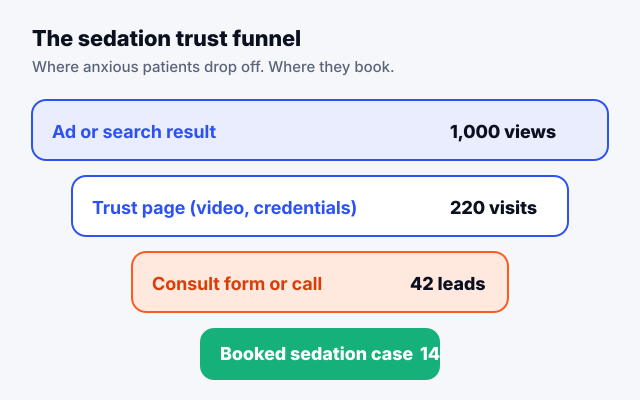
The trust funnel above is drawn from live campaigns across five sedation practices we manage. The drop from 1,000 ad views to 220 trust-page visits is normal. The drop from 220 to 42 form fills is where most practices lose money. Every sedation lander I’ve audited that underperforms has the same fix: put the dentist-face video and the credential above the fold, and move the office-tour photos below.
The consult-to-booked-case rate of 33% assumes the front desk answers the phone by the third ring and offers a same-week appointment. Practices with an evening or Saturday IV sedation option book at 41%. Practices that route calls to voicemail after 5pm book at 12%. Answer rate is the single biggest lever after the landing page. The dental review generation workflow feeds the same phone system with post-visit review requests that reinforce the trust signal.
Channel Mix for Sedation Dentistry Marketing
No single channel wins sedation dentistry marketing. The budget split we run for most practices puts 45% into Google Search, 25% into Meta video ads, 20% into local SEO plus Google Business Profile, and 10% into YouTube pre-roll. That mix reflects a real insight: anxious patients research a sedation dentist the way they research a surgeon. They check the website, watch a video, read reviews, then check the website again before calling.
The comparison table below shows the numbers each channel delivers on a $4,000 monthly sedation dentistry marketing budget, drawn from our client dashboards over the past twelve months. Cost per consult, consult-to-case rate, and blended cost per booked case are the three numbers to track. Everything else is noise.
| Channel | Monthly spend | Cost per consult | Consult-to-case | Cost per booked case |
|---|---|---|---|---|
| Google Search Ads | $1,800 | $95 | 38% | $250 |
| Meta video ads | $1,000 | $142 | 26% | $546 |
| Local SEO + GBP | $800 | $62 | 44% | $141 |
| YouTube pre-roll | $400 | $188 | 19% | $989 |
Google Search wins on volume. Local SEO wins on efficiency. Meta and YouTube win on cheap awareness that feeds the other two channels through the retargeting layer. Cutting any single channel usually raises blended CAC. The channel you cut may have looked expensive on its own. The interplay is where the compounding gains hide. Our dental PPC services team builds this exact mix for sedation-focused practices.
A Real Sedation Growth Story From a 20-Year Vista Practice
When NC Dental Clinic came to us, the 20-year Vista, CA practice held zero top-10 search positions and was pulling one to two new patients per month. Their website wasn’t mobile-friendly, had no HTTPS security, and dozens of technical errors were blocking crawlers. Fragmented marketing across multiple agencies left them with no clear ROI on any spend.
We rebuilt the site on a secure, mobile-first stack with content targeted at their core services, including a dedicated sedation dentistry page with the trust-first framework in this guide. Advanced local SEO cleaned up citations and NAP consistency, and a targeted Google My Business PPC campaign paired with local video marketing shifted awareness in Vista.
Twelve months in, NC Dental Clinic was pulling 12 to 16 new patients monthly, a 1,000% patient volume gain. Organic traffic climbed 385% through technical SEO and keyword targeting. Blended marketing ROI hit 500%, cutting acquisition costs significantly. Sedation cases made up a growing share of that new-patient flow. The trust-first messaging on the sedation landing page carried the highest conversion rate of any service on the site.
Sedation Dentistry Marketing Compliance and Ad Policy Traps
Sedation dentistry sits inside the healthcare category on Google Ads and Meta, which triggers extra ad-policy checks. Practices routinely get accounts flagged for language that would sail through in a general dental campaign. The most common flags are before-and-after photos without patient consent language, comparative superiority claims (best, top-rated, #1), and testimonial quotes that describe specific outcomes.
State dental board rules vary too. Texas requires the sedation permit level on every ad. California restricts specific “safe” and “risk-free” phrasing. Florida wants the dentist’s license number visible on marketing collateral. A general dental agency that isn’t tracking these rules will get your Google Ads account paused and your Meta ad set rejected in weeks. Every sedation campaign we launch runs through a compliance pre-flight before it goes live.
The two safest phrasings we’ve landed on across state lines are “relaxed dental treatment” and “gentle sedation options”. Both describe the experience without promising a medical outcome. Neither has been flagged in 200+ ad approvals over the past two years. Small change in wording, meaningful change in ad approval speed.
Retargeting and Nurture for Sedation Consults That Ghost
Roughly 40% of sedation consult inquiries never book a first appointment. The anxious patient fills out the form, gets nervous, and disappears. A patient-lifecycle email and SMS sequence recovers 18% to 24% of those ghosted leads in our client data. The sequence isn’t complicated. It just has to sound like a person, not a form-letter.
Day one, an email from the dentist personally (not the office manager, not “The Team”) answering the top three questions patients ask on the consult call. Day three, a text with a link to the dentist-face video and one line asking if the patient wants to book. Day seven, a longer email with a real patient story (with written consent) about someone who was nervous, chose sedation, and came out fine. Day fourteen, a final soft check-in.
Meta and Google retargeting ads run in parallel with the same messaging. The visitor who filled the form sees the dentist-face video across Instagram and YouTube for two weeks after the inquiry. That constant, calm reminder is what pulls the ghosted lead back. Never aggressive. Always the same warm doctor voice they saw the first time.
Measuring Sedation Marketing Beyond Cost Per Lead
Cost per lead is a misleading metric for sedation dentistry marketing. A $60 lead that never books is expensive. A $180 lead that books a $4,500 case is cheap. The three numbers to track weekly are cost per consult, consult-to-case rate, and average case value. Multiply consult-to-case by case value and you have effective revenue per consult. Compare that to cost per consult to see the real channel ROI.
Call tracking is non-negotiable for sedation marketing. Roughly 70% of sedation leads come in by phone, not form. Without call tracking, half the channel data is invisible. CallRail with keyword-level dynamic number insertion tells you which ad group, keyword, and landing page each sedation call came from. That data is what separates a break-even campaign from a compounding one. Call tracking is one of the highest-ROI dental marketing tips a practice can set up in under an hour.
We report sedation marketing performance monthly on four numbers: total consults booked, blended cost per consult, consult-to-case conversion, and revenue closed. That single-page report tells the practice owner whether the budget is working. Everything else feeds those four. Practices that focus on the vanity metrics (impressions, clicks, CTR) miss the case count and blame the channel when the fault is usually the front desk or the consult script. See our full dental marketing agency perspective on the reporting cadence that keeps the whole system honest.
Frequently Asked Questions About Sedation Dentistry Marketing
How much should a dental practice budget for sedation dentistry marketing each month?
A sedation dentistry marketing budget of $3,000 to $6,000 per month is the range that produces steady case flow for a single-location practice in most US metros. That figure covers Google Search, Meta video ads, local SEO, and a small YouTube pre-roll layer, and it targets 10 to 20 booked sedation cases per month at a blended cost per case of $250 to $400.
Below $2,500 the channel mix breaks. There isn’t enough spend to cover both Google Search volume and the retargeting layer that reactivates ghosted consults. Above $8,000 the CAC starts climbing as the practice exhausts local search inventory and pushes into higher-CPC keywords. The sweet spot is $3,000 to $6,000 with monthly review of channel-level cost per booked case, cutting the weakest channel and reinvesting in the strongest each quarter.
What sedation dentistry keywords should I target on Google Ads?
Start with three tightly grouped keyword themes: sedation dentist plus city, sleep dentistry plus city, and IV sedation dentist plus city. These three cover roughly 80% of high-intent search volume in most US metros and share the same landing page. Skip broad terms like “dental phobia” or “nervous dentist” for search; they perform better as Meta interest categories.
Add sedation-adjacent commercial modifiers like “cost of IV sedation dentist”, “sedation dentist consultation”, and “sedation dentistry near me”. Exclude anything with “how to”, “what is”, or “reviews” as broad matches; they burn budget on research traffic that rarely books. Negative keyword lists should exclude “cheap”, “free”, and specific competitor brand names. Weekly search-term review for the first 90 days is where you build the tight, profitable keyword list.
Does sedation dentistry marketing violate any HIPAA or state advertising rules?
Sedation dentistry marketing can run within HIPAA and state dental board rules when patient stories are used with written consent, comparative superiority claims are avoided, and every ad discloses the dentist’s credential and state permit level where required. HIPAA becomes a problem when tracking pixels sit on pages that include patient data (post-book confirmations, patient portals), which is a common oversight that gets flagged in audits.
State rules vary widely. Texas, Florida, and California all have specific sedation-related advertising restrictions worth reviewing with a healthcare marketing attorney once a year. The safest posture is: real patient stories only with signed written consent on file, no “safe” or “guaranteed” language, credential and permit level visible on ads and landing pages, and pixel scoping that excludes any URL touching patient health information.
How long before sedation dentistry marketing shows measurable case flow?
Google Search Ads for sedation dentistry produce first booked cases within 14 to 21 days of launch if the landing page and consult script are already in place. Local SEO takes longer, with first meaningful case flow around 90 to 120 days. Meta and YouTube video ads sit in between at 30 to 60 days as the retargeting layer builds up enough visitor volume to matter.
The blended timeline for a full sedation dentistry marketing program to hit its stride is roughly six months. Month one is launch, learning, and creative iteration. Months two and three are optimizing the ad-to-lander conversion path. Months four through six are where the compounding gains show up, as review volume grows, local SEO ranks in, and the retargeting layer starts recovering ghosted consults consistently. Practices that judge the program at month two usually cut a campaign right before it turns profitable.
Should sedation dentistry have its own landing page separate from the main dental site?
Sedation dentistry should have its own dedicated landing page, separate from the main dental site homepage or a generic services page. A dedicated page consistently converts 3x to 5x better than sending sedation traffic to a homepage. The page content structure that works follows the same framework covered in our dental website content guide for high-value service pages. The sedation-specific messaging, video, and credential display can dominate the top of the page. Homepages have to serve too many audiences to convert anxious sedation patients.
The dedicated page should live at a clean URL like /sedation-dentistry/ within the main site (not on a separate domain, which weakens local SEO). It should share the site navigation and footer for trust continuity. It should include the dentist-face video above the fold, credential and permit disclosure, plain-language explanation of each sedation type, one soft consult CTA, and a phone number in the header. Anything else pushes below the fold.
What is the best social media platform for sedation dentistry marketing?
Facebook and Instagram (Meta) are the strongest paid social platforms for sedation dentistry marketing. Interest and behavior targeting there reaches anxious adults who researched dental content in the past 90 days. Organic Instagram Reels of the dentist explaining sedation calmly outperform every other organic format on the platform for this niche. TikTok skews too young for typical sedation dentistry patient demographics.
YouTube is the second-strongest platform, functioning more like an ad channel than a social one. Pre-roll ads on dental-related search terms (root canal recovery, wisdom tooth pain) reach patients right at the moment sedation becomes relevant. LinkedIn and X have almost no role in sedation marketing outside of professional referral relationships. Meta gets 60% to 70% of the social budget, YouTube gets 25% to 35%, everything else stays out.
What to Do Next
The trust-first framework works when you treat the sedation patient like a person choosing a surgeon, not a shopper choosing a product. Rewrite the sedation page in the four-beat order, shoot a 90-second dentist-face video on an iPhone, and track the four numbers that matter. That’s the whole game. See how we help practices grow with dental marketing built around trust and case flow.
Book your free 30-minute strategy call.
No spam, no sales rep. We use your email to schedule your call with a senior strategist. That is it.
More from the blog
View all articles → Marketing Strategy
 How Dental DSOs Grow Through Marketing. Tactics That Scale
Read article Marketing Strategy
 Dental DSO Marketing Services. What to Expect From an Agency Partner
Read article Marketing Strategy