
Ecommerce SEO Strategies That Drive Organic DTC Revenue
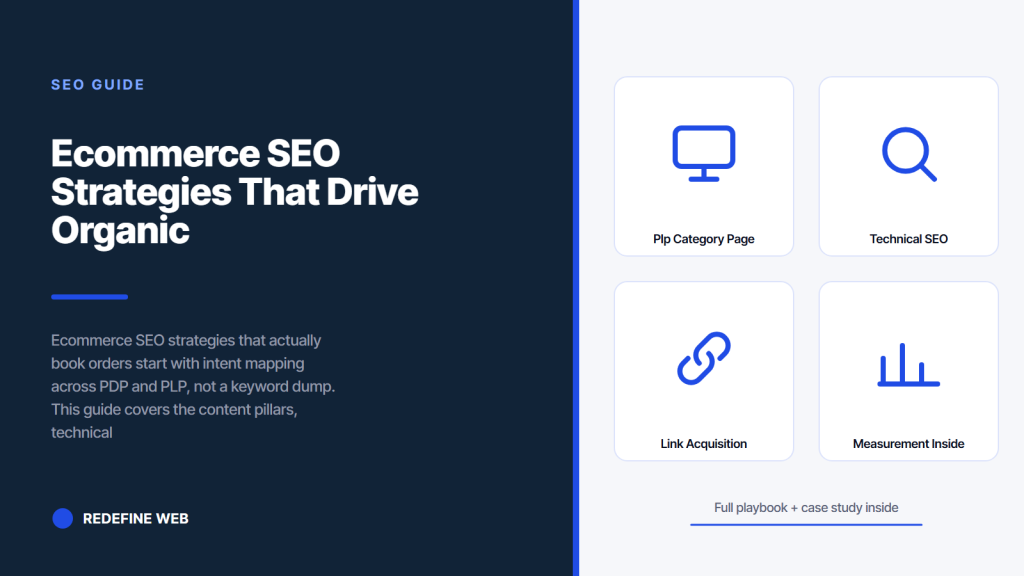
- Fix PDP and PLP templates before writing more blog posts.
- Content pillars split 60 percent informational, 40 percent commercial early.
- Technical debt cleanup runs in the first 45 days.
- Link acquisition through real editorial coverage, not paid networks.
- Measure organic revenue by pillar, not sessions.
- PDP optimization inside ecommerce SEO strategies
- PLP and category page optimization for DTC brands
- Technical SEO priorities for DTC ecommerce stores
- Link acquisition inside ecommerce SEO strategies
- Ecommerce SEO strategies split across Shopify and WooCommerce
- Measurement inside ecommerce SEO strategies
- International and multi-language ecommerce SEO for DTC brands
- Where AI search fits into ecommerce SEO strategies in 2026
- A real ecommerce SEO strategies engagement that shipped
- Where ecommerce SEO strategies fit the DTC growth stack
A DTC brand doing $3M annual revenue spent $180,000 across two years on ecommerce SEO strategies that produced 41 percent more organic traffic and 4 percent more orders. The traffic gains landed on blog posts about care instructions. The order gains never showed. The founder blamed Google. The real problem was the SEO scope. Nine of ten strategies got aimed at informational queries the buyer had already answered elsewhere, while the pages that actually convert (product detail pages and category listings) sat untouched under the same generic template Shopify shipped in 2019. A workable ecommerce SEO plan starts from the reverse direction: fix the pages that sell first, then earn the top-of-funnel traffic that feeds them.
This guide covers ecommerce seo strategies our team runs for DTC brands between $500k and $40M annual revenue. Content pillars split by commercial and informational intent. PDP and PLP optimization at the template layer, not one URL at a time. Technical priorities that move rankings on Shopify and WooCommerce. Link plays that earn authority without paid schemes. Measurement stacks reporting organic revenue, not sessions. Every number below runs off real client projects from 2024 and 2025.
PDP optimization inside ecommerce SEO strategies
Product detail page optimization is the highest-ROI surface in ecommerce SEO strategies. A PDP ranks for the SKU-specific query, the closest generic buying query, and often a long-tail variant of the category term. Brands that fix the PDP template once fix every product page in the catalog at the same time, which is a 400x return on the same optimization work compared to editing pages one at a time work (see our guide on seo for ecommerce product pages).
| PDP element | Common failure | Fix at the template | Typical ranking gain |
|---|---|---|---|
| H1 | Product name only | Add primary keyword modifier | 2 to 6 positions in 60 days |
| Meta title | Storename appended | Frontload keyword, remove brand | 3 to 5 percent CTR gain |
| Description | Manufacturer copy | Original 200-350 word body | 5 to 12 positions in 90 days |
| Schema | None or Offer only | Product plus Review plus Breadcrumb | Rich result eligibility |
| Reviews | Below fold, no HTML | Above fold, structured markup | 1 to 4 percent CVR gain |
| Related products | Random shuffle | Category-linked with keyword anchors | Passes link equity to hub |
| FAQ block | None | 4 to 6 real buyer questions | Featured snippet eligibility |
Description depth against thin catalog syndication
Most PDP descriptions on DTC stores under $5M annual come straight from the manufacturer feed. Google reads this as duplicate content across every retailer selling the same SKU. The store that writes an original 200 to 350 word description covering use cases, sizing detail, comparison points, and 3 real buyer questions ranks above the store using manufacturer copy in 8 to 14 weeks. Writing original PDP copy for 400 SKUs takes 3 to 4 months of writer time at 6 SKUs per hour. Brands treating this as a template-first job rather than a per-SKU job overspend by 40 percent on writer hours and still produce a catalog that reads inconsistent.
PLP and category page optimization for DTC brands
Product listing pages carry more organic revenue than any other page type on a DTC store, and they get the least SEO attention. A PLP ranks for the category-level buying query, which is where 60 to 75 percent of comparison-stage traffic lands. Stores that treat PLPs as filtered product grids without SEO copy leave rankings on the table for the exact queries their buyers are running.
Where PLP copy actually belongs
PLP copy belongs above the product grid and below the H1, in a 150 to 250 word block that answers the category-level buying question directly. Copy stuffed at the bottom of the page (a common Shopify default) passes some ranking signal but bounces at 60 percent because buyers scroll past the grid, not below it. A short intro block covering what the category is, who it fits, and the top 3 questions buyers ask about the category raises category-page rankings by 4 to 9 positions in 90 days on average across the DTC clients our team has measured. Brands can pull the top 3 questions from Google’s People Also Ask block or from customer support ticket data.
Faceted navigation without index bloat
Faceted navigation (color, size, price, feature filters) generates thousands of parameterized URLs that Googlebot wastes crawl budget on. The fix depends on the platform. Shopify stores handle it with rel=canonical pointing every faceted URL back to the parent PLP. WooCommerce stores handle it with a mix of noindex directives on parameter combinations and rel=canonical for the primary facets. Getting this wrong lets Google index 8,000 near-duplicate PLPs per category, which dilutes ranking signal across all of them. Getting it right consolidates ranking signal into 40 to 60 canonical PLPs that rank in the top 10. Google’s guidance on canonicalization is the correct outside read for engineers scoping this fix.
Technical SEO priorities for DTC ecommerce stores
Our technical seo for ecommerce playbook pairs with the strategies below for teams working the architecture, crawl budget, and Core Web Vitals layers directly. Technical SEO sets the ceiling on how far the content and link plays can go. A store with broken crawl paths, slow LCP, and no structured data caps rankings for its whole catalog regardless of how strong the writing gets. Technical priorities on DTC stores split into four buckets, ordered by revenue impact rather than difficulty.
The four technical priorities that move rankings
- Core Web Vitals. LCP under 2.5 seconds on mobile PDP and PLP. Every 500ms of LCP gain moves organic revenue 3 to 6 percent per Google’s own field data across ecommerce sites.
- Structured data. Product, Offer, Review, Breadcrumb, FAQ schema on every PDP. Organization and Website schema on the homepage. Missing schema costs rich result eligibility on 100 percent of the catalog.
- Crawl efficiency. XML sitemap segmentation by content type. Robots.txt hygiene. Faceted navigation canonicalization. Broken links and redirect chains cleaned up quarterly.
- Internal linking hygiene. Category hubs link to top PDPs. PDPs link to related PDPs and back to the parent category. Blog posts link to the closest commercial-intent PDP or PLP. No orphan pages.
- Mobile-first rendering. Server-side rendering or hybrid for headless stacks. Client-side rendering delays Googlebot’s content parse by 30 to 90 seconds per URL, which stretches indexing timelines.
- hreflang for stores selling in multiple regions. Wrong hreflang collapses international rankings into one canonical page.
Fixing technical debt before the content push
Brands publishing content on top of unresolved technical debt produce content that ranks at position 40 for six months and then stalls. The right sequencing runs technical fixes in the first 45 days of the engagement (LCP, schema, canonicalization, sitemap), then starts the content and PDP work in month 2. Technical fixes cost 60 to 120 developer hours on a standard Shopify store, or 120 to 300 hours on a WooCommerce store with legacy plugins. Founders skipping this sequencing usually re-engage the SEO agency 8 months later for a technical audit anyway. Search Engine Journal covers the technical audit checklist at more depth for engineers running the audit in-house.
Most SEO retainers spend 80 percent on blogs. Product pages sell. Rewrite your top 10 PDP templates first. Blogs feed pages that convert, not the other way around.
Link acquisition inside ecommerce SEO strategies
Link acquisition raises the domain authority the store operates under. Higher domain authority raises the ranking ceiling on every URL, which multiplies the returns from PDP, PLP, and content work. Brands skipping links altogether can rank well for long-tail queries but never break the top 5 for head terms in competitive categories, because the head-term SERPs get won by domain authority as much as page-level quality.
Real link plays that DTC brands can run
- Product review outreach. Send free product to 40 to 80 category-specific reviewers per quarter. Coverage rate lands around 15 percent when the pitch matches the reviewer’s audience.
- Comparison and buying-guide inclusion. Reach out to publications running best-of lists in the category (Wirecutter, NYT Wirecutter, Rolling Stone, Forbes vetted lists). Inclusion earns dofollow editorial links.
- HARO and Qwoted responses. Answer 3 to 5 journalist queries per week where the founder or product manager has expertise. Coverage rate lands around 8 percent, with major-outlet placements every 2 to 3 months.
- Digital PR campaigns. Original research (survey data, product usage benchmarks, industry reports) pitched to trade publications. One good campaign per quarter earns 20 to 60 editorial links.
- Partnership content. Co-created guides or campaigns with non-competing DTC brands in adjacent categories. Cross-promotion earns links from both audiences without paid placement.
- Podcast guest appearances. Founder appears on 8 to 15 category-relevant podcasts per year. Show notes carry a dofollow link back in most cases.
Link plays worth avoiding
Paid guest post schemes, private blog networks, expired-domain redirects, and comment spam remain widespread across the ecommerce SEO market. All four carry Google’s algorithmic and manual action risk. Stores that use paid link networks usually get short-term ranking gains inside 6 months, then lose 40 to 80 percent of organic traffic in a subsequent algorithm update. The math almost never works when spread across a 24-month engagement window. Moz covers link building fundamentals for founders and marketers vetting whether their outreach approach carries risk. Founders who cannot name the specific outlets and campaigns their SEO retainer is running for links are usually paying for a link network under a rebrand.
Ecommerce SEO strategies split across Shopify and WooCommerce
Platform choice changes the SEO scope more than founders expect. Shopify and WooCommerce both rank fine at the head-term level, but the technical work required to get there differs sharply. Shopify carries baked-in SEO defaults and locked template limits. WooCommerce carries plugin freedom and technical debt that neither platform hides forever.
Shopify SEO strengths and blockers
Shopify ships with sane defaults for XML sitemaps, canonical tags, mobile responsiveness, and Core Web Vitals on Dawn-based themes. The blockers show up in URL structure (forced /products/ and /collections/ prefixes that cannot be removed), theme template rigidity that limits schema customization without dev work, and the app ecosystem’s tendency to inject slow third-party scripts. Shopify SEO scopes usually spend 40 percent of the hours on theme code (schema, template overrides, PLP copy blocks) and 60 percent on content and links, because the platform defaults handle the crawl and sitemap side already.
WooCommerce SEO strengths and blockers
WooCommerce gives full URL and schema control through the theme code, which is a real advantage for brands with custom category structures or multi-region catalogs. The blockers come from plugin bloat (10 to 20 plugins on a mature store slow the site to LCP over 4 seconds), stale WordPress instances that miss core updates, and a plugin-driven schema stack that often ships broken JSON-LD. WooCommerce SEO scopes spend 30 percent of the hours on plugin audit and cleanup, 25 percent on schema and template code, and 45 percent on content and links. Our guide on shopify vs woocommerce seo breaks down the platform comparison at more length for founders sitting on that fork.
Measurement inside ecommerce SEO strategies
Measurement closes the loop on the SEO plan. Rankings alone are noise. Organic sessions alone are noise. Organic revenue by page cluster is the number that decides which strategies work and which get killed. Retainers that report only rankings and sessions are hiding the fact that neither correlates cleanly with revenue on ecommerce sites.
Every quarterly SEO review meeting eventually reaches the moment where the agency shows a chart of organic sessions climbing 34 percent quarter over quarter, and the founder asks why revenue moved 2 percent. The agency then explains that ranking gains take time to compound into revenue, that brand awareness is a valid tertiary metric, and that the traffic mix has shifted toward the top of the funnel. Nobody at the meeting believes any of this. A brave marketing director asks whether the sessions might just be junk. The room goes quiet. Somewhere in the corner of a Google Analytics dashboard, a spike from a Reddit thread nobody remembers is doing 60 percent of the quarterly session gain single-handedly.
The six metrics that matter per pillar
The measurement stack tracks six metrics per pillar. Ranking on the primary commercial keyword in the cluster. Organic sessions to the pillar hub and cluster pages. Organic revenue attributed to those pages via GA4 conversion events. Cart-add rate from organic sessions specifically. Assisted revenue where organic content sits earlier in the path than the last-click channel. Cost per organic order across the pillar, calculated by dividing retainer hours by attributed order count. Brands that track all six read the picture honestly. Brands tracking two or three cherry-pick the numbers that support the retainer they already signed. The gap between the two reporting styles usually decides whether the SEO investment gets renewed at month 12.
Dashboards that keep the picture honest
The right measurement stack aggregates the six metrics into a monthly Looker Studio dashboard that the strategy owner reviews with the retainer team. Search Console feeds rankings and CTR data. GA4 feeds sessions, revenue, and cart-add rate. The dashboard flags pillar clusters underperforming their forecast and clusters overperforming, so the next month’s writer capacity gets reallocated toward the topics that are working. Retainers that skip the monthly dashboard review usually keep publishing to the wrong clusters for another quarter, which is where the budget waste compounds fastest on year-two SEO engagements.
International and multi-language ecommerce SEO for DTC brands
DTC brands expanding into new countries hit a specific SEO problem the domestic scope does not cover. Language, currency, hreflang, local search behavior, and domain structure all shift at once. Brands that copy the US SEO plan into a UK or EU rollout usually rank on the wrong domain variant, split link equity across two competing storefronts, and lose 40 to 60 percent of the potential international traffic to poor hreflang setup.
Domain structure decisions that stick
Three domain structures serve international ecommerce. Country-code TLDs (brand.co.uk, brand.de) carry the strongest local ranking signal but split domain authority across each domain, which slows launch traction. Subdomains (uk.brand.com, de.brand.com) inherit some parent-domain authority but Google treats them as partially separate sites. Subdirectories (brand.com/uk/, brand.com/de/) concentrate all authority under one domain and rank fastest for new markets. Most DTC brands under $20M annual should launch international on subdirectories. Brands past $50M annual with country-specific inventory and pricing complexity often earn the ccTLD structure once local operations mature. The choice is hard to reverse, which is why it deserves a real strategy call before the launch, not a mid-project rethink.
hreflang implementation without breakage
hreflang tells Google which page variant to serve which market. Getting it wrong collapses international rankings into one canonical URL and hides regional variants from local searchers. Correct hreflang requires reciprocal tags on every language pair, x-default handling, matching language codes across the sitemap and the tags, and coverage of every URL in the international catalog. Brands running international SEO usually catch hreflang breakage 6 to 12 months post-launch when the international revenue never materializes. Running the setup right at launch avoids that lag entirely. Our writeup on ecommerce market expansion strategies covers the launch sequencing for founders scoping their first international expansion alongside SEO.
Where AI search fits into ecommerce SEO strategies in 2026
AI Overviews, Perplexity, ChatGPT search, and Gemini have shifted 8 to 14 percent of category-level informational queries away from traditional blue-link results. DTC brands need to rank inside the AI answer, not just below it. The good news is that AI search rewards the same signals traditional SEO rewards, plus a few new ones. The bad news is that the new signals require content structure changes most legacy blog posts do not have.
What AI systems cite and what they skip
AI systems cite pages that answer a specific question in the first 50 words of a section, use structured data at the entity level, and carry citation signals (author bylines, dates, and reference links). AI systems skip pages that bury the answer past a preamble, lack schema markup, or read as generic filler. Ecommerce SEO strategies aimed at AI search restructure existing content to open every H2 section with a direct answer, add FAQ schema to every PDP and content page, and cite authoritative outside sources inside the body. Search Engine Land covers AI Overviews optimization at more depth for teams building the citation-optimized content approach.
Product-level AI recommendations
AI systems also recommend specific products inside conversational buying flows (ChatGPT shopping, Perplexity Pages, Google’s Shopping AI). Brands with strong product schema, review coverage, and category taxonomy get recommended more often than brands without. The optimization is not separate from traditional PDP SEO. It is the same schema and content work applied against a new interface. Brands treating AI search as a separate scope pay double for work that overlaps 80 percent with the traditional PDP fix list. The intelligent read is to run one SEO scope that serves both surfaces, rather than paying for two agencies to do overlapping work under different labels.
A real ecommerce SEO strategies engagement that shipped
RAFZ Cirkulära Interiörer came to our team with a WooCommerce storefront selling sustainable Swedish furniture across the Nordic region. The catalog covered 280 SKUs across 12 categories. Organic traffic sat at 4,200 monthly sessions, with 62 percent landing on three blog posts about upcycled furniture care. Category page rankings averaged position 22 across the top 40 commercial-intent keywords. The founder was paying a Nordic SEO agency $4,800 monthly for blog content and complaining that the retainer was not producing orders.
Our team ran a template-first audit and found the PLPs were rendering under 200 words of on-page copy, PDPs used manufacturer descriptions, and the schema stack shipped broken JSON-LD from a legacy Yoast configuration. We rewrote the PLP template to add a 220-word category intro block above the grid, wrote original PDP descriptions for the top 80 SKUs across three quarters, cleaned the schema across the whole catalog, and consolidated the pillar content around three category-level topics (sustainable materials, refurbished versus new, Nordic design principles). Technical debt cleanup took 90 developer hours across month one. Content work ran across the following five months.
Over the following 14 months, category page rankings moved from position 22 to position 6 across the top 40 commercial keywords. Organic sessions grew 148 percent. Organic revenue grew 214 percent, with 68 percent of the gain landing on PLP entries rather than blog posts. Cart-add rate from organic sessions moved from 2.1 percent to 4.9 percent on the fixed PDP template. The retainer stayed at $4,800 monthly across the engagement, so the return on the SEO spend read as $2.60 in incremental organic revenue per $1 spent by month 12. Founders benchmarking their own SEO spend against blog-only retainers should map their numbers against a template-first engagement like this before renewing on the same terms for another year.
Where ecommerce SEO strategies fit the DTC growth stack
Ecommerce SEO strategies compound alongside paid media, email and SMS, and retention. Organic search is the cheapest acquisition channel once the ranking base is built, but the ramp takes 6 to 14 months on a growth-stage DTC brand. Paid media covers the ramp. Email and SMS extend the return per organic visitor once they land. Brands running SEO in isolation from the rest of the growth stack usually overpay for organic sessions that never turn into customers because the store cannot catch them at checkout.
The right sequencing runs technical fixes and PLP work in months 1 to 3, PDP template rewrites and content pillars in months 3 to 8, link plays across the whole engagement, and international expansion once the domestic ranking base holds. Organic revenue starts landing at month 6 in most categories, hits mid-single-digit growth by month 12, and compounds into a 30 to 60 percent share of total revenue by month 24 for brands that stay disciplined. Skipping the technical or PLP phase collapses the whole timeline into a 24-month blog engagement that never earns organic revenue past the informational segment.
Our ecommerce seo hub covers the retainer scope and how our team runs the technical, PLP, PDP, and content work together under one engagement rather than splitting the scope across three vendors. Ecommerce SEO strategies are the plan that decides which organic revenue investments compound and which stay stuck as isolated tactics.
The Google helpful content documentation pairs cleanly with the pillar structure recommendations in this guide for teams pressure-testing agency proposals against Google’s own guidance before signing any retainer. Founders who read both alongside the technical audit checklist end up with SEO scopes that stay honest across the first 24 months of the engagement window. Founders launching a new DTC storefront should also read our ecommerce seo checklist for launch and ongoing hygiene before signing off on any launch checklist.Our writeup on seo ecommerce category pages covers the category template rewrites end to end.
For DTC teams on WordPress plus Woo specifically, our writeup on woocommerce seo services covers the plugin architecture, speed budget, product schema, and Shopify-to-Woo migration checklist that pairs with the catalog work above.
Frequently asked questions
What are the highest-ROI ecommerce SEO strategies for DTC brands?
The highest-ROI ecommerce SEO strategies for DTC brands fix product listing pages and product detail pages at the template layer first, then build content pillars around commercial and informational intent. Template-level fixes cover 400 SKUs at once instead of one URL at a time, which is a 400x return on the same optimization hours. Pillars that split 60 percent informational and 40 percent commercial in the first year earn topical authority that raises rankings across whole clusters. Technical hygiene (Core Web Vitals, schema, canonicalization) sets the ranking ceiling. Link acquisition through editorial coverage and podcast appearances raises domain authority so head terms can rank. Brands running these five plays together earn organic revenue faster than brands publishing blog posts alone.
How do ecommerce seo strategies split budget across content, technical, and link work?
Ecommerce SEO strategies split budget roughly 40 percent PDP and PLP template work, 30 percent content, 20 percent technical, 10 percent link plays across the first six months. The mix flips to 25 percent content and 35 percent PDP and PLP work once the store templates start ranking. Most DTC retainers our team audits reverse this, spending 80 percent on content and 20 percent on everything else. That mix overpays for informational rankings while the pages that carry cart adds stay flat. Founders scoping a real SEO engagement should ask the agency to name the exact percentage split before signing the retainer, then verify the reported hours quarterly against the deliverables.
How long do ecommerce SEO strategies take to move organic revenue?
Ecommerce SEO strategies take 6 to 14 months to move organic revenue meaningfully on a growth-stage DTC brand. Technical fixes and PLP copy work land ranking gains inside 60 to 90 days on individual pages. Pillar content clusters compound rankings across 8 to 12 months. Link acquisition raises the ranking ceiling across the whole domain across 12 to 24 months. Paid media has to cover the acquisition gap in the first two quarters. Brands expecting SEO to produce revenue in month three are misreading the channel. Brands that stay disciplined across the full ramp see organic revenue hit 30 to 60 percent of total revenue by month 24, at a cost per order 40 to 70 percent below paid channels.
What are the ecommerce seo best practices for product detail pages?
Ecommerce SEO best practices for product detail pages start at the template level. H1 should carry the product name plus a primary keyword modifier. Meta title frontloads the keyword and drops the brand suffix. Description body runs 200 to 350 words of original copy, not manufacturer syndication. Schema stack ships Product, Offer, Review, Breadcrumb, and FAQ blocks together. Reviews render above the fold with structured markup. Related products link to category-siblings using keyword anchors that pass link equity to the parent PLP. A 4 to 6 question FAQ block earns featured snippet eligibility. Fixing this template once fixes every product page in the catalog at the same time.
Should DTC brands prioritize AI search optimization inside their ecommerce SEO strategies?
DTC brands should optimize for AI search inside the existing ecommerce SEO scope, not as a separate engagement. AI Overviews, Perplexity, ChatGPT search, and Gemini reward the same schema, content depth, and authority signals traditional SEO rewards, plus a few new ones (answer-first section openings, entity-level structured data, citation signals). Brands treating AI search as a separate agency scope pay double for work that overlaps 80 percent with the traditional PDP and content fix list. The intelligent read is to restructure existing content and PDPs to serve both surfaces at once. AI search accounts for 8 to 14 percent of category informational queries in 2026 and will climb across the next 24 months.
Book your free 30-minute strategy call.
No spam, no sales rep. We use your email to schedule your call with a senior strategist. That is it.
More from the blog
View all articles → SEO
SEO Organic Search Engine Optimization Services That Grow Real Traffic
Read article SEO
SEO SEO for Pet Groomers That Fills the Appointment Book Weekly
Read article SEO
SEO