Open rates on a well-run SMS list run around 98 percent inside three minutes. Email tops out around 22 percent across two days. That single ratio explains why every DTC brand doing over $2M a year eventually opens a text channel, and why the ones that skip it lose 15 to 25 percent of their retention revenue to competitors who did not. SMS marketing for ecommerce is not a new idea. It became the retention channel that got legally cleaner and technically easier around 2022. Brands that treated it seriously since then compounded a real revenue line and the rest were still testing subject lines.
This guide is the setup we run on DTC accounts before we send a single text. Which SMS platform to pick based on brand size and stack. The TCPA rules that keep the channel legal. The list-growth tactics that build a subscriber base worth texting to. The core flow architecture and the campaign types that produce revenue. Read straight through, then copy the parts that fit your account.
Why SMS marketing for ecommerce works
The channel works so well since a text lands in the same inbox a friend uses, and the phone buzzes within seconds. Around 98 percent of texts get read, 95 percent within three minutes. Email tops out at 22 percent open across 48 hours. Attention is the scarce input every channel fights for, and SMS wins on speed.
Our sibling read on ecommerce social media marketing covers the channel mix and creator strategy that feeds this playbook.
The revenue math follows the attention math. DTC brands running SMS at maturity see the channel produce 15 to 25 percent of total retention revenue, and up to 5 to 10 percent of total store revenue on a blended basis. Klaviyo’s own 2024 benchmark data puts the average SMS revenue per recipient at $0.11 to $0.15 for campaigns and $0.90 to $1.40 for flows. Compare a $0.11-per-recipient text sent to 20,000 subscribers against a $0.04-per-recipient email sent to 80,000. The smaller SMS list often out-earns the larger email list on any given send day.
The catch is that SMS is the most expensive channel per message across the retention stack. Every text costs the brand between $0.008 and $0.015 in carrier fees before the platform markup, which puts SMS at 10 to 30 times the cost of an email. That cost structure means every message has to earn its send. A brand that treats SMS like a second email newsletter burns money and subscribers at the same time. The channel wins only when the list stays engaged and the copy is worth reading.
Best SMS marketing platforms for ecommerce
Pick the platform that fits your revenue tier, your existing email tool, and the level of segmentation you already run on email. The best platforms cluster into four camps. Bundled with email, dedicated SMS-first, community-driven, and enterprise multi-channel. Each camp has a right-fit account. Each camp also has plenty of wrong-fit accounts running the wrong tool.
| Platform | Camp | Best-fit revenue | Starting price | Notable strength |
|---|---|---|---|---|
| Klaviyo SMS | Bundled with email | $500K to $20M | $0 base + usage | Same segmentation as email, one profile view |
| Attentive | SMS-first | $5M to $100M | ~$500 monthly minimum | Managed model, advanced list growth |
| Postscript | SMS-first | $1M to $50M | $100 monthly minimum | Deep Shopify integration, transparent pricing |
| Community | Community-driven | $3M to $200M | Custom | Two-way conversations, founder-led brands |
| Yotpo SMSBump | Bundled with reviews | $300K to $10M | Free tier + usage | Fits brands already on Yotpo Reviews |
| Emotive | Managed hybrid | $1M to $30M | Custom (managed) | Human copywriter + AI blend |
Our default recommendation for DTC brands under $10M running Shopify plus Klaviyo email. Turn on Klaviyo SMS, since the segmentation already exists and the operational cost of a second tool rarely pays back. Brands over $10M running heavier retention programs usually benefit from Attentive or Postscript, since both have list-growth surfaces and campaign tooling that Klaviyo SMS still trails on. Community is worth a look for founder-led lifestyle brands where the two-way conversation model matches the voice. Enterprise brands multi-market and multi-language, look at Braze or Iterable, both outside this SMS-only comparison. The right pick depends less on brand prestige and more on whether the account already has a segmentation layer that would survive a tool swap. If moving between platforms would rebuild every segment from scratch, stay on the current stack and improve the messaging cadence first.
TCPA rules for SMS marketing ecommerce
The Telephone Consumer Protection Act is the federal statute that governs SMS marketing ecommerce brands run inside the United States. Violations run $500 to $1,500 per unauthorized message, and the plaintiffs’ bar treats class-action TCPA suits as a full-time practice area. A brand that treats compliance as an afterthought builds a class-action liability that scales with list size. Get the compliance layer right on day one or pay for it in year two.
The consent standard that keeps a list legal
Prior express written consent is the standard for marketing SMS. That means a checkbox that is not pre-checked, disclosure language stating the subscriber will receive automated marketing messages, message frequency stated, a clear reference to standard message and data rates, and a link to terms of service and privacy policy. The consent record has to be logged with a timestamp, IP address, and the exact opt-in language shown, so the brand can produce it if challenged. Every reputable platform stores this record automatically once the opt-in surface is wired correctly.
The five compliance rules platforms enforce
- Every message identifies the sender brand in the first line or the signature. Anonymous texts get filtered by carriers and reported by subscribers.
- STOP, HELP, and UNSUBSCRIBE keywords work automatically. The platform handles these, but the brand still owes a keyword footer on the first message and quarterly reminders.
- Quiet hours are respected. No marketing texts before 8 a.m. or after 9 p.m. in the recipient’s local time zone. The CTIA guideline is stricter than most brands realize, and violations trigger carrier throttling before they trigger lawsuits.
- Message frequency stays under the disclosed cap. If the opt-in language said 4 to 6 messages per month, sending 12 is a straight consent violation.
- No third-party sharing. The phone number list stays inside the brand’s SMS platform. Selling or sharing the list to affiliates violates both TCPA and the platform terms of service.
Read the FTC’s guidance on spam text messages once so the compliance conversation goes faster with legal. Every SMS platform in the market handles the technical enforcement, but the brand still owns the copy of the opt-in disclosure and the message frequency it committed to. Get those two right, and the compliance layer runs quietly in the background where it belongs.
SMS marketing software for ecommerce list growth
SMS software lives or dies on list size and engagement. A 50,000-subscriber list of buyers who opted in inside checkout out-earns a 200,000-subscriber list of cold sweepstakes entries every time. List growth is the top of the funnel and the constraint every mature program eventually hits. The tactics that grow a list without polluting it are the ones worth investing behind.
Opt-in surfaces that scale
Checkout opt-in with a pre-populated phone field and a marketing consent checkbox produces the highest-intent subscribers on any DTC store. Expect 30 to 55 percent of buyers to opt in when the disclosure language is short and the incentive is a small first-order thank-you. Pop-ups with a two-step SMS plus email offer produce the highest volume, typically 4 to 8 percent of site visitors, but the intent per subscriber runs lower. Landing pages tied to paid social ads pull subscribers at $0.80 to $2.50 acquisition cost depending on niche, and the engagement profile sits between checkout and pop-up.
The list-growth incentives that work
10 to 15 percent off first order is the DTC standard and it earns the highest opt-in rate at the smallest brand cost, since most first-time buyers were already in the consideration mode when they hit the pop-up. Free gift with purchase produces slightly higher opt-in but higher return rate on the redeemed offer. Sweepstakes and giveaway acquisition burns the fastest, since the intent gap between sweepstakes entrant and product buyer runs wide. Community-style content offers, like early access to a drop or a private product launch code, work only for brands with a strong brand identity, but produce the most durable engagement per subscriber. Postscript’s own list growth documentation is a good outside read once the strategy is picked.
Core SMS flows for ecommerce
Flows are the always-on automation layer of the channel. A campaign is one text sent to a segment. A flow is a series of texts triggered by a subscriber action, running on autopilot for months. Flows produce 60 to 75 percent of total SMS revenue on a mature program, since the trigger correlates with buying intent much more tightly than a broadcast blast. Get the flow architecture right first, then run campaigns on top.
- Welcome flow. 2 to 3 messages over 48 hours. First message delivers the promised discount code within 60 seconds of opt-in. Second message reinforces the brand story or highlights a hero product. Third message expires the discount to drive first-order urgency.
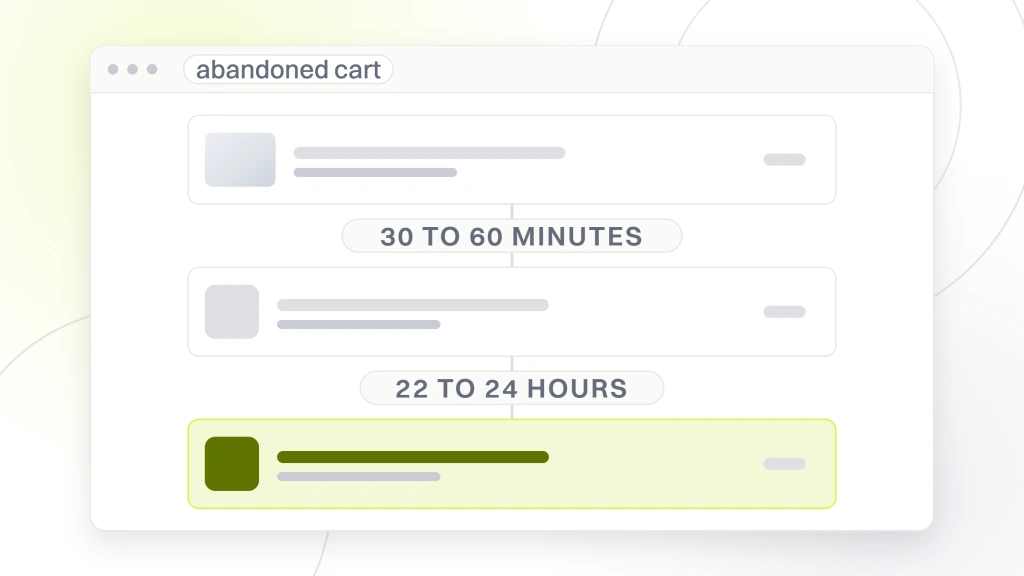
- Abandoned cart flow. 2 messages over 24 hours. First message at 30 to 60 minutes after cart abandon with product name and one-click return link. Second message at 22 to 24 hours with a small incentive or a soft social proof line.
- Abandoned checkout flow. 1 or 2 messages within 4 hours. Higher intent than cart abandon, so the message runs shorter and more direct. Skip the incentive on the first send.
- Browse abandonment flow. 1 message at 2 to 4 hours after a product view that never made cart. Only activate this on brands with a mature list and a clear browse-to-buy pattern.
- Post-purchase flow. Shipping notifications first, review request at day 14, cross-sell recommendation at day 30. Review requests over SMS pull 3 to 5 times the conversion of email review requests.
- Win-back flow. Triggered at 60 or 90 days since last purchase. 2 messages spaced 4 days apart, first message opens with a brand-story hook and second closes with a discount if the subscriber has not returned.
The abandoned cart flow alone typically produces 25 to 40 percent of the total flow revenue on the account. Prioritize it first, then welcome, then post-purchase, then the rest. Sequencing the build in that order lets the brand see revenue inside two weeks of platform activation and pays for the platform cost inside the first month. Our sibling read on marketing automation ecommerce platforms and flows covers the trigger logic that sits behind these flows on the platform side.
Text message marketing for ecommerce campaign examples
Text message campaigns are the broadcast layer of a healthy program. Unlike flows, campaigns get planned per week and target segments of the list. The rule of thumb is 4 to 8 campaigns per month at maturity. Fewer than 4 leaves revenue on the table. More than 8 burns the list and pushes unsubscribe rate past 2 percent per send, and that is where carriers start throttling delivery.
Five campaign templates that convert
Product drop announcement. 140 to 160 characters, one product image, one link. Send Tuesday 11 a.m. or Thursday 2 p.m. local. VIP early access. Same format but sent 24 hours before the public drop and only to top-quintile buyers. Restock alert. Only sent to subscribers who requested the alert on the sold-out product page. Highest conversion rate of any campaign type at 8 to 15 percent. Sale event. Send at start, midpoint, and 4-hour warning before the sale ends. Editorial newsletter-style text works only for brands with a strong content voice, and only on 1 in every 4 to 6 sends. Overuse breaks the list.
Message length and creative discipline
Every character over 160 forces the platform to send a multi-segment message, and that costs the brand 2 to 3 times as much and hurts delivery on older phones. Keep body copy under 140 characters. Include one link, one call to action, and one urgency signal. Skip emoji chains and marketing exclamation stacks. The best-performing texts read like a note from a friend who knows the product, not a coupon flyer. Klaviyo’s SMS marketing playbook covers copy patterns worth borrowing.
Segmentation and list hygiene for SMS marketing
A 100,000-subscriber SMS list that broadcasts one message weekly to everyone lasts about 8 months before unsubscribes and dead numbers kill the revenue line. The same list segmented and messaged at variable frequency lasts three years and produces double the revenue over that window. Segmentation and list hygiene are the invisible half of a durable program.
The segments every account should run
Run engaged 30-day, 60-day, and 90-day windows. Split buyer versus non-buyer at 30 and 60 days. Add a VIP tier by lifetime value threshold. Add a product-category segment based on last item viewed or purchased. Add a location segment for time-zone-aware quiet hours and regional promotions. Add a recent unsubscribe-attempt segment to suppress for at least 30 days before re-engaging. A 5-segment structure with those splits earns 20 to 40 percent revenue growth over a single broadcast list within 90 days.
List hygiene the platform does not do for you
Suppress numbers that have not engaged in 120 days. Suppress numbers that generated a hard delivery failure twice in a row. Suppress numbers that clicked STOP once the platform kept them nominally active. Run a quarterly list scrub through the platform export and reconcile against email engagement to catch subscribers who churned quietly. Our sibling read on email marketing for ecommerce covers the parallel hygiene rules on the email side, and running both cadences in sync doubles the operational gain on both channels.
SMS and email together in the retention stack
The channel is not a replacement for email. It is the higher-intent, higher-cost partner channel that email prepares subscribers for. The best DTC programs run email as the wide top of the funnel with 60,000 to 200,000 subscribers, and SMS as the tighter bottom with 15,000 to 40,000. Both channels feed the same buyer journey, and the tightest programs share segment definitions across both tools.
The three coordination rules that avoid message fatigue
Never send SMS and email inside the same 4-hour window for the same subscriber. Never send an SMS flow message that duplicates the content of an email flow message inside the same 24 hours. Coordinate campaign sends across both channels on a shared calendar so the marketing team can see one week at a glance. Klaviyo bundles this natively. Postscript syncs with Klaviyo via API. Attentive paired with a separate email tool needs a shared spreadsheet or a Notion page as the source of truth, and that setup demands real operational discipline.
The revenue split at maturity
On a mature retention program, email produces 30 to 45 percent of total store revenue on a last-click basis, and SMS produces 15 to 25 percent. Together the two retention channels drive over half of blended revenue on the healthiest DTC brands. That is the operational payoff for treating the two as one program instead of two silos. Running the two channels on the same segment definitions and the same shared calendar is what makes the coordination hold up when send volume grows quarter over quarter.
Measuring SMS marketing for ecommerce
Measurement centers on five numbers that a marketing lead should be able to recite from memory. Revenue per recipient. Click-through rate. Conversion rate per click. Unsubscribe rate per send. Cost per message including carrier and platform fees. Any campaign or flow that a brand runs should be traceable to those five numbers, and the trend on all five should live inside a monthly dashboard the founder actually reads.
Benchmarks that separate healthy from struggling
Healthy revenue per recipient on campaigns runs $0.11 to $0.20 across DTC brands doing over $2M annual revenue. Flows run $0.90 to $1.60 revenue per recipient, weighted by abandoned cart. Click-through rate on campaigns runs 8 to 15 percent, on flows 12 to 25 percent. Conversion rate per click runs 4 to 8 percent on campaigns and 8 to 14 percent on flows. Unsubscribe rate per send should stay under 1 percent, with 0.5 percent being the target on well-segmented sends. Cost per message hovers around $0.012 to $0.018 all-in. Any brand outside those ranges either has a segmentation problem, a creative problem, or a list-source problem.
The measurement cadence
Weekly SMS-only report inside the platform, capturing revenue, sends, unsubscribes, and click-through rate per segment. Monthly SMS versus email versus paid comparison inside the main marketing dashboard. Quarterly deep review that scrubs the list, revisits the flow architecture, and audits the compliance disclosure text against any TCPA rule changes. Our sibling read on ecommerce marketing dashboard attribution and reporting cadence covers where the SMS tile lives inside the executive dashboard, and how to keep the reporting consistent across channels.
SMS marketing for ecommerce in production
Boogie Board, a Shopify-based ecommerce brand our team runs, arrived with a paid social program that was pulling cost per sale up to unsustainable levels. The founder had held off on SMS since the previous agency framed it as a discount channel that would clash with the product voice. The brand did not need a discount channel. It needed a texture channel with private product access, drop announcements, and product content written the way a friend would text.
Our team turned on Klaviyo SMS as the stack, kept it bundled with the same segmentation the email program already used, and built the list through checkout opt-in and a two-step pop-up promising early access to product drops rather than a 15-percent-off code. Consent language was clean, quiet hours were set, and message frequency capped at 4 to 6 per month. The welcome, abandoned cart, and post-purchase flows went live in the first two weeks. Weekly campaigns launched in month two, one drop announcement and one editorial content text per week.
Over the annual curve that followed, cost per sale for Boogie Board landed at $31 with the retention stack carrying more of the revenue load, unsubscribe rate held at 0.4 percent per send, and the flow revenue split hit 70 percent of total SMS revenue. Combined with the existing email program, the retention channels moved from about a third of blended store revenue to over half. The paid social budget got room to move higher since retention was carrying more of the load, and the brand kept its product voice intact by treating SMS as a texture channel rather than a discount channel.
Where SMS marketing for ecommerce fits the stack
The channel is not a standalone play. It is one seat inside a retention stack that includes email, loyalty, review flows, and post-purchase content. Brands that treat SMS as a bolt-on end up over-sending, burning the list, and blaming the channel. Brands that treat it as one instrument in an ensemble build a retention program that compounds year over year.
Pick the platform that fits your revenue tier. Wire the compliance layer once and forget it. Build the list through the highest-intent surfaces you own, starting with checkout. Build the abandoned cart flow first, then welcome, then post-purchase. Run 4 to 8 campaigns per month against segmented lists at 140-character discipline. Coordinate the calendar with email so no subscriber gets both channels in the same window. Measure the same five numbers every week. Follow that seven-step operating rhythm and the SMS revenue line grows quarter over quarter for the life of the brand.
Our ecommerce marketing agency hub explains the retention-plus-paid operating model the DTC brands we work with run every week. SEO and PPC retainers start at $999 / $1,499 / $2,499 / from $4,500 per month and typical programs run six months, since a retention channel needs a full quarter to build a list and another quarter to prove the revenue math. Move faster and the numbers are still noise. Move slower and the channel gets neglected before the flow architecture has a chance to compound.