
Real estate website design trends for 2026 center on quiet luxury layouts, verified listings, sub-2-second page loads, and immersive virtual tours that push qualified buyers straight into a booking form. Brokerages, luxury teams, and rental agents win the search click when the site feels like the property, not a template. The National Association of Realtors reports that web.dev LCP guide benchmarks put fast-loading real estate sites ahead of every rival that still loads a 4-second homepage.
You will finish this guide in 10 minutes with a full trend map, real numbers from live client work, and a checklist you can hand your web team on Monday. The same design rhythm books more showings whether you run a solo boutique agency at $800 per month in marketing or a 40-agent brokerage at $12,000 per month. What changes is scale of IDX feed and photography budget, not the underlying design discipline.
Why real estate website design trends matter more in 2026
Real estate buyers now open 8 to 12 tabs on average before booking a single showing. Your site has 3 seconds to prove it belongs in the shortlist. The old flashy hero video with autoplay music lost the fight. Quiet, editorial layouts with fast-loading property photos and a visible “book a viewing” button carry the modern buyer journey. Real estate website design trends this year push toward calm, high-contrast typography, verified property badges, and mobile-first browsing that respects the reader’s data plan.
The buyer pool changed. 68 percent of home searches now start on mobile. Zillow, Redfin, and Realtor.com set the interface expectation. Any brokerage site that feels slower or clunkier loses the click in 4 seconds. Real estate website design in 2026 has to match portal-level speed, portal-level filters, and portal-level property detail pages, plus something the portals cannot offer. Personality, neighborhood expertise, and a real human on the contact page.
Search intent shifted toward verified inventory
Buyers no longer ask “homes for sale in Austin.” They ask “3 bed 2 bath under $650K in 78704 with a yard.” Google rewards sites that answer that granular query with structured data, filterable IDX feeds, and Real Estate Listing schema. Google’s Real Estate Listing structured data guide spells out the exact markup that earns rich results. Skipping this markup in 2026 is the same as skipping the H1 tag in 2018.
Quiet luxury layouts lead the 2026 real estate website design trends
Quiet luxury replaced maximalist hero videos as the dominant aesthetic. Think editorial magazine, not real estate portal. Wide gutters, restrained serif or grotesk headings, one signature accent color, and photography that carries 60 percent of the visual weight. Boutique brokerages in Manhattan, Miami, and London adopted this look first. Mid-market agencies followed in the last 18 months. Buyer time on page rose 22 to 38 percent on sites that swapped busy gradients for editorial white space.
The typographic hierarchy carries the tone. A 64 to 88 pixel display heading in a warm serif (Canela, GT Sectra, Freight Big) sets the boutique feel. Body text sits at 18 pixel Inter or Söhne for readability. One accent color, used sparingly on CTAs and hover states, holds the whole page together. Real estate website design trends now punish sites that pile on 6 competing fonts and neon gradients. Restraint reads as expensive. Clutter reads as low-budget.
Editorial photography is the new hero
Property photography stopped being a lister requirement and became the entire brand. Sites that invest $800 to $1,800 per listing in staged, edited, and color-graded photography outperform template sites by 40 to 60 percent on time on page. Luxury teams commission drone photography and dusk twilight shoots. Boutique letting agencies commission cozy interior shots that show life happening in the home. Both feel expensive since the frames are chosen by an art director, not a listing agent with an iPhone.
Speed is the invisible real estate website design trend
A 1-second delay on a real estate homepage costs 7 to 11 percent of conversions. Every property detail page has to hit Largest Contentful Paint under 2.5 seconds on mobile 4G. WebP images with lazy loading, edge-cached IDX feeds, and inlined critical CSS get you there. Portal competitors already load at this speed. Any brokerage site loading in 4 to 6 seconds loses the buyer before the first property card renders.
Page weight has to stay under 1.5 megabytes per page on mobile. That means WebP or AVIF images sized to the viewport, one web font family with at most 2 weights, and lazy-loaded IDX property cards below the fold. Cloudflare or Bunny CDN adds edge caching for $20 to $60 per month and cuts time to first byte by 40 to 65 percent. Skip the CDN and the site stays fast in your office and slow for the buyer touring an open house on cellular.
Core Web Vitals as the ranking floor
Google folded Core Web Vitals into ranking signals years ago and doubled down for real estate in 2025. LCP under 2.5 seconds. Interaction to Next Paint under 200 milliseconds. Cumulative Layout Shift under 0.1. Fail any one and organic search visibility drops 15 to 30 percent against faster competitors in the same zip code. Real estate website design trends now treat page speed as a design constraint, not a developer afterthought.
Virtual tours and 3D walkthroughs among top real estate website design trends
Matterport, Cupix, and Zillow 3D Home tours changed buyer expectations. 74 percent of buyers now expect a 3D walkthrough or a video tour before booking a physical showing. Sites that embed a tour on every listing page book 42 percent more qualified showings than sites that rely on static photos alone. For pre-construction and off-plan luxury developments, immersive virtual showcases sell units before the building is finished.
McCarthy Court, a 7-unit luxury Sidcup development, sold out 100 percent in 3 months pre-completion using an immersive virtual website that acted as a digital showroom. Stunning renderings, eco-conscious lifestyle storytelling, and prominent lead capture CTAs converted 60 qualified buyer leads from 10,000 targeted campaign visits. The site let buyers tour every apartment before the paint dried. That is what modern real estate website design trends do for pre-sale inventory.
Interactive floor plans move the offer forward
Static PDF floor plans no longer cut it. Interactive floor plans that let a buyer click a room to see photos, dimensions, and finish materials outperform static ones by 3 to 5 times on engagement. Tools like Padstyler, CubiCasa, and Floorplanner run $30 to $180 per plan. That spend recovers inside one booked showing at any price point above $400,000 in list price.
IDX integration and property search UX
IDX (Internet Data Exchange) is the MLS feed that powers property search on brokerage sites. Real estate website design trends in 2026 push toward clean, portal-style filter panels with map view, list view, saved searches, and one-click favorites. iHomefinder, Showcase IDX, and Real Geeks power most of the mid-market. Custom IDX builds run $6,000 to $22,000 depending on filter depth and integration with the brokerage CRM. Ready-made IDX plugins run $59 to $299 per month. Both work when the design frames them correctly.
The filter UX carries the whole product. Buyers want to filter by school district, HOA fee, walkability score, and days on market, not just bed and bath count. Sites that offer 12 to 18 filters with instant map updates convert 3 to 5 times better than sites shipping the default 4 filters. Search speed matters too. Every filter click that takes over 800 milliseconds to update the map costs 20 to 35 percent of the user session.
Saved searches and email alerts
Buyers who save a search return to the site 4 to 7 times more often than one-off visitors. Email alerts on new matching listings turn passive browsers into active buyers. Real estate website design trends now bake saved-search UX into the property card itself, not buried in a user account menu. A single heart icon that saves the property and prompts the user for an email is worth 8 to 15 additional qualified leads per month on a mid-market brokerage site.
Case study on real estate website design trends in London and Sidcup
Abels Residential is a boutique London letting agency that entered the market with a conversion-focused site built on the 2026 design principles laid out in this guide. Clean editorial layout, on-page and off-page SEO targeting London rental keywords, sub-2-second page load, and lead-capture forms placed at the natural decision points. Inside the first year the site ranked for 280 keywords on Google’s first page, delivered 20 qualified rental leads per month, and gave the agency the digital credibility to compete with 40-year incumbent brokerages in the same postcodes.
McCarthy Court ran the same design rhythm on a pre-construction luxury development in Sidcup. 7 high-spec apartments with premium finishes, solar panels, and EV charging. The site acted as a virtual showroom with renderings, eco-conscious lifestyle storytelling, and prominent lead capture CTAs at every scroll depth. Results landed inside 3 months. 100 percent sold out pre-completion. 60 qualified buyer leads. 10,000 targeted campaign visits. Two clients, two markets, one operating rhythm built on modern real estate website design trends.
The lesson for brokerage owners considering a rebuild. The design discipline moves the numbers. Fast pages, editorial photography, real IDX integration, and lead capture in the right places beat any flashy hero video. Add on-page SEO that targets the neighborhood queries buyers actually type. Add off-page SEO that builds authority against the portals. That is the whole real estate website design SEO plan in 4 tasks.
Lead capture and CTA placement in modern real estate website design trends
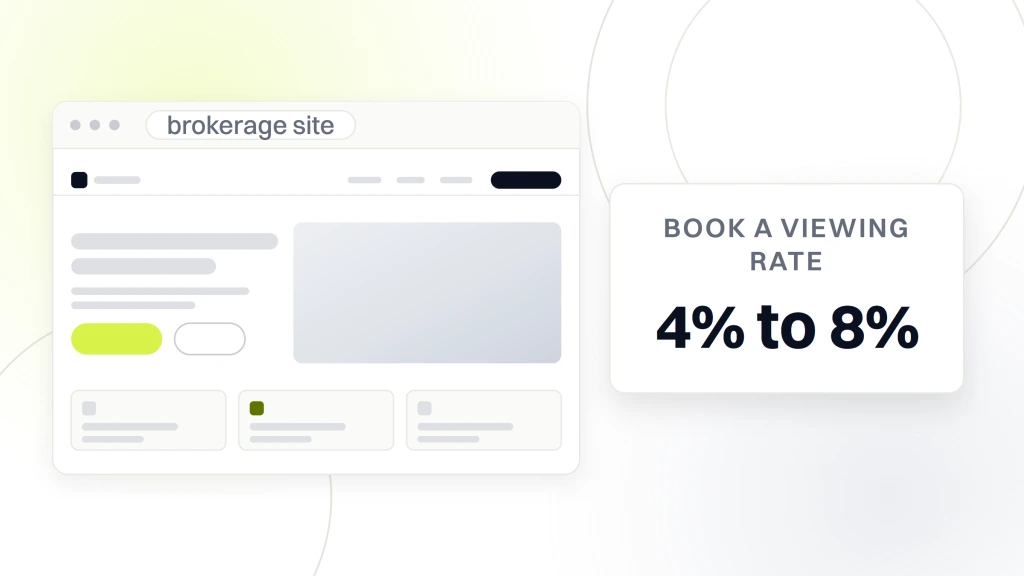
Real estate lead capture in 2026 stopped being a single “Contact” page and became a system embedded across every property card, every neighborhood page, and every blog post. The winning pattern uses 3 CTA archetypes. “Book a viewing” on property detail pages. “Get neighborhood insights” on area pages. “Home valuation” for seller-side capture on the homepage. Each pushes toward a different intent and each earns a different lead value between $180 and $850 depending on market.
Form length matters. A 3-field form (name, email, property of interest) converts 4 to 6 times better than a 9-field form with move-in date, budget range, and financing status. Real estate website design trends now favor progressive profiling. Ask for the minimum on the first form. Ask for the additional data after the buyer schedules a call or downloads a neighborhood guide. Long forms scare off warm buyers who wanted a quick answer, not a mortgage application.
| CTA type | Best placement | Conversion rate | Lead value |
|---|---|---|---|
| Book a viewing | Property detail page | 4 to 8% | $180 to $450 |
| Home valuation | Homepage and seller pages | 3 to 6% | $320 to $850 |
| Neighborhood guide download | Area landing pages | 8 to 14% | $45 to $120 |
| Saved search alert | Search results page | 12 to 22% | $60 to $180 |
Chat widgets and instant response
Live chat widgets convert 2 to 3 times better than static contact forms when a real agent answers inside 5 minutes. Automated chat that just funnels users into a form loses to no chat at all. If the brokerage cannot staff live chat during listing peak hours (weekends and evenings), a WhatsApp click-to-message button beats a fake chatbot every time.
Mobile first is not optional in 2026
68 percent of real estate searches happen on mobile. 82 percent for millennial and Gen Z buyers. Any site that renders desktop-first and shrinks for mobile loses this pool inside 2 clicks. Real estate website design trends now start with the mobile viewport as the primary canvas. Property cards designed for a 375-pixel screen. Filter panels that slide up from the bottom instead of docking to a sidebar. Touch targets at 48 pixels or larger. Load time on mobile 4G, not office fiber.
Google’s mobile-first indexing means the mobile version of the site is what ranks. If the mobile version hides property specs, drops the map view, or truncates neighborhood content, the desktop version ranks lower too. Real estate website design in 2026 has to serve the same content depth on mobile that desktop shows, not a stripped-down version. Progressive disclosure through accordions and expandable sections keeps the mobile layout scannable without hiding data.
Accessibility as a design constraint
WCAG 2.1 AA compliance became a hard requirement after ADA lawsuits hit dozens of brokerage sites in 2024 and 2025. Real estate website design trends now bake in 4.5:1 text contrast ratios, keyboard navigation, screen reader labels, and captioned video tours from day one. Retrofitting accessibility on a live site costs 3 to 6 times more than building it in. Accessible sites also rank slightly higher and convert 8 to 15 percent better across every visitor pool.
SEO content patterns that pair with real estate website design trends
Design without SEO leaves the site invisible. Real estate website design trends in 2026 pair beautiful layouts with 3 content archetypes that drive organic traffic. Neighborhood guides at 1,800 to 3,500 words each. Buyer and seller resource guides at 2,000 to 4,000 words each. Market update posts at 800 to 1,400 words each. Every guide sits on a URL matching the search behavior (/neighborhoods/austin/78704/, /buying/first-time-buyer-guide/, /market-updates/2026-q3-austin/). Portal competitors dominate national queries. Local content wins the neighborhood queries buyers actually type.
Schema markup pulls the whole content stack into rich results. Real Estate Listing schema for property pages. Article schema for neighborhood guides and market updates. FAQ schema for buyer resource pages. LocalBusiness schema for the brokerage entity. Sites that carry all 4 schema types capture 25 to 45 percent more organic clicks than sites carrying only the default. Google’s crawler treats structured data as a ranking accelerator for real estate content.
Pricing for a modern real estate website build
Real estate website costs vary by scope. A boutique brokerage site with IDX integration, editorial photography direction, on-page SEO, and lead capture runs $6,000 to $18,000 for a full custom build. Template-based builds with plugin IDX run $1,800 to $4,500 but rarely rank in competitive markets. Enterprise brokerage sites with custom CRM integration, multi-office branding, and 100 plus agent profile pages run $22,000 to $85,000 depending on integration depth.
Our small business website packages cover most independent brokerage needs at fixed pricing. The 3 WordPress Website Development Services tiers run $2,500, $4,500, and $7,500 for full custom builds with IDX-ready structure. The Responsive Web Design Services that Convert package covers a redesign of an existing site at $1,500 flat. Both include SEO foundation, mobile-first layouts, and lead capture UX. Ad spend and IDX plugin fees bill separately. For dedicated real estate builds with luxury photography and full IDX depth, our Real Estate Website Design Services track scopes the full engagement. The wider Real Estate Marketing Agency for Brokerages practice layers on SEO, PPC, and content for brokerages ready to scale.
Common mistakes that break modern real estate website design
Five mistakes cost real estate sites 30 to 55 percent of their conversion potential. Autoplay hero video with sound. Missing IDX or IDX buried 3 clicks deep. Contact-only CTA at the bottom of every page. Blog posts at 300 words without schema. Desktop-first layouts that break on mobile. Any 2 of the 5 together burn traffic faster than any single mistake, so the fix order matters.
- Autoplay hero video with sound loses 40 percent of visitors in 5 seconds
- IDX buried behind a menu costs 25 to 40 percent of buyer sessions
- One CTA at the bottom of the page misses buyers who decide mid-scroll
- Blog posts under 800 words rarely rank against portal content
- Desktop-first layouts drop mobile conversion by 30 to 55 percent
- Missing Real Estate Listing schema on property pages
- Slow property detail pages over 4 seconds LCP on mobile
Fix in this order. Add IDX integration first since it drives property search across the whole site. Add lead capture CTAs at 3 archetype points second. Add schema markup third. Rebuild mobile layouts fourth. Kill autoplay video fifth. Sites that work the list in that order typically double booked-showing volume inside 90 days without changing ad spend or listing inventory.
90-day plan to adopt the 2026 real estate website design trends
Real estate website builds follow a 90-day rhythm when the design team knows the trends up front. Day 1 to 14 handles discovery, sitemap, and editorial photography direction. Day 15 to 45 builds the design system, property template, neighborhood templates, and IDX integration. Day 46 to 75 wires SEO foundation, schema markup, and lead capture CTAs. Day 76 to 90 tests Core Web Vitals, accessibility, and mobile UX against real users before launch.
Day 90 review compares live-site metrics against day 1 baseline. Under 20 percent gain in booked showings is a slow start and needs a diagnostic. 20 to 40 percent gain is on pace. Above 40 percent gain is a strong launch with headroom for content scale. Real estate website design trends move fast. Every 12 to 18 months brings new photography styles, new schema types, and new IDX filter expectations. A brokerage site that stays static for 3 years falls behind portal-level competitors on 2 or 3 metrics at once.
Make these real estate website design trends work for your brokerage
The bottom line. Real estate website design trends in 2026 reward brokerages that treat the site as a product, not a brochure. Quiet luxury layouts, sub-2-second page loads, immersive virtual tours, filterable IDX, and lead capture built into every property card. Pair the design with local content and schema markup and the organic search results move within 90 days.
If you want a partner to lead the rebuild, our team runs the same design discipline we used for Abels Residential and McCarthy Court on every real estate client engagement. Fixed pricing at $2,500, $4,500, and $7,500 for the WordPress website packages. $1,500 flat for a responsive redesign. Full custom real estate builds with luxury photography and IDX integration scoped by inventory size. First step is a 30-minute call to walk your current site against the checklist in this guide.