
Web Development for Med Spa Sites That Book Real Consults
- Med spa sites need WordPress plus native booking and price bands.
- HIPAA-safe forms and BAAs are non-negotiable.
- Beauté Aesthetics grew consults 166 percent after rebuild.
- Before-and-after galleries drive consult intent.
- Core Web Vitals under 2.5 seconds keeps mobile bounce low.
- Core Web Vitals and mobile speed for med spa sites
- Copy and photography inside a web development for med spa scope
- Timeline and phases for a med spa web development engagement
- Reporting cadence you should expect from a med spa web development partner
- How to vet a med spa web development partner before signing
- How web development for med spa builds feeds the marketing channels
- Wrapping up the web development for med spa decision
Web development for med spa sites is the practice of building a WordPress site that answers three questions in three seconds, opens the booking flow in one thumb-tap, and keeps the treatment gallery fast on a Pixel 8 on the subway. You want a site that books consults for Botox, filler, laser, and body contouring, not a brochure that lists services in a slider. The build stack pairs WordPress with a native booking plugin, a HIPAA-safe intake form, indexable before-and-after galleries, and a price estimator that pulls the visitor into a booking window before the bounce timer runs out.
You want proof before pricing. Beauté Aesthetics New York rebuilt with us and grew leads 166 percent, new users 88 percent, and conversion rate 27 percent inside 12 months. The old site loaded in over six seconds and the calendar sat half-empty on a Tuesday. The new site loads in under 1.6 seconds on mobile, opens booking on the treatment page itself, and reads at reading age 8 across every service line. Read the sections below and you will know the exact scope a med spa web development engagement covers today.
Core Web Vitals and mobile speed for med spa sites
Mobile speed decides half the booking rate. A site that loads in 1.6 seconds books at 12 to 18 percent. The same site at 4.2 seconds books at 4 to 6 percent. The math is not subtle. Core Web Vitals cover three metrics you control at build time. Largest Contentful Paint under 2.5 seconds. Interaction to Next Paint under 200 milliseconds. Cumulative Layout Shift under 0.1. Hit all three and the site rewards you with organic gains and a paid CPC that drops on Google Ads Quality Score.
Image and font handling
Every before-and-after image runs through WebP compression at 82 quality and stays under 90 KB per file. Fonts self-host with preload directives on the primary weight. Hero images set fetchpriority high and skip lazy loading. Below-fold images lazy load with intersection observer. Skip these and the site drags LCP past three seconds on a mid-range Android phone. Do these at build time and Google rewards the site inside four crawl cycles.
JavaScript and third-party tag hygiene
Third-party tags kill mobile speed faster than any hosting choice. A typical med spa site carries Google Tag Manager, GA4, Meta pixel, TikTok pixel, a chat widget, a review widget, and a booking iframe. Every tag adds 40 to 200 milliseconds to Time to Interactive. Load the chat widget after user idle. Defer the review widget below the fold. Skip the TikTok pixel until the practice actually runs TikTok Ads. Trim these and Interaction to Next Paint stays green on a Tuesday afternoon in Manhattan.
Copy and photography inside a web development for med spa scope
Copy sells the treatment. Photography sells the room. A dev-first agency that leaves both to the practice owner ends up with lorem ipsum on launch day and a photo shoot two months late. A working scope includes a copy strategist who writes the eight to twelve service pages and a photography plan that captures the treatment room, the provider portraits, and 20 to 40 before-and-after images with consent forms filed.
Service page copy pattern
Open with the outcome the patient wants. Follow with the procedure in plain language. Add a price band. Add three to five before-and-after images with alt text. Add an FAQ that answers pain, downtime, cost, longevity, and side effects. Close with a booking widget above the fold on mobile. Every service page runs 800 to 1200 words. Skip the word count and the page will not rank against DSO-backed competitors with 30 pages per treatment. One site we replaced still had the theme demo copy on the Botox page. It read like the marketing team went on vacation to Costa Rica and never came back.
Photography that reads as premium
Stock photography from Shutterstock reads as generic inside two seconds. Original photography of the treatment room, the reception area, and the provider portraits reads as trustworthy inside 400 milliseconds. Budget 1,800 to 4,500 dollars for a half-day shoot with a photographer who has aesthetic practice work in the portfolio. The photos live for four to six years on the site and every ad campaign built during that period. Cost per impression on original photography drops below one cent inside 18 months.
Timeline and phases for a med spa web development engagement
A working med spa build runs 8 to 14 weeks from kickoff to launch. Discovery lands in weeks one and two. Wireframes and copy in weeks three and four. Design in weeks four and five. Development in weeks six to nine. QA and launch in weeks ten and eleven. Retainer starts in week twelve. Rush timelines under six weeks are possible for template builds but skip the copy phase, and the practice pays for that skip inside the first paid campaign.
Discovery and wireframes phase
Discovery covers competitor audit, keyword research, treatment page inventory, booking flow requirements, and technical stack decisions. Wireframes map the mobile-first layout for the home page, the treatment page template, the gallery template, and the membership page. The wireframe review lands with the practice owner and the front desk lead so both sign off on the booking flow before design starts. Skip the front desk review and the site ships with a form the team refuses to check.
Development and QA phase
Development covers WordPress setup, theme build, plugin configuration, page assembly, form and booking wiring, analytics install, and Core Web Vitals pass. QA runs cross-browser on Chrome, Safari, Firefox, and Edge plus device testing on iPhone 12 and up plus Pixel 6 and up plus a mid-range Samsung. Launch runs a DNS cutover during off-hours with a 24-hour monitoring window. Any 500 error inside that window gets a rollback within 30 minutes. Our website maintenance packages team runs this cadence on every launch.
Med spa sites die on booking-widget load time. Time your consult flow on a real phone. Over 8 seconds and you fix bookings faster than a redesign.
Reporting cadence you should expect from a med spa web development partner
A working partner sends a weekly one-pager plus a monthly deep-dive on the numbers that decide renewal. The weekly covers booking volume, consult conversion rate, top pages by consult, mobile page speed, and any 500 errors in the last seven days. The monthly adds cohort analysis, cost per booked consult across channels, and revenue attribution across paid, organic, and direct traffic.
Weekly one-pager metrics
Booked consults for the week. Conversion rate on the top three service pages. Mobile Largest Contentful Paint on the home page and the Botox page. Time to First Byte on the booking widget. Any error rate over 0.5 percent in server logs. Any Core Web Vitals red flag flagged by CrUX data. A partner who cannot show a real weekly report from a prior client during the pitch is not sending them to you either. Ask for a redacted sample before the contract signs.
Monthly deep-dive metrics
Cost per booked consult across paid channels and organic. Consult to booked appointment ratio. Revenue per booked appointment across new patients and repeat. Membership sign-ups from the site. Gallery view time as a proxy for treatment interest. Chat widget open rate and answered rate. Skip the monthly and the practice runs blind on which channel is actually funding the treatment rooms. Add the monthly and the practice knows where to add the next 5,000 dollars of paid budget.
How to vet a med spa web development partner before signing
You read three proposals and they read alike until you look at the line items. The differences show up in the numbers the first proposal quietly leaves out. Ask these six questions before the contract signs, and cross-check every answer against a written scope with named plugins, hosting, and analytics stack that the partner will deliver at launch.
- Ask which specific med spa builds they have delivered in the last 18 months, with client names and one measurable outcome per site.
- Ask whether the HIPAA form plugin is in scope from day one, and whether they will sign a business associate agreement with the practice.
- Ask which hosting the site will run on and what the guaranteed uptime is across a 12-month window.
- Ask whether the site launches with GA4, GTM, and CallRail wired to the booking flow.
- Ask for a Core Web Vitals target on launch day. A partner who cannot commit to LCP under 2.5 seconds should not be building your site.
- Ask what the retainer includes on plugin updates, security patches, and monthly speed audits.
Green flags in a real proposal
Green flags look like a written scope naming the WordPress theme, the booking plugin, the HIPAA form plugin, the hosting company, and the analytics stack. A launch-day Core Web Vitals commitment. A sample weekly report format. A retainer that covers plugin updates plus one strategy call a month. Case studies with named med spa clients, real timeframes, and real numbers across at least six months of post-launch data. A signed BAA. A backup schedule the practice can audit. Anything short of that means the partner is guessing at the deliverables.
How web development for med spa builds feeds the marketing channels
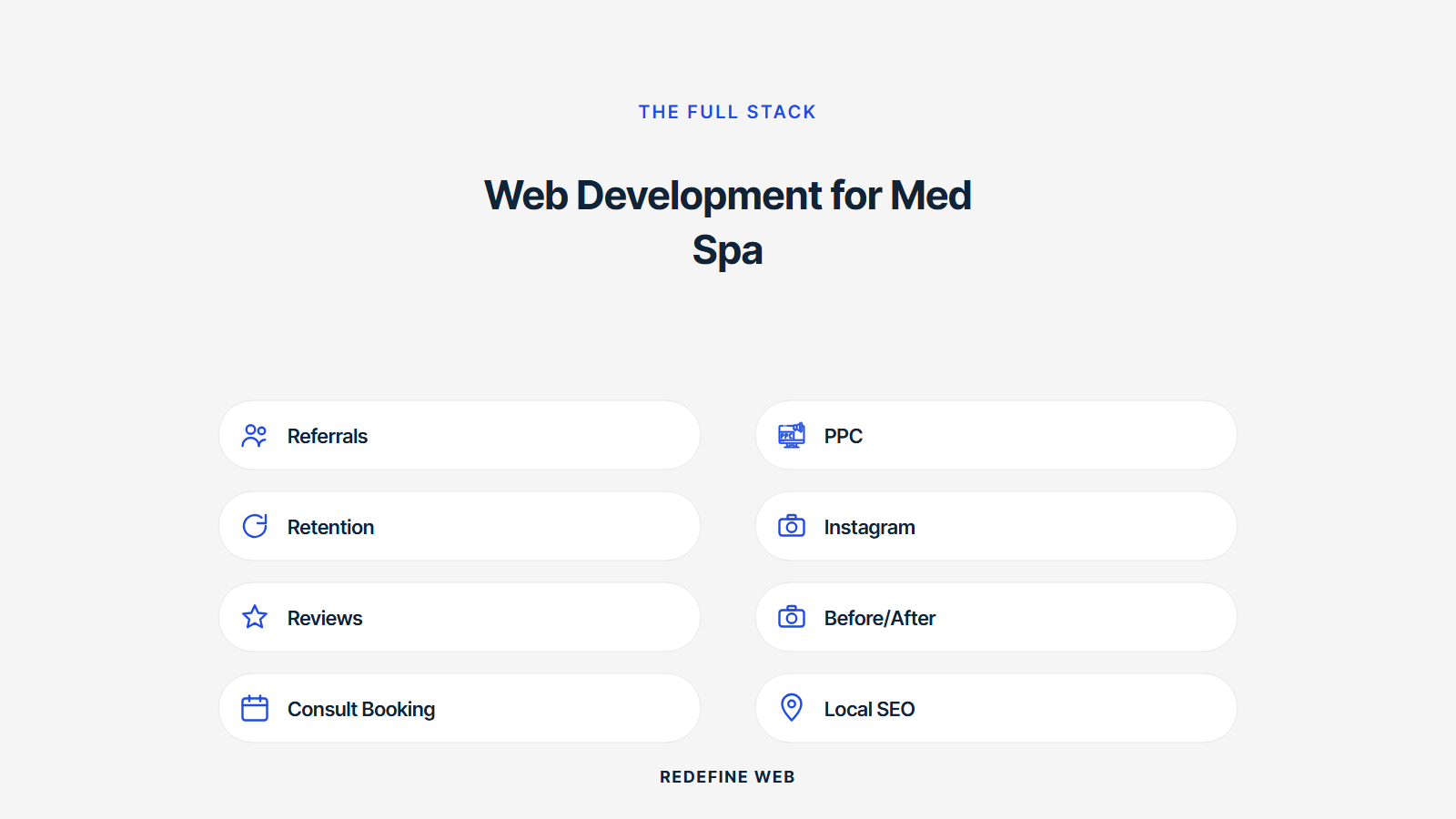
The site is the foundation every marketing dollar hits. Paid search sends visitors to the treatment page. Local SEO sends visitors to the location page. Social sends visitors to the gallery. Email sends visitors to the membership page. Skip the site work and every marketing channel underperforms on cost per consult.
Paid channels the site supports
Google Ads Search on Botox and filler queries hits treatment pages at 14 to 22 percent conversion rate on a well-built site. Meta Ads for gallery-driven awareness campaigns hit the gallery at 3 to 5 percent conversion to booking widget. TikTok Ads on before-and-after transformation posts land on a landing page variant of the treatment page. Every channel needs a page shape that matches the ad intent. Our med spa PPC team pairs each campaign with a matching site page inside the first sprint.
Organic and local channels the site supports
Local SEO on Google Business Profile pulls new patients into the map pack. The treatment pages and the location page anchor those map pack impressions. Reviews pulled from Google and Podium into the review schema block feed the local pack ranking. Content marketing on the blog feeds long-tail treatment queries. Skip these on a template build and the practice pays 40 percent more per lead on Google Ads to make up for the missing organic pipeline. For a full breakdown, see our med spa marketing agency hub.
Wrapping up the web development for med spa decision
A working med spa web development engagement runs 8 to 14 weeks, lands the site under 2.5 seconds on mobile, opens the booking flow in one thumb-tap, and returns 4x to 8x on the build fee inside 18 months on freed paid spend and booked consults alone. The build stack pairs WordPress with a HIPAA-safe form plugin, a native booking system, indexable galleries, and analytics tied to booking outcomes.
If your current site loads over three seconds on mobile, has a booking flow more than two taps deep, or drops mobile visitors on a 22-field contact form, a rebuild pays for itself inside 90 days. Ask three vendors for line-item scopes with hosting, HIPAA form, and Core Web Vitals commitment named. Look for the green flags above. Pick the one that names the plugins, the analytics stack, and a real launch-day speed target. Redefine Web runs a fixed-scope program inside our med spa web design track, a paired med spa marketing retainer starting at 599 per month, and hosting inside med spa hosting and maintenance. Book a call and we will walk you through Beauté Aesthetics New York’s launch numbers line by line.
Frequently asked questions
What does web development for med spa engagements cover?
A working med spa web development engagement covers six workstreams. WordPress theme and page templates aligned to treatment lines. Native booking flow wired to the treatment room calendar. Indexable before-and-after gallery with WebP compression. Treatment-specific service pages with plain-language copy and visible price bands. Analytics through GA4, Google Tag Manager, and CallRail with conversion events tied to booking. And a HIPAA-safe intake form with a signed business associate agreement so protected health information stays inside the encrypted database rather than a marketing inbox.
How much does web development for a med spa cost in 2026?
Custom med spa builds run 6,000 to 22,000 dollars for a 20 to 40 page site with a booking flow, indexable gallery, price estimator, and analytics wired in. Templated builds on a paid theme with a booking plugin land between 3,500 and 6,000 dollars. Enterprise builds for DSO groups run 30,000 to 90,000 dollars. Monthly hosting and maintenance retainers run 199 to 599 dollars depending on site size and how many treatment pages the content team updates each quarter.
Which WordPress plugins does a med spa site need?
A lean med spa stack runs on a lightweight child theme like Astra or GeneratePress, a booking plugin like AestheticNow, Vagaro, or Boulevard, a HIPAA-compliant form plugin like Gravity Forms with HIPAA Vault or Jotform HIPAA Gold, an SEO plugin like Rank Math or Yoast, an image compression plugin like ShortPixel or Imagify for WebP output, and Google Tag Manager plus GA4 for analytics. Fewer plugins keeps the site fast. Any stack that carries more than 18 active plugins pays for the bloat in load time and security patch cadence.
How long does a med spa web development project take?
A working med spa build runs 8 to 14 weeks from kickoff to launch. Discovery and wireframes take three to four weeks. Design takes two weeks. Development takes three to four weeks. QA and launch take two weeks. Rush timelines under six weeks are possible for template builds but usually skip the copy phase and the practice pays for that skip inside the first paid campaign. Retainer for hosting, plugin updates, and monthly speed audits starts the week after launch and runs on a rolling six-month agreement.
How do I make sure a med spa web build is HIPAA compliant?
Use a form plugin with end-to-end encryption and a signed business associate agreement with the plugin vendor. Encrypt the database at rest through the hosting provider. Fire analytics events on generic labels like consult_booked rather than the specific treatment name and body area. Keep the intake data inside the booking system and the CRM behind a login wall rather than piping it to a marketing inbox. Audit the retention policy so records get deleted after the six-year mark. Skip these and a state investigator has an open case inside a lunch break.
What Core Web Vitals target should a med spa site hit at launch?
Largest Contentful Paint under 2.5 seconds on mobile. Interaction to Next Paint under 200 milliseconds. Cumulative Layout Shift under 0.1. Time to First Byte under 300 milliseconds on managed hosting. Hit all four and the site rewards you with organic gains on treatment-specific queries and a paid CPC that drops on Google Ads Quality Score. Miss any one of them and mobile bounce rate climbs 8 to 14 percent per half-second of delay, and consult volume drops in step with the extra load time.
Book your free 30-minute strategy call.
No spam, no sales rep. We use your email to schedule your call with a senior strategist. That is it.
More from the blog
View all articles → Web Design
 Core Web Vitals Healthcare Websites Actually Need to Book Patients
Read article Web Design
 Professional Services Website Design Best Practices for 2026
Read article Web Design